Garry Trudeau Writes Essays. His Essays Look Like Comics.
Garry Trudeau Writes Essays That Get Read.
 Garry Trudeau has been writing essays for as long as I’ve been reading comics. His essays get read because they are peopled with, well people. Characters. Hand-drawn characters. We call his essays a comic strip. Comic strips are easy to read. Essays are hard to read and boring—unless they are comic strips.
His current essays on for-profit colleges make me want to run out and check facts, though the tone resonates with what I’ve seen. But Trudeau is a master at breaking facts (and innuendo) into panel-sized chunks. How I could do that with my essays is worth thinking about.
###
Via Slate
This is how to do an Ignite talk: Commutapult
I did an Ignite talk once.
Not so good. Maybe I’ll try it again. Maybe I won’t. But Mark Selander did it right:
###
Via Scott Berkun
This Cheers Me: Rejected Muslim Supporters Invite St. Anthony to Dinner
Not so many weeks back the St. Anthony Village community (not far from the Livingston Communication Tower) held a meeting to consider whether an Islamic center could be built in the community. The meeting got heated, lots of ugly stuff was said aloud, and the proposal was rejected. Whether or not the council acted on anti-Muslim bias (the U.S. Department of Justice is investigating), fear of the unknown seems to have ruled the roost.
People will say what they will say—our country protects that right—which is a fantastic freedom. But our country (city and suburb, mind you) is composed of lots of different folks: religion, color, body shape, languages, musical tastes. A crazy diversity which becomes more interesting every single day. Christians (whether in name only or fully functional) don’t own the place and cannot dictate the rules.
I’m cheered because in this case the stranger has acted on the words that would/should/could motivate the Jesus-follower: they are throwing a dinner (an iftar) Thursday night at the St. Anthony Community Center.
What an interesting time to be alive.
###
Pleasant Propaganda: The Museum of Russian Art

Vlad, let’s hang out at the people’s dam today.
Plan on seeing the exhibit of Soviet Paintings (From Thaw to Meltdown: Soviet Paintings of the 1950s-1980s) at The Museum of Russian Art in South Minneapolis before it closes shop later this month.
The paintings on the top two floors start with unbridled propaganda, depicting solid workers grinning about their jobs in the steel mills, factories and collectivist farms. The strong women and robust men in their industrial settings are both beautiful and horrifying at the same time, when you realize some of the workers were more likely emaciated prisoners from the nearby prison (“Beautifying Saransk” by Alexander A. Mukhin). But the exhibit takes you beyond the grand hyperbole to show how the artists worked within the political boundaries even as they let bits of reality in. By the time you get to the back of the top floor, you are seeing more realistic depictions, including the unsettling working conditions in steel mills.
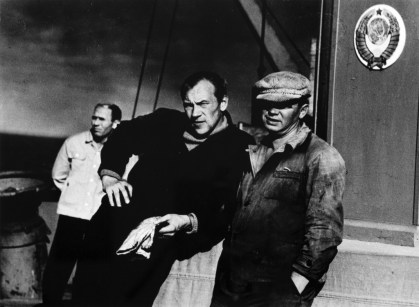
Comrade…you want soy milk in your latte?
It’s worth walking downstairs to see photos of actual workers, families and daily life in the Soviet Union: gritty and sober images in black and white. If you grew up during the Cold War, these are the images you remember.
And then it’s worth considering how images shape our lives. The propaganda paintings are easily recognized and dismissed—though many seem stunning today. The photos in the lower gallery seem more real—but they are just as much showing one viewpoint—another kind of persuasive effort that contrasts well with the upper galleries. A guy can’t help but wonder what sorts of images our political candidates can paint when $1 million fundraisers are the standard fare. A lotta loot buys a lotta propaganda.
Go soon—the exhibit closes shop in August.
###
Image credit: Vladimir Petrovich Tomilovski via The Museum of Russian Art
Related: Hard-hitting Russian safety posters that need no translation
Relevance is Dead. Long Live Relevance.
Future church isn’t like present church: connect four dots

here comes what’s next
We’re relating differently these days. I’m not talking just about Facebook and Twitter and/or any other rising social media. We’re relating differently because our expectations are changing—partly due to our experience of being heard (which does relate to social media). This post is aimed at the church, but much of it could apply to any organization. Some parts are unique to the church.
Here are four points to consider as you think about how organizations may connect in the future. Apply yourself to three bits of reading and one bit of listening. It’s all interesting/amusing/amazing. Then tell me: how do you see the church changing?
Dot 1: Jeff Jarvis & the Death of Content
Jeff Jarvis was invited to speak to a group of professional speakers. He spoke about how content is dead and how the speakers should really be hearing from the audience and piecing together brand new things.
I suggested — and demonstrated — that speakers would do well to have conversations with the people in the room and not just lecture them. I said I’ve learned as a speaker that there is an opportunity to become both a catalyst and a platform for sharing.
His talk did not go over well with the professional speakers and there was plenty of harrumphing. Read his article here. But the take-away was the opportunity for speakers (and leaders) to be both “catalyst and platform for sharing” versus pouring content from a podium.
Dot 2: Jonathan Martin & the Decline of the Church Industry
Over at Big Picture Leadership there is a lengthy quote from Jonathan Martin who has suddenly seen that he is not at the center of things. He laments that the Spirit has passed him and Piper and Driscoll and CT and all the other usual suspects in favor of the rush of new Jesus-followers in developing nations. Read the excerpt here. Read the whole thing here.
I like this guy’s approach. I think he nailed it. But I disagree that the Spirit has moved on to other countries and peoples. I think the Spirit is alive and well and deeply embedded in God’s people—wherever they are—just where the Spirit will always be as long as people profess faith in Jesus the Christ. But what Mr. Martin observed is simply the decline of church as an industry in the U.S.
To that I would add: and not a moment too soon.
It was never sustainable, anyway: all the inward-focused authority generated by books and CDs and conferences and leadership gurus and models and formulas. Why did we think that God worked through all that? Oh. That’s right. Because the authors and conference leaders told us so. Here’s my favorite take-away from Mr. Martin:
We enjoyed our time in the mainstream well enough to forget that the move of God always comes from the margins . . .
But what if Mr. Martin is even more accurate than he knew or believed? What if the locus of authority is shifting from controlling authorities to the people in the pew who refuse to spectate? What if people really started taking seriously the notion that they should bring their gifts and voices directly into the ritual gatherings and far beyond—sort of like that inveterate scribbler Paul wrote?
Dot 3: Apophenia and Participatory Culture
At Apophenia they are asking questions (fitting!) in preparation for a book on participatory culture. What is participatory culture? I’m new to the phrase too, but danah boyd cites several characteristics of such a culture:
- With relatively low barriers to artistic expression and civic engagement
- With strong support for creating and sharing one’s creations with others
- With some type of informal mentorship whereby what is known by the most experienced is passed along to novices
- Where members believe that their contributions matter
- Where members feel some degree of social connection with one another (at the least they care what other people think about what they have created)
I very much like this notion and phrase because that is the culture I most want to belong to. I spend my days thinking about communication in industry. I think the church holds the key to the most invigorating participatory culture possible. I believe the future of the church will be a participatory culture speaking directly to all culture rather than focusing inward to build a religion industry.
Dot 4: Reggie Watts: Sing the Milieu
Watch this guy produce his own content (sounds)—even as he grabs content (sounds and ideas) from the environment—to make something new. It reminds of Jeff Jarvis’ note that content is not king, and how he challenged a group of professional speakers to listen to their audience. It also hints at a jazz-like participation with the audience and the larger environment.
Perhaps one way to connect the dots is to say that the top-down approach to relevance is dead or dying. The top-down approach has long been a battle cry of the church-industry: let’s give the people what they ask for, but we’ll mix in the stuff we think they need, like giving a pill to a dog by mixing it in her food. Maybe what we’re seeing now is a new mix: content relevant from the bottom up because people are listening in a new way. More precisely, they are listening for the good stuff planted there by the Spirit of God.
And please hear: this is not either-or. It is both-and.
The church can lead the way in this. Not the church as an industry, but the church made of people. But will leaders have courage to listen to individuals? Or will leaders circle the wagons?
How do you connect the dots?
###
Image credit: Howard Penton via OBI Scrapbook Blog
Stopped on a Montana Highway
Travel is never what you expect and always more than you ask for.

All you can do is try to take it in.

Montana varies by at least 180 degrees from sitting before a screen and keyboard in the Livingston Communication Tower (high over Saint Paul).

It’s just a whole different horizon.
Conversation Is An Engine. This Engine Is On Vacation.
 Image Credit: Wes Hempel Via 2headedsnake
The Moving Horizon of Engagement: The New Yorker’s Nathan Heller on TED
How to Boil Down Levinas?

help find a way
A recent issue of The New Yorker includes an excellent article on TED talks. On his way to explaining why the talks are so popular, Nathan Heller stumbles onto the differences between our rituals of learning in college and how college is set up to support those rituals, and compares that with the kind of learning people need outside of college—the kind that keeps expanding rather than narrowing. Along the way he mentions in an offhand way how Levinas does not lend himself to a quick recap. One must do much preliminary work to begin to understand Levinas. Philosophy, especially phenomenology and theology are useful backgrounds to begin to understand Levinas. But only as a beginning.
The author of Conversation is an Engine is well familiar with this. As he tries to explain Levinas from time to time, blank stares and hasty retreats to other subjects are typical reactions. The French philosopher and apologist for The Other is famously obscure. And fascinating. But obscure.
Heller’s offhand remark reminds me that the bigger challenges ahead of us as communicators have to do with how we let people in on the details that engage us. Over at Big Picture Leadership there was a discussion recently about what it means to witness. That discussion reminded me of an ongoing conversation a few of us have had about what makes something remarkable, as in, making me remark out loud to another person because it was that important to me. In both cases there has to be an intensely personal connection for it to bubble up through our conscious mind and cross our lips.
If we are intent on rhetoric that draws others in (and I believe it is a most excellent thing to be a passionate booster for what we love and understand), than we are constantly providing low-hanging fruit for newcomers to grab and taste so they too will become enamored by the taste and want more. This is the horizon of engagement. That horizon is growing shorter and getting closer with every Google Search.
More sophisticated discussions will always have their place among practitioners and experts. But we’re quickly moving to the point where we each need to have a ready answer about our work, or firm, and what we believe.
###
Image Credit: Martin Morazzo via thisisnthappiness
Of Crotchety Old Men and their Winning Ways
Get off my lawn.
 A few days back George Tannenbaum, the crusty old copywriter behind Ad Aged, wrote about the box of good ads he ripped out of magazines and carried with him from job to job. These good ads became a starting point or a kind of measuring stick to gauge his own practice of the craft. To have a box of ads you consider good is itself a positive statement. Most folks in advertising are quick to point out what is bad, what doesn’t work. What is worthless. Copyranter does this constantly, so every once in a while when he says something positive, his readers sit up and take notice. To say something is good is also to say something about your taste level. Doing most anything positive opens you to criticism. Maybe that’s why most of us prefer to not step out of the crowd. I locate myself in that passive crowd.
I’m a fan of George Tannenbaum’s blog. So are a bunch of other people, which is why his blog appeared on somebody’s top 100 list of influential bloggers. He may be the very definition of a crotchety old man, but his near constant kvetching holds lots of secrets about how a person makes it through life as a creative person. What I like about his raw, scenic and often obscene musings is that they give insight into a person and an industry. In a sense, to follow his posts is to follow a story. Not everyone has the courage to tell a few successes, complain about useless meetings (in real time) and the people who organize them, and tell of his own screw-ups.
There are a couple other of these seasoned, old-guy blogs I like and keep returning to, including Dave Trott’s blog and Hey Whipple. It would be a crazy fun party if all these guys showed up. I would not invite my grandmother.
My only point is to express thanks for these vets who share their experiences so willingly and so poignantly. Nearly every day there is an actionable thought to come from their writing. And that is saying something.
###
A New Tone to Grind from Axe?
Fear No Susan Glenn
Discharge smelly spray across your torso and watch angels fall from heaven. Or spray and wait for women’s clothing to spontaneously come undone. Why do you find that cause and effect so hard to believe?
The Axe/Lynx brands always and forever illustrate teenage male fantasies (“Chicks dig me.”). But this. This is different. Beautifully photographed and polished, this is a believable reminiscence rather than a teenage fantasy. Maybe it’s Kiefer Sutherland’s narration that sets off the nostalgic lighting. Did the older brothers of the junior copywriters at BBH find the creative brief lying around and decide to take a shot at the account? Nice job changing the tone, Peter Rosch & BBH New York.
###

 conversation is an engine