Posts Tagged ‘conversation’
How to Hold God Accountable
3 Surprises About the Almighty

There is an old story of a wealthy man whose seven sons and three daughters continually held rounds of parties. The sons and daughters would meet at one son’s house to eat and drink. Next day they all met at the next son’s house for more food and drink. And so it went, day after day until all had hosted. Then they began again.
The wealthy man was pleased at their joy but worried that some son or daughter might curse God in a fit of exuberant boasting or perhaps just deep in her or his heart. So he took steps: after every cycle of feasting and drinking, he would rise early in the morning and make offerings. In this way he consecrated his children.
The wealthy man was known far and wide for his wealth but also for being a blameless and upright man. Everything seemed to go the right direction for this man and his family.
Until it didn’t.
In this old story, the man absorbed a one-two punch: he lost all this wealth and his children. Then he lost his health. Like any absorbing movie, that’s where the story really begins.
You may recognize the story of Job. A lot of people read themselves into Job’s story: things are going well and then whammo—the winged monkeys descend outa nowhere. And then as one professor liked to say, you are left to “sit with” the problems, the questions and the profound distress, scraping your sores with broken pots. If you can make it through all 42 chapters of Job, you’ll notice some surprises.
- Surprise #1: Job’s pals comforted him with arguments any of us if-we-do-good-we’ll-receive-good theorists might use. In each case they were sorta right but mostly wrong.
- Surprise #2: Life is full of a fair amount of un-knowing. Well that’s no surprise. But it’s worth repeating in our culture where we demand black and white answers to most of life’s vexations. Sometimes stuff happens and we never really know why/how/who/what.
- Surprise #3: God can be held accountable—at least as far as our questions go. Which is not to say we’ll receive answers. But the questions…it’s the questions that spur conversation. And in Job’s story God was interested in the conversation.
Wait–stay with me:
This third surprise is tricky and I’ve added a gloss that does not quite ring true. We may want to hold God accountable for the bad stuff that happens, but there are a lot of reasons why we cannot (just) do that. We could talk more about that and have a thrilling conversation. But what I can say after living with Job for a couple months is that conversation with God is, well, it just may well be everything. The most important thing. The central thing—especially after the winged monkeys and sitting with job loss or death and the scraping of open sores with broken pots—the central thing may be this conversation.
###
Image credit: Lara Shipley and Antone Dolezal via Lenscratch
Thad Starner: Multiplex Don’t Multitask
What Personal Protocols Do You Observe?

Long before Google Glass, there was Mr. Thad Starner and his wearable computer. Clive Thompson in Smarter Than You Think tells the story of how Mr. Starner, a Georgia Institute of Technology professor and eventual developer of Google Glass, put the computer together himself and devised a discreet keyboard he could hold and use without drawing attention. Mr. Starner’s computer did not visually record all that was happening around him (making this less likely), but it did give him the ability to quickly query any question before him and take notes on his conversations.
Mr. Starner has been making notes on conversations for upward of two decades. Through experience Mr. Starner found that he needed to “obeys strict social protocols” around his wearable computer:
He uses it his wearable only to look up information that augments a conversation he’s having. If he’s talking with someone about the Boston Red Sox, he might pull up statistics to sprinkle in, but he’s not secretly perusing cute-cat videos. (p.142)
And he definitely did not check email while in conversation with people. That would be bad. Really bad. Anyone with a smartphone should know: bad form to check your email with in conversation with the human before you.
Mr. Thompson’s point in Smarter Than Your Think had to do with “transactive memory,” how sometimes we offshore our knowledge to a reference book or Google—or to other people. We come to depend on the knowledge of a professor or spouse or friend because we know they will indeed hold on to that information. And they’ll release it so us if we ask. So we need not try to remember it. Transactive memory is a pretty big deal when thinking about learning communities and organizations. Transactive memory is helped by free and open dialogue. Transactive memory is short-circuited by members of an organization who hold a knowledge-is-power ethic.
I like how Mr. Starner’s ethic developed over time: as he witnessed how his own computer searches took him offline from humanity. I also like how he reframed his searching to look like multiplexing rather than multitasking. Still: one person’s multiplex may well look just like multitasking.
###
Image credit: lacedartillery via 2headedsnake/generic–eric)
Getting at what others know but can barely say
We Learn When We Talk

A few days back I pointed to Nancy Dixon’s book Common Knowledge and her useful notion of tacit vs. explicit knowledge. Dr. Dixon’s recent post (Part II “We Know More Than We Can Say: How to Use Tacit Knowledge) over at Conversation Matters is worth a read if you are interested in how anyone ever gets at the depth and layers of experience of a seasoned colleague, for instance. Not surprisingly, face to face conversation with a person of deep experience transmits much more than the content of the words.
###
Image Credit: National Geographic Found
70 Sheets. 700 Signals.
My $1.25 Grist Mill
For years I’ve kept notes on conversations with clients.
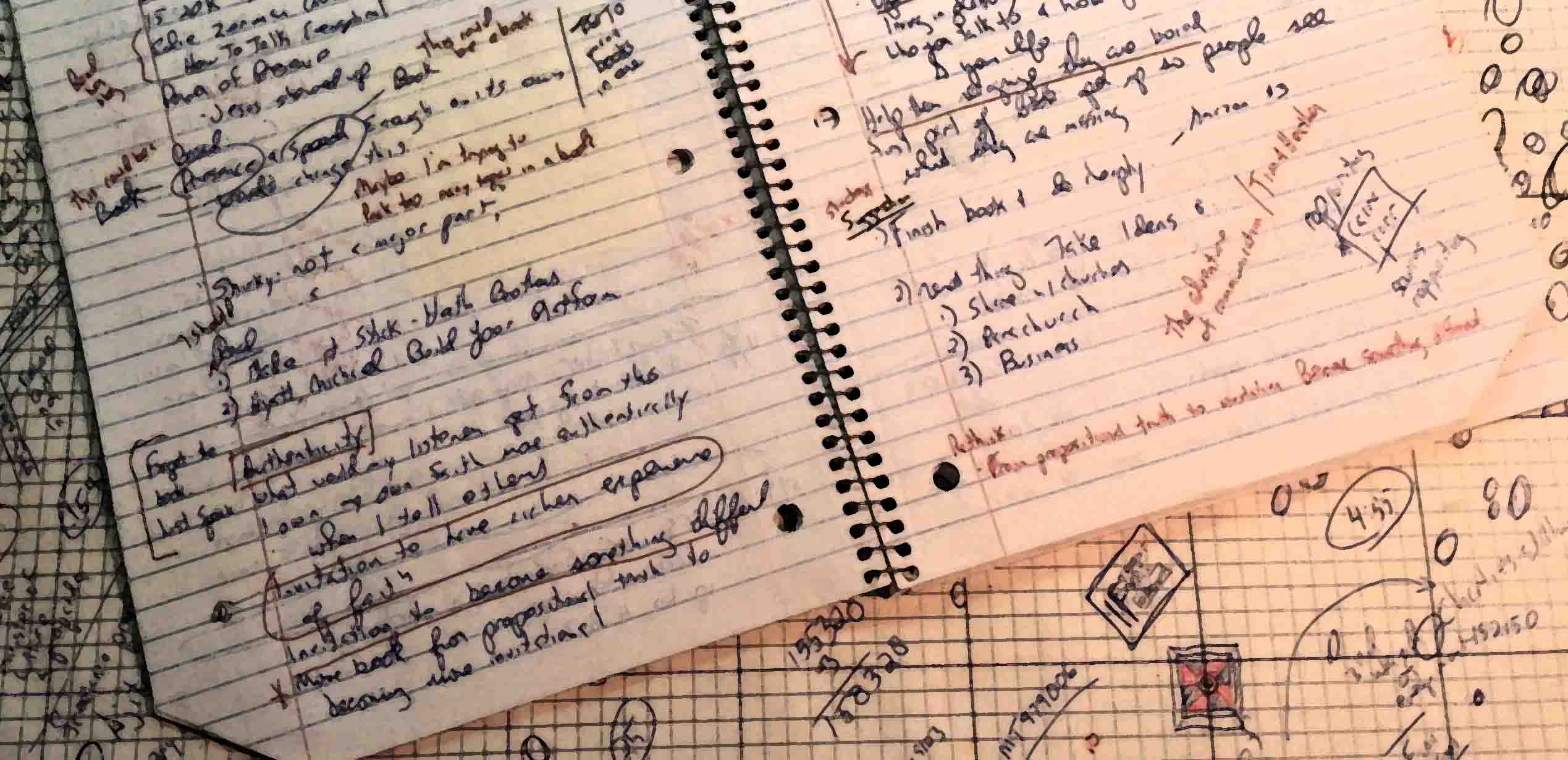
Anyone in business (or anyone in the business of getting something done) knows the value of accurate notes from a conversation. These quick jottings record promises made, delivery dates, special circumstances and conditions.
As a copywriter, I’m also poised to record quotes from my client or team: small summary statements, overview quips, self-proclaimed “dumb” analogies and tangential jokes. These little asides often prove valuable to solving the communication or marketing problem we’re gathered to work on. It’s curious how often the seed for the solution is in the conversation we had that defined the work we would do to solve the problem.
I know this because I often look back through my notes. I go back using a red pen and highlight notes that are proving critical (that’s right: reviewing notes in real-time is productive. Reviewing notes after the work is done is even more illuminating.).
Just today I found myself paging back through my notes looking for a particular conversation and stumbled on another conversation I had forgotten. And that forgotten conversation announced in red ink the precise answer to a communication question I’ve been asking for the last six days.
What good fortune!
###
Image credit: Kirk Livingston
Do a Dumb Sketch Today
Magnetize Eyeballs with Your Dumb Sketch
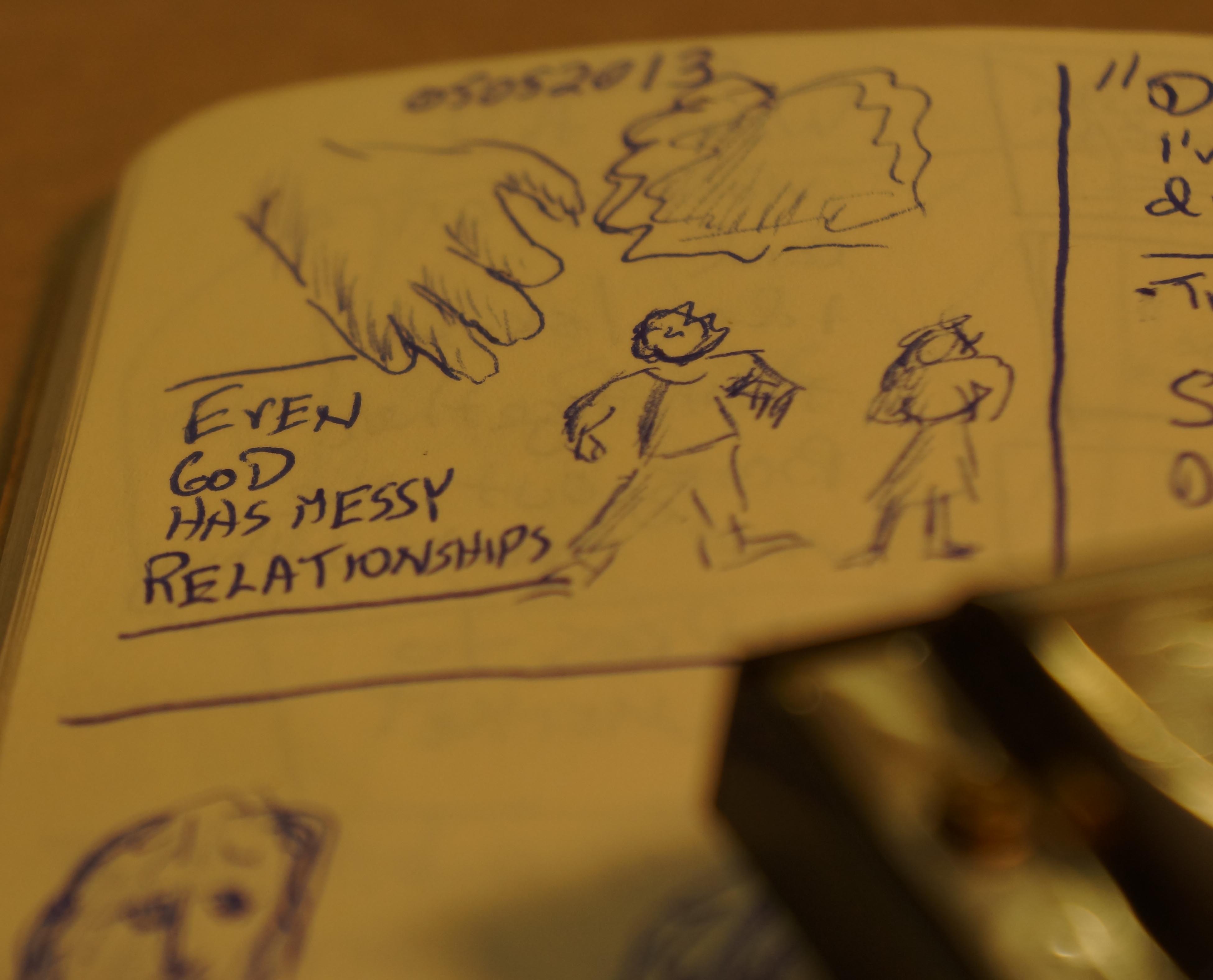
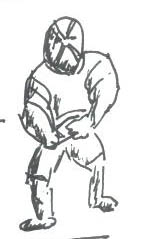 As a copywriter, I’ve always prefaced my art or design-related comments with, “I’m no designer, but….” I read a number of design blogs because the discipline fascinates me and I hope for a happy marriage between my words and their graphical setting as they set off into the world.
But artists and designers don’t own art. And I’m starting to wonder why I accede such authority to experts. Mind you, I’m no expert, but just like in the best, most engaged conversations, something sorta magical happens in a dumb sketch. Sometimes words shivering alone on a white page just don’t cut it. Especially when they gang up in dozens and scores and crowd onto a PowerPoint slide in an attempt to muscle their way into a client’s or colleague’s consciousness. Sometimes my words lack immediacy. Sometimes they don’t punch people in the gut like I want them to.
A dumb sketch can do what words cannot.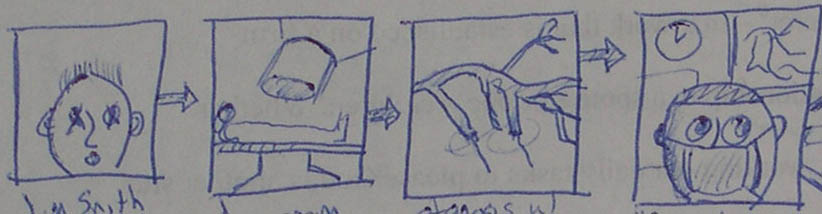
I’ve come to enjoy sketching lately. Not because I’m a good artist (I’m not). Not because I have a knack for capturing things on paper. I don’t. I like sketching for two reasons:
- Drawing a sketch uses an entirely different part of my brain. Or so it seems. The blank page with a pencil and an idea of a drawing is very different from a blank page and an idea soon to be fitted with a set of words. Sketching seems inherently more fun than writing (remember, I write for a living, so I’m completely in love with words, too). Sketching feels like playing. That sense of play has a way of working itself out—even for as bad an artist as I am. It’s that sense of play that brings along the second reason to sketch.
- Sketches are unparalleled communication tools. It’s true. Talking about a picture with someone is far more interesting than sitting and watching someone read a sentence. Which is boring. Even a very bad sketch, presented to a table of colleagues or clients, can make people laugh and so serve to lighten the mood. Even the worst sketches carry an emotional tinge. People love to see sketches. Even obstinate, ornery colleagues are drawn into the intent of the sketch, so much so that their minds begin filling in the blanks (without them realizing!) and so are drawn into what was supposed to happen with the drawing. The mind cannot help but fill in the blanks.
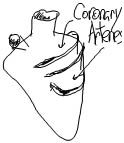
The best part of a dumb sketch is what happens when it is shown to a group. In a recent client meeting I pulled out my dumb sketches to make a particular point about how this product should be positioned in the market. I could not quite hear it, but I had the sense of a collective sigh around the conference table as they saw pictures rather than yet another wordy PowerPoint slide. In fact, contrary to the forced attention a wordy PowerPoint slide demands, my sketch pulled people in with a magnetism. Even though ugly, it still pulled. Amazing.
###
Dummy’s Guide to Conversation #9: Say it Out Loud To Get It
 A pastor friend once wondered why the congregation didn’t know this certain fact he had mentioned in a sermon. My friend was under the notion that people listen closely to every word of a sermon. I am convinced people do listen—just not to every word.
I know this because I have taught college students and mistakenly thought that the wide-open eyes and direct eye contact meant they were listening. It took me until my first test to realize how mistaken I was. Direct eye contact is as much an act as appearing to type notes while facebooking friends. Students and all of us easily adopt the outward behaviors that allow us to escape miles away to play on the beach while the person in front persists in boring monologue.
But a conversation is a different environment than a lecture or sermon. Don’t let your conversation partner bore you with abstractions. Challenge them. Question. Ask. This is the very nature of conversation and it fits with how we understand anything: we need to try an idea on for size to sort out whether it fits us or the situation.
Trying an idea on for size looks like talking.
We must turn something over verbally to begin to understand it. It’s just how the will is connected to the brain—through the voicebox. Not exclusively, sometimes we get it without saying it or asking. And sometimes writing a note helps in understanding (that’s often how it works for me). But make peace that people need to respond in one way or another to truly begin to understand something.
This is part of the reason lectures can be so ineffective.
###
Image Credit: BLU (street artist from Bologna Italy) via 2headedsnake
On Being: One Shining Moment for Talk
Krista Tippet, David Gushee and Frances Kissling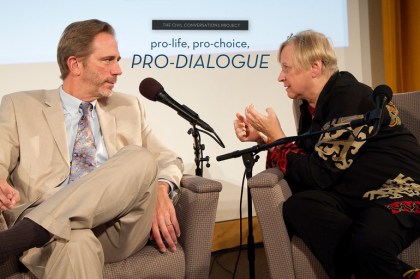
On Being recently broadcast a 51 minute conversation entitled Pro-Life, Pro-Choice, Pro-Dialogue. The recording includes a bunch of great moments and thoughts about communication and conversation as David Gushee and Francis Kissling each have their say and then tell what they’ve gained from the other side of this deeply divided topic.
I need to listen to the entire conversation again.
But toward the end of there was a moment where Ms. Tippet asked about the paradox of passionately clinging to what you know is true even as you reach out to understand what your opponent/conversation partner says/thinks/feels. There is a growth that happens, a change. It is not a giving away of passion or the rightness of the cause, but a deep concern that emerges. Here’s Mr. Gushee:
…after the Princeton conference in 2010 I felt clearer [about the] the position I had going…. But also I was more clear about the intelligence and the love that motivated the people on the other side too. And I respected that…. (~43:30 to 44:01)
There is a mistaken fear about dialogue that says if I engage with another person who does not believe like I believe, I run the risk of losing what I believe. But most people find the opposite to be true: passion grows deeper and something else is added: an understanding care about the other person. The passionate divide may remain, but surrounding that divide is care for another. And that begins to change everything.
This seems to me a shining moment.
A moment many of us could pursue.
###

Ray Becoskie: The Solution Should Always Have a Flag
Because There’s a Pistol in Her Purse
More Art-A-Whirl aftershock.
A few days back I wrote about Cody Kisel’s vision for consumerists. On that same floor of the massive Northup King Building, I had a hard time tearing away from Ray Becoskie’s paintings. Mr. Becoskie’s work transmits a wry humor and a fair amount of joy along with the puzzle of his titles.

The Solution Should Always Have a Flag
Here’s Becoskie on his process:
The work is generally constructed from three things. Things I know, things I believe, and things I make up. I get them all together in a room and I do my best to document the conversation that happens.

Like the Librarian Said

Because There’s a Pistol in Her Purse
###
Image credit: Ray Becoskie

 conversation is an engine