Posts Tagged ‘conversation’
Meaning Shows Up Between Us
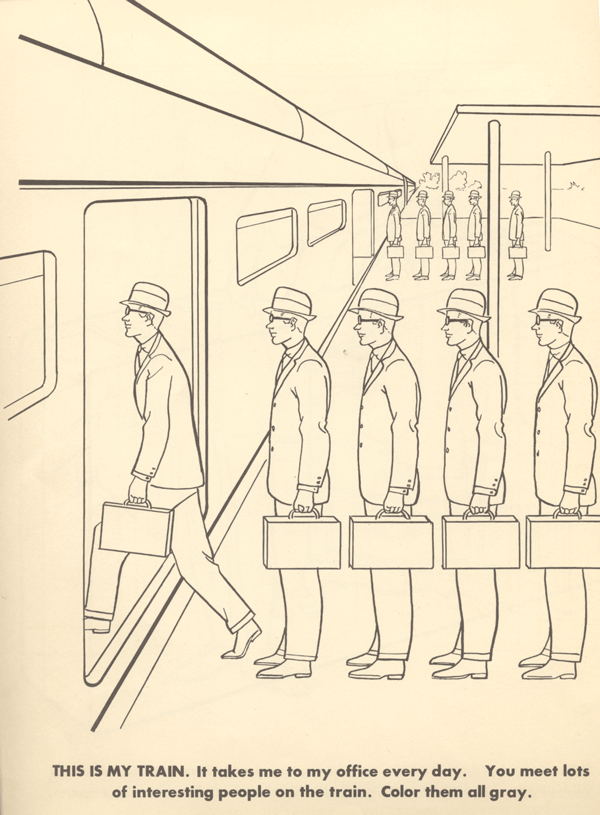
We are each products of the conversations we’ve had, whether with people, books or situations.
That’s why we keep changing.
###
Image credit: A Hole in the Head
Dialogue is a place
 Dialogue is a place. It’s a playground where humans come to teeter and totter, to swing and slide. It’s a geography—a verbal top-of-the-Foshay—where we suddenly see for miles though still sitting in a coffee shop talking with an old friend. Our best conversations become spots on the map we revisit for the rest of our lives.
###
Photo credit: Minnemom
They shoot listeners, don’t they?
Exercise this underused relational tool
 How could listening ever be bad or wrong? For a long time I thought of listening as a sign of weakness: if you are listening, you must not know something. Or maybe you don’t have your ideology straight. If you are listening than you are not talking. And leaders talk: they present solutions. They know stuff and they say it like a champion news reader. Leaders gather followers by releasing streams of words.
It turns out listening is an incredibly rich relational tool: it lets us hear another’s voice. Listening moves a thought from one brain to another. It pulls an experience from one set of muscles to another. Even if we seem to be hearing all the same old words, relational work is accomplished between two talkers when there is also hearing: someone is less alone.
Maybe we don’t listen because we already know what this person will say. But what if we focused on becoming the kind of people others could explore ideas with?
I like those conversations best: where we step outside of ideology and ask “What if?”
###
Image credit: Jacob Etter
All Things Awesome
 In the realm of how we talk with each other, Wayne Booth saw three options: convincing someone of our position, bargaining for concessions or listening to “pursue the truth behind our differences.” But what if we knew something even more stunning than the ingredients of Hahn beer? That would be an example of reconciliation-rhetoric: listening + naming what’s awesome. ( Via Adland TV )
###
Who shows up in your conversations?

show up for a few of your conversations today
There’s you. And your conversation partner. And since your discussion stumbled into talking about money, your Grandad showed up who always said “Save your money.” If you talk politics, some talking head from Fox shows up, or some voice from NPR joins in. You didn’t invite them. But you really did, because you heard them speak and absorbed their words as truth—at least until you repeat them aloud. Then you start to wonder.
Maybe you went to a funeral over the weekend and the widow shows up in your conversation, with what she said about her husband, your friend. And then your daughter shows up, because of the tiny gravestone she put over the mole you buried in the back yard ten years ago: “Here lies one dead mole.”
And sometimes even you don’t show up to your own conversations. And neither does your conversation partner. Because you’re both on autopilot and talking past one another as you walk past one other down the long hallway toward the coffee machine.
A good conversation is part mystery, part shining beauty, part toilsome information exchange—and frequently all three. But you need to show up.
###
Image Credit: Jay Fleck
US to Issue Alerts by Text—Just Don’t Go all Hosni on Us
Just used for good. Honest.

Thanks, I'll keep that in mind.
We’re welcoming texts from the president, right? Amber Alerts, alerts involving imminent threats to safety or life, and messages issued by the president, as reported by the Associated Press in the Star Tribune. Users can opt in or out on the first two, but not the third. President Obama will have the ability to speak directly to us through the device in our pocket. That’s good—we want to hear from the president if some catastrophic thing happens. But wait—what if we get reassuring messages like Hosni Mubarak’s regime issued in February as reported by the WSJ? If I see “American middle-aged taxpayers beware of rumors and listen to the voice of reason. America is above everyone so protect it,” I’m going to get all fidgety.
Image Credit: P.Nguyen via Arrested Motion
###
Do a Dumb Sketch Today
Magnetize Eyeballs with Your Dumb Sketch
 As a copywriter, I’ve always prefaced my art or design-related comments with, “I’m no designer, but….” I read a number of design blogs because the discipline fascinates me and I hope for a happy marriage between my words and their graphical setting as they set off into the world.
But artists and designers don’t own art. And I’m starting to wonder why I accede such authority to experts. Mind you, I’m no expert, but just like in the best, most engaged conversations, something sorta magical happens in a dumb sketch. Sometimes words shivering alone on a white page just don’t cut it. Especially when they gang up in dozens and scores and crowd onto a PowerPoint slide in an attempt to muscle their way into a client’s or colleague’s consciousness. Sometimes my words lack immediacy. Sometimes they don’t punch people in the gut like I want them to.
A dumb sketch can do what words cannot.
I’ve come to enjoy sketching lately. Not because I’m a good artist (I’m not). Not because I have a knack for capturing things on paper. I don’t. I like sketching for two reasons:
- Drawing a sketch uses an entirely different part of my brain. Or so it seems. The blank page with a pencil and an idea of a drawing is very different from a blank page and an idea soon to be fitted with a set of words. Sketching seems inherently more fun than writing (remember, I write for a living, so I’m completely in love with words, too). Sketching feels like playing. That sense of play has a way of working itself out—even for as bad an artist as I am. It’s that sense of play that brings along the second reason to sketch.
- Sketches are unparalleled communication tools. It’s true. Talking about a picture with someone is far more interesting than sitting and watching someone read a sentence. Which is boring. Even a very bad sketch, presented to a table of colleagues or clients, can make people laugh and so serve to lighten the mood. Even the worst sketches carry an emotional tinge. People love to see sketches. Even obstinate, ornery colleagues are drawn into the intent of the sketch, so much so that their minds begin filling in the blanks (without them realizing!) and so are drawn into what was supposed to happen with the drawing. The mind cannot help but fill in the blanks.

The best part of a dumb sketch is what happens when it is shown to a group. In a recent client meeting I pulled out my dumb sketches to make a particular point about how this product should be positioned in the market. I could not quite hear it, but I had the sense of a collective sigh around the conference table as they saw pictures rather than yet another wordy PowerPoint slide. In fact, contrary to the forced attention a wordy PowerPoint slide demands, my sketch pulled people in with a magnetism. Even though ugly, it still pulled. Amazing.
###
You Scare Me

What can you expect from a conversation with another?
What can you expect from a conversation with another?
Levinas Says Why
I’ve always felt the problem with others is they keep talking about themselves. It’s always what they need, what they want, what they think. Their opinion. There is far too little about me in what they say.
You might think I’m joking. I’m not. It’s what many of us truly think just under the surface and it hints we are not far from that three year old phase of shouting “Mine.” You know I’m speaking truth because you’ve thought the same thing: waiting for someone to stop talking so that you can voice what is important to you.
Emmanuel Levinas was another 20th century philosopher who knew something about finding people interesting. He penned his first book while in captivity in a Nazi prison camp. His imprisonment proved valuable in forming a set of thoughts that went a very different direction from what others were thinking. Levinas was concerned with what happens when we encounter the “Other.”
Levinas understood that the Other was outside of ourselves. Painfully obvious? Maybe not. We humans have this tendency to force every encounter through our grid of experience, our intent and, frankly, our ego. We too often reduce others to something that looks very much like us. So while we hear the person beside us talking, we may pick up only on the words they say that affect us and miss the words that don’t affect us. We may routinely miss the words that oppose our intent along with the ones that describe the passion of this other person. Anyone with an old married couple in their lives has had first-hand experience with the practice of selective hearing.
“Wait,” you may say. “I’m a people person. I love being with others. Surely I have no natural aversion to others?” But Levinas pointed well beyond personality concepts like introversion/extroversion. He pointed beyond the contexts that inform our relationships: how we respond differently if the person before me is a subordinate or a boss, someone from the executive suite or a lowly clerk who can (should?) wait while I finish my dinner before I deign to speak with him. You can perhaps see the problem: how we interact, how we even think of the person before us—whether we even see the person before us—all is rooted in our context. It is rooted in how we perceive ourselves in culture, how we understand our position and our role. Standing is a very encultured episode.
Levinas invites us to strip away these contexts and come face to face with another. You’ve already had encounters like this, where context has been entirely scrubbed clean. Maybe you were at a party and met someone who later you found out was “Someone.” But during your chat you treated him or her like any other schlep.
How we deal with others, what we expect from our interactions, how often we assume others thinks like us and/or read that into our interactions—all these instinctual reactions limit our listentalk. Maybe they even derail our listentalk.
Listentalk means embracing the notion that others around us have much to contribute. And possibly that others are integral in helping us become the humans we were want to be. Levinas also awakens the very faint hunger in all of us to hear from The Other—God. And listening to God is a crucial piece of successful listentalk.
###
How Could this Book be More Interesting?
I’m about to go fishing with my Listentalk book proposal (via www.ChristianManuscriptSubmissions.com). How could I make the summary (below) more interesting? Be honest. People respond to these posts by email, on Facebook and occasionally right here at “Engage.” Vent your spleen. I’m listening.
 Listentalk: How Simple Conversation Changes Your Life Every Day
Why does one conversation make you scan the room for escape while the next sends you breathless to register to run a marathon—though you hate exercise? Listentalk: How Simple Conversation Changes Your Life Every Day shows how humble, mundane conversations have the power to turn our life direction every single day, by:
- Reminding us of the pivotal conversations that have shaped and sculpted our own lives. Like the chance comment to your 18-year-old-self from an acquaintance about a “school you should check out,” which sent you a direction that ended in law school, marriage and being appointed as a judge (true story).
- Showing how God purposefully composed the human condition so that while we are limited, we are limited together. Conversation has a way of bumping out our human limitations in extraordinary ways, so that my lack of understanding leads to a discussion that sheds light on a key topic but also opens an opportunity to pursue the work I love.
- Exposing the component parts of listening and talking so we can better understand how God speaks to and through us
- Providing practical insights into how we can listen and speak for powerful good every single day—including wise use of social media
Today’s incendiary and vitriolic talk leaves people feeling weary and soiled. Listentalk refreshes Christian adults, Sunday School classes, small groups and college students by reminding them of the wonder, curiosity and serendipity that have been part of the deep verbal connections that have shaped their lives. These deep connections have often sprung from the unlikeliest of mundane conversations.
Listentalk tells stories of conversations that both suggest and model an extraordinary set of expectations and outcomes for ordinary talk. Listentalk helps people see verbal, visual and other-sensory conversational episodes as the powerful shaping tools they are—and provides suggestions for making them even more powerful. Unlike possibility-thinking, self-help books, Listentalk is grounded in the nature and actions of the conversing God of the Bible who expected and realized world-changing outcomes from each conversational episode. Listentalk frees readers to see daily conversation in a very different light by inviting readers to reach out in trust to each day’s conversational partners—an ever-expanding set of partners due to changing attitudes (about communication, authority and the loss of gatekeepers) and developing technologies.
Listentalk offers a primer on navigating the growing social media space as redeemed conversational partners. Creating communities of target audiences is the new marketing strategy. Leading public conversations by reaching out with dialogue that gifts and blesses is not only supremely Christian, but supremely strategic.
###

 conversation is an engine