Posts Tagged ‘copywriting’
Boss: With this ping, I have now pled
Think Globally. Act Tactically.
Sometimes we just do our job.
Sometimes we think bigger thoughts and help our boss sort out what next—long before being asked.
I maintain our best work comes from that place where we think strategically and act tactically. Our best work comes from big thinking harnessed to this moment’s need.
Today in our copywriting class we talk about relationships with clients. My line on this is to cherish, honor and protect your client—which starts to sound like a marriage—not quite the right analogy.
Then again, maybe it isn’t far off.
Clients are people who trust us to handle their message. They’ve hired us to do something they cannot do. This is a privilege. Our favorite clients know the best work comes from well-articulated need and parameters followed by the freedom to go and do. And sometimes our clients depend on us to help articulate those needs and define those parameters—simply because we get very close to the need.
This is where the copywriter’s outside perspective helps immensely. It’s also where we deploy our skill of listening into the deep waters of what our client eats/sleeps/breathes/knows. Because sometimes what seemed like only tactical work can turn into an opportunity even the client didn’t realize was before them. And we need to say so.
Such is the opportunity with collaborative teamwork and trusting work relationships. And that’s why it is important copywriters always think Grande or even Venti rather than Short.
Here’s to clients! (Jaunty raising of the ice water glass)
Long may they…, well. Hire.
###
How You Say: Not Just “What” But “When”
A word is a fuse. Light the fuse.
I’m teaching a freelance copywriting class at the University of Northwestern—St. Paul. Yesterday was our first day and I wanted the students to begin the shift from writing papers for professors to writing words to make a difference. I maintain that excellent copywriting is the very opposite of spewing malarkey and hype. Especially today, when anybody who can read and/or listen and absorb marketing messages has their BS meter set on high all day long.
The best copy doesn’t call attention to itself. The best copy is nearly invisible and absorbed without realizing it. The best copy latches on to or illustrates a larger idea and leads the reader to the idea threshold. The best copy is emotive and rational. If it can be silly too—all the better.
We talked about the differences we perceive in writing for non-profit, mission-driven organizations and for-profit organizations. At first glance we might think one organization is all about mission and the other is all about money. But that is a mistaken notion: for-profit organizations can be all about mission and non-profits can be all about fundraising. Examples abound in each category.
One of the things I love most about teaching these particular students is the sensitivity to mission. They are cool with the notion of using your writing skills to help others. Many are considering starting work with non-profits, but that is not unusual for many studying the liberal arts. These particular students are often eager to trace their motivations for helping others back to some of the ancient texts that drive much of this school’s mission.
But one thing that is not so clear is that mission-driven work exists in both non-profits and for-profits. One’s mission comes largely from within. Our job—that thing we get paid for—is an outward-focus of the mission we bring with us. A copywriter with a sense of wanting to help others can find a home in any number of organizations, whether for-profit or not-for-profit. And using that copywriting skill to bring a reader to a life-changing realization can be a primary motivation for the whole task of writing.
I would like to see more copywriters with that motivation.
My go-to example is the quiet laugh from the writer in this four-minute film. Listen for the laugh. Think about what that laugh says about delivering the right words at the right time:
###
It’s Better to Have the Conversation Than Not
Assumptions are a cul-de-sac. Admissions, an autobahn.
A fast-moving project I’m on pits the changing need of the client with the frantic response of the agency. I’m writing copy and providing strategic direction for a moving target, which has (literally) kept me up nights.
One truth that has proven itself to me several times over the past few weeks is that it is simply better to have a conversation than to not. That may seem obvious to you. But it’s taken me years to come to understand this. I’m too easily put off by the gruff manner or the fly-off-the-handle personality. It’s too tempting to put my head down and just do the work. But the way forward—especially when the task and deliverables are murky—is to talk together about what we understand. Naturally it is embarrassing to admit I know only this much (thumb and forefinger stretched) when I imagine those who wrote the scope of work know this much (from here to the wall, say).
But admit I must.
It is the only way forward. And sometimes it is the only way to get to the place where you can put your head down and do the work. Admitting what I know is also the best way forward: anything I can do to get the team on the same page, whether that means showing my rough draft copy or my quick dumb sketch of what I think the interactive designer just said. And by admitting what I know, others can feel free to admit what they know. That’s usually when I come to find out someone heading up the whole thing is just as baffled. But when we talk openly about what we know and especially what we don’t, a measured response can emerge and we assemble our next steps. At least until the next client meeting.
There is something of an art to getting people on the same page. Some personalities fall into this easier than others. Getting open discussion is aided by vulnerability: the admission. The confession. I suppose the question is: how badly do you want to move forward?
See also Seth Godin’s commentary about fearing the fear vs. feeling the fear. It may give you courage for your task.
###
Image Credit: Mark Brooks via 2headedsnake
Get a Job. Or Don’t.
Rethinking My Standard Line on Employment
What to say to folks starting in this job market?
I’m gearing up to teach a couple professional writing classes at the University of Northwestern—St. Paul. I’ll be updating my syllabi, looking at a new text or two. I’ve got some new ideas about how the courses should unfold and about how I can get more discussion and less of that nasty blathery/lecture stuff from me. I’ll be thinking about writing projects that move closer to what copywriters and content strategists do day in and day out.
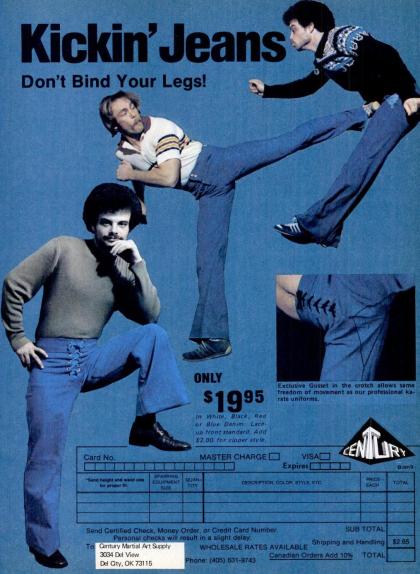
Yeah: don’t bind your legs when you really need to take action.
One thing I’m also doing is reconsidering the standard advice for people on the cusp of a working life. I usually tell the brightest students—the ones who want to write for a living and show every indication of being capable of carrying that out—to start with a company. Starting with a company helps pay down debt, provides health insurance (often) and best of all, you learn the ropes and cycles of the business and industry. I’ve often thought of those first jobs out of college as a sort of finishing school or mini-graduate school where you get paid to learn the details of an industry (or industries). Those first jobs can set a course the later jobs. And those first friendships bloom in all sorts of unlikely ways as peers also make their way through work and life. You connect and reconnect for years and years.
But I’m no longer so certain of that advice. While it’s true that companies and agencies and marketing firms provide terrific entry ramps to the work world, they also open the door to some work habits that are not so great. Every business has its own culture, of course. Sometimes that culture looks like back-biting and demeaning and discouraging. Sometimes the work culture can be optimistic and recognize accomplishment and encouraging and fun. Mostly it’s a mix of both.
But one thing I don’t want these bright students to learn at some corporate finishing school is the habit of just doing their job. By that I mean the habit of waiting for someone to tell them what to do. Every year I watch talented friends get laid off from high-powered jobs in stable industries where they worked hard at exactly what they were asked to do. And most everyone at some point says something like:
Wait—I should have been thinking all along about what I want to do. [or]
How can I be more entrepreneurial with my skill set? [or]
What exactly is my vision for my work life?
Some of these bright writing students are meant to be entrepreneurial from the very beginning. Though a rocky and difficult path in getting established with clients and earning consistently, it may be a more stable way to live down the road. Maybe “stable” is not quite the right word for the entrepreneurial bent—“sustainable” might be more appropriate. The quintessential habit to learn is to depend on yourself (while also asking God for help, you understand) rather than waiting for someone to come tell you what to do.
I’m eager for these bright, accomplished people to think beyond the narrow vision of just getting a job. The vision they develop will power all sorts of industries over time.
###
Image credit: arcaneimages, via rrrick/2headedsnake
70 Sheets. 700 Signals.
My $1.25 Grist Mill
For years I’ve kept notes on conversations with clients.
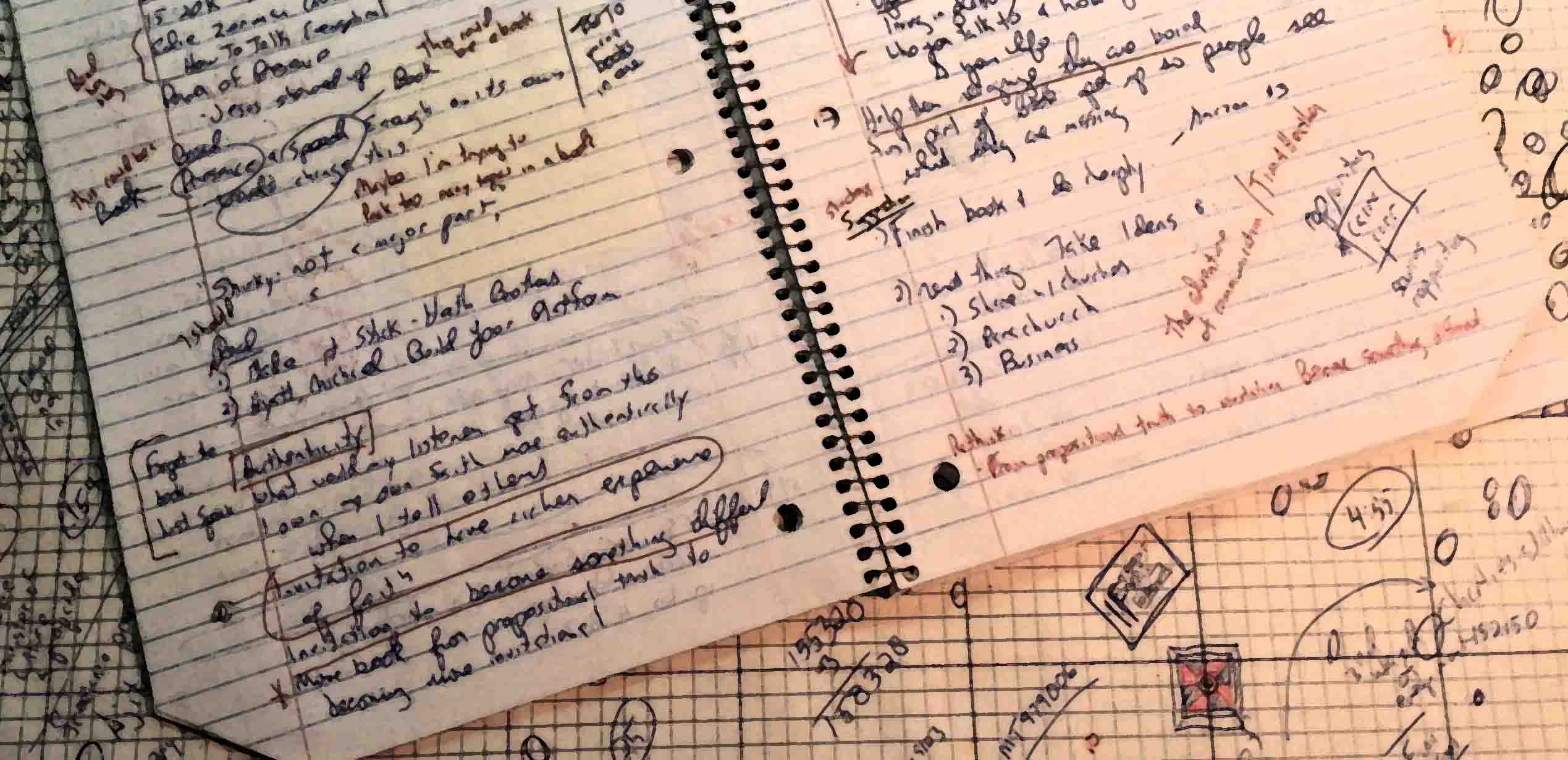
Anyone in business (or anyone in the business of getting something done) knows the value of accurate notes from a conversation. These quick jottings record promises made, delivery dates, special circumstances and conditions.
As a copywriter, I’m also poised to record quotes from my client or team: small summary statements, overview quips, self-proclaimed “dumb” analogies and tangential jokes. These little asides often prove valuable to solving the communication or marketing problem we’re gathered to work on. It’s curious how often the seed for the solution is in the conversation we had that defined the work we would do to solve the problem.
I know this because I often look back through my notes. I go back using a red pen and highlight notes that are proving critical (that’s right: reviewing notes in real-time is productive. Reviewing notes after the work is done is even more illuminating.).
Just today I found myself paging back through my notes looking for a particular conversation and stumbled on another conversation I had forgotten. And that forgotten conversation announced in red ink the precise answer to a communication question I’ve been asking for the last six days.
What good fortune!
###
Image credit: Kirk Livingston
Copywriting Tips for English Majors #8: Work Past Your First Thought
Instant believability is a must + clowns are not a message
This ad is like a DVD scratch that hits at the climax of Inception: all plot and story get stuck and there is no movement forward.

Copyranter offers a mini-lesson in copywriting from this ad from Kazakhstan. Too many times we go with our first gut idea without knowing how the pieces fit. When the pieces do not precisely fit the message is lost.
Check out Copyranter’s list of questions/thoughts about the ad.
###
Via copyranter
Is Your Job Fulfilling? (Shop Talk #3)
Depends: what do you mean by fulfilling?
 An art director and I were talking once about the different jobs we had done over the years. Al said he did some work as a freelancer he was not particularly proud of: wasn’t bad work, just didn’t highlight the creative style he had become known for. Why did he do it? “Well, I had a family and a mortgage and…you do what you gotta do.”
This is my story, too. It is everyone’s story.
An English student asked me how someone writing for an agency or corporation can find fulfillment when the writing is essentially voiceless. By that I understood she meant that the writing was not coming out of some personal deep need to communicate. I get what she means and I think this is an important question. But I also think we romanticize the production of art, novels and poems.
I’ve been arguing that work and art sometimes fit hand in glove and sometimes stay at opposite ends of our daily teeter totter. I’ve been arguing you need both to make either work. If you just have paying work, you are not exercising your creative self. If you just are creating, you’re broke and maybe you don’t have a place among real people in real life. Here are a few things that happen when work and art find a way to live together:
- Workmanlike attention: Our work with its deadlines and status updates helps us (sometimes forces us) to be productive. This is useful when it comes to delivering on our art or craft. Just getting to it—every day—is the way we produce anything. None of this waiting for enlightenment stuff.
- Having a place among people: isolation is not good. Those colleagues and bosses and clients who critique our work help shape it (no matter how painful). In the same way as we try to explain our craft or art to others, it gets shaped as well.
- It is your job to develop a voice. It may not be your voice, but it must be a believable voice. And to run that voice through the gauntlet of critics and peevish managers and lawyers and regulators is no small feat. The voice you produce can become a team or corporate asset. That is something to be proud of.
- Now is not forever. If you are not producing the art/poems/novels you intended, find a way to get to it. This usually involves owning up to the myriad excuses we present for not doing it. And if today’s work is less than fulfilling: start looking. It’s the steely beauty of the free market system that you can change. Recognize that this job is for now and not forever (more and more I’m convinced different seasons in life hold different tasks and levels of fulfillment. Plus, we are personally changing all the time, which means fulfillment is a moving target.)
Several of the hard-bitten copywriters I know would say “Who has time for writing outside the office?” To these I would say your own art and copy is a gift to yourself that pays back in meaning and insight.
There’s more to say about this. What would you add or subtract or say to my student?
###
Image credit: Kirk Livingston
Ginsberg’s “tanked-up clatter” vs. the Gray Flannel Suit vs. a Third Way
Peace for the Listening Lurking Capitalist
We’re at the Beats and Allen Ginsberg and Howl now in our march through modern poetry. A recent discussion took in a stanza that seems relatively autobiographical, describing Ginsberg’s failed flirtation with advertising:
who were burned alive in their innocent flannel suits on Madison Avenue
amid blasts of leaden verse & the tanked-up clatter of the iron regi-
ments of fashion & the nitroglycerine shrieks of the fairies of advertis-
ing & the mustard gas of sinister intelligent editors, or were run down
by the drunken taxicabs of Absolute Reality,
 There is lots to talk about in this section (indeed, the entirety of Howl begs for response and discussion), including “leaden verse & the tanked-up clatter” and the irresistible “nitroglycerine shrieks.”
Of particular interest to me was the quickness with which our TA/discussion buddies blasted the hackiness of advertising copy. Of course the poets are right (and anybody actually creating ads readily confesses to their role in purveying crass capitalism), still…not everything is “clumsy, tacky copywriting.” That knee-jerk reaction to advertising covers a lot of ground well. But the comment misses the diabolical under-the-skin genius of the copy that got through and has already been ingested and now guides our subconscious. Professor Al hit closer to home when brought up “very slick” old slogans that remain memorable. Ginsberg’s insights at that point are perceptive and well-wrought, but I cannot help but insist on seeing the beauty of some advertising. The turn of a phrase that attaches (yes, at times parasitically to a target brain) is, well, amazing. It’s a kind of poetry let loose among today’s pages and screens and whispers.
There is a way to be at peace with using creativity to solve business problems. The way of peace wanders alongside the grove of manipulation without wandering in. This path follows a course of respectful persuasion, with nods to the “I and Thou” while resolutely trimming and toning messages for real-life use.
There is a way between “clumsy, tacky” and slick manipulation. That is a way of service that can be beautiful in its workmanlike portrayal of practical truths.
###
Image Credit: marcedith via 2headedsnake
Endo Brochure Silent on Vital Bits—2 Skills for Tonight’s Debate
Read the White Space. Hear the Silence.
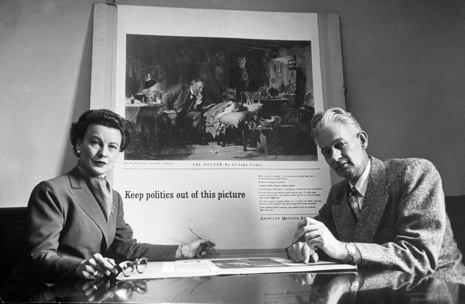
Campaigns, Inc.: My Antiheroes.
MedCity News reports on an Endo Pharmaceuticals brochure under scrutiny by the FDA. The problem was a lack of transparency about the dark side of the therapy—a therapy designed to slow the growth of prostate cancer cells, namely:
- paralysis that may result from the risk of spinal cord compression
- the increased risk of diabetes/heart attack/sudden cardiac death/stroke
In a lively debate in comments section of the Pharmalot blog, the consensus seems to be that the FDA made a good call. Commenters began by speculating this was likely more than just a slight oversight as the Endo communicator skipped regulatory/legal review in a rush to meet a deadline. Then commenters started tracing the language to the Vantas Implant website and began speculating on the rest of their messaging and promotional literature.
The debate amuses me because it is the rare product brochure that is read outside of a sales presentation. And it is even rarer for a brochure to withstand extended exegesis. That the FDA does this regularly earns my respect/awe/fear. Love them or hate them, the FDA’s dogged attention helps medical copywriters and marketers hew to the high road.
The debate also serves as a reminder of the skills needed for watching tonight’s presidential debate. It’s the white space and silence that may be most eloquent. The skill of reading the white space and hearing the silence means the audience must be equipped with the fuller argument. The FDA certainly was. But to read Jill Lepore’s recent New Yorker essay (“The Lie Factory: How politics became a business,” Sept. 24, 2012) is to come away with all the history and reasons as to why the American populace remains a happily uninformed audience. Whitaker and Baxter of Campaigns, Inc. helped set the stage for the current state of our spectatorship:
In tonight’s debate, I’m trying to break free of my usual indolence to hear between the lines (as it were).
###
Image credit: The New Yorker

 conversation is an engine