Posts Tagged ‘copywriting’
How to Pitch a Medical Device Company #1: Know MedTech Context
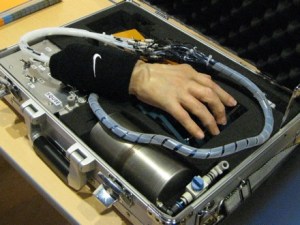
help us feel human again
I spent the early years of my working life being formed by the medical device industry. I was energized by the mission of seeing people restored and hearing joyful patient stories. I enjoyed the banter with physicians and learning about the junction of technology and living systems. And I was charmed by the folks I worked with: some of the smartest people around, with a bent toward helping others. Not everybody, mind you, but enough lively, mission-fed people that the workday was full of surprise.
Things change. Corporations mature—for better and worse. Lately it seems the balance sheet and the quarterly earnings call too easily drown out mission. Smart people who enjoy a challenge still work there, and it is an industry with more and more specific boundaries. So if your agency is pitching medical device work, please be aware of these three influences that shape the perspective of the people you will be talking to:
- Legal pinioning
- Regulatory straight jacket
- Branding dead ends
These perspective-shapers sounds like a bummer, but smart agencies with a knack for operating in tight quarters can help make a difference. The first two perspective-shapers are fairly obvious. Naturally, the best medical device companies hold the patients who receive their therapies in the highest regard. And you would not want to work with a company that didn’t. But in our litigious age, there’s lots of money to be made from suing manufactures for all sorts of things. Naturally, medical device companies ramp up their risk-averting processes. Lawyers review nearly every outward facing piece of communication and regulatory reviewers—the picky cousins of lawyers—delight in ferreting out each word of potential deviation from the FDA-approved copy. And the work of lawyers and regulators is invaluable.
Branding dead ends are not so obvious and few will admit to them out loud. These take a bit more explanation, so I’ll reserve it for another post.
But in your initial approach to conversations with med tech employees, know that most of their conversations are like walking a tightrope: marketing is always a balance between what you’d like to say and what you can say given the published studies. Agencies with more consumer experience can find this deadening. But resisting the pinioning and the straight-jacket—in your own way—is one of the ways your team can add value. It’s just got to be believable. And it becomes more believable when you ask for and expect the list of approved claims before starting work on your pitch. Since every claim must have a valid reference, basing your creative on the right foundation can make the difference between making the final cut and being dismissed as not up to snuff.
Image Credit: Engadget
You’re Soaking In It—Creative Unresolve and the Good Life
The issues that roil your nerves and kick you in the gut may be instrumental in pushing you forward.
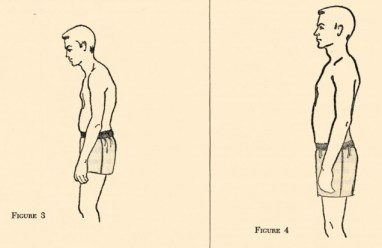
let creative unresolve lead you forward
A few days back I wrote about sitting with unresolve as long as you can, as one method for producing creative ideas. John Cleese had a few choice words on the topic. After talking about this in class and listening to Mr. Cleese and experiencing it afresh with my own writing, I realized a couple of ancient voices had been swarming around, punching me in the face with this very point—only applying it to the rest of life.
One voice is a warrior-poet. Aside from being handy with a lyre and deadly with a sling and stone, he had a very lucid and descriptive (often prescriptive) way of asking God to do terrible things to his enemies. And yet, though he often had the power and opportunity to take action, he didn’t. Instead, he turned from the shortcut, obvious solution and waited. We all know that waiting for God seems to take longer than anyone likes.
Same thing with another Old Testament character—Habakkuk. He saw bad stuff coming (a brutish band of thugs coming to decimate his homeland) and decided also to fix his attention on God. And wait.
Something happens when we wait. Sometimes we can fix things in life right away. Often we can’t. So we wait. And just like when we’re working through a creative solution to a thorny business or communication problem, we sit with unresolve and let the discomfort itself push us forward.
Same thing with life. We wait and seek and wait. And–this may be most critical—we reach out. We reach out when things are not right with us. And reaching out is nearly always worthwhile. Reaching out looks like a phone call. Reaching out looks like an email. Like prayer.
Some students from my copywriting class are graduating. Everyone says it’s a low-energy job market—difficult for the job hunter. I sympathize. To these graduates I simply offer the notion that your creative unresolve can lead you forward into networking, conversation and, yes, to reach out in prayer.
I still maintain that the best stuff in life happens in and through the choices and actions made directly from chaotic, creative unresolve.
###
Image Credit: itchy banquet via thisisnthappiness
Copywriting Tip #5 for English Majors: Why Voice Matters
The human voice will always reign as king of communication.

words contextualize our presence and vice versa
I recently talked with a pastor who opted out of social media. Entirely. If he wanted to connect with someone, he picked up the phone.
“That seems anachronistic,” I said.
“No—that’s how I connect,” he said. “I talk with people.”
And then I realized: Yes! The sound of the human voice will never go away entirely. People may joke about removing the phone app from their phone, but that remains a joke. There’s something about the human voice that demands a response and always will. The human voice has a directness that goes beyond any technology, whether text or tweets or simple words on a piece of paper or images scattered on a cave wall. When our advertisements don’t get through, when our emails fall short, when our Facebook message goes unanswered, we go stand in front of someone and ask our question.
The human voice will always reign as king of communication–it says “I’m here. I’m present.”
Students in my professional writing classes at Northwestern College wander the web with ease. But they are loathe to pick up the phone to talk with people about potential job prospects. This is, perhaps, a pitfall with pursing writing. But perhaps the pitfall itself can show the way forward.
As copywriters we try to use that voice. We mimic it by writing in a conversational manner. With short sentences. We try to “sound” like the voice—“sound” because the sound is in a reader’s head (so—not really a sound). The more our writing sounds like the human voice, the more invisible it becomes—with the goal of messages that get into one’s mind without someone remembering they just read something. Kind of like how you drive to work everyday.
Unconvinced? Check out this German ad (and below) about organ donation. The pathos in the voices is unmistakable, even if you don’t speak German. But the voice is magnified by the dialysis chair. In the train station. It’s a bit of theater that amplifies the voice.
Context switching—from hospital to busy platform—becomes that platform that makes the human voice all that much more effective. The voice, plus the human before them—hard to resist. And emotion is a definite part of this.
Moral: “Write like you talk” is good advice. And not easy to achieve.
###
Image via thisisnthappiness
No One Expects the Spanish Inquisition
 This was a favorite phrase back in High School, when there was no end to how much Monty Python we could quote each other. Lo these many years later, it turns out that John Cleese had quite a lot to say about creativity. I invited Mr. Cleese to lecture in my Freelance Copywriting class last week (via Youtube). Two lectures—spaced 18 years apart—show and reinforce that the best ideas come from sitting in that uncomfortable spot where things are not resolved. The quick solution is often not the best solution. Mr. Cleese argued we need space to become playful, time to border our playful escape from life’s ordinary pressures, time to grind through creating, confidence that mistakes made while creating mean nothing and humor—which is one of the quicker ways to get to this open mode needed for creation.
My goal with copywriting students (and with myself) is to learn to inhabit that chaotic place of unresolve. To live in that space—for as long as possible—while fitting different ideas to the problem. Looking for a match. The chaos of the unresolved space has some motivating effect that helps generate new solutions.
If we wait there.
###
Via Brain Pickings
Copywriting Tip #4: Speak Truth to Profits (Dan’s Story)

ancient copywriters rocked
I’m fond of a particular collection of ancient texts. One tells the story of a copywriter named Dan. Dan’s client was all-powerful and routinely dismantled (sometimes literally) those who did not do exactly as he asked. This client never hesitated making impossible requests and had no problem forcing his teams to guess his mind.
Dan was an employee who had been groomed and mentored and specially-trained for leadership. And yet Dan retained a commitment to the recognition that even his abusive, ill-tempered, seemingly all-powerful employer had to answer for his actions and did not have as much control as he liked to believe. This perspective had been shaped early in Dan’s life by his large, extended family.
Dan’s understanding of life held sway over his work. And while he was dedicated employee, he had committed himself to write truth, no matter the cost. This put him in a bind when it came to this client, because this client’s wealth and power routinely corrupted those around him, so most everybody told the despot exactly what he wanted to hear.
The story goes that one gruesome assignment forced the entire team to guess what the employer dreamed and interpret that dream. Or be dismantled. Of course no one could do it, and so they said. The employer force the point and the team prepared to be dismantled. Dan heard of the impending mass dismantling and he and his buddies thought they better act on their understanding that even the king answered to God. So they prayed. That’s right, this is a story of a copywriter who conversed with God so he could do his work better. Dan would often point to these conversations with God when people praised his insights.
And he did get insight. From God. It was not an insight that put the employer in a good light, but Dan told it anyway. And everyone lived another day.
The Moral
Truth matters more than appeasing the abusive despot before you.
And This
The copywriter’s work has always been about providing insight into the soul of a client and the heart of a client’s audience. Get help with that.
###
Image credit: Douglas Smith via 2headedsnake:
Copywiting Tip #2: Start Fast. Engage Brain.
Start today.
Now. This very moment—long before you have a clue what you are doing. This sounds different from what Young said. Young said go slow, gather your material and masticate. Chew it over. And keep chewing. I agree with Young but with this addition: trick your mind into engaging the problem by jumping all the way to the end before even beginning to gather. Then go back to Young’s process.
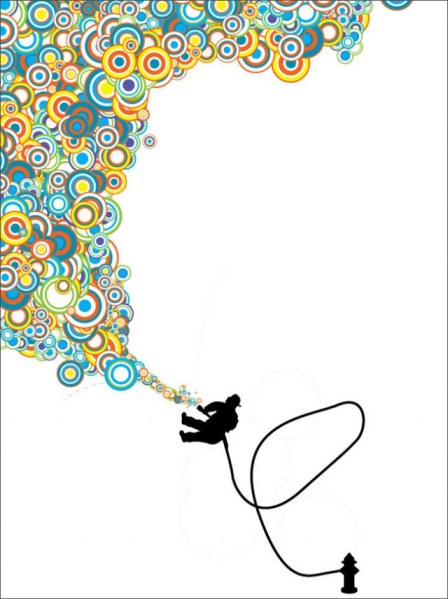 Writing the end result out of ignorance does this: you know you’ll write dreck so your internal Editor-Nazi takes a nap while your inner poet-child scrawls all over the wall with red crayon. When you wake up the next day and look at the terrible mess the poet-child made, you recognize a couple very productive words that hint at where this thing needs to go. Sometimes those words or images drill to the internal core of the problem you might never have guessed at with all your precious process.
###
Image Credit: Oliver Barrett via 2headedsnake
Wait for It (And Resist Checking Your Phone)—Dummy’s Guide to Conversation #8
Anyone who writes for a living or who must regularly produce creative solutions knows the best ideas are typically not the first ideas.
I’m about to begin teaching a freelance copywriting class at Northwestern College and I’m guessing there will be some who will submit copy they’ve done at the last minute: something thrown together to meet the assignment requirements, but just barely.

don’t rush me
I hope college students don’t remember college as the place where they learned to do the least at the last minute to see how much they can get away with. This is not a great attitude to take into the workplace. And it is a fatal if you work on your own, because it leeches craftsmanship (and joy) from the work itself. And craftsmanship—care for the work itself—is one of two key elements in meaningful work. The other element is learning how to serve someone else’s needs and finally get over yourself.
When I brainstorm for an ad or a bit of copy I fill up pages and pages with pure dreck. Worthless stuff that only serves to get my keyboard moving. And then, at some point, one bit of dreck solidifies into a line that is sort of ok. Or a direction that makes sense. But that only comes after the pages of dreck. Occasionally it comes first, but I need the pages of dreck to help me realize any possible or potential brilliance.
How does that work in conversations? Same way. The first stuff we way say is obvious and not that interesting. The first conversations of a cross-country car trip have a vanilla flavor. But by the time you’ve arrived at New York to catch a flight to Europe, you know the deep hurts and high joys of everyone in your car, and you’ve somehow settled on a series of jokes about fast food restaurants or particular car types that leave you all gasping for air because they are so funny. It takes time and sustained attention to get to that place where the good stuff comes out. It’s almost like you invent the context for familiarity as you go.
This is the way for lots of satisfying things. And it is the way for ordinary conversations. I’m learning to dwell in a conversation. To not rush it. To give myself and other space to breathe so that they (and I) feel free to let come what may. And that can be uncomfortable because silence is awkward for us. Soap opera stars lock their eyes in those silences. In a cross-country car ride you look out the window. In a conversation, you just…look…and wait. But the silence works to lube thoughts. Resist the urge to move to the next thing. Resist the urge to pull out your phone. Wait for it. Because eventually something will come along that changes everything.
###
Image Credit: Langdon Graves via thisisn’thappiness
Risky and Risqué Reading for Christian Copywriting Students

Reading is dangerous. And profitable.
On Tuesday I start teaching Freelance Copywriting (Eng3316) at Northwestern College in Saint Paul, Minnesota. These are junior and seniors largely from the English department, but also from Journalism, Communications and Business. They are generally excellent writers and engaged students—people eager to take their faith into the street. We’ll use a few thought-provoking texts that deal with the business side of copywriting, along with the what to expect as a copywriter and how to get better at producing salable ideas (Bowerman’s The Well-Fed Writer, Iezzi’s The Idea Writers, Young’s A Technique for Producing Ideas). But I’ve become convinced the real-time critiques of working copywriters around the web are just as helpful if not more useful than our texts. It’s just that the language and images used in the critiques often veer outside the lines of nice and polite, though I would argue the critiques follow the line of conversation Jesus the Christ encouraged with regular people like me.
So.
I’ve devised a warning:
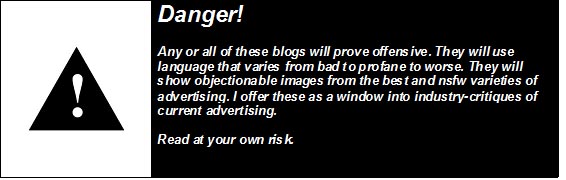
Question: Is this overkill? My goal is to help prepare thoughtful writers who fold God’s message of reunion into their communication work and live it out in a world that operates on a very different basis. I think students will understand. I’m not sure the administration will.
What do you think?
###
Image Credit: Chris Buzelli via 2headedsnake
Two Words Cost Me Dearly
 My Splendid Sabotage
Please know:
First: I wrote the words 40-some hours into a 51 hour project spread across a week and a half.
Second: I was desperate to capture the zeitgeist bouncing between client and agency principals.
As I wrote these two words I immediately moved to delete them. But something stopped me. Was it reckless whim? Had I given up? Why oh why did I pause over “Delete”? My self-editor should have been there, sitting beside me. He was still locked in the self-editor-dungeon where he has a cot and a Folgers can to pee in. He doesn’t get out much when I’m creating.
“Flabby Paths”
Oh, sure. They seem innocuous—even forgettable. But as a subhead for a component of this project, they were the stalled car on the track that derailed the train pulling boxcars of produce that needed to get through right now. Or: These words distracted the creative team and hurried them down a path and off a cliff.
So, my bad. Personal penalty: pulling my invoice and attacking it with scissors and fresh resolutions. It’s a matter of integrity. It’s also a matter of retaining relationships.
Floated or Finished?
It’s never just the words, of course. It’s the trust built between creatives as a project moves forward. With some team members you are free to say the really stupid stuff and let it sit for a moment between you, even as you all know some better idea is moving up an esophagus about to be uttered. But with other teams, and especially in hurry-up mode, words appearing on paper carry more weight: not of an idea floated but an idea finished. At this point in the project, my self-editor needed to be there with his “HIT DELETE” stamp poised. Because time was flying and next steps need to step up solidly.
My point? Conversations are never formulas that work in every case. And: while creating, the self-editor needs to dwell in the dungeon, but words making their way out in public need to meet his approval. Let him out sometimes.
###

 conversation is an engine