Posts Tagged ‘curiosity’
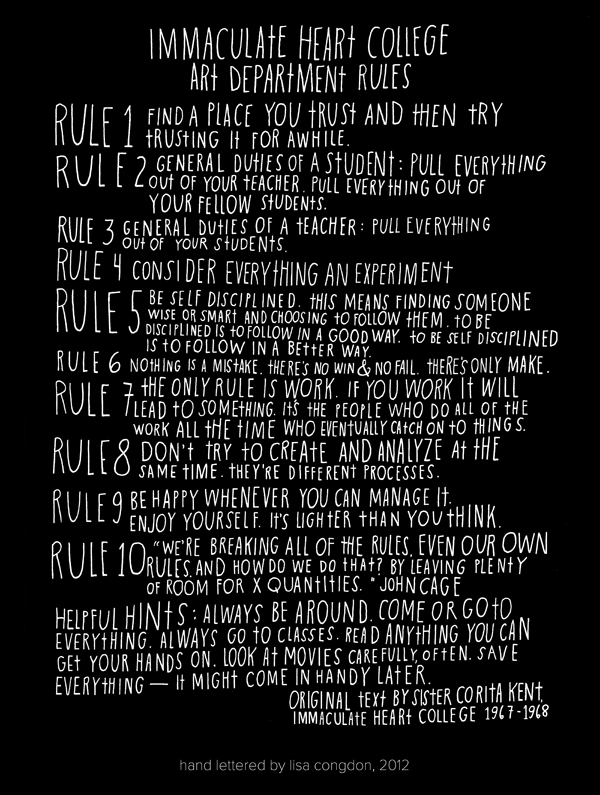
Sister Corita Kent’s Art Department Rules
 ###
###
Image credit: Lisa Congdon via thisisn’thappiness
The Etiquettes of Therapy/Religion/Business
When must we say “No!” to etiquette?
 We don’t talk in elevators. Many of us avoid taking a cell phone call in a restaurant. We don’t use church language at work. And we don’t use plumbing words at church (those words that come with a pipe wrench in hand and head under a sink—according to Steve Treichler). We observe all sorts of behavior habits and patterns from day to day, all of which we call “etiquette.”
In Encountering the Sacred in Psychotherapy (Guildford Press, 2002), James and Melissa Griffith attempt to bridge a taboo of talking about God with clients in their psychotherapy practice. As you may or may not know, conversation is key therapeutic tool and Griffith and Griffith believe therapists too easily dismiss a powerful ingredient when they don’t allow for stories of how people’s faith effects whatever is the topic of therapy. The caveat is that Griffith and Griffith have opened themselves to hear all sorts of faith stories—not just those they might have considered orthodox. The two therapists tell of their own journey toward openness to the varieties of ways patients tell personal stories. By the way: let the record show that openness to hear the wide variety of things our conversation partners say is not the same as giving up on our deep-seated beliefs. We too often confuse openness with wishy-washy. Not the same.
I was initially attracted to the Griffith and Griffith book because of the details they reveal about conversations: how to help each other talk, the amazing nature of a simple conversation, and the mechanisms of speaking that prove so healing. Along the way I’ve come to realize they’ve done something substantial by breaking down a Berlin wall between problems and potential solutions (though perhaps psychotherapy practices have changed quite a bit since 2002).
Over the years I’ve found that colleagues at work will talk about all sorts of stuff in the course of a day, from money to sex to faith to the Twins to the boss to marriage and kids—plus everything else. This is to be encouraged—this flow of words is both natural and cathartic. It’s all about encouraging relationships (which are the primary source of joy for many at work) and work talk routinely breaks across walls of etiquette.
###
Image credit: fredrikrattzen via 2headedsnake
Is it Time You Wrote Your Autobiography?
I’m not writing one. Then again, who isn’t adding to their autobiographical material daily, whether with words or deeds?

but surely I am king of something
I’ve been reading the autobiography of R.G Collingwood, an Oxford philosophy professor of the last century. He set out to trace the outline of how he came to think—a kind of personal intellectual history. Early on in his life (at 8 years old) he found himself sitting with a philosophy text (Kant’s Theory of Ethics). And while he did not understand it, he felt an intense excitement as he read it. “I felt that things of the highest importance were being said about matters of the utmost urgency: things which at all costs I must understand.” (3) That reading set one course for his life.
One thing that makes this book worth reading is his notion of how questions and answers frame our production of knowledge. Collingwood said he “revolted against the current logical theories.” (30) He rebelled against the tyranny of propositions, judgments and statements as basic units of knowledge. He thought that you cannot come to understand what another person means by simply studying his or her spoken or written words. Instead, you need to know what question that person was asking. Because what that person speaks or writes will be directly related to the question she or he has in mind. This is incredibly useful when studying ancient texts—like a letter from the Apostle Paul, for instance. It’s also incredibly useful when listening to one’s wife (ahem), or a student or to anyone we come in contact with.
Another thing that recommends this book is hearing him tell about his main hobby: archaeology. Collingwood was the opposite of a couch potato. He spent a lot of times in digs around the UK, unearthing old Roman structures and then writing about them. Here too, he explained that while some archaeologists just set out to dig, he only set out to dig when he had formed a precise question to answer. His digging (tools, methods, approach) were all shaped by this question. By starting with a question, he came to very specific answers and, of course, other brand new questions.
Questions begat answers. And more questions.
What question is your life answering?
###
Image credit: J-J. Grandville via OBI Scrapbook Blog
How Can I Accelerate Adoption of New Ideas? PBS Arts Off Book
Aesthetics or style isn’t what drives me. What drives me is the core idea, and then I apply a design sense to that core idea. (2:08)
###
Via: The Casual Optimist
Fear as a Communication Tool: Hearty and Cruel Visuals
The Truth in Consequences

Ouch.
Today in class we talk about visuals and how to use them. Graphs, charts, line drawings, photographs—all the stuff we see every day in our media excursions. As a copywriter I am very fond of visuals: I love the way they succinctly tell the story I labor to explain with words.
But there is a genre of images we shy away from—images entirely out of sync with the pleasant, positive, climate-controlled and safe communication we aim for. These images follow the shock and awe tactics of the Brothers Grimm: show what happens when you don’t follow our rules. Things just may not turn out so well, Mister.

Bam!
You don’t need to know Russian to see that you really should be careful around turning axles, backing train cars and the odd drill press. And it was not so long ago in our country that we showed our youngsters exactly what might happen with their lively hijinks.

Pow!
But maybe we’ve gone too far with our de-linking of action and consequence. When writing copy I rarely name the negative side of things. Instead, I always build on the positive. Maybe we could all use a bit of that Russian backbone.

Not again!
###
Image Credit: Soviet Posters via Copyranter. Vintage safety manual via Retronaut.
We may play the text, but it is also playing us.

“Another model, which undermined the designer’s new claim to power surfaced at the end of the 1990s, borrowed not from literary criticism but from human-computer interaction (HCI) studies and the field of interface and usability design. The dominant subject of our age has become neither reader nor writer but user, a figure conceived as a bundle of needs and impairments—cognitive, physical, emotional. Like a patient or child, the user is a figure to be protected and cared for but also scrutinized and controlled, submitted to research and testing.
How texts are used becomes more important than what they mean. Someone clicked here to get over there. Someone who bought this also bought that. The interactive environment not only provides users with a degree of control and self-direction but also, more quietly and insidiously, it gathers data about its audiences. Barthes’s image of the text as a game to be played still hold, as the user respond[s] to signals from the system. We may play the text, but it is also playing us.”
Ellen Lupton, Thinking with Type, (NY: Princeton Architectural Press, 2004) p. 73
###
Image Credit: this isn’t happiness
David Lynch, Creepy Coffee and the Power of Suggestion
Your slowest four minutes today

Just stand me in a cup, please.
David Lynch, as famous for swearing off marketing (literally!) as he is for making powerfully unsettling films, has his own coffee brand. His marketing is, well, unsettling. But it is marketing (proof: I’m passing it on. Oy! I’ve fallen for his demented plan.)
A couple days ago I wrote about how the power of suggestion helps my audience show me mercy as I show them my dumb sketches even as they fill in the blanks with their own story. It’s the power of suggestion: we cannot help but begin a story with every image we see. Writers have known this for years: using certain words and phrases that hint at something much more ominous (or much more glorious) without actually saying it. Copywriters love this tool.
In this slow-moving commercial, listen for the pauses even as you listen for the words. I found myself remembering from the video how much Barbie seemed to like me (especially ~ 1:50). Then I remembered BARBIE IS A DISEMBODIED HEAD WITH DAVID LYNCH’S VOICE.
Where and how have you been affected by the power of suggestion?
###
Jeff Jarvis: “When I was the Goulish Gawker”
Great story by Jeff Jarvis about when he covered the last royal wedding. I love the gritty details about how the paper-bound press ran.
How Could this Book be More Interesting?
I’m about to go fishing with my Listentalk book proposal (via www.ChristianManuscriptSubmissions.com). How could I make the summary (below) more interesting? Be honest. People respond to these posts by email, on Facebook and occasionally right here at “Engage.” Vent your spleen. I’m listening.
 Listentalk: How Simple Conversation Changes Your Life Every Day
Why does one conversation make you scan the room for escape while the next sends you breathless to register to run a marathon—though you hate exercise? Listentalk: How Simple Conversation Changes Your Life Every Day shows how humble, mundane conversations have the power to turn our life direction every single day, by:
- Reminding us of the pivotal conversations that have shaped and sculpted our own lives. Like the chance comment to your 18-year-old-self from an acquaintance about a “school you should check out,” which sent you a direction that ended in law school, marriage and being appointed as a judge (true story).
- Showing how God purposefully composed the human condition so that while we are limited, we are limited together. Conversation has a way of bumping out our human limitations in extraordinary ways, so that my lack of understanding leads to a discussion that sheds light on a key topic but also opens an opportunity to pursue the work I love.
- Exposing the component parts of listening and talking so we can better understand how God speaks to and through us
- Providing practical insights into how we can listen and speak for powerful good every single day—including wise use of social media
Today’s incendiary and vitriolic talk leaves people feeling weary and soiled. Listentalk refreshes Christian adults, Sunday School classes, small groups and college students by reminding them of the wonder, curiosity and serendipity that have been part of the deep verbal connections that have shaped their lives. These deep connections have often sprung from the unlikeliest of mundane conversations.
Listentalk tells stories of conversations that both suggest and model an extraordinary set of expectations and outcomes for ordinary talk. Listentalk helps people see verbal, visual and other-sensory conversational episodes as the powerful shaping tools they are—and provides suggestions for making them even more powerful. Unlike possibility-thinking, self-help books, Listentalk is grounded in the nature and actions of the conversing God of the Bible who expected and realized world-changing outcomes from each conversational episode. Listentalk frees readers to see daily conversation in a very different light by inviting readers to reach out in trust to each day’s conversational partners—an ever-expanding set of partners due to changing attitudes (about communication, authority and the loss of gatekeepers) and developing technologies.
Listentalk offers a primer on navigating the growing social media space as redeemed conversational partners. Creating communities of target audiences is the new marketing strategy. Leading public conversations by reaching out with dialogue that gifts and blesses is not only supremely Christian, but supremely strategic.
###
On Intersubjective Finitude
 I think I just made that phrase up (really: Google says “No results found for “Intersubjective Finitude”). What I mean is that the human condition is chock-full of limits: we have limited energy, we age and parts droop or just stop working, finances are always ¾ empty (partly because we always want more than we have). Look: we still have to sleep every day because we simply run out of steam! The human condition is all about these limits.
I think it is purposeful.
The wonder of conversation is that it has the possibility of bumping out limits in the most surprising ways. I talk with my wife and she says something that lifts my spirits (and energy) in an unexpected way. A dinner discussion with a colleague reveals a new approach to exercise that may provide a more sought-after outcome. A haphazard conversation outside a coffee shop and I suddenly realize a next step for a vexing copywriting problem.
Our humanness bespeaks frailty and limits at every turn. And at every conversational turn, we run smack into words that would free us from momentary miseries. Multiply the effect by ten thousand in the mysterious conversations with God we call “prayer.”
I’ve been writing about it here as I get my book proposal ready to go out and seduce potential publishers.
What pivotal conversation will happen today?
###
[Image Credit: Marc Johns]

 conversation is an engine