Posts Tagged ‘dialogue’
Dummy’s Guide to Conversation #5: Sit With It

Go trolling with your decision.
Despite the passive image, it’s an active decision-making strategy powered by talk. And it has everything to do with the people you mix with every day.
Here’s how it works: You are vexed by some perplexing question. Some potential fork in the road. Let’s say the stakes are high so the choice is even harder. This question takes up residence in your mind. You don’t know what to do or which direction to take. With no decision forthcoming, you watch pieces of your life go on hold, each waiting for the choice.
So you force a choice. You make your best guess, but you leave time—if possible—to rethink your choice. You shoulder the mantle of owning the decision and taking it with you out into your work and your relationships and even into the casual acquaintances that pop up. And you just watch and see how it feels. This is how you sit with a decision.
Sit with it and watch. You are making a choice and trying it on for size. This is not done in isolation. It happens in conversation. With our words we explain what we’ve chosen to do. Amazingly, it is as we form words and explain what we’ve chosen that we come to grips with the full dimensions of this choice. People respond: “Yes. That’s perfect for you.” Or “Hmmm. That doesn’t seem like you.” Casual acquaintances hear the slimmest snippet of the choice in story form and ask a question that reinforces the decision. Or not.
It’s as if we need to listen to our own words to see how we feel about something. Sitting with a decision means hearing yourself form and reform the story in ways unique to each audience you encounter.
This strategy works for all sorts of things—not just decisions. Relationships. New ways of looking at things. Learning. Sitting with a notion is a way of collecting wisdom from others as you make life choices.
###
Image Credit: leonid tishkov via 2headedsnake
Extreme Listening in a Congregation: Framing a Question and Listening for the Reply

and yet, sometimes it does work
Once upon a time a church had outgrown their facility and the leaders wanted to raise money to build. So they thought of a campaign and called it “Hearing from God.” In the campaign they asked members to pray about how they should give and then pledge toward the amount they heard. After several months of praying, along with weekly stories from the pulpit of people who prayed, heard and decided to give generously, the final day came when all the pledges were in. But the pledges did not cover the costs of the new building—not even close.
Did the “Hearing from God” campaign succeed as a marketing tool? Yes. The campaign focused congregational interest by tying growth plans with the expectation that this was God’s vision and God’s work. This tactic is nothing new to the human condition, whether we’re talking about starting a war, running for office, providing jet fuel for the pastor’s personal jet or gassing-up any other part of the church growth business The campaign worked exactly as planned: it helped elicit pledges from the congregation, pledges over and above typical giving.
Did the “Hearing from God” campaign succeed as a moment of corporate listening? No. And massively so. The congregation was asking “Should we?” while the leaders were asking “How much?” The end of the campaign revealed how different the two questions were, as leaders refused to revisit the what they actually heard from God. Instead they pushed the project forward, despite the seemingly obvious conclusions.
The multi-million dollar project moved ahead, but the twist on hearing and resultant lack of listening initiated a corrosive set of questions about leadership. Subsequent decisions about firing and hiring supported the growing congregational awareness that the entire church entity had been hijacked by a set of leaders pursuing private dreams. “Hearing from God” became a shorthand joke among the congregation for whatever current project leadership was pursuing. Over the course of the next two years, thirty-three to fifty percent of the long-term members leaked out the back door.
What does it cost to avoid hearing?
###
Image credit: x-planes
Meaning Shows Up Between Us
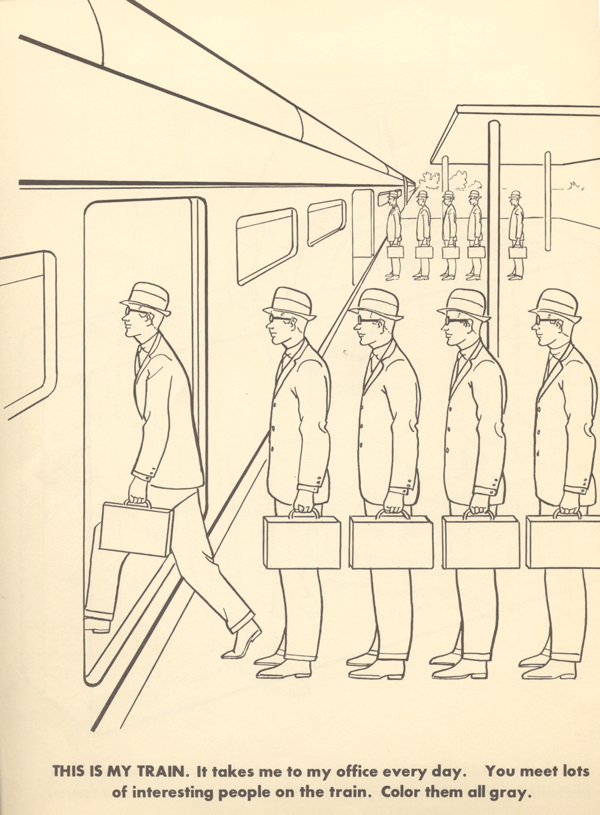
We are each products of the conversations we’ve had, whether with people, books or situations.
That’s why we keep changing.
###
Image credit: A Hole in the Head
Dialogue is a place
 Dialogue is a place. It’s a playground where humans come to teeter and totter, to swing and slide. It’s a geography—a verbal top-of-the-Foshay—where we suddenly see for miles though still sitting in a coffee shop talking with an old friend. Our best conversations become spots on the map we revisit for the rest of our lives.
###
Photo credit: Minnemom
Who shows up in your conversations?

show up for a few of your conversations today
There’s you. And your conversation partner. And since your discussion stumbled into talking about money, your Grandad showed up who always said “Save your money.” If you talk politics, some talking head from Fox shows up, or some voice from NPR joins in. You didn’t invite them. But you really did, because you heard them speak and absorbed their words as truth—at least until you repeat them aloud. Then you start to wonder.
Maybe you went to a funeral over the weekend and the widow shows up in your conversation, with what she said about her husband, your friend. And then your daughter shows up, because of the tiny gravestone she put over the mole you buried in the back yard ten years ago: “Here lies one dead mole.”
And sometimes even you don’t show up to your own conversations. And neither does your conversation partner. Because you’re both on autopilot and talking past one another as you walk past one other down the long hallway toward the coffee machine.
A good conversation is part mystery, part shining beauty, part toilsome information exchange—and frequently all three. But you need to show up.
###
Image Credit: Jay Fleck
Riot, Restart and Scrubbed Minutes: The Bradlee Dean Prayer
But really…what happens when someone prays?

Say more.
Last Friday Bradlee Dean gave the opening prayer at the Minnesota House. His words caused such uproar that Speaker Zeller apologized and had the prayer scrubbed from the historical records of the day. The session was restarted and Rev. Grady St. Dennis, the house chaplain gave the new prayer.
Was it a prayer Mr. Dean offered or was it a speech intended as a burr under the saddle of the gathered legislators? I don’t know all that Mr. Dean stands for, but his rhetorical mix seems misdirected. Yesterday I wrote about mixing an ancient form with something of today. In Mr. Dean’s prayer, the result from mixing an ancient form and using it as a rhetorical bully pulpit is repellent. The communication seems more speech than prayer, and seems to have been interpreted that way by the humans in attendance. And yet it is possible Mr. Dean was sincere in his conversation with God.
The notion of a public prayer is actually kind of complicated, and is perhaps a mix of forms from the beginning. One person speaks aloud. The person implores God’s attention and action. Perhaps the person seeks wisdom and mercy, or help with any of the myriad needs finite beings have. Listeners listen and agree. Or disagree. Rather than praying along and seeking the same things, the potential prayers in the House rose in disagreement shouted the guy down (figuratively, I think).
I agree with Rev. Dennis Johnson writing about the work of guest chaplains in saying “We have a special burden to include all people in our prayers….” But I’m not so sure about the last part of the quote in Lori Sturdevant’s op-ed: “…and to make the prayers nonsectarian.” Because real prayer must come from somewhere, some belief in God. It is true that belief in God need not highlight a specific brand of religion, but any prayer must be grounded in belief that God exists and hears—that alone will be offensive to some. Otherwise the prayer is just good wishes and positive vibes—not bad stuff, just not, well, real. And not that useful in seeking help from the Eternal.
King Solomon got the form right (1 Kings 8.22ff) and set a lasting example and practice. Of course, Solomon’s prayer was spoken among a set of like-minded people. So the context helps the prayer stay as a prayer: spoken to God from a bunch of people going a similar direction.
If we’re going to have prayer in the Minnesota House, there needs to be some elasticity in allowing people to pray for real. And people praying need to examine their intentions before uttering word one. But let’s continue the notion of conversing publicly with the Creator.
###
Image Credit: Buramai
Schwarzenegger, Total Recall and the Offspring of Error
How does sharing mistakes affect our relationships?

Sharing can be painful
Today’s shocking revelation takes the form of a ten year old child as part of the reason for Arnold’s impending divorce. It seems the Governator worked a bit too closely with the hired help. Not that the child is at fault—and I fear for the child’s unwanted celebrity status. And this: divorce and broken relationships are not good and no child should be hidden. But there are lessons to learn.
Recently in our Social Media Marketing class we discussed how sharing failure draws readers toward us. Failing at preparing a particular facial mask, for instance helps us sympathize with the beauty enthusiast. Negative reviews at a website help offset glowing reviews and hint that the positive reviews might not just be cherry-picked. Poised to buy some spendy item, we look closely at the negatives to balance the positives. On a personal level, sharing our failures has a way of redeeming our relationships and drawing others toward us, though who knows what that might look like for Mr. Schwarzenegger and Ms. Shriver.
One of the underlying themes as we move toward this social sharing world is that companies no longer control the monologue because the monologue is now a dialogue, whether they like it or not. Letting go of control will mean less pleasant communication about our product or service will certainly surface. The question becomes how we deal with those negatives. We won’t be able to play Terminator. Instead we’ll need to share our true lies.
###
David Lynch, Creepy Coffee and the Power of Suggestion
Your slowest four minutes today

Just stand me in a cup, please.
David Lynch, as famous for swearing off marketing (literally!) as he is for making powerfully unsettling films, has his own coffee brand. His marketing is, well, unsettling. But it is marketing (proof: I’m passing it on. Oy! I’ve fallen for his demented plan.)
A couple days ago I wrote about how the power of suggestion helps my audience show me mercy as I show them my dumb sketches even as they fill in the blanks with their own story. It’s the power of suggestion: we cannot help but begin a story with every image we see. Writers have known this for years: using certain words and phrases that hint at something much more ominous (or much more glorious) without actually saying it. Copywriters love this tool.
In this slow-moving commercial, listen for the pauses even as you listen for the words. I found myself remembering from the video how much Barbie seemed to like me (especially ~ 1:50). Then I remembered BARBIE IS A DISEMBODIED HEAD WITH DAVID LYNCH’S VOICE.
Where and how have you been affected by the power of suggestion?
###
Do a Dumb Sketch Today
Magnetize Eyeballs with Your Dumb Sketch
 As a copywriter, I’ve always prefaced my art or design-related comments with, “I’m no designer, but….” I read a number of design blogs because the discipline fascinates me and I hope for a happy marriage between my words and their graphical setting as they set off into the world.
But artists and designers don’t own art. And I’m starting to wonder why I accede such authority to experts. Mind you, I’m no expert, but just like in the best, most engaged conversations, something sorta magical happens in a dumb sketch. Sometimes words shivering alone on a white page just don’t cut it. Especially when they gang up in dozens and scores and crowd onto a PowerPoint slide in an attempt to muscle their way into a client’s or colleague’s consciousness. Sometimes my words lack immediacy. Sometimes they don’t punch people in the gut like I want them to.
A dumb sketch can do what words cannot.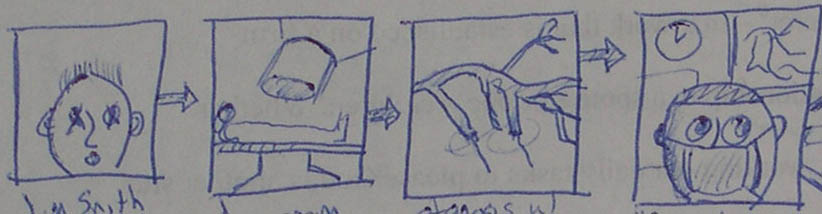
I’ve come to enjoy sketching lately. Not because I’m a good artist (I’m not). Not because I have a knack for capturing things on paper. I don’t. I like sketching for two reasons:
- Drawing a sketch uses an entirely different part of my brain. Or so it seems. The blank page with a pencil and an idea of a drawing is very different from a blank page and an idea soon to be fitted with a set of words. Sketching seems inherently more fun than writing (remember, I write for a living, so I’m completely in love with words, too). Sketching feels like playing. That sense of play has a way of working itself out—even for as bad an artist as I am. It’s that sense of play that brings along the second reason to sketch.
- Sketches are unparalleled communication tools. It’s true. Talking about a picture with someone is far more interesting than sitting and watching someone read a sentence. Which is boring. Even a very bad sketch, presented to a table of colleagues or clients, can make people laugh and so serve to lighten the mood. Even the worst sketches carry an emotional tinge. People love to see sketches. Even obstinate, ornery colleagues are drawn into the intent of the sketch, so much so that their minds begin filling in the blanks (without them realizing!) and so are drawn into what was supposed to happen with the drawing. The mind cannot help but fill in the blanks.

The best part of a dumb sketch is what happens when it is shown to a group. In a recent client meeting I pulled out my dumb sketches to make a particular point about how this product should be positioned in the market. I could not quite hear it, but I had the sense of a collective sigh around the conference table as they saw pictures rather than yet another wordy PowerPoint slide. In fact, contrary to the forced attention a wordy PowerPoint slide demands, my sketch pulled people in with a magnetism. Even though ugly, it still pulled. Amazing.
###

 conversation is an engine