Posts Tagged ‘God’
Pray Like You Talk. Talk Like You Pray.
How to be.
 Back when I was newish to this notion of pursuing reunion with the Creator, I began to wonder about prayer. Was it just a kind of thick wishing; full of detail and electric longing, uttered into the silence? The practices of prayer remain mysterious to this day, but way back then my buddy said something I’ve never forgotten:
“Look. Just pray like you talk. Simple stuff. Forget the impressive words. Just talk.”
That proved useful. It still makes sense to me today.
Prayer is an articulated event. A speech-act that causes things to happen out in the world—though not exactly the way you might hope. This is what people who pray believe (people like me): that by talking to the One who controls everything, laying out the case, and leaving it there, stuff starts to happen. Of course, dictation and demands are fruitless. So are bargains. Prayer doesn’t work that way—it’s not exactly a reciprocal relationship.
But what if my friend’s advice worked the other way too: what if that easy conversation full of detail and electric longing was a part of our daily, hum-drum human conversations? So rather than utter desire into silence we uttered it into relationship? That does not sound like wishing into the silence. People would be listening—the very people right around you. They would hear. And sympathize. Or challenge. You’d get known. Your peaks and valleys would be known. There would be no hiding. If our talk were like our prayer, there would be a measure of freedom, and a whole lot of assumptions about the level of interest in our conversation partner.
No. Now I see that would never work.
But. Wait—that characteristic of being known is a peak human experience. What if we were designed for that very thing?
That would be something.
###
Image Credit: Kris Graves via Lenscratch
Just How Bad Were You?
 When I was a kid going to church, there was a lot of excitement generated around the story of how you came to faith. Being a good kid (in the generalized sense of comparison to people, but not in comparison to God, you understand), I didn’t have much of a story. In conversation with friends once, we lamented not having amazing from-the-pit-of-hell stories. We were convinced that was the whole essence of Christianity—that story of how you were a junkie/homicidal maniac/generalized ass but now you are a teetotaler/upright citizen/polite human of seeming different coinage.
It wasn’t until years later I realized that conversion story was only one small story that became a kind of exploded view in my church culture. We encouraged it to show the difference our faith made—sort of like baiting the hook. Our church was constantly inviting others in and we thought this was why they would come. But once in—then what? Life as usual, I guess. We seemed to drop the topic or just worked on becoming more polite and avoiding being a self-righteous ass. (I generally failed at this).
We seemed not to know what to do beyond inviting and converting. There was no place in our theology for the wisdom of God to penetrate into our work relationships or to investigate story-telling in art and theater and music. Those were off-base tools of the dark lord. I never heard about boldly moving forward in faithful work.
I thought of this after reading the Coracle Journeys post on beauty and seeing again that old emphasis on witnessing. I’m not against witness, in fact I’d like to take the word to rehab along with fellowship and strategy. But life is a fully-orbed thing, not a single set of words that when uttered complete you. Life is full of gifts to give away out of crazy chesed to any and all—just like God does it.
Think about that as you go to church today, and step out of the straight jacket and into the sprinkler.
###
Image Credit: marina molares via 2headedsnake
How to Sap Energy & Steal Creativity: “Just Execute”

Don’t think. Just do.
A talented strategic friend chatted with the vp of marketing at a medtech startup. What was the company looking for in their posted marketing hire? They just wanted someone to execute. Just execute? My friend was floored. You want to hire someone and not use their entire brain? You want to disengage the emotion that arises from thinking through a problem? You have such knowledge of the market, you’ve considered every angle, you know all there is about your target audience, you are so confident you don’t need anyone else thinking this through? Or—was the pressure so great to show results that they could not waste time on strategy. Either way, the entire conversation pointed out this was a company to avoid.
“Just execute” is corporate bully language for “Do it because I said so.” Nearly every human benefits from knowing the “what” and “why” behind an order. And even God entertained modifications to His plan while Moses verbally worked through the mission as they chatted around the burning bush.
Don’t misunderstand: there is absolutely a place for “just execute.” Stuff gotta get done. Yes. But long term, stuff gets done much more effectively when we enlist whole people to work with us. And that means bringing people along with us as we process our mission. Just say “No” to the smoky backroom where highly paid C-suiters work out the details and then send a courier with decrees out to the rank and file.
This authoritarian tendency looks even worse in a volunteer organization like a church. Because money is not a factor there—it’s all about feeding motivation. Avoiding rich conversations about “why” short circuits the process and makes whole people flee.
Whatever your position, do yourself and your organization a favor by helping people see the big picture. Helping them form and reform and personalize the big picture. Whether you are a manager, a volunteer coordinator, a pastor or lead worker on an assembly line. This is what leaders do.
And know this: Those who won’t share or budge on the big picture will not attract or retain talent. But they will find themselves starting from scratch again and again.
###
Image Credit: C-front
Start Anywhere Not Over
Starting over, would you do it different?
Today’s project? This job? That relationship? This marriage?
Looking back, we all see some things that would benefit from a shift in approach.

I was recently talking with a new college grad in a job with significant responsibility. He wants to do great work, but the immense pile of work before him and the fast pace environment seem to conspire against ever feeling caught up, letting alone doing the exceptional stuff he did in college. I recognize lots of friends and clients in this same spot. Most of us have been there or perhaps that is our permanent home.
But if you started over, you’d do things differently.
Really?
Some things. Perhaps. But those old patterns are woven deep into the fabric of our approach to any given day. Starting over may not have the cleansing effect we hope for. There are no easy answers to managing your time to do great work. Saying “No” to some work and “Yes” to other work is part of the solution. Learning to focus and keep distractions at bay is another piece. Lots of people have lots of advice for how to deal with this and much of it is quite good. Seth Godin distributes advice like this every day. Free. His “The Dip” is all about when to quit and when not to.
Training Day
Maybe the pressures we face today or this year have everything to do with the direction we need to grow. Maybe the pressures we face are part of how we are to be shaped right now. I’m fond of an old dead poet/king/dancing machine. In this particular ancient text of his, he offered that the troubles we find ourselves in have a disruptive quality designed to help us look again for balance. And balance is found in a deepening alignment with, well, God. Whether in today’s project, this job, that relationship and especially this marriage. This poet had strategies for his pursuit. Those strategies make sense any time we’re wondering whether we should just start over. And his strategies make even more sense if we’re trying to figure out how to pick up just one piece right now. Right in the middle of the pressure—which piece can I start that will unravel this tangled mess?
Before you start over, start anywhere.
###
Image Credit: via thisisnthappiness
I Wish More Churches Observed This Convenient Fiction: Outsiders Are Among Us
Outsiders seeking truth won’t settle for bland spirituality
 Our church is at its best when we say to ourselves there are people here kicking the tires of Christianity. I think it can be true, but in the church I attend, I rarely meet anyone who has not already bought the car. Still—don’t we all keep kicking the tires?
Saying there are outsiders lets us drop the clichés and insider language. It lets us jettison the assumptions about being good or put together. It makes us all a bit less stodgy and a bit more honest. Even the most deeply devoted person keeps thinking through the issues of her or his life where they are still kicking the tires: can I trust God in an economy that keeps swirling in the toilet? Or to guide my grown-up kid to make good choices? Can I still trust God when (perhaps) more years lie behind me than before me? Life constantly changes, of course. There is always more living than there is faith to meet the next challenge. But then we watch together for how God intervenes even with faith to move forward.
I like boiling down clichés and disposing of the club mentality that insider language inevitably fosters. But this is not the same as the traditional understanding of seeker-sensitive, where actual content is tossed aside in favor of a bland spirituality. No, Christianity has some barbs that are difficult to understand and hard to come to peace with. The key is to present the barbs honestly and admit we struggle with them too. All while hearing regularly from the ancient texts that have always informed the church. That is a text that speaks to any outsider willing to listen–and is the time-honored antidote to bland spirituality.
###
Image Credit: Max Streicher via 2headedsnake
Church Scattered Looks Different From Church Gathered
But it is still the Church

what of the church scattered?
I’m starting to wonder about the church gathered and the church scattered. When gathered, the church is governed by the authoritative voices elected/appointed that would seem to speak to/for the entire body. Pastors, associate pastors, sub pastors. Women pastors purposefully not called pastors (in the great Evangelical tradition of shell game authority).
But the church scattered…what of that? Are the pastors/elders still in control? Not hardly—the church has reconvened out in their work places where the docile congregation morphs to serfs, middle-managers and captains of industry. With varying levels of ability, authority, autonomy and knowledge. The church is dispersed like clockwork every Monday and there is no stopping that. What is the goal of the church when not gathered? The same: to display the manifold wisdom of God, as the Apostle Paul said. And perhaps the social chirps from the pocket (the Tweets received, the prayers sent by text, the blogged thoughts and updated Facebook statuses that indicated relationship) enhance the scattered church’s connections and saltiness out in the world.
The mission when gathered is to whoop it up over the God of the universe and the truth about Him letting us know Him. And to help each other grow in knowing God. The mission when scattered? Like oil in gears, or salt on food, or light scattering cockroaches on a dark floor: individuals act out the presence of God in direct contact with the corrupted and corrupting stuff of everyday life (which is to say, the human condition).
The church industry spends a lot of time working on and directing the gathered piece. But the scattered piece gets less attention, though there is a kind of osmosis assumed to be at work, where the context of church gathered gets translated to church scattered. But it’s always been up to individuals to sort that translation out.
What do you think? How is the church scattered different from the church gathered?
###
Image credit: Michael Jantzen via 2headesnake
Big Church
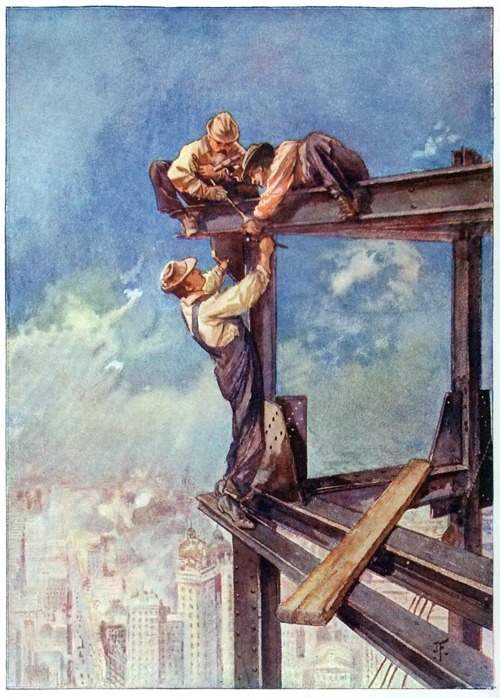
big church extends deep into the work week
There are big churches—but this post is not about large buildings and lots of people. There is the political big tent, which tries to draw together all sorts of people with diverse viewpoints. There is the Big Ten and the big top and the big bang theory and the Big Gulp—from which Mayor Bloomberg wants to save New Yorkers. This post is about none of those, though perhaps Big Bang is closest.
This post is about Big Church.
It’s not about size so much as messaging. Not about authority so much as a disbursing of gifts, talents, passions and mission. Not about one person’s vision and that person’s ability to pull others with him or her so much as it is about a silent listening of many to One, and each responding in kind.
Sometimes we need to state what something isn’t to figure out what it is (a kind of apophatic attempt, you might say).
I’m stuck on a quote from an old dead guy who wrote letters trying to help his readers recognize the big church already at work among them. I wrote about a couple of this guy’s quotes here, and I’ve started with all the “this is not’s” because I’m convinced we mostly don’t see what this old dead guy was saying. That is, we don’t see it, though it is there and vibrant and alive in ways that are still largely invisible to us.
Big church is an entity that communicates persistent care through all its parts. We may think the pastor is the voice of the church, but that’s not so. The pastor is one voice. But the voice of the church looks like words and action. It looks like words and action that extend deep into the work week, far beyond Sunday morning. Big church lives out a redemptive message while embedded in culture and work and relationship. And big church is constantly inviting. But not inviting to a place or a political party. Or to put on a narrow (or wide) filter. Big church invites people into relationship. And it invites people already in relationship to go deeper.
All this because the individuals who comprise the big church routinely step out of self-created subcultures—we’ve done so for centuries—as seasoning for the broader culture. Stepping out carrying God’s passion for other individuals, in all the many ways God has in mind. Big church seamlessly folds in “together” and “apart.” That’s why church is big. And certainly much bigger than a place you go for an hour on Sunday.
###
Image Credit: OBI Scrapbook Blog
Going to Church Today? Consider This.

expect a conversation that will help sort things
Probably someone will speak to the group—that’s typically what happens. And there will be singing. Prayers will be offered. You’ll shake a few hands. Maybe you’ll learn something new. Maybe you heart will be lightened. Your load lifted.
If heart-lightening or load-lifting happens, stop and think why. Was it because of magic words spoken from the pulpit? Not likely, as there are no magic words. But there are words that find a home in a person’s conscious thought and get absorbed there to do some work. One of the tests the old church fathers used to determine if a letter or text should be included in the Canon (our Bible today) was whether it had the power to change people—did the text speak with authority into a people’s lives? Did something happen because of hearing the text? When those old words get uttered from the pulpit today—they are not magic—but their truthiness has sticking power.
Just as likely: you meet someone who says something that affects you. Makes you think. Makes you reconsider an impending decision. And perhaps that same heart-lightening or load-lifting occurs. Sometimes we meet people who speak truth and it has the same effect.
And consider this: perhaps you go into that time expecting to hear something. What I mean is, sometimes we move into a situation actually expecting to hear something that could have the power to change how we think or act. You might call this listening. Or attentive listening. Or attenuated listening. Or listening on steroids. But whatever you call it, this is the most productive penultimate approach: listening with expectation. Then you pick up the tasty truthiness from any source.
###
Image credit: Douglas Smith via 2headedsnake
You’re Soaking In It—Creative Unresolve and the Good Life
The issues that roil your nerves and kick you in the gut may be instrumental in pushing you forward.

let creative unresolve lead you forward
A few days back I wrote about sitting with unresolve as long as you can, as one method for producing creative ideas. John Cleese had a few choice words on the topic. After talking about this in class and listening to Mr. Cleese and experiencing it afresh with my own writing, I realized a couple of ancient voices had been swarming around, punching me in the face with this very point—only applying it to the rest of life.
One voice is a warrior-poet. Aside from being handy with a lyre and deadly with a sling and stone, he had a very lucid and descriptive (often prescriptive) way of asking God to do terrible things to his enemies. And yet, though he often had the power and opportunity to take action, he didn’t. Instead, he turned from the shortcut, obvious solution and waited. We all know that waiting for God seems to take longer than anyone likes.
Same thing with another Old Testament character—Habakkuk. He saw bad stuff coming (a brutish band of thugs coming to decimate his homeland) and decided also to fix his attention on God. And wait.
Something happens when we wait. Sometimes we can fix things in life right away. Often we can’t. So we wait. And just like when we’re working through a creative solution to a thorny business or communication problem, we sit with unresolve and let the discomfort itself push us forward.
Same thing with life. We wait and seek and wait. And–this may be most critical—we reach out. We reach out when things are not right with us. And reaching out is nearly always worthwhile. Reaching out looks like a phone call. Reaching out looks like an email. Like prayer.
Some students from my copywriting class are graduating. Everyone says it’s a low-energy job market—difficult for the job hunter. I sympathize. To these graduates I simply offer the notion that your creative unresolve can lead you forward into networking, conversation and, yes, to reach out in prayer.
I still maintain that the best stuff in life happens in and through the choices and actions made directly from chaotic, creative unresolve.
###
Image Credit: itchy banquet via thisisnthappiness
Copywriting Tip #4: Speak Truth to Profits (Dan’s Story)

ancient copywriters rocked
I’m fond of a particular collection of ancient texts. One tells the story of a copywriter named Dan. Dan’s client was all-powerful and routinely dismantled (sometimes literally) those who did not do exactly as he asked. This client never hesitated making impossible requests and had no problem forcing his teams to guess his mind.
Dan was an employee who had been groomed and mentored and specially-trained for leadership. And yet Dan retained a commitment to the recognition that even his abusive, ill-tempered, seemingly all-powerful employer had to answer for his actions and did not have as much control as he liked to believe. This perspective had been shaped early in Dan’s life by his large, extended family.
Dan’s understanding of life held sway over his work. And while he was dedicated employee, he had committed himself to write truth, no matter the cost. This put him in a bind when it came to this client, because this client’s wealth and power routinely corrupted those around him, so most everybody told the despot exactly what he wanted to hear.
The story goes that one gruesome assignment forced the entire team to guess what the employer dreamed and interpret that dream. Or be dismantled. Of course no one could do it, and so they said. The employer force the point and the team prepared to be dismantled. Dan heard of the impending mass dismantling and he and his buddies thought they better act on their understanding that even the king answered to God. So they prayed. That’s right, this is a story of a copywriter who conversed with God so he could do his work better. Dan would often point to these conversations with God when people praised his insights.
And he did get insight. From God. It was not an insight that put the employer in a good light, but Dan told it anyway. And everyone lived another day.
The Moral
Truth matters more than appeasing the abusive despot before you.
And This
The copywriter’s work has always been about providing insight into the soul of a client and the heart of a client’s audience. Get help with that.
###
Image credit: Douglas Smith via 2headedsnake:

 conversation is an engine
