Posts Tagged ‘marketing communication’
David Lynch, Creepy Coffee and the Power of Suggestion
Your slowest four minutes today

Just stand me in a cup, please.
David Lynch, as famous for swearing off marketing (literally!) as he is for making powerfully unsettling films, has his own coffee brand. His marketing is, well, unsettling. But it is marketing (proof: I’m passing it on. Oy! I’ve fallen for his demented plan.)
A couple days ago I wrote about how the power of suggestion helps my audience show me mercy as I show them my dumb sketches even as they fill in the blanks with their own story. It’s the power of suggestion: we cannot help but begin a story with every image we see. Writers have known this for years: using certain words and phrases that hint at something much more ominous (or much more glorious) without actually saying it. Copywriters love this tool.
In this slow-moving commercial, listen for the pauses even as you listen for the words. I found myself remembering from the video how much Barbie seemed to like me (especially ~ 1:50). Then I remembered BARBIE IS A DISEMBODIED HEAD WITH DAVID LYNCH’S VOICE.
Where and how have you been affected by the power of suggestion?
###
Do a Dumb Sketch Today
Magnetize Eyeballs with Your Dumb Sketch
 As a copywriter, I’ve always prefaced my art or design-related comments with, “I’m no designer, but….” I read a number of design blogs because the discipline fascinates me and I hope for a happy marriage between my words and their graphical setting as they set off into the world.
But artists and designers don’t own art. And I’m starting to wonder why I accede such authority to experts. Mind you, I’m no expert, but just like in the best, most engaged conversations, something sorta magical happens in a dumb sketch. Sometimes words shivering alone on a white page just don’t cut it. Especially when they gang up in dozens and scores and crowd onto a PowerPoint slide in an attempt to muscle their way into a client’s or colleague’s consciousness. Sometimes my words lack immediacy. Sometimes they don’t punch people in the gut like I want them to.
A dumb sketch can do what words cannot.
I’ve come to enjoy sketching lately. Not because I’m a good artist (I’m not). Not because I have a knack for capturing things on paper. I don’t. I like sketching for two reasons:
- Drawing a sketch uses an entirely different part of my brain. Or so it seems. The blank page with a pencil and an idea of a drawing is very different from a blank page and an idea soon to be fitted with a set of words. Sketching seems inherently more fun than writing (remember, I write for a living, so I’m completely in love with words, too). Sketching feels like playing. That sense of play has a way of working itself out—even for as bad an artist as I am. It’s that sense of play that brings along the second reason to sketch.
- Sketches are unparalleled communication tools. It’s true. Talking about a picture with someone is far more interesting than sitting and watching someone read a sentence. Which is boring. Even a very bad sketch, presented to a table of colleagues or clients, can make people laugh and so serve to lighten the mood. Even the worst sketches carry an emotional tinge. People love to see sketches. Even obstinate, ornery colleagues are drawn into the intent of the sketch, so much so that their minds begin filling in the blanks (without them realizing!) and so are drawn into what was supposed to happen with the drawing. The mind cannot help but fill in the blanks.

The best part of a dumb sketch is what happens when it is shown to a group. In a recent client meeting I pulled out my dumb sketches to make a particular point about how this product should be positioned in the market. I could not quite hear it, but I had the sense of a collective sigh around the conference table as they saw pictures rather than yet another wordy PowerPoint slide. In fact, contrary to the forced attention a wordy PowerPoint slide demands, my sketch pulled people in with a magnetism. Even though ugly, it still pulled. Amazing.
###
What Didn’t You See Today?

pylon of the month
pylon of the month
Giant Metal Men Matter
Have you noticed the gigantic metal men standing in your neighborhood? One’s over there, just above the tree line. Enormous and sinister. Sort of hulking at around 100 ft. tall. What’s that–you’ve not noticed it? How could you miss it, standing there in the wide open? Your kids saw it and have already made up stories about it: why it’s there and how it could reach down and grab anybody at any moment so let’s not spend too much time beneath it.
Electrical pylons are just one of the things we miss as we walk or drive around our city. They only become visible when someone shows you. Then you see them. Your eyes probably registered the shape and presence, but somehow the tall tower did not enter your consciousness. You needed someone to point it out—not that you particularly care about pylons. Same with people: do we even notice the janitor cleaning the corridor at the airport or the clerk at the grocery store? We are trained to have these people blend into the background, just like the pylons. Just like the homeless guy at the stop light on Hennepin and Lyndale. It makes our life easier—less to deal with—when we don’t see these things or people.
How much we are missing when we tune out stuff we don’t want to deal with?
One of my clients is trying to help a particular set of physicians tune in to a class of patients that are largely unstudied. These patients present with certain features in their heart that routinely exclude them from pharmaceutical and other clinical trials. The conventional wisdom is that the outcomes would be significantly worse if these patients were included. So they aren’t. It’s a kind of research Catch-22.
My challenge this week is how to help these physicians see these patients. These patients cannot be treated until they are seen. Which is true for all the invisible stuff in our lives: we can’t deal with it as long as it is out of sight.
More on pylon appreciation: Alain de Botton from The Pleasures and Sorrows of Work.
###
How Could this Book be More Interesting?
I’m about to go fishing with my Listentalk book proposal (via www.ChristianManuscriptSubmissions.com). How could I make the summary (below) more interesting? Be honest. People respond to these posts by email, on Facebook and occasionally right here at “Engage.” Vent your spleen. I’m listening.
 Listentalk: How Simple Conversation Changes Your Life Every Day
Why does one conversation make you scan the room for escape while the next sends you breathless to register to run a marathon—though you hate exercise? Listentalk: How Simple Conversation Changes Your Life Every Day shows how humble, mundane conversations have the power to turn our life direction every single day, by:
- Reminding us of the pivotal conversations that have shaped and sculpted our own lives. Like the chance comment to your 18-year-old-self from an acquaintance about a “school you should check out,” which sent you a direction that ended in law school, marriage and being appointed as a judge (true story).
- Showing how God purposefully composed the human condition so that while we are limited, we are limited together. Conversation has a way of bumping out our human limitations in extraordinary ways, so that my lack of understanding leads to a discussion that sheds light on a key topic but also opens an opportunity to pursue the work I love.
- Exposing the component parts of listening and talking so we can better understand how God speaks to and through us
- Providing practical insights into how we can listen and speak for powerful good every single day—including wise use of social media
Today’s incendiary and vitriolic talk leaves people feeling weary and soiled. Listentalk refreshes Christian adults, Sunday School classes, small groups and college students by reminding them of the wonder, curiosity and serendipity that have been part of the deep verbal connections that have shaped their lives. These deep connections have often sprung from the unlikeliest of mundane conversations.
Listentalk tells stories of conversations that both suggest and model an extraordinary set of expectations and outcomes for ordinary talk. Listentalk helps people see verbal, visual and other-sensory conversational episodes as the powerful shaping tools they are—and provides suggestions for making them even more powerful. Unlike possibility-thinking, self-help books, Listentalk is grounded in the nature and actions of the conversing God of the Bible who expected and realized world-changing outcomes from each conversational episode. Listentalk frees readers to see daily conversation in a very different light by inviting readers to reach out in trust to each day’s conversational partners—an ever-expanding set of partners due to changing attitudes (about communication, authority and the loss of gatekeepers) and developing technologies.
Listentalk offers a primer on navigating the growing social media space as redeemed conversational partners. Creating communities of target audiences is the new marketing strategy. Leading public conversations by reaching out with dialogue that gifts and blesses is not only supremely Christian, but supremely strategic.
###
Oh to be an Introspective French Firm.

People have conversations. Do companies?
On Tuesday the head of France’s national railroad apologized for trundling 20,000 Jews to Nazi camps in 1943-1944, as reported by the NYTimes and carried locally by the StarTribune. US Lawmakers, survivors and descendants had moved to block SNCF from winning US contracts had the company not acknowledge their role. The official word from the firm said the apology was part of “the company’s longtime effort to examine its past and denied that it was prompted by the company’s U.S. ambitions.”
There are at least three striking things about this story.
One: It defies logic to disconnect the company apology from looming loss of revenue from possible US contracts. To insist otherwise cheapens their communication. One clearly connects with the other.
Two: Applying economic pressure to force a company to tell the truth about their role in administering a great evil is a marvelous use of our capitalist instincts. There is a fair amount of both optimism and boldness in this move, especially since official spokespeople nearly always sidestep words that link their brand with anything other than blue sky, sunshine and happy smiling faces. Bravo, lawmakers, survivors and descendants!
Third: To think that a company has a “longtime effort to examine its past” strikes me as, also, beyond belief. Companies incorporate for economic muscle. They organize to move forward, they look for opportunity, hone in and exploit. Companies make money. Companies don’t sit at an outdoor café examining past failings. I’m hard-pressed to think of any introspective executive who would free a budget line item for “Company Introspection.” Please, please let there be such a leader in this world. But maybe French companies have a soul?
###
Sometimes a Conversation is an Image
We Act Out What We Cannot Say
There are moments when we are open to listening. These moments may indicate we are open to change as well. People have been telling me their stories about conversations that changed their lives. Sometimes an inconsequential conversation at an inconsequential time can make all the difference in the world.
Louise Bell tells of a moment, not exactly a conversation but an image, that changed her life. Years ago her African-American grandparents had been murdered in the most gruesome way over an act of mercy on their part. Justice had not been accomplished in their murder and the wound was deep. It was when Louise mother died, after moving back to the south with an interest in reconciliation, that this moment occurred.
Listen to the December 30 edition of The Story over at American Public Media. It’s in the second half of the show.
###
Please, Back Away from the Controller.

It’s about interest, not control.
It’s not like you can just adopt this new channel, buy space and you’re good to go.
It’s more like learning to be a friend again. I described the equivalent of “winning the lottery” in a dialogue-based medical device marketing context, but Seth Godin takes the next step with his Tribes: We Need You to Lead Us. Instead of focusing on the tools of social media we all find so interesting (or not), he posed the provocative question “Who is it we should be leading?” His question presupposes this inward-looking beginning point for any who care to begin dialogue: “What change am I passionate enough about to lead?”
I like that Godin helps me see that the coming dialogical world is much broader than today’s set of bloggy-twittery-searchable tools. The questions we ask when moving from monologue to dialogue have more to do with what we all care about together. Finding what we care about together is a necessary stop on the journey. And knowing what we care about together is a step beyond carefully controlling the conversation with fine-tuned messages.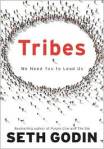
What we care about together as humans has always been different from the one-dimensional messages with which we’ve surrounded our product messages. The secret to dialogue is what we learned years ago when our first friend showed up that summer day: we look for common interests. We expect give and take, and a willingness to hear and try something new. Friendship is formed when we stop claiming to know all the answers. Inviting marketers to rethink friendship is a step toward dialogue and a step away from monologue. Inviting marketers to find their place of leadership within friendship and within dialogue is a step toward freeing them to be the leaders they secretly want to be. The tribe-formers we need them to be.
###
Medtech Using Social Media #5: Winning the Lottery

Our conversations help individuals lead groups forward.
Working on a client’s factory floor yesterday, I heard a guy describe how his troubles would be over if only he won the lottery. It’s a common enough thing to say and I’m sure we all think it from time to time. I happen to think winning the lottery would be more like trading one set of problems for another. Without the life disciplines that build on any skill (including making money), without a bit of thankfulness, suddenly receiving lots of money may not change all that much about a person’s life. Maybe for the moment more expensive toys enter the picture. But without discipline, the money eventually runs out and even larger debts take their place.
In marketing communication, just like in every other area of life, we search for the perfect tool that will solve everything. The perfect strategy of engagement. The perfect ad or the perfect media buy. The perfect social media tool. But deep-down we all know that perfect tools don’t exist. Or perhaps the perfect tool for the job does exist, but it gets corrupted when interacting with us.
The vision for engagement using these new social media tools is a vision for engaged contact with a group of people who believe in what you are talking about because you are talking about what they believe in. The vision is precisely not sharpening the perfect tool for the perfect kill (that is, the perfect sale, or the perfect implantation of our message in some consumer’s brain along with the instruction to “Buy!”). And even though lots of folks are—for the moment—listening to the social media channels, with Twitter and Facebook making headline news daily, newer channels will arise and suck away attention. The enduring lesson is that we all do better when we talk things through—no matter what technology enables that talk.
The equivalent to winning the lottery for a medical device firm using social media is a group of committed friends, colleagues and fellow-travelers making a journey together. It is a group where questions are shared as freely as answers. It is a collection of conversations where your brand is given legs and flesh as the brand promise works its way out through conversation after conversation. Winning the lottery is about building a fierce loyalty along the way.
###

 conversation is an engine