Posts Tagged ‘Nicholas Carr’
Try This: Wait
Waiting has a silver lining: breathing space

but remember to breath
Years ago my wife and I met friends living in a developing country. We hung around for a few days to see what life looked like. Turns out life looked like lines. Long lines. Hours to pay an electric bill in person. Hours more for the water bill. This country was known for layer after layer of bureaucracy to handle the red tape, so the lines kept people employed even as they drove me crazy. I wondered aloud how my friend could stand it—especially knowing he tended toward a Type A personality who relished getting things done. He said, “That’s just the way it is.”
It’s hard to see any benefit in waiting. We work hard to eliminate waiting every day. I pull ahead of drivers focused on phone conversations rather than the road. I seek out the shortest line at the grocer. I click elsewhere when a web page loads too slowly. I don’t like waiting. I bet you don’t like waiting.
But my friend used his waiting time wisely. There was no plugged or unplugged then. Unlike today when most people waiting are looking into a screen, he brought a book. He prayed. He talked with people in line. My friend was a smart guy (still is) and he made a lot of connections between different parts of life. He ran a printing business, started a college and a home for families whose children were in the local hospital—even as he waited in long lines for the business of everyday.
Two recent books advocate intentional unplugging from the web, if only for short times: The Shallows by Nicholas Carr and Hamlet’s Blackberry by William Powers. Both books look at the effect of a mind crowded with stimulus and hint at what might happen with a bit of mental breathing space, which is a kind of waiting. Waiting is also a time-honored means of reflection and forward-movement in the Bible. I just finished reading the book of Psalms and saw how author after author waited for God to do something. They prayed. And they waited. And they watched (and waited).
Waiting comes with the capacity to sharpen our interest, our eyesight and our appetite. Waiting also has a purifying effect on our long-term goals. We become more realistic as we wait (or perhaps we become more insistent). But know for certain that something will change as we wait.
I’m working at waiting. Today I’ll look for an opportunity to stand around and wait. It will be hard to not pull out my phone with its checklists and documents. But waiting may allow me to connect the dots in a fresh way.
###
Photo Credit: We Love Typography
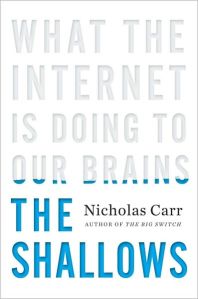
“The Shallows: What The Internet Is Doing To Our Brains” by Nicholas Carr
 Maybe a Break is in Order
We can do research, entertain ourselves, communicate and think without the Internet, of course. It’s just that the addiction-like rewards of constantly seeing something new—along with the web’s ubiquity (given our groovy gadgets)—keeps pulling us back. Again and again. Carr’s book makes at least that point. One surprise is how plastic even the adult brain is (no one’s brain ever stops growing and adapting it seems). Combine that plasticity with the very old argument that the tools we use, while extending our reach and ability, also subtly limit us (make that “self-limit” because we naturally begin thinking of what we can do in tool terms), and you’ll understand the basis for Carr’s argument. What’s fascinating in the book is the conversations he has with himself and with a variety of authorities and thinkers about how and why we love the clicking life of the finger.
Carr’s much-reviewed book really has started a number of conversations among people who care about books and publishing, as well as among folks just curious about how we think and communicate. Carr builds a strong argument for taking a closer look at our own habits and even to consider taking a break from our 24/7 connections and the mesmerizing screens.
At least that was my reaction: to begin to take intervals of internet silence (small intervals—let’s not get carried away). As far as experiments go, that’s a good one, because if nothing else, the interval is perspective-producing (if uncomfortable). Carr described his own withdrawal from constant connection in a move he made from NYC to Colorado in terms that would put any junkie at ease.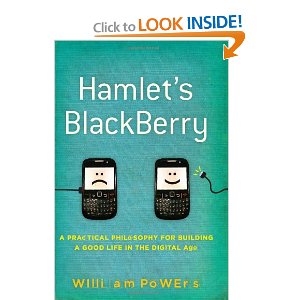
I’m preparing a class on Social Media Marketing and The Shallows, plus Hamlet’s Blackberry A Practical Philosophy for Building a Good Life in the Digital Age by William Powers (which I’m reading and enjoying now) both provide a useful counter to the always-connected expectation. There is something refreshing about an hour or two of focus on a single task.
###
I Quit You, Right-Hand Page Beginnings
I might stop printing. But you’ll have to pry transitions from my cold, dead hands.

"...from my cold, dead hands...."
I’ve been doing things differently without realizing it. For over twenty years I’ve inserted a blank page at the end of sections and chapters so my next section or chapter can begin on a right-hand page. I admit to finding a certain elegance in beginning a new thought on the page lying flat before me and close to my right hand. It just felt right.
No more.
Most of the documents I produce for clients will be used electronically. Few even consider printing them because, well, why would you? Since the screen is always there…and since paper just gets lost anyway…and since as soon as you print something, it changes and your print is outdated…so why print something again? Current audiences will not realize how a right-hand page lies flat on a surface while a left page bubbles up and distorts—an open invitation to move forward.
It’s not just blank pages. Transitions are transitioning away. Remember when transitions were the thing: when you wanted to gently lead your reader from one topic to the next, from one moving part of your argument to the next? Some writing textbooks still talk about making transitions in your writing. But are the days of transitions—just like the days of inserting blank pages—are swiftly passing. Since everything is modular we expect to jump from topic to topic rather than be wooed along.
Nicholas Carr in The Shallows talks about the atomization of information. How books and chapters and articles are already being dismantled so pieces are available here, there and everywhere. People writing books with the help of social media use the situation when they post as they go, so potential reviewers have the opportunity to interact with the writing long before it is even put in the longer (and more expensive book form). One of the dangers is that writers will write for short attentions spans—wait aren’t those people called bloggers and copywriters?
In truth, writers have always written for short attention spans. Back when reading books was the thing smart and interesting people did, writers talked about the reader’s constant pressure to walk away from the text. That was a key motivation for the writer to make the text more interesting. In my writing classes we often lament the lack of readers (in general) and the reader’s constant temptation to click away from the text. Clicking is so much easier than walking.
Blank page insertions may go away, but I doubt transitions will. That’s because communicators still have an innate need to keep an audience interested. Blank pages may be an artifact from the printing days. But transitions are a piece of our humanness that is alive and well and will stick around until our final…transition.
###

 conversation is an engine