Posts Tagged ‘photography’

Start at the Top. Again. (Copywriting Tip #10)
Tell Yourself the Story
Imagine holding a long piece of tangled fabric. You hold it high above your head because you want gravity to gradually unravel the twists and tangles. Maybe you shake it. Probably you smooth it out: starting at the top again and again and work your way down the length to get the fabric straight or flat.

Many threads to unravel.
What works for fabric also works for a complicated idea. Sometimes the only way to unravel a complicated topic is go back again and again to the beginning, flattening and shaking out the twists and turns as you retell the story.
I’ve recently finished up a complicated article about our changing health care system. The article had lots of moving parts. It was not a long article, just dense and in need of translation: from jargon-filled, industry-speak to human.
Time and again I found myself stuck in the middle and staring at the screen: so many bits and pieces to fit. Absolutely stuck and wondering how to line these parts up so they make sense (and so they are sorta interesting for the target audience). Because in the end we read one word after another. We read in a linear way, even though the story may compose itself in our brainpan in non-linear chunks.
The only way I could get myself unstuck was to start at the beginning again. Back to that very first paragraph, and work my way through. Sometimes I would modify that paragraph to fit what was next. Sometimes I would modify what was next to fit the lede. But the only way forward was through the beginning.
During National Novel Writing Month I found myself doing this, mostly as a way to find out where the story was going and how it could possibly move forward. It was a way of telling myself the story hidden in the words already written. There are one thousand ways to write the story and some will present as we retell it to ourselves. And so we pick one.
Sometimes retelling the story again and again is the only way forward, because it leads to understanding:
By the way, a wonderful book about locating the story of your own life is Parker Palmer’s Let Your Life Speak. Check it out.
###
Image credit: Kirk Livingston
George Saunders: How do you energize someone?
Sometimes it will be a word.

Bright bits among the ordinary.
George Saunders, on the odd little Zen parables he heard growing up. Told for laughs, they also carried deeper hints about how to live and what is important in life:
My whole childhood we lived next door to this family I’ll call the Smiths. We didn’t know them very well at all. At one point, Mrs. Smith’s mother, who was in her nineties, passed away. My dad went to the wake, where this exchange occurred:
Dad: “So sorry for your loss.”
Mrs. Smith: Yes, it’s very hard.”
Dad: “Well, on the bright side, I suppose you must be grateful that she had such a long and healthy life.”
Mrs. Smith (mournful, dead-serious): “Yeah. This is the sickest she’s ever been.”
My dad came home just energized from this. I loved his reaction.
–Mike Sacks, Poking a Dead Frog: Conversations with Today’s Top Comedy Writers (NY: Penguin Books, 2014), 241.
###
Image credit: Kirk Livingston
Beer, Soda, Daughter: What to pick up? What to put down?
Fatherhood’s tricky questions.

Makes a guy laugh–or is that a grimace? More on laughter here.
###
Image credit: Kirk Livingston
The Talking Part of Writing
Talking Through the Valley of the Shadow of Death
When it comes to brand new, unpaged ideas (that is, not yet written), J.K. Rowling is right:
But at some point every idea needs to make contact with an audience. Writers want their idea fully-formed with beautiful plumage before they exhibit it to anyone (lest someone call my baby ugly). Copywriters know this is not possible when it comes to collaborative writing—writing that serves some mission or purpose for an organization or cause—which needs client eyeballs as a part of the process.
Because Lillian Hellman is also right:
And Nora Roberts is especially right:
There’s the writing. And then there’s the fixing. I often think of the fixing as equally creative as the original writing. Great and wonderful things happen at the fixing/revising stage.
There is a point in every copywriting project where it must be discussed. It must be read aloud. And the key is—especially with new clients—fail faster.
I recently made a category error with a new client and I’m wondering how high a price I’ll pay. Rather than insisting on an early reading and sharing first thoughts when the bar was low, I let my content slide through several holidays until the deadline is an approaching storm and the bar is high for the copy to be right on the first reading.
Which it isn’t: it’s full of questions.
Which is almost always the case with a new client. Especially if the topic has a lot of moving parts.

So lesson learned (again): insist on failing faster and earlier.
###
Image credit: Kirk Livingston
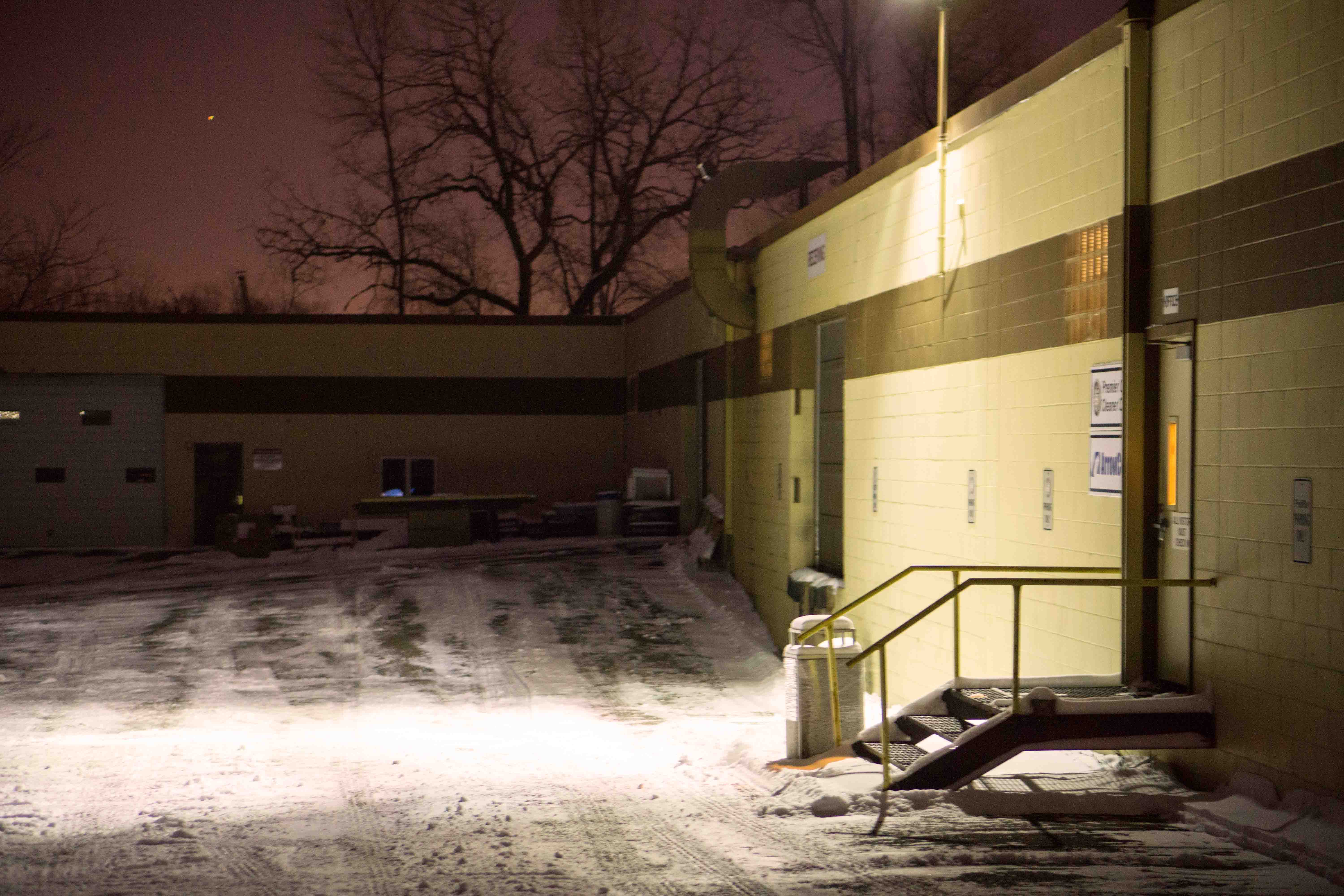
Who Can Resist a Good Loading Dock?
This one is a moody gem.
###
Image Credit: Kirk Livingston
Not Resolutions: New Year’s Experiments
What will you try next?
Another way to approach the beginning of the year.
Science constantly tries to rid experiments of bias and prejudice. Medical researchers set up double-blind, randomized studies in an attempt to remove personal bias and to avoid the temptation to game the results according to how we want to see them. Bias always and forever creeps in—it is part and parcel of the human condition.
But what if, instead of looking for work-arounds for our basic subjectivity, we embraced our very human bias and used it to move forward? Not so much in science experiments and medical trials, but in our personal lives?
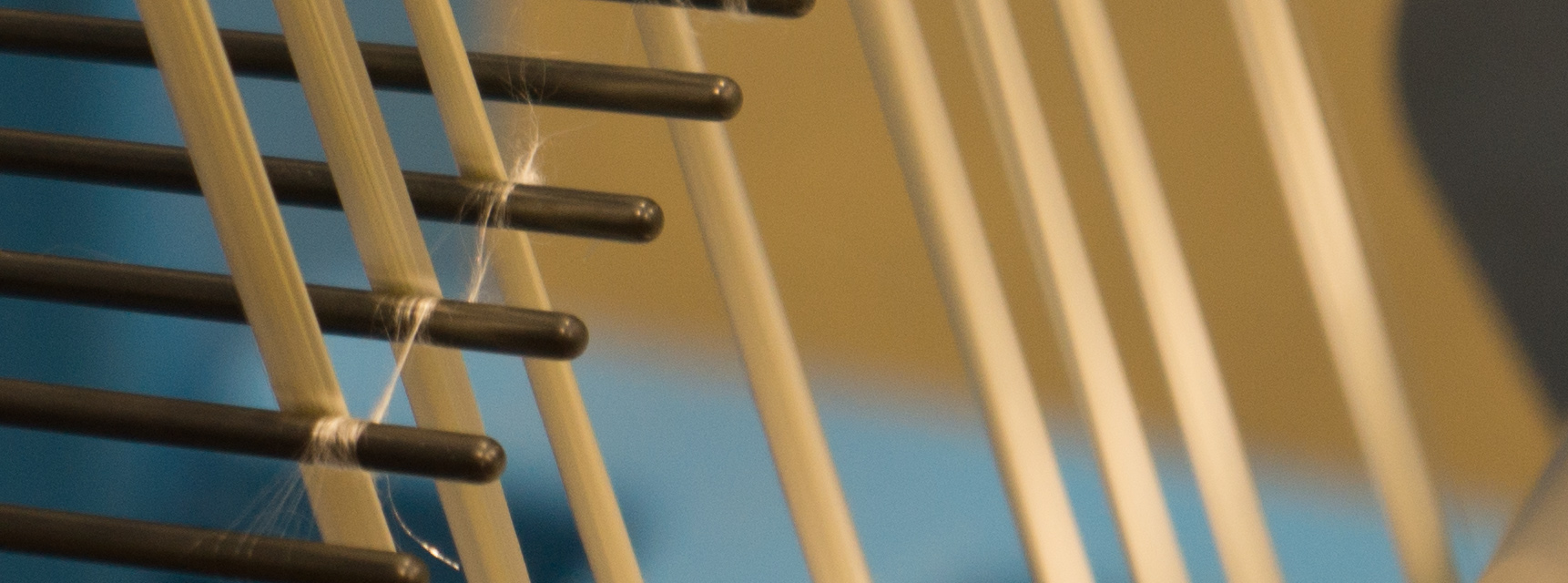
A theologian tweeted the other day about the lack of research and experiments in theological studies. He was right, in theological research you do not see big multi-center clinical trials running across the country. Partly because pharmaceutical companies are not lining up to fund such studies. And when they do, we’ll have an entirely new class of worries about drug-induced faith.
But, in fact, we each experiment constantly. Each of us in our own way. We experiment with ways of living. We experiment with belief systems: trying this or that to solve those deep questions. We allow ourselves to be deeply affected by what our friends, family, colleagues and neighbors believe. These experiments are a simple fact of how the human condition works. We game the system all the time and it works.
Or not (and even then, we know something new).
Some of us make resolutions this time of year. Others of us try to set direction (versus resolutions) for the year in an attempt to avoid the dismal reality of resolutions quickly broken.
But how about running your own set of experiments this year?
My friend suffers acute anxiety. It’s not a clinical condition, just solid worry as a way of life. She would like to not be such a worrier. My suggestion was an experiment in trust. Pick up nearly any of the poems by the poet-king and simply do what he did. In plain, persistent, passionate language, exclaim and define with agonizing precision the current situation and ask for release. Or help. Or mercy. The poet-king talked frankly to God—which seems like a solid experimental idea for any of us.
Experimenting with our dissatisfactions is not that bad an idea. Last year I tried to write a novel in a month (National Novel Writing Month) and I tried to make a sketch a day. Both attempts were wildly unsuccessful. But as experiments they announced solid directions by the end: write more fiction and keep practicing drawing. Last year I also experimented with following the poet-king’s example. My subjective results were mixed and positive and pointed in a direction: more trust. And more gratitude.
What subjective experiments will you run this year on your guinea-pig self?
###
Image credit: Kirk Livingston
Hello, 2015
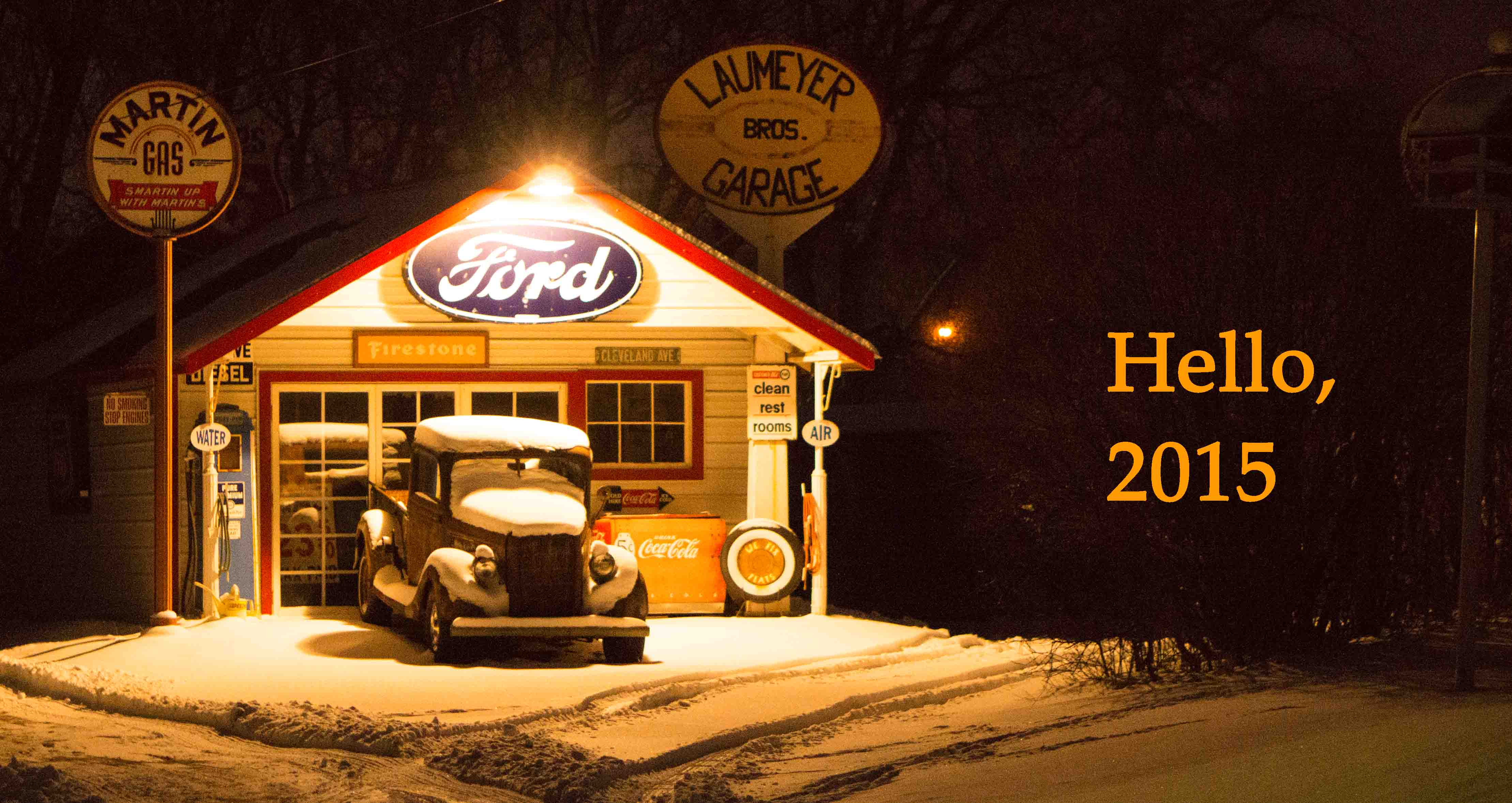
By the way, this is a real place in New Brighton, Minnesota.
###
Image credit: Kirk Livingston
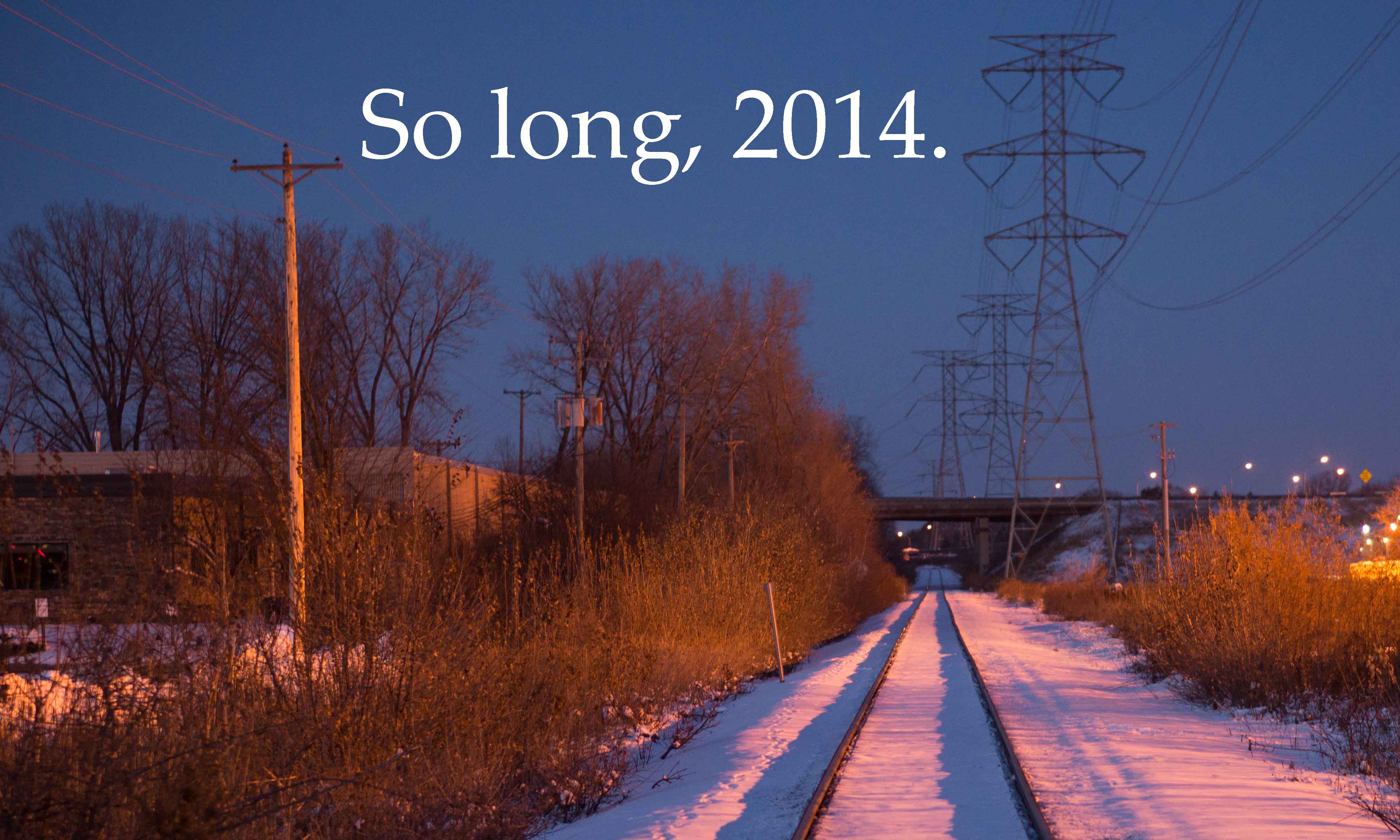
Stop On The Way
Ask: “What do you see from there?”
Mostly we hurry from this to that.
In this season we move from party to party. At work we move from meeting to meeting, hardly stopping to breathe, let alone reflect or appreciate the unique spot we’re in.
We do this because we are crazy-busy (always the right response in our culture). And sometimes reflection is uncomfortable, especially between things. No one really wants to dwell in the space between. But the space between has things to say as well. Things you would never hear otherwise.

Always “crazy-busy.”
We all know someone stepping between things. Maybe our friend has left a job or school or some relationship. Maybe we ourselves own some piece of life that has less than secure footing. All of us caught in between want the solid ground of the other side.
But we gain perspective by asking what we see from this liminal space. What does life look like from this uncomfortable, slippery place? What is important here—and should that thing be important when our footing is more secure?
Perhaps we do our friend a favor by asking what they see from that uncomfortable place—could it even be bit of mercy to ask that question?
###
Image credit: Kirk Livingston

 conversation is an engine