Posts Tagged ‘Rewriting’
“Just Exactly What Are You Up To?”
Then ask: “What is your point?”
We ask this of each other constantly: “What’s your point?”
We also ask it of poems and movies and op-ed pieces and windy monologues and sermons and sacred texts and profane screeching. Is this desire to quickly get to the nub a peculiarly American trait?
 Maybe.
Or maybe it’s just a sign of these fast-paced, self-important times. Unfortunately, the question allows little room for dilly-dallying with ambiguity or gray.
Because we got stuff to do.
We want the point. And we want it now. So we can reject it. Or, possibly we’ll agree (but with provisos. Naturally).
Authors and friends who take time to really get to know a subject or to get to know another person’s thought are great counterweights to this tendency. Mortimer Adler’s How to Read a Book comes to mind, with his intense working-over of a text so as to master it. This is the opposite of reducing this to that. And I’m lucky enough to have people in my life who listen carefully without reducing. I’m trying to learn from them to do the same
I’ve just begun a book by Joseph Harris, Rewriting: how to do things with texts (Utah State University Press, 2006). Mr. Harris’ book has lots of wise and useful things to say about how to handle other people’s thoughts in ways that allows you to hear them, while allowing room for moving the topic forward. He advocates a generous approach with a text: trying to understand. The generous approach to another person’s thought reminds me of Wayne Booth’s notion of listening-rhetoric: looking for similarity of thought before blindly reducing and striking back with counter-arguments.
“Pursuing truth behind our differences,” is how Dr. Booth would say it.
One thought Mr. Harris puts forward is that rather than forcing a text to get to the point, it might make better sense to ask, “What is the author’s project?” This question is about the intention behind the text. What was this poem/movie/op-ed/monologue/sermon/text trying to accomplish? Why did [whomever] write it and what did they hope to persuade the reader of? After you guess at that you stand a better chance of understanding their point (if there is one point). And this is particularly helpful when an author is presenting multiple points—like in the back and forth of a conversation, when someone is trying an idea on for size. This appeals to me because I’ve sat through too many meetings and preachments where the speaker’s point was forced out of a text that had zero to say about the topic. I have also been guilty of this violent approach to a text.
I like the notion of being generous with the texts we read and the conversations in our lives.
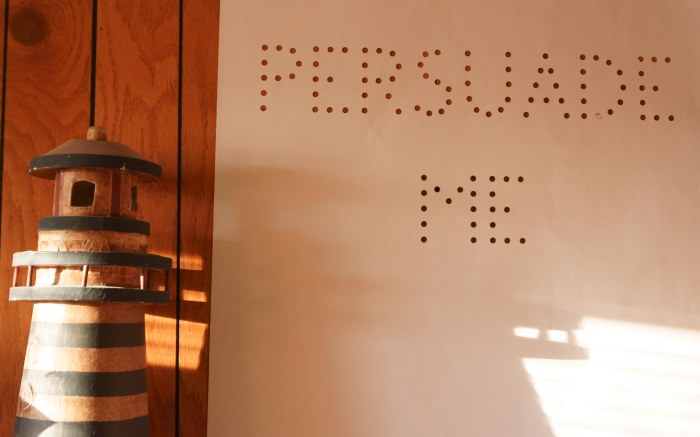
I am also persuaded we are all in the business of persuading each other all the time. We all have projects.
###
Image Credit: Kirk Livingston

 conversation is an engine