Posts Tagged ‘work’
Collaboration in Real Life: The Book Cover
Self-promotion is stinky poop
This week I spoke with a copywriter who writes plays and novels on the side. But he doesn’t work too hard on promoting his finished bits of literature. He prefers to stick to the writing part (who doesn’t?). This copywriter is not atypical on two counts:
- If you don’t need to get your message out (that is, move product to earn the feeble coin a book represents) you can let it languish.
- Copywriters are bad at self-promotion.

Roger’s cover
Not all copywriters, and probably not the copywriter I spoke with. But many are bad at self-promotion. It’s funny because while copywriters have insight into the psychology of business problems and use divergent thinking to solve those problems, they have a hard time turning that insight onto their own projects.
And that is true for all of us.
It’s not just because self-promotion has the feeling of swimming in a septic tank. It is also because we are truly blinded to the very things we are most passionate about. We’re typically deep inside those passions, and we have no clue what it all looks like from the outside. That’s why we need to tell others and get the outside insight that telling affords.
A client and friend provided a quick insight that has proved far better than anything this insider could produce. My first book, ListenTalk: When Conversation is an Act of God, is on its way through this marathon called publishing. Encapsulating the message into an image and a few words has proved daunting to me. Roger’s cover, with the fire, well, most people love it better than my covers. I’m not bitter, I’m grateful: grateful to have people around who can offer very tangible insights. These insights regularly, well, cover my arse. And I’ve always maintained that I am neither a designer nor photographer.
I thank God for people with such quick insight.

My covers.
A word about ListenTalk versus “conversation is an engine”
If you’ve dropped by this blog, you may have noticed I hit on different topics as they relate to conversation. Business and the business of writing, and the business of how faith and craft and work fit together are key drivers for me as I write.
My first ongoing project along these lines was to develop a sort of practical theology of persuasion—something I was desperate to understand as a copywriter who regularly trusts in God. That is what ListenTalk represents. It takes some topics from “conversation is an engine” but develops them specifically for people of faith. Here’s the draft copy from the back cover:
“Talk is cheap.”
So we say, but deep down we know different.
We know talk is a potent engine for war and love and all that lies between. Talk is our entertainment and our tool for exploring every relationship. Talk is an economic engine. Lives change—culture changes—when we talk together. In many ways, the future is patterned after our speech.
And this: even God responds to talk.
Yet we pay scarce attention to the working parts of conversation: the listening, the words used, and the intent behind the words. And we hardly think about God’s purpose in speaking, and how God speaks today with fierce desire for reunion—and how that desire motivates all God says and does.
Every day, people work out God’s desire in thousands of ordinary ways. Not so much through sermons and high-minded programs as through the ordinary conversations among themselves.
ListenTalk will help you to re-think what God accomplishes in even your smallest, most ordinary conversations.
“ListenTalk is a wonderful book with deep wisdom, practical advice, and heart-warming encouragement. Read it, converse with it, and share it with others.” –Dr. Quentin Schultze, Calvin College
“In our contemporary world where words and ideas seem to divide far more than they unite, ListenTalk provides an antidote of balance and sanity. ListenTalk reminds us of a power that can lead to greater understanding, intimacy, collaboration, and even personal transformation…culminating in deepening our life with God.” –Judith Hougen, University of Northwestern—St. Paul
Hey—wait a second. You could buy ListenTalk!
###
Image credit: Kirk Livingston
Don’t Bother Me. I’m on Fire.
Too Busy: 4 Takes
- My contact is too busy to talk about collaboration: “Too many deliverables, scheduled too tightly.”
- Another colleague laments the lack of time to think ahead about the broader picture. She chides the constant race to get stuff done.
- A friend observing the inner-workings of a logistics department 2000 miles from where he was trained could identify key process components missing. The very components that created the immediate chaos the team waded through each day.
We earn our keep by being busy. None of us want the boss to wander by and say, “Fire up that keyboard/drill press/classroom/spreadsheet and get to work.”
Busy is always good.
There are no exceptions.
And yet:
- We lament “busy” but secretly get a buzz from opening the adrenalin spigot.
- Busy looks productive. But looks can deceive. We easily deceive ourselves with busyness.
- When taken out of action (for instance, when downsized/right-sized/laid-off/fired), we suddenly have time to ask:
- “Where am I?” and
- “What (the heck) am I doing?” and maybe
- “What was I thinking?”
- No one likes the off-balance, adrenalin-free stance of waiting, watching, knocking and waiting. Are we genetically predisposed to seek action? After all, aren’t verbs the action-heroes in our favorite writing?
It’s hard work to look at the bigger picture and make difficult choices about direction, use of resources, usefulness. And yet those are the very questions that help us move forward. As the wheel of seasons grind toward winter in Minnesota, we might take a page from the farmer’s playbook and let snowy fields lie.
Even on purpose: the fallow field may allow us productive time to consider what it means to be productive.
Versus just busy.
###
Dumb sketch credit: Kirk Livingston
Jacob Morgan: Working Out Loud
Can collaboration lead to the fancy donut shop?
We’ve all known people who narrate their way through the day. Whether choosing today’s outfit or cooking or driving, these people say what they do as they do it. What they say includes the choices of the moment.
Such narration could drive you mad.
Unless you cared.
Say you were in the car and the narrator/driver mumbled something about turning left at the light. But you knew the fancy donut shop was to the right. So you suggested going right at the light. The narrator/driver turns right and, Behold!
“Hey—there’s the fancy donut shop we heard about. Should we stop in and get a dozen for the team?” you ask (innocently).

Take a right at the light.
What if we heard about work details we cared about in real-time? But not the kind of hearing that entails being pulled into a conference room so the boss can blather on about goals and objectives. I’m talking about the kind of hearing where your genius colleague one cubicle over shares a “Eureka” about the message your team is crafting. Or—more likely—when your colleague in Scotland answers your informal text message from the U.S. with a game-changing insight. An insight that has the power to order your work for the next two hours.
Being present with each other in our work has the power to delight our working selves. As we toss out ideas and questions amidst the ordinary banter, brand new stuff happens. It’s the stuff that can only happen between people in conversation. It’s not the stuff some boss orders you to do.
 I just ordered a copy of The Future of Work by Jacob Morgan based solely on the articulation of “working out loud” from this author interview on the Kinship enterprise blog. I’ve not yet read the book (did I mention I just ordered it?) but I firmly agree with the notion that the future of work entails some configuration of people wanting to work with a given organization rather than having to. “Get to” versus “have to” makes a huge difference to the motivation and energy with which we approach our work. I’ve argued for a LEED-like certification for workplaces that sustain the human spirit, and I think that is on the radar screen of job seekers today.
“Now let’s get back to that bakery,” he said, as he pocketed his car keys.
###
Image credit: Kirk Livingston
Doing Versus Planning To Do
Stay close to the work

Man is after all a finite being in capacities and powers of doing actual work. But when it comes to planning, one mind can in a few hours think out enough work to keep a thousand men employed for years.
McCullough, David. The Great Bridge (NY: Simon and Schuster, 1983), 381. Quoted in Berkun, Scott. The Year Without Pants (San Francisco: Jossey-Bass, 2013), 67.
###
Image Credit: Kirk Livingston
Could Your Organization Grow Your Spirit?
LEED-like certification for human-spirit-sustainable workplaces
LEED certification is a rating system that recognizes a building’s sustainability. LEED or Leadership in Energy and Environmental Design, rates a new building project using five different categories:
- Site location
- Water conservation
- Energy efficiency
- Materials
- Indoor air quality
Businesses and organizations with the highest ratings display them as a sort of badge of honor for the public to see.
What if there were some system to measure and rate the culture within a company or organization? Since we worry about bullying at school and we’re starting to recognize bullies in the office and toxic corporate cultures, does it make sense to start thinking about organizations that sustain people rather than beat them?

For instance, what if any organization was judged by these four categories:
- Bias toward collaboration
- Employee engagement indicators
- Mix of top-down messaging with true conversation
- Ratio of CEO-pay to rank-and-file pay
Seem ridiculous?
It would be difficult to measure many of these, especially since most of the categories seem so subjective. And yet, would it be impossible to measure? Would it be worthwhile to measure? Are we already moving in that direction?
In Minneapolis/St. Paul—like any set of cities—insider talk has long identified those cut-throat corporate and institutional cultures that routinely toss human capital to the side. Insider talk also identifies those bosses, managers and C-suite people without empathy and/or ethical moorings. New employees are generally forewarned when they sign up.
Of course, business is still about earning a living for the people involved even as the organization serves some human need. So don’t think I’m championing some communistic collective. Profits will and must be made to help society move forward.
But as we move toward fuller employment, workers will become more choosy about where they spend their days. And those cultures that have a less sustainable ethos will not be the winners.
I’m not convinced I’ve identified the right categories to measure. What categories would you include?
###
Image credit: Kirk Livingston
Should You Make Your Boss Cry?
Just draw me a picture
In a conversation yesterday my new friend self-identified as one who enjoys the “messy work” of helping groups get on the same page. To that I say: may her tribe grow. Because that is messy work indeed—fraught with bruised egos, sullen colleagues and cross-purposed tasks.
I maintain there is a fair amount of artistry involved in helping a group begin to move forward. Those who help others catch a vision for a project or cause have a knack for painting pictures. These pictures help team-mates understand just what is at stake. Those pictures may be dumb sketches or verbal images. The word “picture” here is important because an image conveys emotive content often missing with words alone. Without the emotive content of a picture, we are back to just using our intellect. And intellect only carries us so far. We can know the reasons behind a purpose, walk through spreadsheets and examine data without ever getting our emotive selves involved.

For many of us, real meaning has an emotional nexus. Pushing forward together springs quite naturally from that place where reason and care have linked arms.
The picture my new friend painted drew people from different business units in her organization—each armed with very different purposes and possibly their own rhetorical axes to grind—into a shared objective. The painting of the picture and telling of the story helped gradually align those cross-purposes.
What pictures are you sculpting for those around you today?
###
Image credit: Kirk Livingston
Writing with Sheet Metal (ShopTalk #2)
The Pull of the Factory Floor
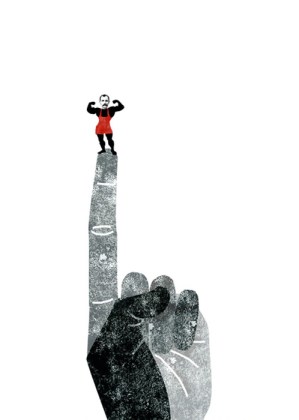 As a copywriter I spend my days in front of a pair of computer screens. Writing. Yes, I have meetings with clients and colleagues, brainstorming sessions and updates and phone calls. But mostly I remain planted before my computer, sorting through masses of information, ordering data that came with competing priorities and generally figuring out new ways to present the right facts to the right people in a way that causes a reaction.
Then there are days I visit a particular client’s factory. It’s a factory with a whistle that blows, union members who take 15-minute breaks, safety glasses and focused workers at benches doing macro and micro tasks. It’s a factory that stamps and welds metal, where electricians wire metal carcasses as long and tall as a semi-trailer. This factory is lit so everything is visible and produces a hum of activity across the concrete floor, which is the size of several football fields.
Why give so much detail? Because many who read this—myself included—spend our days in offices. But a factory floor is a different sort of place—a different world, with a different set of priorities and where production is king but craft sits near the throne.
I like this factory floor because it is different from an operating room, different from a cath lab, different from a conference room during an endless PowerPoint presentation, different from a row of cubicles and different from the Livingston Communication Tower (high over St. Paul). There is an irresistible, energizing activity on this factory floor that flows out of the scores of workers. But maybe that energy also comes from my past, because I grew up watching my dad craft furniture from oak and walnut. Maybe that’s where I absorbed the notion that producing a solid piece someone might actually use is a great way to spend your time and a fulfilling thing to do.
In this ongoing discussion of what makes for fulfilling work, I want to trace fulfillment down a different thread. This thread places the writer in a team with a goal of productivity. The writer and the team are focused on this goal of shipping something real and substantial. At the same time this team is also sort of doing life together—because in the middle of work there are the discussions about the rest of life. For a writer, this team-ness is a different way of spending the day and not to be missed.
Don’t take this as a romantic view of factory work. Instead, see it as the reality of the life situations where your craft takes you to meet a need.
###
Image credit: Yael Frankel via 2headedsnake
What Do You Need To Move Forward?
Applause? Permission? Donuts?
Twice in the past week I’ve asked myself this question.
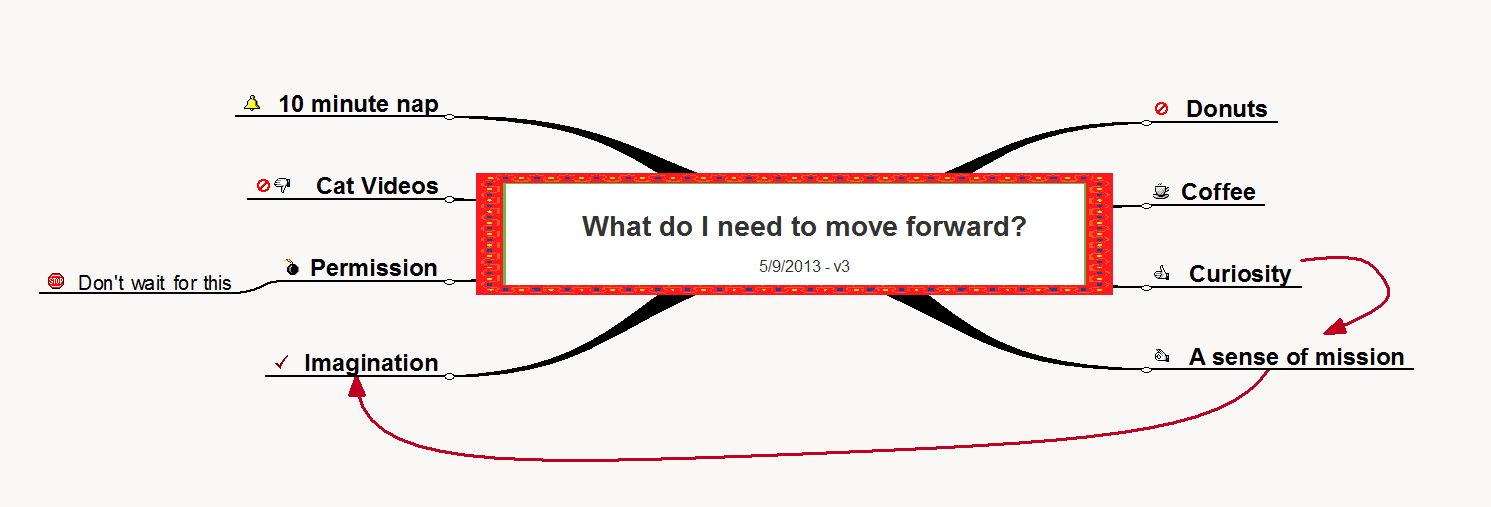 In one case I had just started a large writing project requiring all sorts of information that is not available and will not be available any time soon. My topic is partly in a shipping container in the Pacific, partly in a guy’s head in Scotland, partly in a set of computers in Minnesota and mostly nowhere near complete. But the need is approaching and my content must move on a parallel path with product development. A very specific audience needs very specific information.
In another case the blank page itself kept reminding me of the limitless intrigue of cat videos and TED talks. There’s nothing like a blank page to send you to all the advertising blogs and newspapers you’ve not checked on the web lately.
In both cases a conversation helped me mend the tracks to send the idea and task trundling forward. As I heard myself describing what I was trying to do with the idea and what I needed to complete the task, I realized I have the tools before me right now. There is nothing holding me back.
Waiting for permission to move forward is nearly as fruitless as waiting for someone to applaud your work or tell you what to do.
We move forward and the work has a role in showing us how to do it.
###
Image credit: Laurent Millet via 2headedsnake, kirkistan
Marissa Mayer May Be Right: Show Up (How To Talk Series #1)
You can’t talk if you’re not there.
With your colleague, maybe with your spouse when you left the house. Maybe your sister on the phone, the friend in London using Skype. Nothing happens when you don’t show up.
 Today we continually fine-tune our understanding of showing up: we show up with a tweet, with a blog post, with a telephone call. We show up by email (and sometimes our explanatory emails mark us absent). And then there is actual, physical, atoms and genes-on-the-scene showing up. But even that is not so clear, because despite standing here as you jabber, my mind is seated on the couch reliving that scene from Terminator (was it II?) where the semi-truck-trailer shoots off the bridge to land in the concrete spillway to continue chasing our heroes.
Maybe this is part of the “Why?” behind Marissa Mayer monkeying with the Yahoo! work-from-home policy—to help people be present:
Mayer defended her decision by first acknowledging that “people are more productive when they’re alone,” and then stressed “but they’re more collaborative and innovative when they’re together. Some of the best ideas come from pulling two different ideas together.” The shift in policy affects roughly 200 of Yahoo’s 12,000 employees. (reported by Christopher Tkaczyk, CNN Money)
I hope and believe collaboration and innovation are at least partially behind the Yahoo! change (which is to say, I hope the change is not a retrograde movement toward tighter control of knowledge workers and the corporate monologues they produce). There is some truth in the move: we cannot collaborate without being present. Also true: there are a lot of ways to be present when the collaborator is not physically there just as there are a lot of ways to be absent even while your carcass sits upright at a desk.
So today, choose to show up. Signal your decision with active listening skills. Refuse to be put off by anti-collaborative rants and power plays—say what you need to say to contribute. Refuse the director’s feigned emotion over this or that decision and tell the truth.
Show up today. It feels way better than hiding on the couch and watching your internal TV.
###
Work Matters. And Show Beats Tell.
Tom Nelson Vs. Wendell Berry Vs. Your Work Horizon
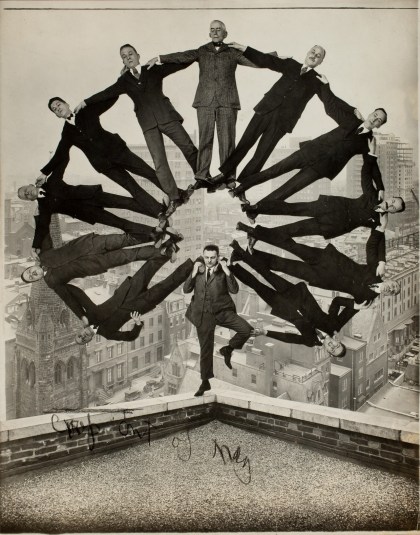 Not so long ago I heard Tom Nelson speak about his book Work Matters: Connecting Sunday Worship to Monday Work at a Bethel University event. Reading his book confirmed what I noted after hearing him: that preachers often talk about work from an abstracted viewpoint that collects themes from the Bible for a positivistic spin on what many consider the nasty business of business. I’ve tried to understand this phenomenon and I’ve come to suspect it has to do with the horizon anyone brings to their work: if you work but are really on your way to seminary or some transcendent mission, your horizon is 3-5 years, give or take. But if you work and your work is your life work, you have a different set of questions that are not exactly urgent, but are incredibly important.
Those questions are not easily addressed by a set of principles or a preacherly communication event. It’s not that Nelson’s book is wrong. It presents solid thoughts that are good to remember during one’s workday, though the preachy voice is there, the one that happens when oral delivery lands on a page. This voice puts a light, happy, totally-enjoined and engaged touch on every human encounter—which is not how real-life relationships work. Perhaps that voice more than anything provides makes the topic feel trite. Maybe I tuned out because of that voice.
If you were asking questions about why work matters, you can do no better than to pick up nearly any story or other piece of writing from Wendell Berry. Berry doesn’t just tell why work and faith and life fit together. Berry’s fiction shows people enmeshed in lives of work. Yes: he shows older agrarian communities. But he doesn’t show them in the abstract. He shows people who have a basic dignity—an understood dignity, not given by a preacher or unearthed from long silence. Berry’s characters are often in their work for the long haul, and their work becomes part of their identity. That’s a very long horizon indeed. Through their work they understand that they are doing a thing that brings order to the earth.
In my mind bringing order to chaos is a thing our work can do that is closely related to the stuff God does. Bringing order to chaos is a good way to spend a day.
###
Image credit: Metropolitan Museum of Art via Old Chum

 conversation is an engine