Archive for the ‘Ancient Text’ Category
My Raw Argument for Conversation
The Practice of Dialogue Rests on Solid Ground
I’ve become intrigued by trying to boil Listentalk down to the most elemental forms. Intrigued because there is a firm foundation for which I can build things on. Here’s what I know so far:
you really should
- There is a performative aspect of language. This performative aspect allows language to actually do something out in the world, to make things happen. It is not just that speaking something makes it true. But there is something closely related that is less about true/false and more about perception/reality: when we speak something, it becomes public, it becomes known, it becomes the story we’re going with—unless immediately debunked by those involved in the hearing and telling. So…stuff happens when we speak it. It becomes true…or at least truish. JL Austin, John Searle and others go on and on about such speech acts. I intend to hear more from them.
- We do right by others when we treat them as people. Obvious? Yes and no. Martin Buber suggested we often treat each other as objects rather than as people. He talks about “I-Thou” relationships where we treat the person before us as fully-human, whole people. Beings with many facets, interests, parts of their character. We talk and (especially) listen to them as we respect the dignity of their being human. But too often we treat others with an “I-It” sort of connection. That is, the kind of connection we have with an object too often becomes the model for the way we connect with people. We use a hammer to pound a nail, a George Foreman Grill to press a Panini for lunch. It makes sense to use tools in that way. But we mustn’t treat people as if they were objects. We devalue them. People are people. People are not objects placed on earth for the sole purpose of carrying out my personal (sometimes diabolical) will. There’s much more to say about this (in particular from Emmanuel Levinas), but that is the basic argument.
- God created and interacts with people. Lest you think I’m writing some humanistic diatribe, both the performative nature of language and the treatment of people as beings of dignity flow directly from the Old and New Testaments. Look at the role of “Word” from Genesis 1 to John 1 to Revelation 22. Words are performative so often it will make your head spin (If your head is subject to spinning) (You might want a doctor to look at that). Watch how the Eternal One allowed for the possibility that words spoken could be rejected. Even the words of the Creator. Even the Word that was a person as well as God.
- We’re at a new time when gatekeepers no longer control the discourse. Social media is part of the deal, but not the whole deal. New attitudes about who is in authority, who we can trust and who we cannot trust are in operation. Technology is opening doors.
Those are “Listentalk’s” four building blocks.
What did I miss?
###
Two New Conversations with Not-So-Ancient Texts
 Not long ago a few of us talked our way through the ancient text of Amos, a minor prophet in the Old Testament. We had a rich conversation as we tried to enter the text and the ancient culture.
I’m in two more of these conversations: in one group we’re working through a fragment from the Apostle John: His account of Jesus’ words just after the last supper but before He was led away to His death. We’re curious why John had all this extra material the other writers telling the same story did not include. But even more, we’re eager to know the ins and outs of talking with God. John’s Jesus had a lot to say about such conversations in that fragment—some of it almost (but not quite) unbelievable.
The other conversation is a manuscript study of Mark’s gospel. We’re committed to turning and prodding and poking and hashing through the text per Professor Agassiz’ recommendation. It could get heated.
The Beauty and Horror of a Text
In the conversation about the fragment from John’s Gospel, one woman said, “It would be so great to actually hear the tone of voice and see the body language behind what He said.” She was right. The problematic phrase: “Have I been so long with you, and yet you have not come to know me…?” (John 14.9) Did Jesus use a joking tone, like mock exasperation? Or did he shout it or was there some heat applied in the utterance? It’s hard to tell just from the text. It depends on how you read the story. Another conversation around Mark’s story had us wishing the author was around so we could ask a few questions—like how he knew what he knew.
In both cases, the author was not there. The only thing we have from the author was the text before us, and even that has been put through a translation process long before reaching our eyes and ears. What to do? Maybe if we had Kerri Miller interview the author (Hey, I’d attend that), we’d finally get our questions answered.
Or would we? Possibly the (long-dead) author would have forgotten just what body language or tone was used to make the point. Even if he remembered, would we have more information and would that information supersede the text itself?
Both stories (John and Mark) hold clues in the text that lead me away from wishing Ms. Miller could interview the authors. Interesting question because it points to something Jesus said to his followers in John. There were all twitchy with nerves because Jesus kept talking about leaving. He finally said, Look, You can’t handle the truth right now. I’m doing you a favor by going because God’ll send His Spirit. His Spirit will never leave you, He’ll always be with you, and He’ll actually direct you into the truth.
There’s truth in the text and I’m eager to ferret it out. But there certainly is something special that happens in the conversation around the text. Maybe I’ll invite Ms. Miller back for that.
###
Seattle Pike Place Market
 Among barkers and pitches and queries over price.
Prunes and potatoes and fish packed in ice.
A tiny man sat on a low stool
Lonely notes sounded, a string his tool.
One lone string sang strength and long-life,
And crossings and family and a well-loved wife
Of war and of peace
And of work without cease
In the market and deep in the throng
I heard clearly every man’s song.
###
The Rhetoric of Rhetoric: The Quest for Effective Communication by Wayne C. Booth
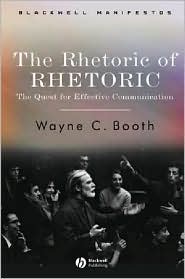
Readable.
Wayne C. Booth’s The Rhetoric of Rhetoric: The Quest for Effective Communication (Malden, MA: Blackwell Publishing, 2004) was published in a series called “Blackwell Manifestos.” Booth’s passion is equal to the series’ task, whether he is preaching the gospel of “listening-rhetoric” (really getting at underlying truths in conversation versus “bargain-rhetoric” where your goal is to mediate a truce or “win-rhetoric” where your goal is to engage in monologue and so browbeat the conversation partner into submission) or ranting about the rhetorical missteps of the George W. Bush government, there is no lack of passion.
But perhaps the clearest message and the one I take with me is the notion that every piece of communication carries (furthers?) some rhetorical purpose. Every communication has a purpose. And to sit passively receiving without considering what the author/rhetor hopes to accomplish is to allow myself to be taken advantage of. Whether I’m watching a commercial on TV (even a good one), listening to a sonata, hearing a preacher or even reading the prophet Amos or some other ancient text, I’m at my best when I consider—and possibly reject or even accept—the message coded into the communication.
A text wants a response.
###
We Need Your (Creative) Briefs

Unsettle the brain and spirit to move forward.
Don’t just paste in your purpose from the last creative brief. Don’t fill your creative brief with numbers and trivia that aren’t sharpened to make your point. Especially don’t dump in the jargon your client prattled on about. Make your brief work first as a communication tool and then as a community-building tool, because (you know this already) you’ll get the best work from your creative team by engaging them with more than facts. You’ll want them excited. Not excited about a tactic, but excited about what this communication (and what this product) will accomplish out in the world.
Don’t let your creative brief be just another check mark on your ever-expanding list of things to do to get a project started (and thus off your desk). Make your creative brief a thing of beauty and curiosity, like Cicero made his speeches: put in an exordium to get the team riled up about the opportunity. Put in some narrative that explains the full scope of the issue at hand, but sharpen it so your copywriter feels the pain the audience feels (and also feels the opportunity revving up your client). Confirm the why of your point: what are the salient details your copywriter can use? Then refute your point: what reasons will your detractors trot out to show how wrong you are? Then send the team off with a stirring conclusion (peroratio) that sums things up and blends pathos (emotion), ethos (your own sterling character) and logos (reason) in the most unsettling way. I always write my best copy when something isn’t sitting right in my soul.
Some of these ancient guys (like Aristotle and Cicero) have a few things to tell communicators today. How to rouse a team to action is one of those things. We need that.
###
What Does it Take to Listen? Amos on Hearing.

The power was in the message not the prophet.
For several weeks a few of us have been talking our way through an ancient text written by a shepherd named Amos. He came to the task of writing with no credentials and claimed only to be articulating stuff the Almighty had been roaring.
Like a finger circling a map before punching hard on the destination city, Amos’ started with a talking tour that included cities and regions where residents had stepped away from honoring God. But eventually Israel was the focus of this roar. And by the middle of chapter two, it’s clear the relationship between God and people was broken. The prophet prompted the people to remember how the Almighty had acted in their lives: destroying enemies as they made their way from slavery through a wilderness to a place of promise. The Almighty even equipped them with people specially tuned to hear more of what He was saying: Nazirites and prophets. But the actions of the crowd drowned God’s voice. The nation happily trampled the poor if it meant more money for them. They damaged their marriages and invented their own gods. Whatever worked.
That the people thought this was no big deal was key to what happened next.
Stuff happens for a reason, the shepherd/prophet said (Amos 3.3-8) and present sufferings will give way to something much worse, so now is the time to return. The predictions only get more violent as the book progresses and Amos does not spare the detail. That the nation collapsed within the generation puts even more muscle behind Amos’ words.
By the end of chapter four, the people had refused to hear and continued to invent their own terms of engagement.
What I learned:
- If I want to hear something bigger then myself, I need to listen beyond my own desire. It’s a matter of pulling out of the evil I’m participating in (a prophet worth his or her salt would say “Repent!”) and “returning” (which occurs five times in Amos 4) to God before being forced to meet Him on much less ideal terms (compare Amos 4.6-11 with 4.12-13).
- It’s good to remember the milestones and turning points God creates in your life. In our family, we’ve got dozens of places where we’ve sensed a divine hand reaching down and turning the course of our lives. Those times make for good stories—plus they actually inform present dark times with hope and light.
- God does stuff to get our attention. It’s better to develop a listening spirit than not.

Start listening at 5:15
###
Blinders, Diamonds and Choices
Do our life choices change the reality around us? Or do our choices fit us with a set of blinders so we pay attention only to what is of immediate interest? Winifred Gallagher in “Rapt: Attention and the Focused Life” argues that our senses are fine-tuned to track the smaller set of interests that are important to us. Her masterful book shows the physiological and neurological changes—and the enormous benefits—that happen when we pay attention. But it is also true that life choices change the reality around us.
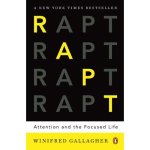
You'll be glad you read this.
A few of us have been reading the minor prophet Amos. Amos spoke against the treatment of the poor—over and over again. That’s what prophets do: with little personal authority (Amos was a shepherd), they get tricked-out with a much larger message (larger audience, bigger content, massive ramifications) and they…say it. Out loud. Come what may.
Which is what Amos did. He spoke out against nation after nation for taking advantage of their helpless (among other things). He had a special harangue against nations that should have known better, nations who should have had top-of-mind recollection about how they were recently saved from helplessness themselves.
As we talked about Amos, I mentioned how the poor seem almost invisible today. There are the homeless, but because I’m not paying attention (I’m not actively looking for them), I don’t see them. A couple students in my “Writing for Community” class are doing a masterful job bringing attention to the faces and people-ness of the homeless here. But how can I, how can we begin to see the poor among us? And more importantly, how can I/we keep from choices that trample on them? This spot hints at the effect of our choices:
 ###
###
Entering an Ancient Text
Our small group is reading an ancient text together. It’s reproduced in a contemporary volume and to my eye looks like the same English words and punctuation I might find in today’s StarTribune. But the prophet Amos is writing from a very different time and place. He was a shepherd back in the B.C.’s when kings ruled the peoples. And though he was (again) just a shepherd, he spoke a message that came from the God whose roar could wither a mountaintop and drop a pasture into mourning.

The text works on the reader
John Walton, in his introduction to “The Lost World of Genesis One” (Downers Grove: IVP Academic, 2009) writes that understanding an ancient text is not a matter of translating the culture but entering that ancient culture—as much as possible. I picked up Walton’s book because I am fascinated by the huge task taken on by the writer of Genesis 1 and mirrored in John’s Gospel (John 1). Who doesn’t wonder how everything began? And this: what do those deep roots say about life today?
Entering into Amos’ ancient culture will be our task. We’ll do it as a group. We’ll bring supporting sources and texts that point us toward that ancient culture as we walk through those nine chapters. We’ll look at how the author uses his words, what he repeats, what he emphasizes. How he frames his argument. We’ll take a bunch of conversational stabs at understanding the text and I expect to be deeply challenged about the ephemerals I fixate on.
And…I’m expecting God to show up. I’m listening for that roar.
###

 conversation is an engine