Archive for the ‘art and work’ Category
Stephen Fry’s Voice Serving Heathrow
Please speak human
Copywriters try to harness voice to say their client’s message. There’s lots of talk about being on brand these days, and for copywriters that means speaking in the voice of the brand. But voice must always be human to be heard. That’s why press releases and spokespeople are so easily dismissed—they generally don’t sound human.
John Cleese felt he could perform Basil Fawlty for Specsavers because the voice they wanted was true to the character he had created. He had refused many opportunities because unfunny scripts deviated from that character.
Check out how Stephen Fry voices a gentle, unhurried, humorous take on a place that launches an airplane every 45 seconds.
###
Via Ads of the World
Writing Through and To
Rinse and Repeat.
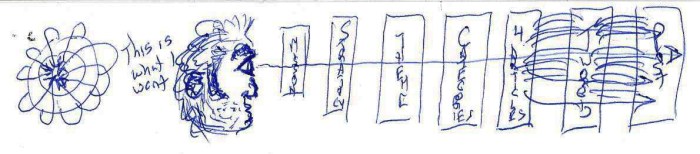
Today’s Writing Task
###
Dumb sketch: Kirk Livingston
“What Will I Be When I Grow Up?”
Start Your Process Early to Answer Life’s Recurring Question
This question will not go unanswered.
As a kid you quickly volunteer answers: firefighter, ballerina, basketball player, scientist, pilot. It’s right that action-jobs attract kids. You may defer answering it as a college senior. You may say, “I’m not sure. We’ll see what comes up.” You find yourself saying it in your first job, hinting that “This is OK, but it’s not quite the right fit.” In fact, you may think it through a career.
I’ve had two different conversations recently with people suddenly seeing the horizon of retirement off in the distance. Both said some variation of “I’m not sure what I want to be when I grow up.”

The question is tricky because it sounds like an all or nothing deal: you do this or you do that. Binary. One or the other. But the truth is more like life is filled with all sorts of opportunities that are concurrent. You must pick. You must choose. If you don’t pick and choose, chances are good you’ll simply slide into being entertained. That’s not bad, it’s just that being entertained generally pacifies the urge to create.
And yes, I am talking about creating. Because one assumption behind the “What will I be?” question is “How will I take action in the world?” I argue that the sooner we find ways to address that question, the better off we’ll be at every stage of life. One old model of retirement was that you put in your time for 30-40 years (at something you hate or just tolerate), and then head to the golf course in Florida or Arizona to be entertained until you tip over into the grave. Today people approaching retirement are looking for ways to keep making a difference. The lucky ones have both their health and some sense of the art or craft or service they simply cannot live without doing.
I’m thinking about this today because one central piece to my social media marketing class asks students to pursue their passion publicly using every social media avenue open to them. This is a difficult question and commitment for these students to make. I like the exercise because it forces them toward the larger life question. I like the exercise because it initiates a process that, if they follow it, will begin to answer that question.
Locating that thing we are passionate about involves experimentation, of course. And if your work does not leave any time for locating your art/craft/serve/tribe, is it possible that in 30 years you might still be asking, “What will I be when I grow up?”
I hope not.
###
Image credit: Kirk Livingston
What is Engagement, Anyway?
Are Likes Helpful or Corrosive?
The college where I teach is something of a bride-and-groom factory. This [largely unstated] expectation of finding your soul-mate by the time you graduate lurks in the halls and hovers over tables in the cafeteria.
At least that’s what students tell me.
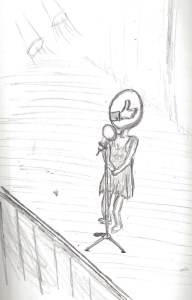
“You like me. You really like me.”
I’m sympathetic: there are few times like college for being surrounded by attractive folks of similar age who are also poised to make big life decisions. And, true, that’s where I ran into the beautiful young woman who a few years later became Mrs Kirkistan (lo these 30 years and counting).
In this particular college social construct, if you ask someone for a date, well, that’s kind of like a proposal. If you actually date, well, you might as well be married. To be fair, I’m not close enough to say if it this is entirely accurate. But my few talks with students make me kind of sad that relationships would be so, well. binary.
So it’s not surprising that these folks have an interesting skew on engagement. These are people who grew up with likes and short texts and public Facebook conversations. The quick word carries a lot of weight. For some, the quickness with which a like comes back speaks volumes to their self-esteem. It seems like engagement is an all or nothing deal and social media has the power to amplify that.
This social construct plays into expectations in my class. What do we expect when we think of engaging with the audiences we pursue? Are likes what we seek? Page views? Actual comments? Someone stopping you in the hallway? How does anyone determine if someone else is interested in what they say? Social media experts have all sorts of answers for this and all sorts of complicated metrics, some of which even make sense.
One thing is certain: grooming your personality and language for likes is dangerous. Just as it always has been. Of course we all do this to some extent. Who doesn’t want to be seen as attractive and groovy?
My hope for my class—and for anyone with courage to create anything—is that they create from an interiority that remains integrated and intact. That is: write and create from what drives your passion. Likes and page views are OK, but they should never substitute for your own sense of chasing the thing you simply must say. Yes, you’ll need to sort out how to get attention, but it is even more important to exercise your creativity along the lines you were made for.
In the end, likes may not be all that helpful.
###
Dumb Sketch: Kirk Livingston
Stuck and Reframe
Just How Real is Our Imagined Beginning?
I’m stuck on a client project. Late in 2015 I devised a social media communication strategy that calls for weekly themes. But one of my weekly themes provides very little fodder for producing content. And so I’ve been spinning my wheels and getting exactly nowhere.

Maybe it’s a good time to be stuck, because this is the season of reframing. Old things ended as 2015 shuffled out and new things began with the calendar change. Everything outside my window looks the same, but we’ve all group-thinked (group-thunk?) ourselves into what we call a new year. Is it an imagined new beginning? Of course. But that doesn’t make it any less real. Somehow that calendar change gives a bit of courage to consider releasing the strategies that don’t work.
Reframing—trying to see a problem or need differently—is a way out of stuckness. My tools for building a new frame around a client need or personal problem include words on pages and dumb sketches and mind-maps and fartleks and conversations. You already know that conversations hold quite a bit of promise: telling someone else about your stuckness has the effect of bringing to light a problem and beginning to find your way through it.
If you are of the tribe that makes resolutions, you also know that telling your resolution to someone can have a positive effect on keeping those resolutions. And you may even have someone who holds you accountable.
I’m stuck on a client project.
I’m going to talk with my client.
Staying stuck is not an option
###
Image credit: Kirk Livingston
4 Ways to Bring Creativity to Work
Hint: Creativity is not easily contained
I’ve been reworking priorities for the social media marketing and copywriting classes I start teach again in January. If these are like previous classes (I’ve not yet looked at the rosters), there will be quite a few English majors, juniors and seniors, many of which will be excellent writers. I teach the class in a sort of writing-forward way: we use writing as our primary tool for sorting client brand problems and opportunities. But over the last few years, the copywriting class has morphed from a focus on “copywriter” to “idea writer,” which is a book by Teressa Iezzi that I’ve become very attached to. We use The Idea Writers as a text to help grow our understanding of our task.
My syllabus is mostly intact from last time I taught, but this time it I see four areas where additional emphases are needed. These four areas make it difficult for a student to jump from writing papers for an English professor to writing copy in the world of commerce: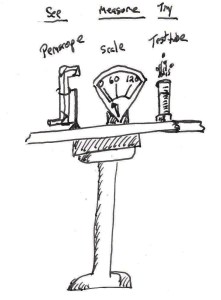
- See: this has to do with trying to get out of your own brain-pan and jumping into someone else’s life situation. Read more: How to Go Out of Your Mind
- Try: social media, in particular, rewards those who jump in and try stuff—all sorts of stuff. Trying stuff is a way of learning what your audience will listen to, and will respond to, along with understanding the limits of their attention. Yes there are some best practices and some favored tools, but social media is in constant motion.
- Measure: The goal really is to move the needle, that is, to get a response. Hits, page views—so many of these numbers are really only incidental to engagement. Real engagement looks like a comment or a share or some other solid action in the world. This is debatable, of course, and varies by audience and objective. But social media opens a window to see just what effect our words and ideas can have. Which can also be terribly discouraging for a writer with a message to deliver.
- Passion: This is the surprise for students, that they can channel a passion about a topic or tool or process into a project for a client. Many think passion and inspiration are ingredients only safely stirred into their own poetry or short stories. It turns out the more you run on inspiration, the more you run with inspiration.
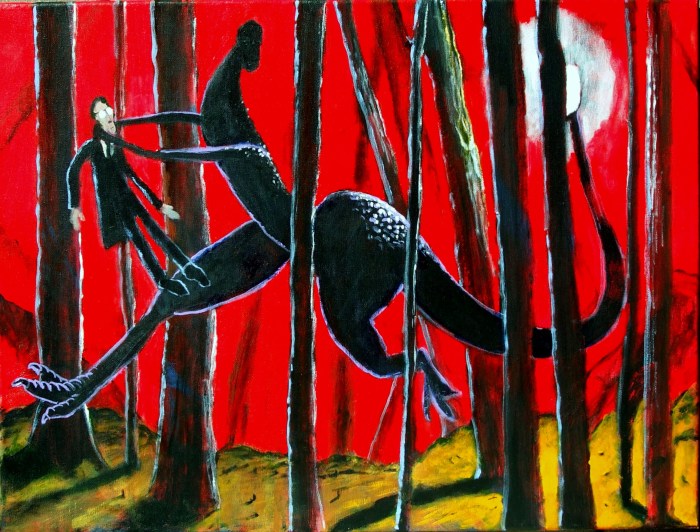
“Inspiration” by Richard Bledsoe
Richard Bledsoe’s interpretation of “Inspiration” is completely right: there is often a point where the idea carries the writer forward, eyes bulging, wishing only to stop.
###
Dumb Sketch: Kirk Livingston
Image credit: “Inspiration” by Richard Bledsoe, used with permission
7 Questions that Shape Your Art/Work Life
Please Write this Book: The Freelancer’s Attitude Kit
I’m working out new ways to present the freelance life to college writing students. They are interested in this independent life but not clear about all it entails. They wonder: is there more to it than sitting around in your underwear all day?

I’d like to present them with a textbook that answers these seven questions. Because these are seven questions that freelancers and other independents continually ask and occasionally even answer. These questions are useful for anyone trying to figure out the relationships between work, craft, art and employment.
- How do I balance art, craft and economics? Is it even possible? Because there is stuff I want to do that has no audience. There is stuff I’m less interested in that has a larger audience. And there is stuff I can do to pay the bills, which frankly doesn’t engage me much. I feel less fulfilled when I do that third category of stuff. Then again, I feel pretty fulfilled when I cash the check from that third category. Part of the answer has to do with what your time in life allows. Part of the answer has to do with the economic choices you make.
- Is it me or is it you? What does it mean to care for others with my work? Is it possible to use my art or craft or skill to truly look after the needs of another—or perhaps to look after the needs of an organization? One point I’ve made repeatedly to students is that while introspection is one way to sort out who you are—and our creative lore pegs introspection as the main work of writers and artists—there is another way. And that way is finding places and people to work alongside and, well, serve. Sometimes we begin to sort out who we are as we seek to help others. Sometimes our collaborator and our collaborative processes reveal more than we could ever sort when isolated at our desk or easel.
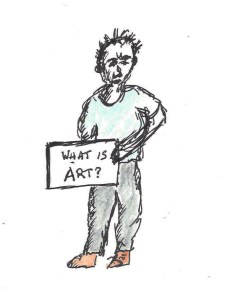
- What unseen forces are at work? I am a copywriter who also believes that God answers prayer. I am a copywriter who is also comfortable with artists who say the universe provides. My point is that the independent person has a better perspective when convinced there is more going on than what they can muster on their own. For example: every client I called last week said “No.” But then two new calls came in from completely unexpected sources. And these calls said “Yes.” Coincidence? Faith of one kind or another plays a role in this life—especially if a spouse/children/mortgage are part of the picture.
- Where does my ladder lean? Aiming for the approval of your boss is not bad, just limited. Bosses change—and sometimes very quickly. Better to climb toward a larger goal. In corporate life, we climb toward this position or that responsibility. In freelance, we climb toward this kind of project or that kind of project. Freelance does not have titles and offices that automatically designate how important you are. Are you ready for that? Freelance depends on intrinsic motivation—the stuff that bubbles out from inside. In fact—it turns out—that corporate life does too. The intrinsically-motivated colleagues are far and away the happiest, because they do the work out of willingness and mission. Just like freelancers.
- What do I look like, an entrepreneur? In fact you do, if you are someone who sees a need and starts to figure ways to meet that need. One textbook defines entrepreneur this way:

Entrepreneurship is the process of identifying opportunities for which marketable needs exist and assuming the risk of creating an organization to satisfy them.
–Hatten, Timothy S. Small Business Management, Entrepreneurship and Beyond (New York: Houghton Mifflin Company, 2003)
There is risk with the approach: you might fail. It might take a long, long time. This approach requires turning that intrinsic motivation into an engine that chugs along every single day. That can be exhausting, especially when met with a daily chorus of “No.”
- What’s sharing go to do with it? Today artists and writers and crafters and tribe members find each other online. Not exclusively, but frequently. Part of the independent life has to do with finding generous ways to talk about your passion. This is not shilling for work, this is giving away good stuff. Good stuff that people can use. It turns out that clients just might find you this way as well
- What if people knew how weird I was? That’s right, you are strange. Really strange. But everyone is. Freelance capitalizes on weird by you doing what you do in the way you do it. Freelance is the opposite of cookie-cutter. It is niche-building with much of your weirdness intact (not all, people will run from you).
That’s the book I want to use as a text. Some books I’ve read come close.
What questions shape your work life? Tell me if you’ve read this book.
###
Image and dumb sketch credit: Kirk Livingston
Editorial Cartoon vs. Rough Sketch
Pique a place to begin.
Charlie Hebdo meant to disrupt and paid dearly. That is what every editorial cartoonist wants, well, not so much death as to disrupt. I’m a fan of Steve Sack at the StarTribune, who every day tips some social issue on its ear.
The contribution of the editorial cartoonist is to change the status quo conversation by putting forward an opinion in whatever outrageous way that gets attention and is instantly understandable. Most of their work is an image that evokes a passionate response. The editorial cartoon is typically polarizing, immediately dividing those in violent disagreement from this in violent agreement.
In contrast, the rough sketch is presented to people who are already with us. They may not agree with our nuanced vision of a project, but they at least have the project on their radar.
We use the rough sketch to present our vision for the project, to show more precisely what we mean and to invite discussion. The whole undone sketchy ethos of it can accomplish all those things.
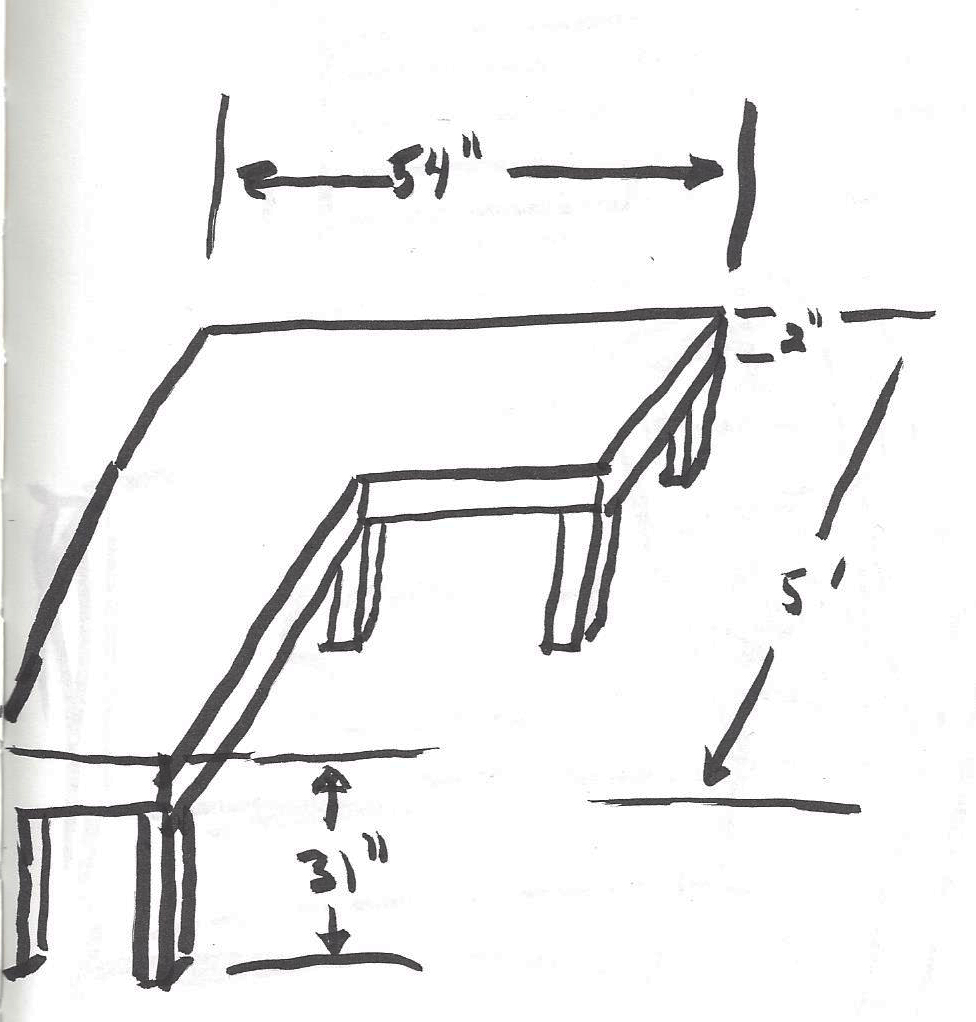 Sometimes we need a rough sketch to present our idea in the easiest possible way—so our friend or client cannot misunderstand us. And sometimes we need to disrupt a status quo conversation and risk passionate ire.
###
Image credit: Steve Sack, StarTribune
Dumb sketch: Kirk Livingston

Casket Arts: The Artist’s Palette
High in the Casket Arts Building

The artists in the Casket Arts Building are readying their spaces for Art-A-Whirl, next weekend.
###
Image Credit: Kirk Livingston

 conversation is an engine