Archive for the ‘art and work’ Category
Collaboration in Real Life: The Book Cover
Self-promotion is stinky poop
This week I spoke with a copywriter who writes plays and novels on the side. But he doesn’t work too hard on promoting his finished bits of literature. He prefers to stick to the writing part (who doesn’t?). This copywriter is not atypical on two counts:
- If you don’t need to get your message out (that is, move product to earn the feeble coin a book represents) you can let it languish.
- Copywriters are bad at self-promotion.

Roger’s cover
Not all copywriters, and probably not the copywriter I spoke with. But many are bad at self-promotion. It’s funny because while copywriters have insight into the psychology of business problems and use divergent thinking to solve those problems, they have a hard time turning that insight onto their own projects.
And that is true for all of us.
It’s not just because self-promotion has the feeling of swimming in a septic tank. It is also because we are truly blinded to the very things we are most passionate about. We’re typically deep inside those passions, and we have no clue what it all looks like from the outside. That’s why we need to tell others and get the outside insight that telling affords.
A client and friend provided a quick insight that has proved far better than anything this insider could produce. My first book, ListenTalk: When Conversation is an Act of God, is on its way through this marathon called publishing. Encapsulating the message into an image and a few words has proved daunting to me. Roger’s cover, with the fire, well, most people love it better than my covers. I’m not bitter, I’m grateful: grateful to have people around who can offer very tangible insights. These insights regularly, well, cover my arse. And I’ve always maintained that I am neither a designer nor photographer.
I thank God for people with such quick insight.

My covers.
A word about ListenTalk versus “conversation is an engine”
If you’ve dropped by this blog, you may have noticed I hit on different topics as they relate to conversation. Business and the business of writing, and the business of how faith and craft and work fit together are key drivers for me as I write.
My first ongoing project along these lines was to develop a sort of practical theology of persuasion—something I was desperate to understand as a copywriter who regularly trusts in God. That is what ListenTalk represents. It takes some topics from “conversation is an engine” but develops them specifically for people of faith. Here’s the draft copy from the back cover:
“Talk is cheap.”
So we say, but deep down we know different.
We know talk is a potent engine for war and love and all that lies between. Talk is our entertainment and our tool for exploring every relationship. Talk is an economic engine. Lives change—culture changes—when we talk together. In many ways, the future is patterned after our speech.
And this: even God responds to talk.
Yet we pay scarce attention to the working parts of conversation: the listening, the words used, and the intent behind the words. And we hardly think about God’s purpose in speaking, and how God speaks today with fierce desire for reunion—and how that desire motivates all God says and does.
Every day, people work out God’s desire in thousands of ordinary ways. Not so much through sermons and high-minded programs as through the ordinary conversations among themselves.
ListenTalk will help you to re-think what God accomplishes in even your smallest, most ordinary conversations.
“ListenTalk is a wonderful book with deep wisdom, practical advice, and heart-warming encouragement. Read it, converse with it, and share it with others.” –Dr. Quentin Schultze, Calvin College
“In our contemporary world where words and ideas seem to divide far more than they unite, ListenTalk provides an antidote of balance and sanity. ListenTalk reminds us of a power that can lead to greater understanding, intimacy, collaboration, and even personal transformation…culminating in deepening our life with God.” –Judith Hougen, University of Northwestern—St. Paul
Hey—wait a second. You could buy ListenTalk!
###
Image credit: Kirk Livingston
Rob Moses & the People of Calgary
“Have you ever ridden a horse?”
If you’ve had the pleasure of going to Calgary you’ll know it is truly a western city. Situated not far from Banff and Jasper National Parks, it is also quite spectacular. And rich, fueled by oil and gas money flowing into the city.
Rob Moses is a photographer based in Calgary. I follow his blog because of the extraordinary portraits he takes of complete strangers. His method is to approach someone, have a conversation, and shoot the photo. The endearing thing about this process is the conversation he has. He records it verbatim —or so it seems. His written text includes nervous laughter, indecision, and ricocheting answers. His recorded conversations sound like real conversations to my ear.

Stopping complete strangers is not easy in the best of situations. Asking to take their picture sounds like a scam, but Mr. Moses pulls it off with what seems to be a fair bit of joy. And he always asks if his subject has ridden a horse—critical information for Calgarians, evidently.
The optimism of sharing his talent with photography is not lost on me here. It’s kind of an amazing way to self-promote and, well, bless people. And for those lucky enough to find their way into his lens, they come away with a phenomenal view of themselves. Scroll through his blog and be amazed at the composition, lighting and the ease written on the faces of his subjects. If you’ve ever asked to take someone’s photo, you know it typically ends badly. Unless you are Rob Moses.
May there be more of his talented tribe.
###
Image Credit: Rob Moses
How to Make Your Message Permanent
A tip from a prehistoric consultant
First: Forget about it. Nothing is permanent—at least not in the way advertising mavens augur.
Second: OK—if you insist—make your message about someone else. Make your message give back more than it takes in. “GE” branded on a rock would never last. Even the Apple logo will be chiseled away by Microsoft rebels. But a man with jointed wings, well, who can resist that story?
![Who can resist the story about the “Thunder Being”?]](https://conversationisanengine.space/wp-content/uploads/2014/10/birdman-2-10022014.jpg)
Who can resist the story about the “Thunder Being”?
Prehistoric peoples stopped by these ancient rocks to tell their version of the human condition. So they carved/picked/incised/abraded their messages into the exposed Sioux quartzite outside Comfrey, Minnesota long before there was a Comfrey or a Minnesota or a U.S. of A. Maybe before the pyramids and Stonehenge. Ancients left messages here to direct and entertain passers-by.
Why make your message permanent? We understand marketing communications for companies—it’s about keeping the wheels of commerce turning. But you personally—what messages do you have to communicate? And why would you make them permanent? I argue that your take on the human condition comes out in the way you do your work, the way you interact with family, friends, colleagues, and even the way you see/refuse to see the homeless guy at the end of the exit ramp. And all these daily interactions amount to a carving and incising that is far more permanent than any of us imagine.

The Jeffers Petroglyphs tell a story that became a destination.
Our conversations have an enormous (cumulative) effect on the people around us. An effect that may move through generations.
What exactly is your message, anyway?
###
Image credit: Kirk Livingston
Big Data Will Never Write a Poem
Art & Craft in a Data-Driven Age
Big Data FTW.
With all the information we collect from you (and Bob and Carol and Ted and Ciley), we know when you’ll buy beer, buy steaks, invest in a crock pot, buy an engagement ring, get married, get pregnant, get divorced, get pregnant again, get diabetes, get congestive heart failure and, well, pretty much any of the human conditions. We know what kind of coffins people in your neighborhood buy. We know this because we track it.
We track everything from mouse clicks to toilet paper purchases.
Because we track things we can make offers you cannot resist because you just thought of it yourself. You just thought of what we already knew you’d think about.
This kind of knowing is the goal of the big-data wranglers embedded in most any marketing group these days, whether an ad agency, a car manufacturer, a hospital or my city leaders. Knowing all means better decisions—at least that’s the promise.

Years ago all this tracking would have set in motion a web of fears about being controlled. But since most of have agreed with Amazon and Netflix that we really should order this lens next and watch that movie next (because others did), we’re at peace with each day’s granular tracking.
Is there a place for the crafter in a world of analytics? I say “Yes” because despite all the predictive analytics, we still connect best with real people. Brands are not known for calling us back to our senses. As our buying and consuming gets easier and easier—which is not a good thing—we need the artists and the crafters and the writers and barista-poets to call us back to a life outside of consumption.
Big data is not likely to predict the veering humans are known for. Because, as they say: past performance does not guarantee future results.
Plus: big data will never write a poem—at least a good poem.
Long live the intuitives!
###
Image credit: Kirk Livingston
“Writer without permission.”
Write On Your Own Dime
A new LinkedIn friend in the Minneapolis/Saint Paul area has a job title “Writer without permission.” The genius of her title is to say out loud what most every writer is thinking—nobody asked for this, nobody gave me permission, and frankly, no one is waiting for me to finish it. The whole thing is entirely self-motivated.
Let there be more of her tribe.

Writers without permission may encamp here as needed–not that you need permission.
Writers often stop mid-sentence and think,
I am entirely unqualified to write this. When will someone knock on my door and say, ‘Hey—Stop it: You got no business writing that.’?
When those Philip Glass moments occur, whether real or imagined, the writer without permission pauses and then continues the sentence. And the next sentence. And so on—breezing past the “No Trespassing” signs posted around the perimeter of the topic.
If you are waiting for someone to say, “You should write about X.” You have a long wait. If you are waiting for a fat check to cover expenses while you draft your manuscript, well that isn’t likely. Although I did chat with someone two weeks ago who received a sabbatical from her job to write a book. So, miracles do happen… and all that.
New stuff happens when we start writing without permission. But the alternative is also true: maybe nothing will happen. Maybe it will fail. Given all the books and writing and words floating around today, failure is likely. Then again, what is success or failure? If just getting your story out is success (I happen to think it is), then start writing. If success is getting famous, well…miracles do happen (and all that).
But there is something more to the kudos and the paycheck—it is a kind of validation that you are doing a good thing, a worthwhile thing, an important thing. It’s as if we need someone else’s validation to gather gumption and move forward. But what if someone won’t even understand what you are doing until you are done—because you yourself are working out the details? And you don’t fully understand it. Not yet.
We celebrate the creative genius of long-dead writers. But how many knew they were writing some landmark story until much later—or ever? Most had to battle the “No Trespassing” signs and the missing fat paychecks. And they created anyway.
Do you need permission to create the thing you cannot stop thinking about? You have my permission, for whatever it is worth.
Don’t put off creating.
Start today.
###
Image credit: Kirk Livingston
Let’s Get Liminal: How to be a Co–Laborer/Co-Thinker/Co-Contributor
Show up to explore the space between
My friend helps researchers at his Midwestern university organize their thoughts for publication. He also helps them apply for grants to fund their research—a function many universities are increasingly focused on.
To do this work, my friend has found ways to walk alongside new professors as they form their research interests. By staying beside them over time (years, even), he is able to help identify places where the work can go forward and also begin to locate potential funding sources. That’s when the hard work begins of explaining the research to a funding committee.

Approaches to Minneapolis
This space between—where the research shows particular promise but is still unformed—this is where a conversation can bear fruit. Maybe even the goal itself is starting to take shape, along with possible routes to that desired end. Sometimes it is the conversations surrounding the goal and routes to the goal that open it for exploration.
Michael Banning is an observer and painter of liminal spaces—those spaces and places that we typically don’t even see:
I am interested in the liminal spaces found at the edges of the inner city. Amid the trucks, weeds and railroad tracks of those often post-industrial surroundings, one can find compelling views of the distant skyline as well as a sense of peace and quiet uncommon in the urban experience.
–“Parking Lot near Train Tracks,” by Michael Banning, label from James J. Hill House Gallery
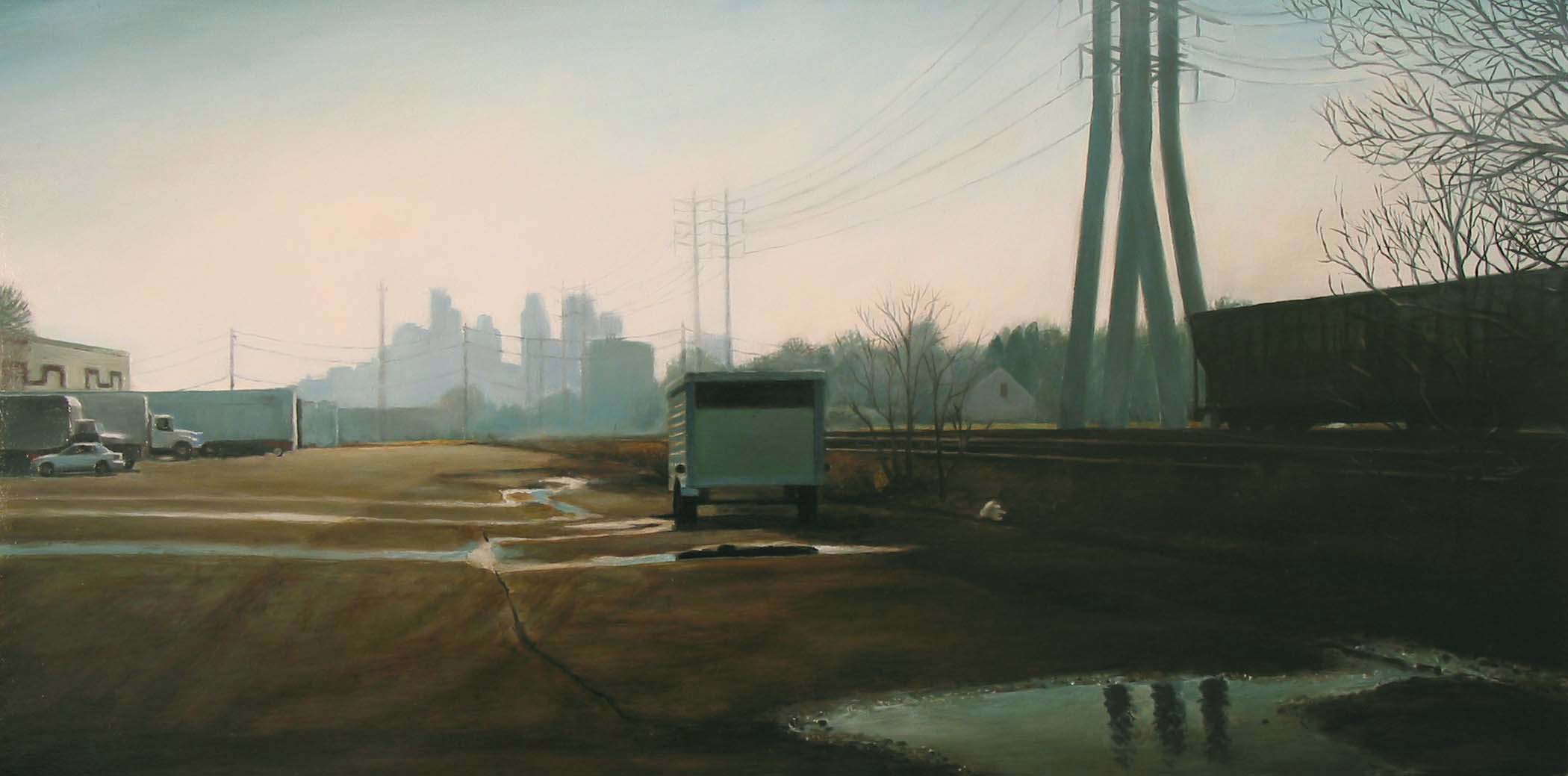
Parking Lot near Train Tracks (Photo courtesy Michael Banning)
See Michael Banning’s work here.
When we are lucky enough to find ourselves talking about these liminal spaces with each other, we might be collaborating in a particularly effective way. Typically we don’t have a clue when we’ve entered such a verbal space. Years later we might identify a conversation that was a turning point. Perhaps the best we can do is to remain open to entertaining each other’s unformed thoughts.
Who knows what might result?
###
Image credit: Kirk Livingston
Steven Woodward: Dictionary, 2005
How did you think of that?

Apart from [extensive world] traveling and reading, the majority of my adult life has been spent alone in a very larger room, imagining what I wanted to see and how to create it.
Read more about sculptor Steven Woodward here and the James J. Hill House Gallery here.
###
Image credit: Kirk Livingston
Joe Lueken: The Grocer With Something To Teach CEOs About Leadership
Joe Knew Where His Success Came From
Are you one of those poor souls who does not read the obituaries?
Pity: so many memorable stories.
Like the story of Joe Lueken. A couple years ago Mr. Lueken turned down the opportunity to make buckets of cash by selling his Bemidji-based grocery store chain. Instead, as he retired, he set up an employee stock ownership program and transferred the company to his workers.
He was a philanthropist who stocked shelves and took his break with the other workers in the break room. And—most telling for me—the people who worked for him had great respect for him. He was a guy whose work ethic and his caring demeanor touched lives. And it seems—at least from my reading of a couple of articles—he did so with joy.
Mr. Lueken died on July 20 after a long battle with cancer.

As we watch the explosion of CEO salaries and look with wonder on the board members who agree to these ridiculous payouts, it’s hard not to wish many of the current batch of muckety-mucks had worked for Joe. Maybe his humanity would have rubbed off.
###
Image credit: StarTribune
But Can You Outsource Imagination?
Consider cultivating time to consider
One persistent problem in today’s workplace: no time to think.

Frank Lloyd Wright re-imagined this windmill in Spring Green, Wisconsin.
Open floor plans contribute to constant interruptions, as do the barrage of meetings we file into and out of most days. Projects have fast timelines, which do not lend themselves to fully consider ramifications—so we default to action.
And as Curtis White might say: our deep involvement in (what seem to be) sacred institutional processes precludes us from using our imagination. The way we get things done—all those guidelines and guardrails—also serve as blinders, shuttling us down the same paths again and again. We stop seeing other ways to do things. Maybe we stop seeing that there are other things worthy of our attention.
As freelance copywriter, I see this all the time: friends and colleagues embroiled in their system so deeply they forget to imagine the larger issues having just as much impact. One of the great privileges of my work is to come alongside friends and colleagues to think through an issue from a different perspective. Of course, no one hires me to think (thought that sounds like the perfect job). They hire me to write stuff. But in the process of systematically going through their marketing campaign or explaining how a product works or working through the medical literature, new perspectives pop up. Things my client has not yet considered. Small tweaks to a product or presentation that make a huge difference in the outcome.
Though your workday may seem too tight to think through an opportunity or problem, isn’t it in your best interest to carve out the time to do just that? You can off-load many project tasks, but it takes fresh imagination—possibly sparked by an hour away from your desk—to see things differently. A fresh take can make all the difference in the world.
###
Image credit: Kirk Livingston
Lack of Imagination and the Middle Mind
Curmudgeon Curtis White May Be Right About ‘Merica
Two friends sat with another friend in a hospital room.
With their friend plugged into monitors and IVs, with frequent interruptions by staff and generally surrounded by unyielding clinical protocols—the best conversation these two friends could muster was…silence.
What to say with someone so needy and so plugged in? How to name the thing their friend was experiencing? Could they talk about his condition and/or prognosis, or was it better to talk about something different entirely?

One friend, the artist Nicolas Africano,
pointed to a length of clear plastic tubing suspended above us, “That amber light is beautiful.”
The other friend, Curtis White responded:
And there in fact was a tiny amber light in the middle of the tubing, a little light I hadn’t noticed at all. It was bright like an isolated star. It triangulated us. Suddenly, the situation changed for me into something completely other than it had been the moment before. We’d been translated. Reordered. Nicholas’s comment reconstellated us. I had a powerful feeling that everything has just been changed utterly and made—what other word was there for it?—beautiful. I smiled, suddenly happy. I looked at Nicholas in awe. And I thought: “You can do that?!”
This is the framing story for Curtis White’s The Middle Mind (NY: HarperCollins, 2003), which is not an easy book.
It was hard for me to stick with it right up until it became hard for me to put down. White comes across as an elitist, academic know-it-all who seems to enjoy pointing out the dark side of everything I hold dear (Terry Gross a proprietor of the middle mind? Really?). Although he insists he is not interested in “high/low culture distinction,” it wasn’t until my second time through the book that I began to understand how his framing story (the amber light in the hospital tubing) is a call to use imagination to see things differently.
White’s “middle mind” is a form of management, a strategy used by leaders in entertainment, academic orthodoxy and political ideology that prevents people from finding their own way. The middle mind management strategy offers up a set of topics that look and smell like genuine thinking, but in fact, are designed to keep an audience from stepping outside the boundaries. Perhaps White’s notion of the middle mind is something like how we get our kids to go to sleep at night: “Would you like to brush your teeth before or after you put on your pajamas?” (See what I did there? Putting on pajamas and going to bed was not one of the choices. Sneaky.)
 White indicts everyone from journalists to entertainment to business. He castigates the American public for lack of imagination to see outside the news cycles and ridiculous sound bites and a two-party political system. The book is more than ten years old, so was written back when the drums of war we being beaten with particular urgency (then again, when is that not happening?). Ten years on, there are legion more opportunities for middle mind observations. Facebook and “following” and Twitter and, our celebrity worship—there is no end of examples.
There is much to disagree with in Mr. White’s book (for instance, his sweeping dismissal of faith). But his underlying notion that we need to get back to the work of using our imagination to interact with our institutions and work and leisure is a valid call to action and worth considering.
###
Image credit: Kirk Livingston

 conversation is an engine