Archive for the ‘art and work’ Category
Social Media: Not Hard. Not Easy.
Write What You Will
I’m struck by the opportunity social media presents to writers.
One of the stories I tell in my Social Media Marketing class is about the demise of The Morning Show on Minnesota Public Radio. For years I listened to Dale Connelly and Jim Ed Poole spin out their eclectic music selections and oddball humor. So did a lot of people.
Jim Ed Poole retired (and then, sadly, passed away) and then The Morning Show went away as well. Dale Connelly began a new show in a similar vein—Radio Heartland—with a blog as co-host. The blog served as that necessary conversation partner—certainly never replacing Jim Ed Poole—but keeping Dale engaged with listeners. Then, as is the way of progress and regress and corporate decisions, Dale Connelly was out of the job. Radio Heartland continued with the same eclectic music but without the oddball humor. I continue to enjoy the music of Radio Heartland.
And, no surprise, the faithful audience for The Morning Show followed Dale Connelly to his Trail Baboon blog. No music, just oddball humor. Now Dale is the news director at KFAI Community Radio in Minneapolis even as he continues to write for his still-growing audience.
I tell this story because it illustrates an opportunity about starting as a writer today. Since there are no gatekeepers on the Internet, a writer can write what a writer wants to write. A writer can take pages and pages to sort through whatever it is she or he has to say.
True: no one may show up to read it. The writing may feel like shouting into the wind, but the point is to keep going in an effort to sort what it is you have to say as a writer. Audiences form. Eventually—at least that is the hope.
But for writers just starting, social media presents an opportunity to hone a message and then tinker with the best way to present it. This process of sorting and honing and tinkering develops a set of valuable skills that are absolutely transferable to the world of commerce (and far beyond, into our creative lives). I will argue that this sorting and honing and tinkering with our messages is the lifeblood of any writer.
My students already understand this. They’ve all begun this process without any prodding from me. But we’ll push a bit on the sorting and honing and tinkering in the next few weeks.
Especially the tinkering.
###
Image credit: respectezcesingeot via 2headedsnake
Click Farms Vs. Philip Glass
The Glass problem: Prolific production of something no one wants.
 I’ve heard rumblings of sweatshops where thumbs and fingers are put to use liking various social media status updates. An AP story running in the Startribune a couple days ago identified even our own State department as buying clicks, possibly from a click farm in Dhaka, Bangladesh. If not exactly illegal, the practice certainly carries the sense of fraud in the false “Like” economy Facebook introduced us to and to which all social media fall prey.
The desire to be liked is so compelling. I’m hoping you’ll like this story (as if you needed to read such a disclosure). But I’m also trying to wean my myself off this desire for constant attention and this eagerness to let a click tell me how successful I am in life. There’s good reason to investigate the internal compass of gifting and bent and pairing those with the hope of connecting solidly with a few rather than seeking the transient adoration that “like” seems to represent.
Then again, the money is in the Likes.
A more balanced and possibly more productive approach to doing our best work is to dive ever-deeper into the well of “What am I here for?” When we ask that question and look to see what fascinates us and what (some, few) others react to or what seems to help those few, then we are on to something. That is a very different process than scanning keywords and offering click bait.
Consider Philip Glass. Maybe you like his music. Maybe you despise his “repetitive structures.” I find his music soothing and at times invigorating and always terrific for writing. But when he started playing and composing, it sounded very different thing from everyone else. He had very few “likes.” In fact many just said to him,
But he persisted and found something new.
That’s what I’m expecting from many: to find passion and service flowing together, even if others don’t understand it. It takes courage to keep walking forward in this way. But that’s the kind of courage we need.
###
Image credit: un-gif-dans-ta-gueule via 2headedsnake
Mike Spitz: Medicated for your Protection – Portraits of Mental Illness
Looking for traces of normalcy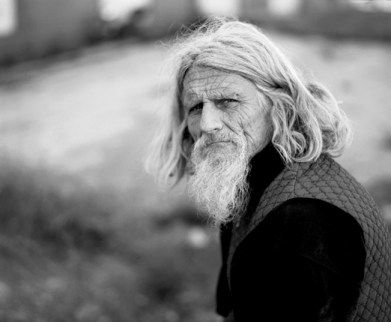
Sometimes an image can help us have a difficult conversation. Mental illness is one of those topic areas we continue to have difficulty talking about.
Mike Spitz is a clinical therapist and photographer who set out to document the faces of people with mental illness. Here’s his process:
Despite their mental and physical deterioration, abandonment by friends and family, and their pathology, my aim was to capture the subjects’ humanity, dignity and any traces of normalcy. I was not trying to present them as “crazy.” I shot in a straight forward manner without unusual angles, blurring, or other tricks to create a madness “effect.”
Mr. Spitz shot photos on weekends and nothing was pre-arranged and the photos depended on the willingness and mental condition of the people being photographed:
Most of them were friendly, helpful, eager to participate, and lacking in the usual self-consciousness and inhibition of models and other “normal” or “sane” subjects.
Check out the full post at Lenscratch, which remains a daily must-read for me.
###
Image credit: Mike Spitz via Lenscratch
Lou Gelfand: No More Complaints
How do you love an impossible task?
In darker moments I wonder what good lies in all the words produced, day after day—especially my own words. But if words serve only to remind or tell again the story of a bright spot someone saw, then maybe that is enough. Because bright spots shine a bit of hope.
Lou Gelfand was a bright spot for me.
I am a casual newspaper reader. I read the StarTribune and various news sources on-line. But the StarTribune has been my go-to, privileged (and sometimes angering) source for many years. Lou Gelfand was the long-suffering ombudsman/readers’ representative. For nearly 23 years he listened to complaints and reader’s rants and charges of bias (a countless number, surely). And then he calmly worked it out with words on paper.
Mr. Gelfand’s “If You Ran the Newspaper” columns were a must-read for me because he seemed fearless in taking colleagues and readers and the process itself to task. He aimed for resolution and made everyone mad as he did it. But there was something satisfying in his assessments. His words produced a sort of end-game where conflict and anger were addressed, if not always resolved.
Here’s Mike Meyers, former Strib reporter and friend of Gelfand, on the mood created by Mr. Gelfand’s assessments:
“He was a guy who often ate alone in the cafeteria because reporters were so damned thin-skinned,” Meyers said.
Mr. Gelfand was a kind of pivot point between audience and the communication machinery that was the daily newspaper. It was a no-win position from the beginning—an impossible assignment—which Mr. Gelfand moved forward with aplomb, sympathy and spirit.
His son called him “relentlessly fair” and Gelfand surveyed his own columns and found he split about evenly between backing the paper and the complaining readers.
Read Mr. Gelfand’s obituary here.
###
Image Credit: via Frank T Zumbachs Mysterious World
Photography and “built-in objectivity”
Hyper-collage from Jim Kazanjian
Lenscratch features photographer Jim Kazanjian, who makes images without ever picking up a camera. Instead, he pieces together found images to form mad hallucinations that are just a bit off—in the way a nightmare is all the more horrifying because it is so close to normal.

I like Kazanjian’s twist on objectivity (which is also a statement on what we privilege):
I’ve chosen photography as a medium because of the cultural misunderstanding that it has a sort of built-in objectivity.
Kaznajian’s aim is to “render the sublime.” His method is, well…
My method of construction has an improvisational and random quality to it, since it is largely driven by the source material I have available. I wade through my archive constantly and search for interesting combinations and relationships. Each new piece I bring to the composition informs the image’s potential direction. It is an iterative and organic process where the end result is many times removed from its origin. I think of the work as a type of mutation which can haphazardly spawn in numerous and unpredictable directions.
Kaznajian’s method is also a sophisticated comment on the creative process. Have a look at the full article: http://lenscratch.com/2013/12/jim-kazanjian/
###
Image credit: Jim Kazanjian via Lenscratch
Talk to Me (Life of Privilege, Part II)
Be a Tool Today
It’s what we each crave: the incisive conversation that changes everything. Some of our most thrilling moments are verbal, from “I love you” to a simple “Thank you,” thoughts and affections formed into words can warm us like nothing else on a cold day. Words are arrows snapped directly into the deep-inside-brain-heart.
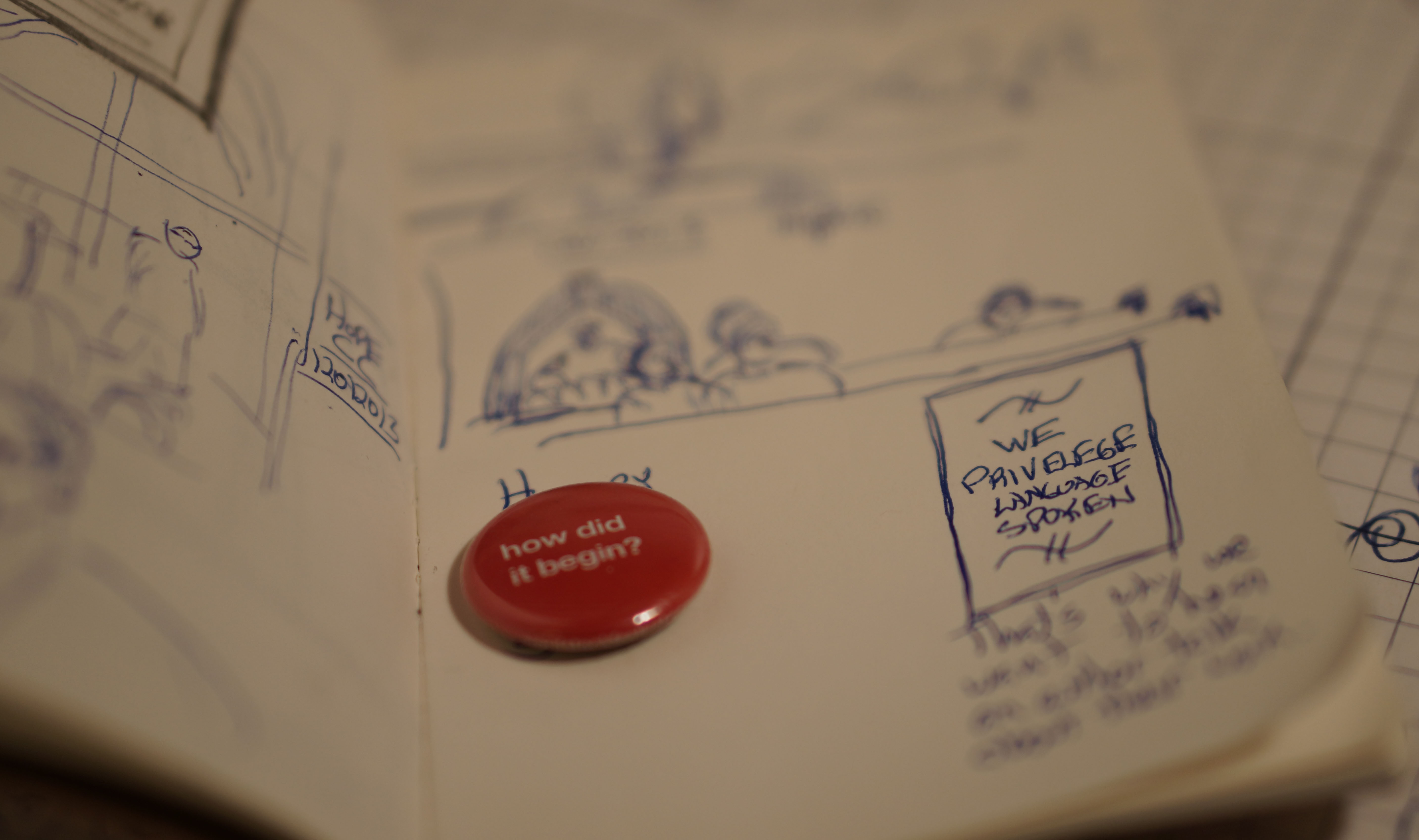
We privilege words spoken—and rightly so. When Kerri Miller hosts Talking Volumes, we listen in because we want to hear some fresh take on the author’s art. We hope the author will reveal some secret to the writing process that fleshes out what we know of her work. We listen intently for some meta-comment that shows how he organized the story. We want more and spoken words are our most believable medium.
Freshly-thought words spoken with spontaneous candor often achieve that end. Fresh words are a response to relationship and a response to the present moment. Which also explains why the CEO’s vetted and scripted remarks at the press conference reek of plywood and formaldehyde. We’re more likely to hear the real story from an employee down in the ranks.
Writing is a technology. Computers, smartphones, pen, ink: all technologies.
Words spoken are not a technology. They are made of breath. They are kind of alive, if only for a moment. But they can also live on in memory (for better or worse).
Which is not to say words are not tools. Words are possibly our closest tools. We use words to accomplish all sorts of things. Words may be our most important tool.
What relationships will you encounter today that will conjure conversations using words you never dreamed you’d say?
See also: Lorde & The Life of Privilege (Part I)
###
Image credit: Kirk Livingston
Taking Direction from Clem Fandango
A Year of Great Clients
I’m counting my blessings these days because I’ve had a year of clients who have been a joy to work with. Which is to say: they let me alone to do the work we’ve agreed on. And then we come together, talk parts through and make the work better.
All in all, there’s been very little Clem-Fandangoing.
And for that I am grateful.
###
Via Sell!Sell!Blog

Talk as an Economic Tool
Flesh out your own opportunity
Grandad was a salesman. Talk was his tool. Talk and presence. He showed up with people to help them locate a house they could own. I doubt he talked many people into buying because he was careful about the economics of the deal. He dealt in houses long before our recent mortgage troubles. He sold houses back when mortgage interest rates were well over 10%. He depended on people keeping current with payments, and they did, mostly. At Grandad’s funeral more than one person told me how the opportunity to own a home had been out of their reach except for his help (which was cool).
Grandad talked his way through a house with a client, through a friendship, through a cribbage game, through dinner. Talk was his tool for getting stuff done, to the occasional exasperation of his wife and daughters. Talk made stuff happen for Grandad.
I’m gearing up for a couple classes that help college students take their writing out of the classroom and into the workplace and Grandad’s example comes to mind. What had been a rather solitary passion for these students—working out stories, poems and arguments for themselves or some instructor—can be made to have broader use in the world they’ll graduate into. This is my argument: enterprising writers use their writing/thinking/talking skills to serve others and actually find it satisfying. Even illuminating: it turns out that looking out for ways to serve others is also as much a knowledge-producing endeavor as the scouring of personal experience and/or feelings that become grist for a poem or story.
Moving writing from an inward to an outward focus begins with a firm grasp on what they can offer—a sort of inventory of one’s communication skills. And then comes some thinking about how those skills may help push forward an organization’s marketing objectives. And just like Grandad’s conversations, writing itself is the route in and the outcome. But it starts with hearing about a need, and that takes a different kind of dedicated listening.
###
Image credit: un-gif-dans-ta-guele via 2headedsnake

 conversation is an engine