Archive for the ‘Brand building’ Category
Brands: Still (Always?) Incidental to Life
Bit of truth from Martin Weigel, Wieden+Kennedy, Amsterdam
We all know this, of course.
###
Via the Sell! Sell! Blog
Let’s get visceral: Choose your signal before you gut-punch
What forms say before we know anything
I recognize a business card because of the shape and size. I recognize a sermon more by a particular tone and rhythm (which signals a certain intent) then I do the presence of a pulpit or podium. I know a joke is coming because Letterman is on stage and it is 10:37pm. I know the joke will have a setup and a payoff. Or perhaps the third of three statements will be funny. I am ready for the joke because of these forms.

Before we know anything we recognize a form. Our brain sorts how to react to that form, and then, once that is settled, we process communication content. Long before I hear any content, I know what category to place each of those communication events. It is the context that prepares me: when I see X, I know Y is not far behind. My nervous system anticipates the next piece.
But what if the form is out of whack?
What if I hear preaching on a street corner? What if a clever copywriter uses a rubber stamp instead of a business card (“Here, give me your hand and I’ll stamp my contact stuff on you palm.”). And what if Letterman was serious? He has been a few times: right after 9/11 his serious tone—entirely uncharacteristic—began a bit of national healing.
I tell my copywriting students to follow the forms at times and to bust the forms at other times. For instance, we must make our ideas as easy to understand as possible, and so we present our ad concept to a client in a form that is immediately recognizable—even if the idea itself is challenging. And sometimes one thumbs one’s nose at the form on purpose, just to bust through (that is, the communication gut-punch).
In any case, following the form or busting the form is a conscious decision.
And the form is not God (not even a god).
By the way, Dan Pink has a great story about the Pixar way of presenting a concept here.
###
Image credit: Kirk Livingston

Tip #9: Launch Your Idea. Don’t Detail It.
We all repackage our stories for the best effect
Writing copy can be disorienting—especially for English majors. Rather than grading on how they develop an argument and how well they follow particular usage rules, they are graded on how well their copy meets a marketing need. They are graded on how well their creativity pulls in the target audience—and how quickly. Each exercise and assignment becomes more about the big idea and the execution of the idea rather telling all the detail in an orderly fashion.
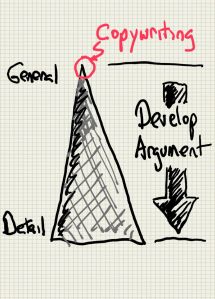 It can be disorienting because we might have mistakenly thought copy was just emotional marketing hype, the (nearly invisible) stuff that abides in much of our current messaging (“clutter,” you might say). Copywriters just toss any word in an ad, like “new” or “organic” or “protein” to get people to buy in, right?
But copywriting is more like a lab where you boil down the raw material to get an essence. Then you adjust the pheromones in that essence to get the behavior you want in the audience you seek.
Wait—that sounds manipulative.
If it is, it is a common trait and practice shared by all humans. We’re all packaging and repackaging our stories in real time. We constantly change-up our experience and knowledge and opinions as we deliver them to friends and family, prospective mates, acquaintances and strangers. It’s not a purposeful misleading, it’s just that the human condition is constantly changing and we see things differently at any given point. And we all want to be heard, so we change how we say things.
Mind you—orderly telling is still critical for copywriting. But audiences don’t make time for essays (sadly). And developing an argument is still critically important—it’s all just very, very fast.
The key is getting—and holding—attention.
Eight other copywriting tips for English majors here.
###
Image credit: Dumb sketch by Kirk Livingston
Let’s have a prune party
In what odd corner of the universe could “prune” and “party” ever fit together?

C’mon copywriter: not everything your product marketer says is true.
###
Via Vintage Ads
Bah: Who needs “personality”?
Give me your risk-averse, your bland spinners of boredom.

Two days ago I talked with a marketer trying to sort exactly what space his brand occupies in social media. His brand generally takes a clear position against the competition and owns 15 to 20 percent of the market. Their messaging is mostly working and they see only growth ahead.
But that growth needs a kick. Getting their brand noticed in social media requires more than mere facts. For instance, when it comes to tweets—what tone to take?
They’ve studied their demographic relentlessly. They know, for instance, that edgy won’t cut it with their particular audience. That’s a shame, because “edgy” tweets attract a lot of attention. My friend pointed to @DiGiornoPizza and the (often hilarious) tweets that set them apart. Their tweets fit their audience.
But my friend was not trying to meet the needs or get the attention of that edgy demographic. Plus, my friend’s brand was lodged within a behemoth of company that has traditionally favored corporate, risk-averse language over “fun” and “personable.”
What to do?
This is a question many companies will face as social technologies advance further and further into the selling cycles. Social media will always be about more than facts. People come back to particular tweeters or blog posts or updates because of the personality represented and the personalities’ take on whatever. We come back again and again because we want to hear what Letterman (or Colbert) or Jimmy Fallon will say about this or that. There is an expectation. And there is an emotional connection. And it never hurts to be fun.
I predict even business-to-business will succumb to personality and human speak.
How can a risk-averse corporation that deals in corporate-speak begin to talk human and engage in conversation with other humans? This is a complicated question that calls for creativity beyond the numbering of facts and features. It calls for a viewpoint or perspective. And those companies willing to move their tone off bland and toward standing for something that matters to their audience will be the early winners.
###
Image credit: TaylorTay via morguefile.com
Dialogue 2.0: Can a Marketer Game a Conversation?
Yes. But maybe no?
Lots of us try to figure how to turn a conversation to our advantage.
Marketers increasingly slip us information just when we want it, like Google giving directions to the donut place on the way to my next meeting.
Bad Google.

Carefully observe, one must.
Carl Griffith, writing over at ClickZ, wants marketing websites to recognize and reengage with returning customers via their behind the scenes content management system. He wants websites to engage in dialogue like people do: no need for reintroductions. We know you—you know us—where did we leave off last time? Cookies help this happen, of course. Amazon is an example of picking up where you left off and adding suggestions for more purchasing joy. That is likely where all web properties are headed.
Mr. Griffith goes further: what if we programmed into our content management systems a way to pick up on non-verbals? He means those signals that pass between animate conversation partners (I wrote human first and then remembered how much non-verbal information dogs pick up): the open or closed hands, the orientation of shoulders or head toward or away from the speaker, the eye contact (or lack thereof)—all these bring depth and context to our conversations. That depth and context adds to the words exchanged or belies the words exchanged. Listen to Mr. Griffith:
You will be familiar with the throw-away lines in everyday conversations around the importance of non-verbal communication and what we have now in the world of digital are ways of understanding the more silent and less obvious conversations and dialogue we now have with our consumers driven by context and the insights we should derive from the sum of interaction and engagement.
As a consumer—or for anyone increasingly wary of how our own national security apparatus listens in at will—it’s easy to read sinister overtones into these marketing improvements. Marketers will want to be wary of any resemblance to the NSA, although all the players are starting to look like classmates from the same surveillance school.
But in a human conversation, we start to get the sense of when our partner is yanking our chain—or outright manipulating facts and/or lying. And we back away. Quickly. Perhaps the computer programs that touch our web conversations will go the way of 30 second TV spots—a chance for us to cognitively check-out because we know we’re being sold something.
Mr. Griffith’ vision of dialogue 2.0 is starting to sound like a return to monologue, only in shorter bits and micro-fitted and shoehorned into seemingly ordinary conversations.
Caveat emptor.
###
Image credit: Kirk Livingston (Weekly Photo Challenge: Street Life)
Copywriting is a Full-Contact Sport
James Young: a Technique for Producing Ideas
Today we discuss Mr. Young’s book on how to have ideas. It’s an old book and disregarded by some of my copywriter/art director friends. But I come back to it again and again. I like how Mr. Young serves up the notion of a way to go deeper than our immediate surface reaction. I like the book because he provides signposts and mile-markers along the road of getting to the heart of a notion.

Now that’s good copy.
To me, copywriting is a full-contact sport. Here’s what I mean: ideas do not come from sitting in a dark room and thinking deep thoughts. That is called a “nap.” Ideas come from a mind-body connection. Copywriting starts with gathering materials (Young’s Step #1) and then writing out the connections between those materials and the target audience’s problem or perceived need (Young’s Step #2—Masticate). This mastication or digestion step involves pages of false starts and headlines and mind-maps. It involves shuffling index cards and drawing with crayons on the walls/arms/shoes and many dumb sketches. It involves telling others your nascent point and watching their reaction (“What the…. Huh? Get away from me.”)
I particularly love Young’s Step #3—Walk Away. It’s when I go for a bike ride or a jog or a walk. Or lunch. Anything other than the problem at hand. And then—Behold—the solution pops into being. Fully-formed. Sorta. Sometimes it’s an ugly baby and needs, shall we say, a trim. But out of this process come useful ideas that get to the heart of the matter and may—just possibly—cut through clutter rather than add to it.
Check out Maria Popova’s take on Young’s technique here.
###
Image via Copyranter
Turn Your Message Away.
What might happen if you spun your story outward?

###
Image Credit: Kirk Livingston
Boss: With this ping, I have now pled
Think Globally. Act Tactically.
Sometimes we just do our job.
Sometimes we think bigger thoughts and help our boss sort out what next—long before being asked.
I maintain our best work comes from that place where we think strategically and act tactically. Our best work comes from big thinking harnessed to this moment’s need.
Today in our copywriting class we talk about relationships with clients. My line on this is to cherish, honor and protect your client—which starts to sound like a marriage—not quite the right analogy.
Then again, maybe it isn’t far off.
Clients are people who trust us to handle their message. They’ve hired us to do something they cannot do. This is a privilege. Our favorite clients know the best work comes from well-articulated need and parameters followed by the freedom to go and do. And sometimes our clients depend on us to help articulate those needs and define those parameters—simply because we get very close to the need.
This is where the copywriter’s outside perspective helps immensely. It’s also where we deploy our skill of listening into the deep waters of what our client eats/sleeps/breathes/knows. Because sometimes what seemed like only tactical work can turn into an opportunity even the client didn’t realize was before them. And we need to say so.
Such is the opportunity with collaborative teamwork and trusting work relationships. And that’s why it is important copywriters always think Grande or even Venti rather than Short.
Here’s to clients! (Jaunty raising of the ice water glass)
Long may they…, well. Hire.
###

 conversation is an engine