Archive for the ‘church is not an industry’ Category
How To Rip The Top Off Your Club
Work or church or bowling: It’s easy to mistake why we’re here
First a quiz:
- My company exists to give me a job. True or False?
- My church exists so I can feel better about myself once a week. True or False?
- I’m part of a bowling league so I can practice bowling and maybe get better. True or False?
Lately I find myself using “club” to describe those organizations that have turned so inward they have forgotten their purpose. Sometimes clients forget they got into the business to help customers live better lives. Sometimes they spend their days fixated on managing up. Sometimes pastors think all these people show up to take direction, fill the offering plates and carry out the pastoral vision. Sometimes parishioners show up thinking this hour will medicate me—I’ll be inoculated from the mundane horror of daily life for about a week.

Of course, none of this we say out loud. We also try not to say these things to ourselves. But our attitude gives us away.
When I teach college writing classes and we talk about finding jobs, we spend a lot of time talking about how work is thing we do together for others. Work is not a thing set up for the sole purpose of getting money. If you think the former (work is about helping others) you’ll have an enduring, meaning-making attitude that will help you accomplish stuff in the real world. If you think the latter (work is for me to get money/fame/prestige), you will never be satisfied. Might as well trade derivatives on Wall Street.
It is true that we each stand at the center of our world. Philosopher Robert Sokolowski calls that stance our “transcendent ego.” And that’s just how we experience all there is to experience in the world. But it takes a maturing person to step away from the giddy, teen-age fiction that all of everything revolves around me for real.
Is it time to call your club back to the central purpose—the purpose that people signed up for in the beginning—making a difference in the world? If it is, you’ll likely have uncomfortable conversations with your friends in the club. You may even cause current programs to jump the tracks. But that’s ok: that’s what happens when we refocus on the bigger purposes of why we are here.
That is a work that helps all of us in the club.
###
Image credit: Kirk Livingston
Are You In—Or Are You a Loser?
Is club membership really that critical to you?
Sometimes we observe similarities between work and church. Here’s a way work and church similarly lose momentum with every conversation: making club membership their most important feature.

At work VPs and managers and employees speak in Dilbertesque code. Acronyms are just the beginning. In the medical device world, there are shorthand words for landmark studies, shorthand words for device features and benefits, shorthand words for certain technological functions. Shorthand words for the management focus of the quarter. Unless you’ve been around the team for a time, you wouldn’t understand 60% of the conversation. That’s why advertising agencies routinely hire translators when they get projects with medical device firms—they just don’t get the gibberish these smart people are talking.
At church we put on holy language and use words that make us seem like we are in the know. We deliver these words calmly as if they were on our minds all the time. The language of doubt is mostly unwelcome in this setting—this is where the faithful come for their weekly booster shot. And so language becomes subterfuge.
The problem with insider language at work or church is that it sets up participants for failure again and again. In both settings, many of the folks in the conversation don’t understand the very words they are saying—and don’t even realize they don’t understand. Or maybe they realize it but the insider current is so strong they are afraid to admit their lack.
Plain speech is a subversive force. Not only does plain speech out those not in the know, it actually forces those who think they know to explain or realize they know less than they thought. Plain speech is a force for progress because it breaks down hidden barriers and destroys a primary rhetorical tool for those who want to sit on their knowledge and keep it for themselves and to protect their kingdom.
This is why…again…no question is a dumb question. The simplest questions often carry great power.
As organizations (like work and church) realize they need to evangelize and draw outsiders in as a matter of survival, insider language must die.
Insider language is dead!
Long live language!
###
Image Credit: Kirk Livingston
Brian McLaren’s Poke at Orthodoxy
Our blindness is one thing the emergent church may have right
Syncretism is the melding of different philosophies or religions or schools of thought. The term (“syncretism”) becomes a pejorative that casts some practice in a negative light. My Christian missionary friends will talk about, say, Hindus who have converted to Christianity. And they’ll notice that some of the Hindu practices have found their way into the expression of Christianity—maybe harmless. Maybe not.
Once upon a time fundamentalist preachers would decry drums as a pagan beat that has no place stirring up emotion in a church service (somehow they missed the use of percussion instruments in Old Testament singing—and dancing).
Are those examples of syncretism? Possibly. I doubt there is a black and white standard about such things—there’s no on/off switch for what’s right and what’s wrong. More likely there is a continuum. And at some point along that continuum we decide (that is, someone claiming authority arbitrarily decides based on their understanding) this other person has crossed the line. The convert has gone too far and now that person has mixed the gospel with paganism.
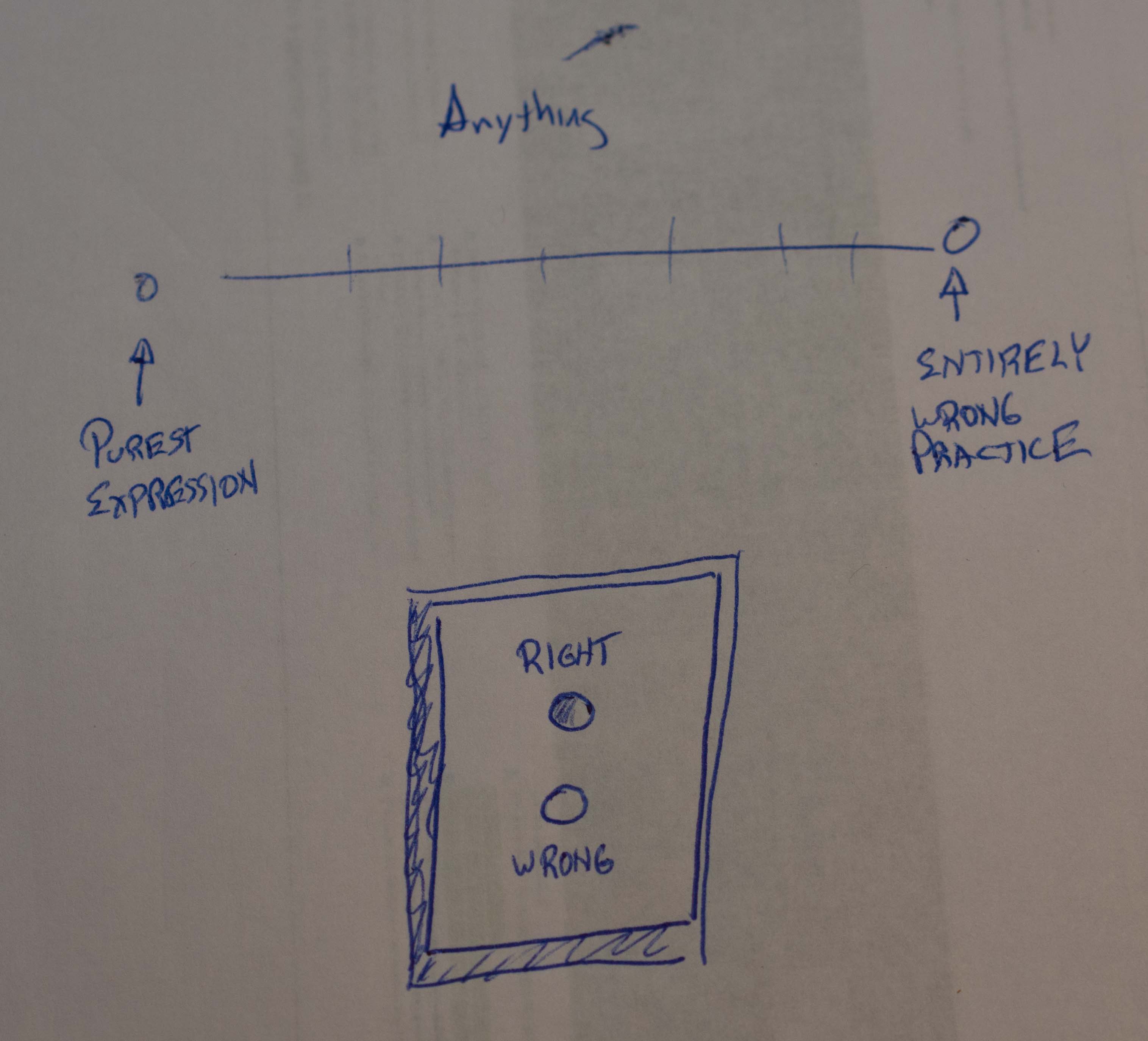
You’re doing it wrong?
Brian McLaren might say: “Not so fast.”
McLaren’s A New Kind of Christianity: Ten Questions That Are Transforming the Faith points out that modern reflections of Christianity (even/especially modern evangelicalism) may themselves owe a lot to this syncretistic impulse. In A New Kind of Christianity, McLaren argued that the reading of the Jewish Bible (the Old Testament) and the New Testament have been overtaken by platonic thinking. He describes a six-step formula that many Christians immersed in the Bible would subscribe to—and then he goes on to point out that formula owes much more to Plato than it does to the Torah. Some argue that McLaren’s is a naïve reading of Plato, which may be accurate: whenever we reduce this to that, we lose nuance and insert our own biases.
McLaren’s notion that we are at cross-purposes with the Bible when we read it as a constitutional law document rather than diligently seeking out (and sticking to) the purposes for which the documents were written also rings true for me. I’ve been on the giving and receiving end of too many interpretations that conveniently keep the people in power in power. But McLaren’s notion has lots of layers that require extensive teasing out and discussion.
Brian McLaren is a lightning rod. People love him. People hate him. It’s not hard to see why, when he accuses the entire ecclesiology industry of syncretism.
I like McLaren’s book because it is a beginning of trying to strip away our syncretistic impulses. Especially those impulses we are so embedded in that we can’t see them, sort of like the fish who doesn’t understand the concept of water. Sure—McLaren’s book has flaws. It turns reductionistic every so often. It makes huge leaps. Yes.
And yet we need real help to see where we have inserted our own thinking into a holy document and called it God’s word. Because this happens over and over again. And I think God doesn’t dig that tendency on our part. I would guess he would prefer the attitude behind, “I am blind. I would like to see.”
McLaren points out some of our blindness.
###
Image Credit: Kirk Livingston
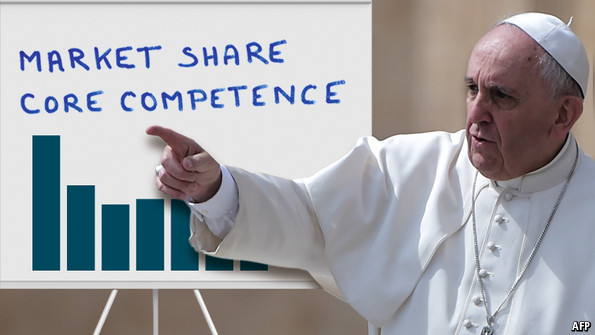
To My Friends Who Have Abandoned Faith
Kathleen Norris: Acedia and Me
If you’ve been turned off by the excesses of evangelicalism or the big-business, industrial mindset of a megachurch, or if you’ve become weary of a clergy-centric approach to faith, or if you are tired of trite, pat answer to life’s really thorny questions, consider reading Kathleen Norris’ Acedia and Me: A Marriage, Monks, and a Writer’s Life (NY: Riverhead books, 2008).
If you’ve turned your back on faith entirely and see no point in going back to the social club that seemed to promise transcendence, especially then, read Acedia and Me. If you’ve become weary of the automatic linkage between Republicanism and Christianity, well Kathleen Norris does not speak to that sorrow. But, patience: within a generation that unfortunate concatenation will be far less automatic.
Kathleen Norris is an engaging writer who addresses the life of one’s spirit wholly without the overweening sentimentality that usually comes with such discussions. Ms. Norris sought answers from an unlikely set of conversation partners: old dead guys who wrote when people could count the centuries on two hands or even one. Many of these old desert monks had abandoned the newly popular, powerful, and politically-connected church. Instead they sought the quiet of the desert to confront their demons.
Acedia, which is perhaps the heart of Ms. Norris’ book, is not easily translated. Some read it as depression. Some read it as sloth or boredom or torpor. Ms. Norris traces the word through the ups and downs of her own life as a writer. Her own marriage is a key player in the story and she seems to hold little back in illustrating her struggle.
I was particularly taken with her definition of sin, which had less to do with breaking a set of rules and more to do with recognizing that people are made in the image of God and there is something hopeful and fetching about aligning one’s direction to recognize that.
In the end, she has a fresh take on one’s faith. You may agree. You may disagree. But you’ll be engaged. And better yet, you may even hold off from tossing everything over.
###
Image credit: Kirk Livingston
Ahh: Back To Work
ListenTalk: The Promise. The Mission. The Chapters.
Dear Reader: A word, please.
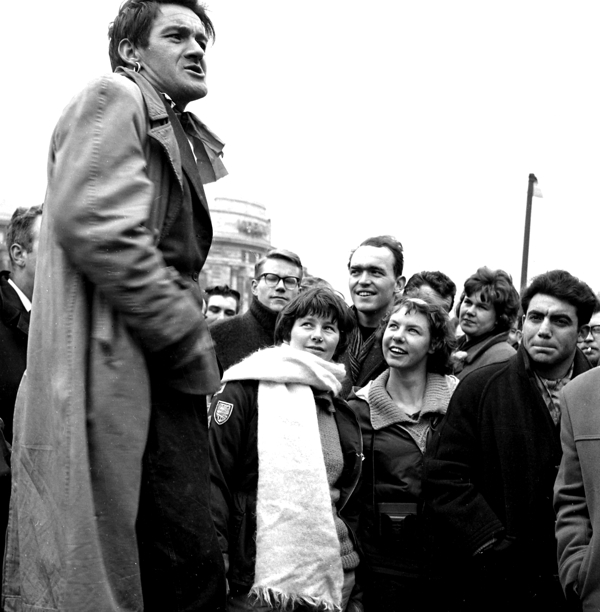
Speakers’ Corner, London, mid-1960s
Over the next few months I’ll be writing in response to a couple classes I’m teaching at the University of Northwestern—St. Paul. That means I’ll be dealing with questions and ideas that pop up in class. The classes tend to be quite collaborative and the students have interesting contributions that I may work out in this forum.
I’m also trying to work out how the notion of ListenTalk applies to the different audiences I work with as a copywriter. ListenTalk: Conversation is an Engine is built on a theological basis and is first a meditation on a new (or—I maintain—a very old) way of looking at how we spend time with each other. Over the course of the year I hope to enlarge the argument to help workers talk with bosses (for instance) and vice versa. I’d like to enlarge the argument so conservatives and liberals can put down their label (and libel) machines to engage in productive talk. I hope to work out the notion of commercial conversation so companies can begin to talk with customers in a way that treats people as rational collaborators versus emotive flesh-encased ATMs.
But first, and to bring a bit more focus on this initial argument, I present the promise and mission of ListenTalk, as well as the chapter synopses:
ListenTalk Promise:
Read ListenTalk and you will be stimulated to reconsider how even your smallest, most ordinary conversations are part of a much larger story.
ListenTalk Mission:
ListenTalk was designed to help individuals in faith communities see how God works through the most ordinary and common conversations—and to see how those conversations transform everything from personal calendars to cultural mandates.
ListenTalk Chapter Synopses:
- The Preacher, Farmer and Everybody Else. What do you expect from a conversation? Preachers preach and hope for the best. But farmers work the soil in a studied way that collaborates for growth. Meet five thinkers who have studied the ways and means and opportunities hidden under the surface of ordinary conversations. These five show that ordinary conversation is full of collaborative potential and regularly turns into some of the most important, creative and lasting work we can do together.
- Intent Changes How We Act Together. If we enter a conversation itching for a fight, that’s just what we’ll find. But we can change our intent. And one thinker shows a better way to engage in persuasion, while the apostle Paul shows God’s intent to pull us toward Him without a fight.
- How To Be with a God Bent on Reunion. The first thing to know is that conversation with God is not limited to a lifetime. Second: talking with God over a lifetime tends to change a person. Third: what does it look like to befriend, follow and serve a God whose full energy is spent on connecting with people?
- Your Church as a Conversation Factory. Peter found a way to incorporate God’s old words into a very new situation. Conversations among believers do the same, person to person, with world-changing results. How conversations emerging from within a church change everything outside the church.
- Extreme Listening. Extreme listening opens us to live in a larger story: Just ask Hannah. Five misconceptions about listening. Become an extreme listener by adopting three attitudes, four motivations and three strategies.
- A Guide to Honest Talk. How to walk your talk in three steps: 1. Show up. 2. Know this about people. 3. Join in and move out.
- Prayer Changes Our Listening and Talking. What really happens when we engage in conversation with God? Conversation with God as our model for talking with each other.
- Go ListenTalk. We are most alive when helping others see the true thing inside us. Marching orders and opportunities.
###
Image credit: Moyra Peralta via Spitalfields Life
Please Write This Book: Seminarians in the Salt Mines
Why I left seminary and why I came back
Short Answer: Seminary trains people to be pastors (no surprise to anyone but me) and while I was interested in God and theology and life’s big questions, I had no intention of being a pastor. My calling was in the world of work and getting stuff done (after a fashion: I still prefer thinking about doing to actual doing). But life’s big questions kept popping up.
Long Answer: one may run but one cannot forever hide from one’s life purpose. For me the big questions reasserted in the regular world most of us live in (versus a churchy, holy world where magical thinking sometimes takes precedent).
One of the big questions had to do with what encouragement looks like when stripped of official roles and titles and authority. To encourage—especially to encourage others to seek after God—floats as calling alongside any and all professions, roles, work and lifestyles. Which is why I finished the theology degree: because I want to encourage people in my profession (communicators, copywriters, art directors, marketers) and concomitant professions (all the folks I interact with every week: engineering, leadership, professors, photographers, pastors, scientists, all manner of physician, nurses, entrepreneurs, students, writers, editors, publishers…it’s a long list for any of us).
There’s a new emphasis out these days among pastors and theological educators. Well, not so much new as renewed: pastors have suddenly realized the world of work has not/does not/will not respond to churchy topics. Tim Keller’s work is pointing people that way and new organizations are springing up all the time, like the Bethel Work with Purpose initiative and Tom Nelson’s Work Matters: Connecting Sunday Worship to Monday Work. I’ve written optimistically and pessimistically about the attempts because I wonder at the intentions behind them:
- Are theological leaders focused on the workplace to enlarge their borders and so pull more people into the orbit of their particular organization?
- Is the workplace viewed as a missional last-frontier where all should be trained to verbalize dogmatic jiu jitsu?
- Or is the emphasis truly on encouraging regular folks (like me) to understand how God works in and through our work—and setting us free to go & do guilt-free?
- Can insular institutions release people to sort out what’s redemptive about their work—even if their ultimate answer has little to do with growing their local institution?
Perhaps I’m asking for too much nuance: is this an institution that focuses in or out? And if it focuses out, what does that mean for sending people and what does it mean for those authorities whose income depends on tethering people to the institutional focus?
Seminarians in the Salt Mines
Please write “Seminarians in the Salt Mines.”
- Start by showing how the God of the Bible was a God who attended to physical work and how work is no less a ministry than caring for souls.
- Help seminarians understand that calling is as much about dealing with the issues of work as it is people’s souls and in fact, people’s souls are laid bare in and through their toil. Or at least it can be that way.
- Have a chapter or section about the horizons of work: how looking out at a lifetime of work forms one’s perspective about what is important and how to spend time.
- Include stories of people who have preached the gospel with the work of their hands, people like Wendell Berry and Frank Laubach. Every chapter could have a story that showed a Wendell Berry-like faithfulness to a community and to substantive faith-giving practices in the world.
- Include stories from people actively pulling faith into their work: not the superstars seeking national attention—just the folks right around you.
I’d read that book. I’d buy that book.
###
Image credit: National Archives of Scotland via Salvage
Chris Armstrong Just Said Something Insightful About Work
Your Actions Keep Shouting To Me
Which is no big surprise—Dr. Armstrong, Professor of Church History at Bethel Seminary, often says insightful things.
But in the Fall 2013 issue of Bethel Magazine (if it were available online, it would be here) he pinpointed a theological missing link: that while people of faith think lots about God and Jesus the Christ and Heaven (and Hell), we have not thought much about what happens between the beginning and the end. Which also happens to be where most of us spend most of our time (that is, we’re all at various points between the beginning and the end).
Work is a key feature of what we often call “life.”
So we have Creation, Incarnation, and New Creation. But most of us are pretty fuzzy on these three key parts of the Bible narrative. And because we’re fuzzy, we super-spiritualize our faith. Faith is about the stuff we do on Sunday, at church. But darned if we knew how it’s supposed to connect with our Monday-to-Saturday life, most of which involves work. The only biblical way to get past this is to reconnect with Creation, Incarnation, and New Creation.”
(Armstrong, Chris. A Theology of Work. Bethel Magazine, Fall 2013. pp. 22-24.)
I like what Dr. Armstrong says and would encourage you to read the entire article. He draws on insights from Tim Keller’s work on work and points out, for instance, that Jesus the Christ had a first career as a contractor (building with wood and probably stone too) before he turned to the Christ business. Or this: the Christ part of his career was there all the time but latent for the first 30 years.
Allow me to adjust Dr. Armstrong’s insight with this: it’s actually our faith spokespeople who direct us toward beginning-and-end thinking. That’s where their expertise lies. You might say pastor/theologian types have (limited) authority and a free pass to talk about that stuff (especially what happens when you die). And so they do. Week after week.
But it’s up to the people living the life and doing the work to talk about what Incarnation says about, say, copywriting. Or craftsmanship. Or selling or surgery or teaching. Or digging wells (or graves). Or caring for kids or forests or the earth itself. And maybe we should look for action rather than sermons from each other, because that is how most of us talk: through the work we do.
I would go on to wager that most of us regularly draw from quite a collection of eloquent life-statements about meaning and work: both how to do it and how not to do it.
###
Image credit: Via Frank T. Zumbachs Mysterious World
When Twitter Visited Third Baptist Church
What Church can learn from Business #1: Acknowledge the Pain
Scene from a Sunday Service
Pastor Smith: We’ve jumped into the 21st century today with our projector up there tuned to the Twitter Channel! Today: don’t silence your smartphones. And you Twitterites, dial in your Twitter smart app and shoot your questions, comments and tweets to At ThirdBaptistRightNow. And remember to use the hash ticket number sign SubmitAndLove!

Acknowledge questions to unlock the door you’ve invited your audience to walk through
Pastor Smith: Open up your Bibles to Ephesians 5 and let’s get right down to the text and how wives need to submit to their husbands and husbands should love their wives.
@ElderEli: You’ll acknowledge how the passage has been abused for years, right? ThirdBaptist is just as guilty as anyone.
Pastor Smith: Now let’s start reading right from verse…what’s that? AtElderEli—I sort of mention that, but I’ll not spend a lot of time on it. Wait—let me see if I can work that in. Now, let’s start with verse…
@SingleSally: Go to the Bahamas in my mind or the coffee shop with my feet? Either way is more interesting than another sermon about marriage.
Pastor Smith: Now you stick around AtSingleSally, I can promise you’ll find something interesting in…
@ILikeBigBibles: Preach it! Submit and love!
@MsBankCEO: Before you go all gender-wars, can you at least acknowledge that in Christ there is no male or female (Gal 3.28). Seems worth mentioning.
Pastor Smith: Well now, AtMsBankCEO, this passage is pretty specific about the ancient household code, but, well. Let me think for a moment how that verse from Galatians might augment my comments about roles. But turn to verse 22 and…
@BlancheWife: You’ve got to start with 5:21! Mutual submission turns your old role argument on its head!
@BlancheWife: All that follows is an outworking of 5:1-21! Please at least acknowledge that!
Pastor Smith: Hoo boy. Preaching and Twitter make an uneasy couple. Let me do something different today. Blanche, why don’t you come up here and let’s start with an old-fashioned conversation. Just you and I and the microphone and all these fine friends out here. Let’s do something new and get your perspective…
@ILikeBigBibles: No! That’s not right. The brother should preach!
@SingleSally: You have my attention.
Consider Starting with People Rather than Texts
This is not heresy. This is basic pedagogy: when explaining an ancient text, gently help people over the hurdles by showing what it meant as well as how it has been understood over the years. Because your audience is thinking these thoughts already.
Twitter is a huge help in the work of naming the things people are already thinking. While churches are not likely to employ Twitter for anything beyond amplifying their monologue, they should begin to see that the conversations they once directed are happening without them.
Learning to listen and then getting at the truth together—that’s worth exploring.
###
Image credit: Kirk Livingston
What Business Can Learn From Church #3: Build Relational Trust
Trust Takes Time. Talking Helps.
In conversation with Groundswell coffeehouse owner/Third Way Church pastor Seth McCoy, we discussed the overlap between business and community. Mr. McCoy pulled out a few business lessons that take a slightly different shape when seen from a faith perspective:
Mr. McCoy also noted how relational trust is essential for business and community.
Relational trust drives collaboration. Relational trust is what allows a collaborative leader to step away from shrill monologue and invite others to contribute their voices and experience. Leader trusts colleague (and vice versa) because they know each other’s intent and because they have recognized the giftedness each possesses.
Building trust things take time. Mr. McCoy voiced a principal that is worth examining: Make it easy to show up or leave a group. And make it hard to become a member. Because membership is the route of committing to shared direction. Spending a year in relationship with a person before marriage lets you see the person in all the seasons. Spending a year in a job helps you fully appreciate the economic cycles, urgencies and payoffs. Human just need time to process stuff. Over the course of four seasons, we interact, voice concerns, we are delighted at some things and taken aback by others.
The truth is that relational trust takes time and patience and lots of conversation. While there are no shortcuts, the words we bring to our time together have a way of spurring us forward and helping each other absorb the direction.
###
Image credit: we apologise for the inconvenience via 2headedsnake

 conversation is an engine