Archive for the ‘church is not an industry’ Category
What Business Can Learn From Church #2: Be Accountable—Especially After Conflict
Stop to Honestly Revisit Decisions
If everyone on your leadership team has an equal voice, how do you sort through conflicting opinions?
First, know that “equal voice” is as rare in teams as it is problematic. It’s likely some team members have a more equal voice—a voice that carries more authority (like the boss, for instance. Or the one who signs the bi-weekly pay stub). And, sadly, team-members willing to scream and throw a fit will often get their way through intimidation and/or sheer annoyance.
In this space between work, craft and carrying out community described yesterday, Seth McCoy talked about a leadership style that didn’t set the founding leader as the all-knowing, final-answer seer whose verdicts were solid gold. Instead, passionate committed leaders bellied up to give their opinions, expecting always to be heard. To continue to get full engagement from these leaders and their wide-open thoughts, team decisions must be revisited and discussed after the conflicting decisions.
Say your leadership team is conflicted on a pivotal decision. You need everyone behind the decision because you know each leader will motivate themselves and their teams based on the urgency of the task. You need them engaged. Whether your team takes formal votes on decisions or just gives a thumbs-up/thumbs-down, the mechanism that allows your leaders to respond to a decision should not be the final word. Allowing the team to revisit decisions in conversation builds trust—but those revisiting conversations must be open rather than defensive.
What business can learn from church is to build enough human to human accountability to actually, really, truly revisit group decision. To ask whether it works or not. And to offer honest assessments. And to build a solid history of honesty.
This is how any organization builds relational trust.
###
Image credit: gh-05-t via 2headedsnake
You may also be interested in:
What Business Can Learn From Church #1: Relational Trumps Transactional
Identify and Hear Gifted Voices
Seth McCoy runs a coffee shop in the Hamline Midway neighborhood of St. Paul. Groundswell makes an irresistible Chai Cinnamon Roll—especially warm.
Especially first thing in the morning.
Seth McCoy also pastors a church blocks away. A new sort of church that takes seriously the notion that people benefit more from dialogue than monologue.
Church and coffee shop each vigorously pursue their mandates: Groundswell makes tasty foods and strong coffee in a high-ceilinged, inviting neighborhood space. Third Way Church takes seriously the notion that community is much more than one guy sermonizing for an hour—you are likely to hear many voices if you show up at a gathering. Groundswell and Third Way Church inhabit the same neighborhood. This community connection also begins to bridge traditional divides, like the sacred/secular myth.
Talk with Seth the business owner and he may tell you how the leadership team works at Third Way Church: discussions can get “heated,” which is to say, leaders are passionate and vocal. One gets the sense they don’t hold back. On the church leadership team they’ve identified different giftedness or abilities in each of the leaders and they try to honor that particular voice. Often leadership voices in a church can follow some of the traditional patterns of prophet/apostle/evangelist/shepherd. Team members speak consistently from their expertise—which is also their natural bent—and they speak with authority.
 Our businesses are typically more transactional affairs. Employees are hired with a set of expectations (whether narrow or wide) and expected to go about their business. Our best work situations are those that move beyond merely transactional and begin to see the various bits of giftedness each employee brings—and then honors that voice. Most of us who have worked in organizations and companies where we remained unheard—and those work situations number among our least favorite. And those best work situations were where we were identified as the person in the know on some particular aspect of the shared vision.
Business can learn from church by recognizing the gifts, abilities and particular bent of employees and hearing the authority that employee speaks from. No matter what position the employee has, there is some authority/expertise/giftedness they bring.
We owe it to each other to move beyond transactional to relational.
###
Church: Neither Benign Social Club nor Political Hack
One Approach to Juxtapose
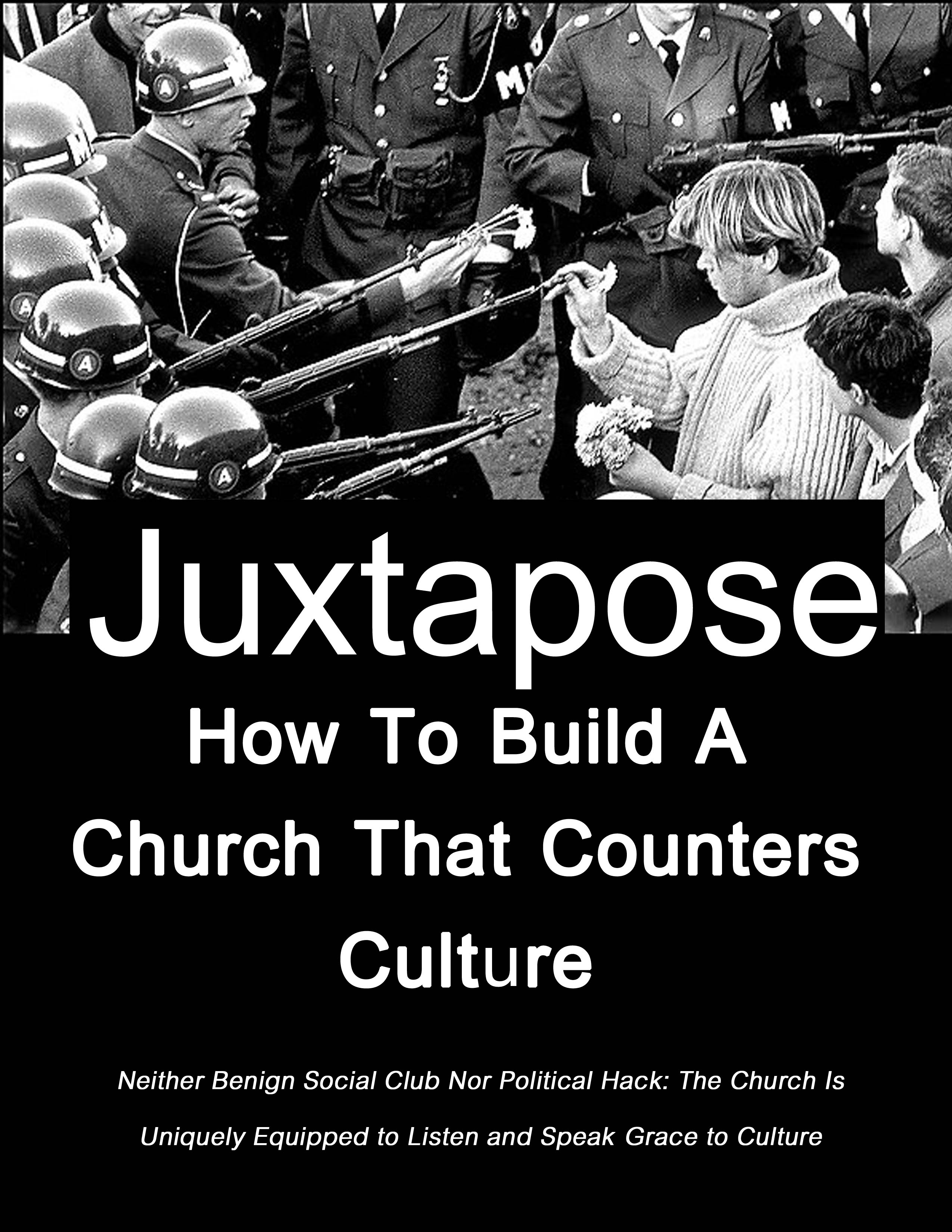
This is one concept as I work out the marketing messages for Juxtapose: How to Build a Church That Counters Culture.
If browsing in Barnes and Noble, would you stop and handle a book that looked like that?
###
Image Credit: Unknown. Do you know?
Please Write This Book: How To Be Properly Peripheral
A word for the 99%
Not everyone can be at the center. Not everyone is the leader, the big cheese, the boss. Some dwell on the fringe. Work, neighborhoods, any given party, hey—even families have members who are more comfortable sidling toward the exit.
In these posts I’ve written that the church is better off not being in the center of things: we do better speaking in from the periphery. Give the church power and it behaves like anyone with power: making the rules and silencing the voices that disagree.
But purposefully peripheral? That’s a hard case to make in our culture, where fame is everything. Especially since most of us struggle with a mild solipsism: do you or your pet poodle or your Prius remain when I walk out of the frame? I’m not so sure. I only know what I know because I am at the center of everything.
Consider: the leadership industry devises all sorts of ways to help people pull themselves up by their own bootstraps so they become the center point, the pulpiteer for their organization. The respected voice, influencing others, perhaps (sinister hope) controlling others. That’s the favored spot—am I right?
But purposefully peripheral? There’s a pretty compelling theological argument for looking for ways to serve rather than control. Please write the book about how that argument unfolds for the 99% of us who are workers rather than rock stars. Please write about how our small daily actions have an impact. Please give me a vision for how the quiet, mostly unnoticed work is really the glue that holds society together and is also—quite possibly—the neurotransmitters of divine action. Tell me again why listening trumps talking most of the time.
I’d read that book.
I’d buy that book.
###
Image credit: Ed Fairburn via 2headedsnake
Juxtapose: How To Build a Church that Counters Culture
 Theological Roots and Practical Hope for Extreme Listening and Honest Talk
A couple nights ago Mrs. Kirkistan and I had dinner with old friends we’d not seen in some time. It was refreshing to catch up and there was lots of that free laughter that happens when old jokes and forgotten quirks reappear. At one point someone asked whether we were hopeful about the state of the evangelical church. We each offered an opinion.
Mine: “No.”
It’s actually a qualified “No”: my sense is that the evangelicalism has largely lost its way following industrial-strength, church-growth formulas and it has also sold its soul to political machinery. Following these tangents we’ve lost the essence of what it means to counter culture by speaking the words that stand outside of time.
I’m actually quite hopeful about what God is doing—especially in the Minneapolis/St. Paul area. We’ve seen a number of groups trying very new things while employing deeply-rooted devotion to sacred texts and veering from partisan nonsense. So my sense is that evangelicalism is morphing and, frankly (I hope) growing up.
For a couple years now I’ve been laying down about a thousand words a day toward this book dealing with the theological and philosophical roots of communication. It’s been a one-step-forward-seven-steps-back process. But I’ve just finished Chapter 8 and by the end of July I’ll deliver the manuscript to my editor friend. I’ll likely self-publish it later this year—I’ll probably have to pay people to read it (Know this: I cannot afford more than $5 a reader. So both of you readers give a call when you are ready. I’ll put a fresh Lincoln in the Preface.)
The book offers new ways to think about the ordinary interactions we have every day. It draws on a few philosophically-minded thinkers and reconsiders some old Bible stories to reframe the opportunity of conversation. It also provides a kick in the butt to move out of our familiar four walls to engage deeply with culture—but not from a standpoint of judgment, rather from a deep curiosity and love. I’ll be sharpening the marketing messages over the next few months, but here are the chapter titles so far:
Would you stop browsing at Barnes and Noble long enough to pick up a book that looked like this?
- The Preacher, Farmer and Everybody Else
- Intent Changes How We Act Together
- How to be with the God Intent on Reunion
- Your Church as a Conversation Factory
- Extreme Listening
- A Guide to Honest Talk
- Prayer Informs Listening and Talking
- Go Juxtapose
Let me know if anything of what I’ve said sounds like you might actually be interested in reading. However: I can only afford to buy a limited number of readers.
###
Image credit: Daniele Buetti via 2headedsnake
Philosophers Make Uncomfortable Pastors
Sermons built on questions only inflame the faithful
 It’s the philosopher’s job to ask uncomfortable questions. They don’t take ideology as a given. They question ideology—that is forever the philosophical task. Some philosophers reading this would say “Yes, and what do you mean by ‘pastor’ and who/what is ‘God’”? That’s fair and a reasonable line of questioning. Certainly worth examining.
But say a philosopher has satisfied herself there is a God. And say that philosopher has a commitment to the God revealed in the Bible (yes there are such people). Can she pastor others? Can he serve as a shepherd? Can she speak sermons that have questions rather than answers?
No. At least not to our typical congregations. People come to church for comfort and to be told they are going the right direction. To offer the food of questions is to deny parishioners the happy holy feeling they paid for when the offering plate passed by.
But honestly, can a pastor be anything less than a philosopher? Because the claims of Jesus (to start there, for instance) are so wildly outlandish as to call into question the threads of daily existence. For instance, this notion of turning the other cheek to the one who just slapped you—it’s completely nutty stuff. Unless it is actually meant to be worked out in daily life. Unless it says something crazy deep about each and every interaction we have. To treat Jesus’ words as ideology only—as some exalted religious state—and to not examine them further in the crucible of daily life is step forward with 75% of your brain shut off.
And that’s no good. That’s no way to live.
It’s also true that most philosophers don’t abide the preacher’s art of packaging things in tidy simple packages that are easily understood. Questions don’t often fit those boxes: they bump against corners and lids with their labored back story and brief histories of how others have asked them. That’s tedious stuff that rarely fits into three alliterative points.
Which is not to say philosophers should not pay attention to packing their thoughts so they become mind-ready. They should and many do. But philosophers mostly cannot escape the orbit of the questions themselves.
I think philosophers don’t make good pastors. But I hope to stumble on such a being at some point in my existence.
###
Image credit: 4tones via 2headedsnake
The Naked Anabaptist by Stuart Murray
What’s on the other side of imperial Christianity?
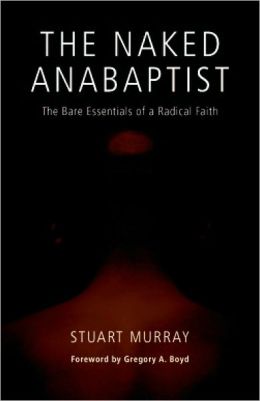
How do you think of church? Many readers of this blog find the church experience painful and reductive: at best irrelevant. At worst, dangerous agitprop. Other readers soar. I’ve been on both sides and I prefer soaring.
Church is an institution forged from a less-than-stable amalgam: people and Other. People are the weak link. But people can also surprise.
On several occasions I have written critically about church (like here and here and here and here plus about a dozen other places on this blog—just type “church” in to the Search bar to the right). For me lately, most churches resemble all the other CEO-driven marketing machines in our culture. But this marketing machine sits at the local level pulling in spectator-consumers to fund the local brand.
Yes that sounds cynical.
But just read through the New Testament and compare the multi-voiced organizations that sprung up with any of the big box affairs we love in this country. Those small communities in the text were chock full of the risen Christ and were spinning changed participants out (and back in and out and in. And out). Notice that growing spectators was not their goal and participation in shaping the organization and experience was expected.
But this book makes me less cynical: The Naked Anabaptist. Tracing a history back to the sixteenth century dissenters (who died for taking Jesus seriously, often at the hands of reformers), the book gives a fresh take on our waning years of Christendom (that is, the curious intertwining of culture, power and religion that started with Constantine in the 4th century establishing Christianity as the state religion and continued to today, give or take).
Many lament the loss of cultural power of Christianity in the U.S.
Not me.
My reading of the gospels puts the poor and weak and needy at the center of what Jesus intended. His was/is an ethic markedly different from the mandates we pursue that force a top-down approach. And The Naked Anabaptist hints at what the church could look like if it were not a univocal marketing machine. Murray’s seven core convictions lay out a compelling picture. And it is not a picture with one pastor/president/CEO at the top. The book probably gives more shortcuts to Anabaptist thinking that some Anabaptists would be comfortable with, but it is thought-provoking and vision-building.
Woodland Hills in Saint Paul, Minnesota is considering joining the ranks of Anabaptists. The church came to the conclusion after realizing the kinship they had with the doctrines. But I wonder: can a mega-church be a multi-voiced church?
###
Pope Francis Tango: Simplicity, Poverty, Rigor
Messaging that Walks Then Talks

I’m not a Roman Catholic sort of guy, still I find myself drawn to the early descriptions of this tango-driven, Argentinian man-for-the-poor Pope. His actions—catching a crowded mini-van to dinner, hoisting his luggage while paying his hotel bill, crowding into elevators and stairways with everyone else—illustrate some new thing. This new thing looks closer to people and sympathetic rather than distant, academic (in the fusty, out-of-touch sense) and authority-driven. The Roman Catholic Church remains an immense hierarchy with all sorts of problems, but this new thing looks positive.
I like that he wants the organization to get back to evangelism. That seems like he is peering into the right well, looking back at the roots. If he had asked me about repositioning the church (still waiting for the call), I could point in no better direction.
Of course, all sorts of bad, coercive, manipulative, openly evil things have been done under the guise of evangelism. But at its best—and it gets hard to strip away the muck accumulated over centuries—Christ’s message of redemption carried by people who are themselves changed, is transformative.
So. Bravo for pointing back to the roots, Pope Francis.
###
Image credit: John Stark via Frank T Zumbachs Mysterious World
Jesus Land vs. The Master
How we pursue power over others

I watched The Master because I was interested in Scientology. I’m not sure how much I learned about Scientology from The Master, but I did see an able portrayal of glib salesmanship and a nifty, nimble made-up religion. And I did see one writer who found a way to sell lots of books, despite the ethical chasm of painting fiction as reality. I did see people who bought in because it fit the way they wanted to see the world. It’s a dark picture and moody. And depressing.
I also just finished Jesus Land, by Julia Scheeres which shows a similar nifty, nimble made-up religion (this one a sad, dark aberration from Christianity). Scheeres’ memoir chronicles growing up in the 70s with abusive, hypocritical parents and power-mad religionists.
There’s nothing like seeing things through the eyes of the resident teenager to unfurl the hypocrisy in a family. You want to hate the parents for their push for outward form even as they undermined their kid’s confidence and ability with ridiculous rules and expectations. And beatings. And micromanagement. And withholding of affection.
As someone who knows that dark side of Christianity is truly an aberration and not at all the entire story, I am so sorry Ms. Scheeres and others had that experience. And I am equally sorry those experiences sent them running the other way. I certainly understand why.
 Many of my friends and likely many reading this will disagree, but I encourage anyone to read through Scheeres’ portrayal of a life where texts and disciplines are wrenched out of context and used as dark and potent weapons. The book is useful if for nothing else than to examine our own habits of turning powerful positive messages to gain power over others.
Both Jesus Land and The Master revolve around made-up religions that are nimble in that they change to suit whatever the leader needs to accomplish. In The Master, Lancaster Dodd is literally writing his new religion as we watch and changing it as he goes. People notice this. He doesn’t care. But his principles are both abusive and entirely without moorings. In Jesus Land, the parents and leaders pick and choose quotes from the Bible to make their point and exert power over the teens. Again—they are blind to having lost the integrity of the message and the ancient moorings that would help them. I can think of half a dozen organizations started in the 70’s that cherry picked Bible passages to make their own aberration of Christianity. At the time, few of us thought to say, “Hey. Stop that.”
Some reading this will say: “But isn’t that the whole point of religion: to make up a set of rules so as to gain power over others?” I appreciate this perceptive comment and it does seem to be true, except that those ancient moorings and understandings can serve to curb the excesses of our current “isms” (whether fundamentalism, evangelicalism, Christian nationalism or whatever). There remains something much, much deeper to explore.
Jesus Land is worth reading, though not at all easy. The Master left me wishing for less.
###
Image credit: un-gif-dans-ta-gueule via 2headedsnake
Wendell Berry’s Jayber Crow: Christ Came to Found an Unorganized Religion
I am, maybe, the ultimate Protestant, the man at the end of the Protestant road, for as I have read the Gospels over the years, the belief has grown in me that Christ did not come to found an organized religion but came instead to found an unorganized one. He seems to have come to carry religion out of the temple into the fields and sheep pastures, onto the roadsides and the banks of rivers, into the houses of sinners and publicans, into the town and the wilderness, toward the membership of all that is here.

Well, you can read and see what you think.
(Jayber Crow, Chapter 29)
###

 conversation is an engine