Archive for the ‘Collaborate’ Category
How LinkedIn Helps Before You Are Between Jobs
Generate The Thing Between
LinkedIn is a powerful tool for connection. But lots of people, once they land the job, put connection on the back burner. Some take it off the stove entirely—and that is a mistake, especially in this economy. I know this because many friends and colleagues are on radio silence most of the time. Until rumors of layoff float by. Then it’s connections galore.

Don’t let connections go dormant.
Connection is something that happens long before you have a need or want to generate a sale. In fact, connection is not about the need or the sale, it is something entirely different. And we make LinkedIn frenemies when we mistake connection for a sale.
For those who understand the importance of connections outside immediate work and building relationships widely, there is a great joy in getting to know people and simply seeing what might happen. It’s not even an introvert/extrovert thing. It is a possibility thing. Maybe it is a thing for dreamers, but I think not. It is for anyone who starts to wonder what is possible outside the structure that encases their days.
This openness to others—this beckoning to others, this waving them close—is the early move toward collaboration. It is the ordinary conversation that starts to generate new things between you, seemingly by magic. It is the beginning of finding common ground that eventually leads to “Wait—what could we do together?”
Curiously, openness to others has a way of working backward into our present job so that we start to see new ways of working, collaborating and connecting.
When teaching college students about professional writing, I try to help them understand that the best jobs are the ones not advertised. The best jobs open and shut before ever posted on a web page or printed as a classified ad. Those jobs are available only to connections. Those jobs are almost incidental to the connection: friends see what you do, how fun you are to work with. Their synapses fire and they say to themselves, “She might be perfect for this need we have.”
Maintaining and growing connection is not for a someday need or someday sale. It is a piece of being human and carries a glory all its own.
###
Image credit: Kirk Livingston
Jacob Morgan: Working Out Loud
Can collaboration lead to the fancy donut shop?
We’ve all known people who narrate their way through the day. Whether choosing today’s outfit or cooking or driving, these people say what they do as they do it. What they say includes the choices of the moment.
Such narration could drive you mad.
Unless you cared.
Say you were in the car and the narrator/driver mumbled something about turning left at the light. But you knew the fancy donut shop was to the right. So you suggested going right at the light. The narrator/driver turns right and, Behold!
“Hey—there’s the fancy donut shop we heard about. Should we stop in and get a dozen for the team?” you ask (innocently).

Take a right at the light.
What if we heard about work details we cared about in real-time? But not the kind of hearing that entails being pulled into a conference room so the boss can blather on about goals and objectives. I’m talking about the kind of hearing where your genius colleague one cubicle over shares a “Eureka” about the message your team is crafting. Or—more likely—when your colleague in Scotland answers your informal text message from the U.S. with a game-changing insight. An insight that has the power to order your work for the next two hours.
Being present with each other in our work has the power to delight our working selves. As we toss out ideas and questions amidst the ordinary banter, brand new stuff happens. It’s the stuff that can only happen between people in conversation. It’s not the stuff some boss orders you to do.
 I just ordered a copy of The Future of Work by Jacob Morgan based solely on the articulation of “working out loud” from this author interview on the Kinship enterprise blog. I’ve not yet read the book (did I mention I just ordered it?) but I firmly agree with the notion that the future of work entails some configuration of people wanting to work with a given organization rather than having to. “Get to” versus “have to” makes a huge difference to the motivation and energy with which we approach our work. I’ve argued for a LEED-like certification for workplaces that sustain the human spirit, and I think that is on the radar screen of job seekers today.
“Now let’s get back to that bakery,” he said, as he pocketed his car keys.
###
Image credit: Kirk Livingston
Doing Versus Planning To Do
Stay close to the work

Man is after all a finite being in capacities and powers of doing actual work. But when it comes to planning, one mind can in a few hours think out enough work to keep a thousand men employed for years.
McCullough, David. The Great Bridge (NY: Simon and Schuster, 1983), 381. Quoted in Berkun, Scott. The Year Without Pants (San Francisco: Jossey-Bass, 2013), 67.
###
Image Credit: Kirk Livingston
Getting Things Done: Better Call Agent 007-0827
Or should we call a prayer meeting?
“Agency” is a word for getting something done. In a philosophical sense, it is the capacity to act in the world. It has to do with choice-making and accomplishment and focus—especially focus. We hire an advertising agency when we need to offload some critical marketing element and make sure it happens. That agency accepts the mission and acts. And so we pay their fee.
Why hire agency? Because we don’t have the capacity to do it ourselves, whether that means talent or headcount or time or interest or focus or all of the above. But the critical thing needs to be done and must be done. So we get someone we can trust to do it. There is an entire industry set up around the notion of getting things done. Time management is always a hot topic for any gender in business or academia and in the rest of life.

But agency has a tricky theological side. Even non-theists debate determinism versus free will. And Christians, well—we’ll kill each other over our views of how the world works. Just find an Anabaptist and ask how their minority voice was received by their determinist rulers, way back when.
Why bring in theology when talking about getting things done in real life? Isn’t theology the useless opposite of getting things done here on earth?
Yes.
And, No.
Because while we can accomplish much with our time-management techniques, there is much outside our ability. Like changing someone’s mind. Or opening long-closed doors. Or protecting oppressed people from their brutal dictator. Or helping a nation care about all its citizens (versus just the privileged ones).
What the time-management industry does not answer and cannot answer is how to work with these very large questions that deal with agency in the larger world. So we back off and shut down and feel guilty.
Can we pursue agency that sees and acts on larger things? Some of my heroes are doing this and their agency consists of some combination of prayer and action and faith and presence.
###
Image credit: Kirk Livingston
Let’s Get Liminal: How to be a Co–Laborer/Co-Thinker/Co-Contributor
Show up to explore the space between
My friend helps researchers at his Midwestern university organize their thoughts for publication. He also helps them apply for grants to fund their research—a function many universities are increasingly focused on.
To do this work, my friend has found ways to walk alongside new professors as they form their research interests. By staying beside them over time (years, even), he is able to help identify places where the work can go forward and also begin to locate potential funding sources. That’s when the hard work begins of explaining the research to a funding committee.

Approaches to Minneapolis
This space between—where the research shows particular promise but is still unformed—this is where a conversation can bear fruit. Maybe even the goal itself is starting to take shape, along with possible routes to that desired end. Sometimes it is the conversations surrounding the goal and routes to the goal that open it for exploration.
Michael Banning is an observer and painter of liminal spaces—those spaces and places that we typically don’t even see:
I am interested in the liminal spaces found at the edges of the inner city. Amid the trucks, weeds and railroad tracks of those often post-industrial surroundings, one can find compelling views of the distant skyline as well as a sense of peace and quiet uncommon in the urban experience.
–“Parking Lot near Train Tracks,” by Michael Banning, label from James J. Hill House Gallery

Parking Lot near Train Tracks (Photo courtesy Michael Banning)
See Michael Banning’s work here.
When we are lucky enough to find ourselves talking about these liminal spaces with each other, we might be collaborating in a particularly effective way. Typically we don’t have a clue when we’ve entered such a verbal space. Years later we might identify a conversation that was a turning point. Perhaps the best we can do is to remain open to entertaining each other’s unformed thoughts.
Who knows what might result?
###
Image credit: Kirk Livingston
Citizens: Neither Audience nor Consumers but Makers

Reuters image
In a viable self-governing nation… citizens can only know themselves by way of the civic agency. True citizens are not the audience of their government, nor its consumers; they are its makers.
–Hyde, Lewis. Common as Air (NY: Farrar, Straus and Giroux, 2010) 27
###
Mind-reading and the Perfectionist’s Dilemma
“Come here, you big, beautiful rough draft.”
You know what needs to be done.
You know how to do it.
But—given your schedule—you simply cannot attend the details. What you want is to jump to editing the rough draft—but who’s got time to create that rough draft?

This is what I’m thinking….
We could be talking about drafting an email, an article or a chapter. We could be talking about a curriculum for a class or a seminar. We could be talking about writing a memo to employees or a letter to partners or a speech to stakeholders—anything that requires focused attention for a time so you can spin out and organize the details. We’re talking about anything you need to create from scratch to deliver to others. Any communication that solves a problem you’ve noticed.
Now is when you need an assistant who can move forward without hand-holding. Now is when you need someone who knows what you know without you telling them. Now is when you need a mind-reader.
But there are no mind-readers.
Are there no mind-readers?
I won’t say copywriters are mind-readers. I will say I find myself in situations every week where my client has provided 15-25% of the details but expects our project to organize 100% of the content in a coherent, compelling fashion.
Sometimes I wonder if our close friends, colleagues and collaborators serve as near-mind-readers. With them we feel free to spit out the raw bits of what we know. And as we say it, we realize what we need to do next. To tell someone what is on our mind is the first step to accomplishing a task. Those conversations are a kind of verbal rough draft.
Don’t be intimidated by the blank page. Embrace the notion of doing something mostly wrong and partly right, which is to say, embrace the rough draft.
It is much easier to change words on a page than it is to put words on a page.
###
Image credit: Kirk Livingston
Could Your Organization Grow Your Spirit?
LEED-like certification for human-spirit-sustainable workplaces
LEED certification is a rating system that recognizes a building’s sustainability. LEED or Leadership in Energy and Environmental Design, rates a new building project using five different categories:
- Site location
- Water conservation
- Energy efficiency
- Materials
- Indoor air quality
Businesses and organizations with the highest ratings display them as a sort of badge of honor for the public to see.
What if there were some system to measure and rate the culture within a company or organization? Since we worry about bullying at school and we’re starting to recognize bullies in the office and toxic corporate cultures, does it make sense to start thinking about organizations that sustain people rather than beat them?

For instance, what if any organization was judged by these four categories:
- Bias toward collaboration
- Employee engagement indicators
- Mix of top-down messaging with true conversation
- Ratio of CEO-pay to rank-and-file pay
Seem ridiculous?
It would be difficult to measure many of these, especially since most of the categories seem so subjective. And yet, would it be impossible to measure? Would it be worthwhile to measure? Are we already moving in that direction?
In Minneapolis/St. Paul—like any set of cities—insider talk has long identified those cut-throat corporate and institutional cultures that routinely toss human capital to the side. Insider talk also identifies those bosses, managers and C-suite people without empathy and/or ethical moorings. New employees are generally forewarned when they sign up.
Of course, business is still about earning a living for the people involved even as the organization serves some human need. So don’t think I’m championing some communistic collective. Profits will and must be made to help society move forward.
But as we move toward fuller employment, workers will become more choosy about where they spend their days. And those cultures that have a less sustainable ethos will not be the winners.
I’m not convinced I’ve identified the right categories to measure. What categories would you include?
###
Image credit: Kirk Livingston
Melted Crayons: What Writing Collaboration Looks Like
Not yours. Not mine. But a new thing created between us.
Years ago we took our kids on the consumerist hajj to Florida’s Disney. We’re more national park vacationers but we resolved to make the best of it. So we battled through the hucksters and scam artists on every corner in Orlando and made our way to the magic kingdom.
It was…ok.
Some of our kids were scared of the rides. Some were thrilled at points. Others (including parents) grew weary of the constant stimulation. I would not be a good spokesperson for Disney.
The most memorable part of the trip was post-Disney, on a drive through the orange groves. At one point we left the rental car for not too long a time to see some Florida oddity. We came back and found crayons melted on the back seat. It gets hot in a Minnesota summer, but I don’t recall crayon-melting hot.

Turn up the heat.
Melted crayons are not any one color. They are a new color that has no name.
Recent writing collaborations got me thinking about those crayons again. Some of my favorite clients invite me into the process by explaining what they want to accomplish with their target audience. They outline the main messages but do not hold those main messages too tightly. They point out the content and invite me to organize and hone the argument so it makes sense. They invite me to retell the main messages. When I come back to my client with something they can react to, we talk and the work gets better and more solid.
The thing is, what we create is not totally mine and not totally theirs. It’s a melted melding of motifs, which we continue to sharpen and fit to the purpose.
It’s a process I enjoy very much.
And it’s a process that is not that much different from our best conversations, where we generate some surprising new thing between us, beyond what either of us set out to say. A sort of intentional, verbal, melting of crayons right before our eyes.
###
Image credit: Kirk Livingston
Joe Lueken: The Grocer With Something To Teach CEOs About Leadership
Joe Knew Where His Success Came From
Are you one of those poor souls who does not read the obituaries?
Pity: so many memorable stories.
Like the story of Joe Lueken. A couple years ago Mr. Lueken turned down the opportunity to make buckets of cash by selling his Bemidji-based grocery store chain. Instead, as he retired, he set up an employee stock ownership program and transferred the company to his workers.
He was a philanthropist who stocked shelves and took his break with the other workers in the break room. And—most telling for me—the people who worked for him had great respect for him. He was a guy whose work ethic and his caring demeanor touched lives. And it seems—at least from my reading of a couple of articles—he did so with joy.
Mr. Lueken died on July 20 after a long battle with cancer.
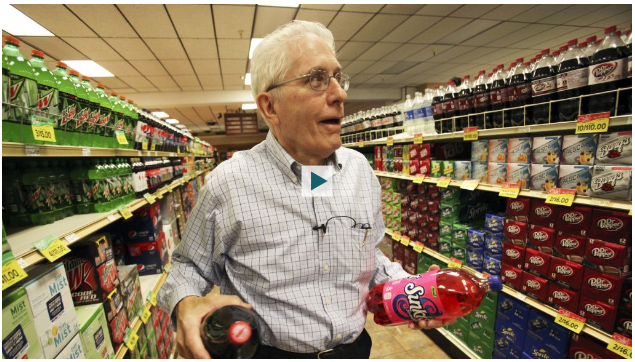
As we watch the explosion of CEO salaries and look with wonder on the board members who agree to these ridiculous payouts, it’s hard not to wish many of the current batch of muckety-mucks had worked for Joe. Maybe his humanity would have rubbed off.
###
Image credit: StarTribune

 conversation is an engine