Archive for the ‘Collaborate’ Category
Edward Hopper: How to Talk to Yourself
Can a conversation result in art?
The answer can only be “Yes!”
Not every conversation, mind you. But some will.
Last weekend Mrs. Kirkistan and I (plus our art-student daughter) wended our way through the sketches and drawings by Edward Hopper currently on display at the Walker. As a nation we’re quite familiar with Mr. Hopper’s drawings and paintings—today they seem perfectly obvious explanations of life in America. But I was intrigued by how he got there. What was his process for producing such enduring images? How did he see what he saw?
His sketches look like conversations with himself. Look how he developed the frame for his (well-beloved, much parodied) Nighthawks at the Diner. His sketches add layer to nuance to layer. It’s almost as if he were explaining something to himself with one approximation and then another and then another. Sort of like conversations with our best friend where we allow each other to say it wrong even as we pursue saying it right.
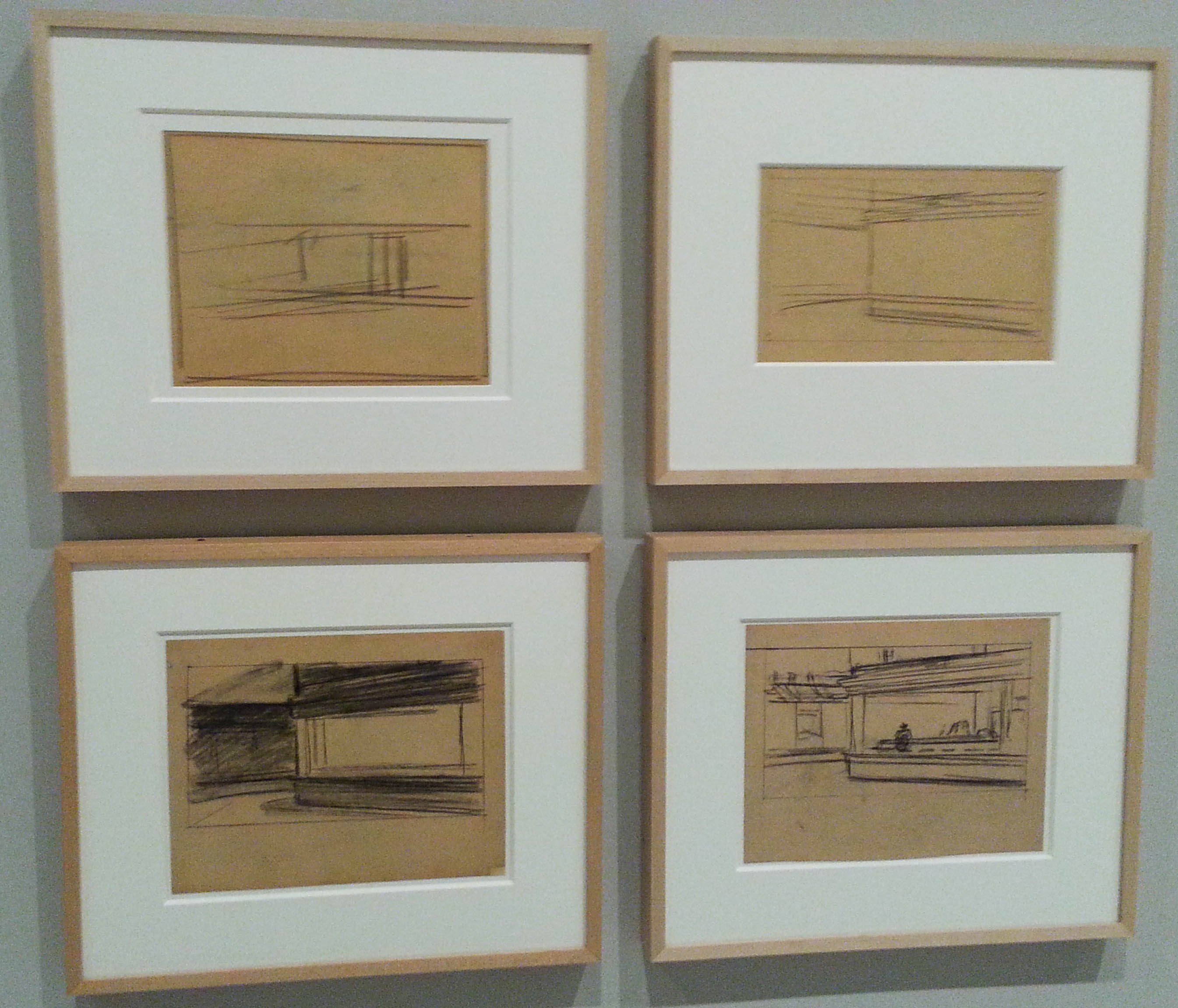
Hopper was a man given to observation and keen on interpreting detail. With quick strokes he captured form and mood and motion. And there’s no question he had an eye for the ladies:
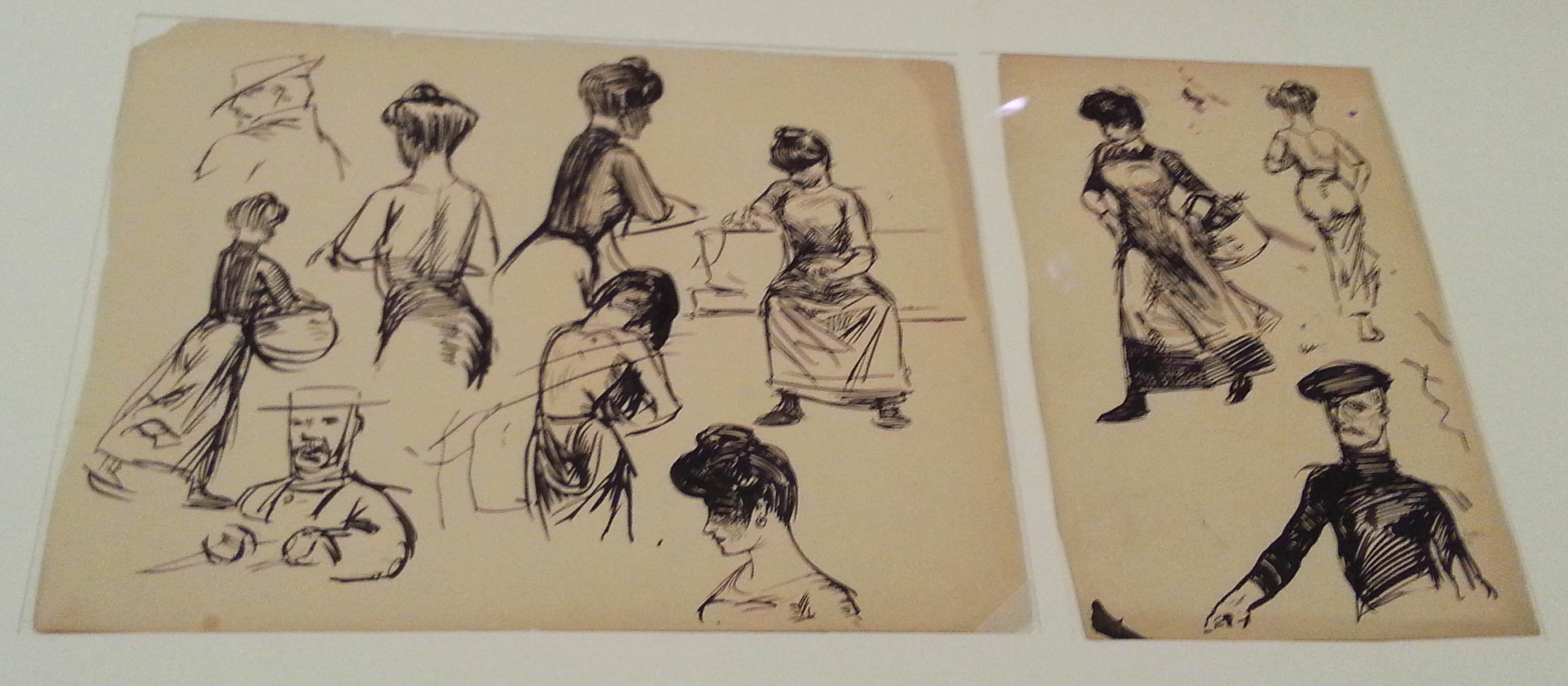
Hopper seemed to never stop observing and capturing. Again and again and again. He spent hours sitting at favorite locations and sketching and perhaps waiting. This quote from Mr. Hopper hints at his process:
My aim in painting is always, using nature as the medium, to try to project upon canvas my most intimate reaction to the subject as it appears when I like it most….
I’ve been a fan of sketches for some time because they give a behind-the-scenes picture into how someone’s mind works. The Hopper exhibit at the Walker does not disappoint. And I cannot help but think how sketches provide such a rich analog to our collaborative conversations.
###
Image credit: Kirk Livingston photos taken at Edward Hopper exhibit, Walker Art Center

How You Say: Not Just “What” But “When”
A word is a fuse. Light the fuse.
I’m teaching a freelance copywriting class at the University of Northwestern—St. Paul. Yesterday was our first day and I wanted the students to begin the shift from writing papers for professors to writing words to make a difference. I maintain that excellent copywriting is the very opposite of spewing malarkey and hype. Especially today, when anybody who can read and/or listen and absorb marketing messages has their BS meter set on high all day long.
The best copy doesn’t call attention to itself. The best copy is nearly invisible and absorbed without realizing it. The best copy latches on to or illustrates a larger idea and leads the reader to the idea threshold. The best copy is emotive and rational. If it can be silly too—all the better.
We talked about the differences we perceive in writing for non-profit, mission-driven organizations and for-profit organizations. At first glance we might think one organization is all about mission and the other is all about money. But that is a mistaken notion: for-profit organizations can be all about mission and non-profits can be all about fundraising. Examples abound in each category.
One of the things I love most about teaching these particular students is the sensitivity to mission. They are cool with the notion of using your writing skills to help others. Many are considering starting work with non-profits, but that is not unusual for many studying the liberal arts. These particular students are often eager to trace their motivations for helping others back to some of the ancient texts that drive much of this school’s mission.
But one thing that is not so clear is that mission-driven work exists in both non-profits and for-profits. One’s mission comes largely from within. Our job—that thing we get paid for—is an outward-focus of the mission we bring with us. A copywriter with a sense of wanting to help others can find a home in any number of organizations, whether for-profit or not-for-profit. And using that copywriting skill to bring a reader to a life-changing realization can be a primary motivation for the whole task of writing.
I would like to see more copywriters with that motivation.
My go-to example is the quiet laugh from the writer in this four-minute film. Listen for the laugh. Think about what that laugh says about delivering the right words at the right time:
###
Lady Gaga: Onstage Vomit Sells Doritos? Of Course.
“Selling In” Not Quite Opposite “Selling Out”

One adorned in a plastic tarp need not “sell out.”
Lady Gaga made a plea for “selling in” at SXSW last week. Doritos sponsored her onstage vomit-art, which attests (she said) to her artistic success. But read the Rolling Stone article and you’ll find a more complex, nuanced notion that falls short of completely bowing to the demands of the sponsor.
When Kerry Miller (@DailyCircuit @KerriMPR) wondered aloud what people thought about “selling out,” she echoed a sentiment borne decades before when the big rock and rollers first roamed the earth and bowed to the demands of advertisers to create art to propel commerce. Ms. Miller’s comment generated responses from scholar Patrick Cox (@patrickcoxMN) and others on just what corporate sponsorship was beginning to look like.
Ms. Miller’s generation (also my generation) labeled such people “sell-outs” and tried to work up disdain for them even as we bought the cans of soda or beer or whatever they shilled. Even as we ourselves sold out to the company we worked for. And never mind that the notion of patronage has been around for as long as artists have starved.
Watch the recent Frontline “Generation Like” and you’ll get a sense of how Millenials approach the art vs. commerce question. Gen Y seems largely happy with getting free swag and brandishing logos on their social spaces/shirts/tattoos/hair cuts.
“What’s the big deal?” [They might ask.]
Ms. Kerry’s generation (my generation) is quick to point out that “You, sir, have sold out.” The Millenials I teach might return: “You, sir, have also sold out.” Which would be entirely accurate.
Maybe Gen Y has done us a favor by repackaging the connection between art and commerce: That repackaging looks more like an articulation of authenticity. It is a voice we need to hear today. I’ve been arguing that craft and service (and art and faith) do better together than separated into holy, inviolable silos.
Gen Y is articulating some of this. Not perfectly, but they are closing some gaps and opening others. The “selling out” conversation has changed.
###
Image credit: Michael Buckner/Getty Images for SXSW via Rolling Stone
How to Cherish Your Provocateurs
Who has the power to rile you?
If you were an all-powerful despot, you might rid yourself of those who disagree. That’s the path of the Stalins, Hitlers and Kim Jong [Whatevers] of the world:
- “Off to Siberia with you.”
- “Work will make you free in this concentration camp.”
- “Here, Uncle, let’s execute you and your entire family.”
But the rest of us don’t have that power. And that is a good thing. Because it turns out we need these people around us who disagree and who see things differently. That’s because no one of us sees things entirely clearly. We need each other to piece together the big picture.
In my country, the United States, we are fond of cocooning with other like-minded members of our tribe. So we listen only to people who agree with us. We develop and watch television and listen to radio that reinforces what we think. We read only the diatribes that we might have written. In our age of cozy groupthink communities, we are quick to hit the panic button for any word that is off ideology, and quick to dissociate with those with a whiff of aberration.
Perhaps other countries have the same problem.
But what if we’ve got it all wrong? What if these different people, these provocateurs actually were providing us with a new, even more true way of looking at the world? What if these people were a kind of gift to us? And what if starting to see from their perspective was more akin to finding a $20 bill in the street?
Big groups of foreigners routinely make their way to Minneapolis and St. Paul. They are very odd, they speak in strange tongues, where strange dress. Have odd habits.
Until they don’t and aren’t.
Until they are us.
Walk back through the public rolls far enough and you’ll find your grandparents were these foreigners. Swedes, Norwegians, Italians, Finns, Hmong, Somalian. I suspect you’d even find a few people from Iowa. If the housing stock in South Minneapolis could talk, it would speak all these languages and many, many more.
The point: rather than fear the stranger, can we ask what there is to learn from this other way of looking at the world?
###
Humble Inquiry: To Lead is to Listen
Help Team Members Find Their Roles
The important lesson here is that teams almost always work better when the higher status person in the group exhibits some humility by active listening, this acknowledges that the others are crucial to good outcomes and creates psychological space for them to develop identities and roles in the group that feel equitable and fair.
…someone is still in charge, but if the group has a chance to evolve, the members can find their niches that both facilitate the accomplishment of the task and satisfy their own personal needs. Status and rank do not become equal, but teammates are comfortable with the appropriate amount of status commensurate with their roles.
Helping: How to Offer, Give, and Receive Help by Edgar H. Schein (San Francisco: Berrett-Koehler, 2009) 108
###
Image credit: Allison V. Smith via MPD

 conversation is an engine
