Archive for the ‘Collaborate’ Category
What is Your Purpose with Your People?
Can You Articulate Your “Why?” and “What for?”
I’ve been gushing over Improv Wisdom lately, this 2005 book by Patricia Ryan Madson. I’m thinking of buying a number of copies to give away and wondering how I can incorporate it as a supplemental text in my next classes. The book is easy to read, memorable and full of actionable wisdom all directed at staying in the moment and building something with others. Ms. Madson—a drama professor at Stanford, improv maniac, eager collaborator and kind-hearted encourager—brings a lot of life to how we can work with others. Now I find myself ordering the primary source texts cited by Ms. Madson.
Ms. Madson has been kind enough to respond to my tweeted epiphanies when reading her book. I am impressed by the longevity and timeliness of certain ideas. Ms. Madson’s 2005 book will likely be relevant for a long, long time.
As I finish with my Social Media Marketing class, I’m reading reflections from the students. One near universal regret was not having a clearer sense of their purposes for the communities they were trying to create. We spent focused time on this early on in the class, but forming a crystal clear picture of what we want to accomplish with others is neither easily understood nor often practiced. I know this from the number of companies I’ve been in that operated every day without a clear sense of what they were trying to do with their audiences.
Students resist the tightly-formed purpose and the close definition of their audience because it feels so restrictive. It just feels easier to write anything for everyone. At least that’s how the class always starts. But at the end of the class, there are multiple confessions about how the tight purpose and close definition actually freed them to say much, much more to their target audience. This experience fits with a bit of improv wisdom Ms. Madson offered:
Rather than asking “What do I feel like doing?” when a free moment arises, instead ask “What is my purpose?”
I love this question for my class and I love this question personally. The question presupposes I have a purpose and assumes I know that purpose. The question assumes I am conversant with my purpose and assumes I am in the habit of articulating it to myself and others.
All these presuppositions and assumptions are worth pursuing. Going back to our purpose again and again sounds like bearing fruit over a lifetime.
And this: Patricia Ryan Madson should write more books.
###
Image credit: imgur
Can A Question Trump A Script?
Don’t Prepare. Just Show Up. Improv Wisdom by Patricia Ryan Madson
A confession: it’s hard for me to break free from notes when speaking.
Maybe notes are a crutch. But I think there is more to it. I spend my days writing so I have an affection and affinity for words on pages. And this: there is specificity to writing that is not quite so available for speaking. It’s a specificity that allows me to work an idea and move the parts around even as I deliver that idea to my audience.
Speaking does not allow that.
Or so I thought.
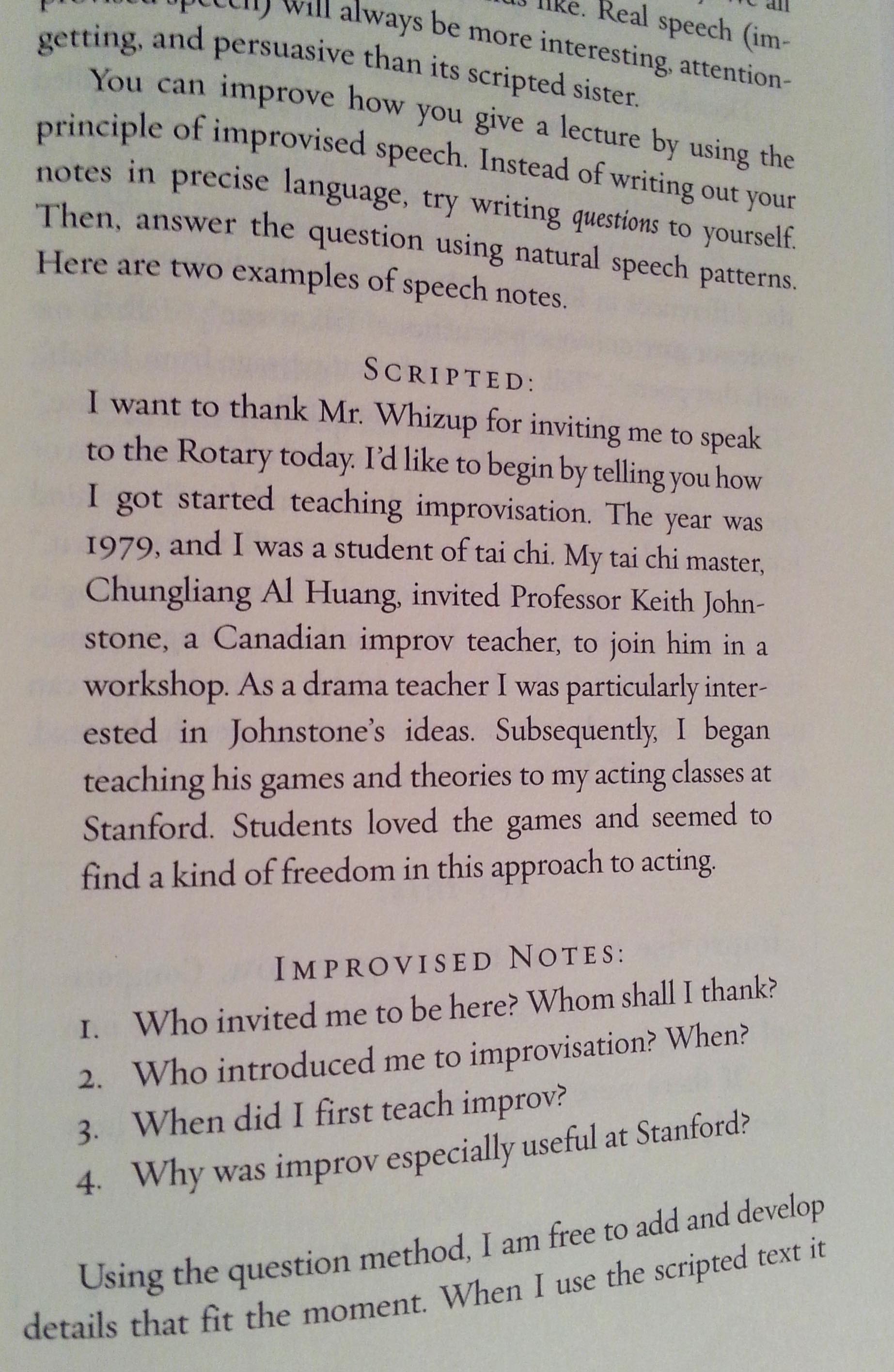
Patricia Ryan Madson’s Improv Wisdom is helping me see things differently. This well-written, easily digestible book (NY: Bell Tower, 2005) is full of all manner of notes about how to move off the page. In particular I’m struck by how Ms. Madson deftly turned scripted notes into an opportunity for spontaneity.  Check out the photo below, where she reformats scripted remarks into a series of prompts—questions—that result in something alive and conversational versus the usual bad voice-over quality that comes from reading a script.
The result of her work and approach is spot on with all we’re trying to do at Conversation is an Engine: live out loud with each other, mistakes and passions all available to each other as we show up. Day after day.
Here’s Ms. Madson speaking at Google (Authors@Google) on her notion of just showing up. I cannot help but notice that she put lots and lots of time preparing before she just showed up. Plus: I am completely taken with Ms. Madson’s willingness to make mistakes in public.
Patricia Ryan Madson may be my new aural hero.
###
When will Your Mission become Mutiny?
Look Boss: It is Written
One of my favorite bosses, when privately presented with a wallet-sized card imprinted with the corporate mission and asked what he thought of it, pretended to use it to wipe his derriere.
Was my boss in open rebellion?
Not in the least.
My boss was responding to a ridiculous communication tool. At that point in the history of that particular medical device company, it was all mission and everyone knew it. Patients and physicians were front and center and no one needed reminding. We were all directly involved in the mission and to think otherwise was to dismiss the conscious and vocal choices people made to work there.
Then again, perhaps the communication tool was a bit prophetic. It wouldn’t be long before many in the firm started taking their eyes off the mission to focus instead on quarterly profit goals to the exclusion of patients, physicians and common sense. These things happen when big bonuses are at stake.
But it need not be that way and you may well be the one to say so.
Unless you simply wanted a job and any job would do, you likely joined your firm because of mission. You found yourself in some level of agreement with the firm’s vision and wanted to help move this thing forward. For many of us, the mission is a motivating and ennobling force, even if we may not think of it constantly.
We know that even the best-intentioned organizations stray from their intended goals and go rogue with evil intent. This happens at high and public levels. It also happens at day-to-day levels, in quick decisions and in small furtive meetings among colleagues. For-profit companies do it. Non-profits do it. Churches do it. Hobby clubs are also capable of it.
That’s when any of us needs to come back to the mission and openly ask whether this quick decision or that furtive meeting is accomplishing our shared mission. Sometimes our best and smartest move is to reprise the mission openly, verbally and with gusto. We all need reminding of our purpose and mission from time to time.
If you care about your organization’s mission, you may need to lead a mutiny today. You’ll want to count the cost, of course, because mutiny can be very expensive.
###

The Problem with Collaboration: Can’t Touch This
You talk. We listen. (Not so) Simple.
Let’s trace social technologies backwards and watch them infiltrate the organizations that launched them. Social technologies carry with them an implicit demand to be heard—if not an outright demand for action.
That demand, from those voices, will—sooner or later—run smack into the command and control mentality: the top dogs who always delivered the monologues. The higher-ups and muckity-mucks who get their way.
This is a problem.
Is this a problem?
Because this problem may be the starting line for any company culture that wants to change. It won’t be pleasant. Because the kind of people that help facilitate the change are a different sort than the ones willing to tell everybody else what to do. There’s a happy move today, currently gaining cultural muscle, to identify the boss-bully in the corner office and make them play nice. This even as people throughout organizations are getting a vision for collaboration vs. command and control.

Letting employees and customers (and possibly congregants and constituents) into the smoke-filled rooms where big decisions are made. What a concept.
Groundswell offered the example of Salesforce.com, their Idea-Exchange and the grass-root effort to excise an annoying banner that always appeared. The company denied themselves, kept listening, and eventually removed the banner they loved and their customers hated.
Bravo!
The problem with collaboration is really an opportunity to become adept at identifying the things that cannot/must not change and holding the rest with an open hand.
###
Groundswell: Your Moment Has Passed.
So 2008.
I’m done with Groundswell.
Oh, I like the book. A lot. And the argument for an empowered people (via social technologies) continues to make excellent sense. Li and Bernoff did a great service by gathering facts and stories into a rational retelling of where we are today with hearing and connecting en masse.
When I first read Groundswell, emotive moments of recognition flickered constantly. Li and Bernoff led the way in helping me understand this unfolding opportunity lodged in my computer. But those moments are not just in my computer any more. They are on my phone, in my pocket and before my eyes as I walk.
It’s the ubiquity of the opportunity that makes everything look different.
Students in my class assume forums for support will be available, they turn to product and service reviews first—why wouldn’t they? Reviews from peers have always been available. These self-proclaimed 90s kids (I guess that’s a thing) interact in most of the ways that Li and Bernoff predicted. So there are few emotive flickers from them even as I shout “Yes!” (possibly to their “Huh?” and amusement). And these students demonstrate a familiarity with technology far advanced from students even two years ago.
So…wheels turn and time goes on and books fade to triviality. I’ll suppose I’ll check out Empowered next time I teach this class. The last thing anybody needs is another old guy in their life telling how things used to be.
And this: the Groundswell moment just passed has opened on a much wider vista that seems to invite collaboration like never before. To not listen to each other is starting to feel like a cardinal sin. Not because it dishonors the human condition (which it does) but because the opportunities in working together are beginning to look massive.
###

 conversation is an engine