Archive for the ‘Collaborate’ Category
“Work is my salvation.”
Theologically—entirely false. Literally—sorta true.
I heard myself say that headline the other day. My buddy and I were talking about what it means to pursue a craft. For me, the work of pursuing a craft is about the ability to focus. And the ability to get back to focus post-distraction.
 Focus and getting back to focus are inherent parts of learning and practicing a craft. I believe that focus on craft builds sanity and humanity. Getting back to focus on my craft of copywriting has pulled me out of many mentally ambiguous places and difficult decisions. Focus on craft—especially as I aim toward usefulness and practical service—allows me to background difficult decisions and gives time for my subconscious to work at them. And after I’ve focused I am able to do productive work on those decisions.
I also think growing in our craft is a way to serve God and people. Bethel Seminary—my alma mater—recently received a $190K grant to pursue a “Work with Purpose” program (Bethel Magazine, Fall 2012, p.8). I’m eager to see how this unfolds because the standard churchy answers for a productive and full life mostly involve using work as verbal platform to persuade others. But the work itself—that’s where I see growth, usefulness and, frankly, the hand of God. This is an old notion from the Reformation that need resurrecting pronto.
Last weekend Mrs. Kirkistan and I watched a documentary called Buck, about a guy from a rough, abused background who had an uncanny way with horses. I’m not a horse guy, and I’m not a fan of cowboy flicks, but this film was mesmerizing from beginning to end. What Buck could tell people about themselves as he watched the way they treated their horse was painfully close to home. The movie is full of notions about collaboration, respecting others and how to work with others without breaking them. One take-away quote from the film was that “horses just need to do something useful. They want work to do.” Maybe Buck was anthropomorphizing horses—maybe not. I do know that the craft we learn and the work we do often places us productively among other people.
And that is a good place to be.
###
Image credit: gibsart via 2headedsnake
Memo To My People Updating My Facebook Page
How about a few less quotes from old dead white guys?
 Post-election, let’s have a little less constitution-driven stuff. I need to sound hip and with-it (You kids still say that?). Sprinkle a few Malcolm X quotes in there (Yes?) and maybe—I don’t know— Nietzsche (why not?). Our business partners and potential clients need to see we’re deep and edgy. But trustworthy—so, ok—maybe a few quotes from Jefferson, but way less than three a week.
Jenny: Put the business books and blogs down: Covey and Collins are sounding stale. Give me more of that pithy stuff like Seth G. puts out. In fact—give Godin’s people a call and tap into that well they are pulling from. I want to sound more like Godin. And Spike Lee.
Jerrold: Give me more comments on human interest stuff. I need to sound warm and supportive. Potential clients need to see the entire organization as approachable—so that starts with me. And do the same with Ivan in the St. Petersburg office. He needs to sound a lot less like Putin, that grandstanding old propagandist. Ivan needs to sound like New Russia—starting now.
Jamison: you gotta tune my Twitter feed. Post-election, work with Jenny on the Godin and Spike Lee stuff—get me solid tweets that pull in about a thousand more young managers. Skew young!
All of you—people tell me I should read beyond history books. Make me current! Wired. Salon. The New Yorker (within reason). Whatever.
Jenny–What’s that? Godin writes his own stuff? Which of his people said that?
###
Image credit: Sammy Slabbinck via 2headedsnake
How to Talk About Stuff That Matters
2 Places to Begin
We’re at a restaurant, my friend and I. We have not seen each other for a while and I am eager to hear what is going on—really going on. Not just work. Not just hobbies or movies or other distractions. But what is the stuff touching my friend’s soul?
 With some friends, a movie watched or a book read or a work assignment is the gateway to a conversation that opens up the irritations and joys, the tough marriage or relational issues we’re going through and the spiritual questions and self-doubts we’re currently entertaining. Maybe some ancient text seems to have pointed the way forward or that inveterate letter writer has provoked a response in us that looked like this set of actions last week. Those are conversations to cherish. They can fill a person up for long time—not with information but with connection and ideas and forward-motion.
With other friends, our work is the only topic and we don’t venture far from that. Rather than opening up, the conversation seems to circle the wagons and becomes something less. Probing is not part of this communication event. I leave somewhat disappointed.
Why is that? How can conversation be so different? I’ve often puzzled through this. Both conversations can happen with friends old and new. Maybe introvert/extrovert/personality type has something to do with it. Maybe trust has not built or has been destroyed. Or maybe we don’t have the language to adequately express what is going on or maybe the last time we were honest with someone they shot us down.
Conversation has so many variables that direct cause and effect is impossible to pin down. And there are no formulas or road maps. But two things are certain:
- Engaging in direct conversation is profitable. If not today, then tomorrow. Or next Tuesday. Or in a month/year. Engaging in conversation is a gift we give to each other, and sometimes it takes time to explore the topic and trust that has risen between us. Our conversation says we value someone.
- Our own willingness to share the deep stuff in us has a direct effect on opening the talk and life of our conversation partner. This is scary: what if someone doesn’t respond? What if they put me down? Trust and boldness help answer that question.
With whom will you talk about what matters today?
###
Image credit: fer1972 via 2headedsnake
Indiana Wants You
Collaboration as the new metric for evaluating employee success

exactly
A sponsored topic in MedCity News presents the CEO of Eli Lilly and Company as bravely moving forward with emotional intelligence. Dr. John Lechleiter cited the need for more collaboration between universities and industry. Lechleiter sees the “…primary function of Indiana’s great research universities is to assist with tech transfer, to bring products…to the society to which they owe their existence.”
While I disagree with that as the primary function of any university (I’m of that old-fashioned tribe that believes learning and research need not always lead directly to a pot of gold), I respect the impetus to find practical outlets for learning.
The brave bit of emotional intelligence is where Lechleiter says Lilly will use a new metric for gauging employee success:
He called businesspeople to task on the lack of collaboration as well. He said that a new measure of an employee’s accomplishments at Lilly would be how many collaborations the person fostered within the state.
That’s radical stuff—and scary—for managers and employees who know only how to bludgeon underlings with orders and monologue. Success will require a whole new tool set, with dialogue anchoring the daily practice.
Lechleiter’s is an attractive stance for a smart, innovative workforce that has grown up with having their voice heard.
Lord You Can’t Go Back There
Minnesota drug lords/pharma execs, students and medical innovators, please disregard this post.
Minnesota wants you (unless you are an outlaw poet).
###
Image Credit: WILFI
Juxtapose: Alongside is the New Black
Confession from a monochrome space
 Putting like and unlike next to each other can have unanticipated results. Chefs know this and routinely put tastes together that “should” never go together to create things that are suddenly wildly tasty (dumb example: salsa on scrambled eggs shattered the sheltered world of my taste buds. So did Chicken Tikka Masala). As a copywriter I pull from poetry and technology and design and even theology and philosophy to place a disparate idea next to my client’s problem to see what may result. It is tried and true method for breaking out of the invisible constraints we didn’t even know held us back.
Yesterday I talked with a friend about a Respectful Conversation Project she had been involved with concerning the upcoming state vote on the marriage amendment. She described the training in dialogue and how so few of us know the difference between dialogue and debate. Debate is our knee-jerk response to different.
And that’s too bad.
Because just a few honest questions about the story behind a conviction, for instance, can do a lot to grow understanding and empathy. It turns out there are academic groups dedicated to this notion of appreciative inquiry as a management tool and a method of organization development. And there are resources like the Respectful Conversation Project moving toward the same end in our communities.
“Alongside” is an effective, creative tool that can build understanding and empathy and solve problems.
I’m still new to this generous notion of “alongside.” My formative years were spent in a land of black and white, where good was good and bad was bad and any fool could distinguish between. This monochrome way of life instilled deep revulsion (yes, that is the word) toward any pursuit of naming the shades of color between the usual poles. It’s taken years and questions and lots of discussion with patient friends but I still find myself curiously uninformed about all the places “alongside” can appear.
###
Image via 2headedsnake
Outside Voice
Recalibrate Your Tribe to Grow
 One of our kids was loud. When this particular child was quite young, Mrs. Kirkistan and I spent lots of time distinguishing an inside voice from an outside voice. This particular person (not naming names) did not sort out the difference until a certain age had been reached. But then it became clear to [Child X] why you might not shout your happiness with the world at 5am, for instance. This person still has the capacity to be heard—which I admire.
Patrick R. Keifert’s, “Welcoming The Stranger : A Public Theology Of Worship And Evangelism” (Minneapolis:Fortress Press, 1992) is a sort of outside voice/inside voice book for an organization. Yes, he’s a pastor writing to pastors. But his topic is much larger and dovetails with all sorts of human groups. He tells stories and redacts around the notion of how off-putting our insider language and idiosyncratic group behaviors can be to new people—those not of the tribe. It happens in a church. It happens in a family (I still do not have the courage to ask my new son-in-law what peculiar behaviors he notices when our family is gathered). It happens in a business. It happens on Minnesota interstates: drivers resent others trying to merge into traffic from an on-ramp. Is that peculiar to Minneapolis/St. Paul drivers or is it a Minnesota thing?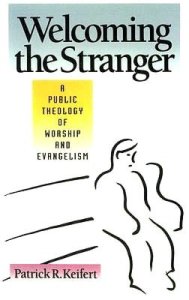
I’m enjoying Keifert’s book because he makes a compelling case for why we should listen to the stranger. He traces the roots of this listening to deep theological places and hints at how we were made for this very kind of interchange. But he also notes there are dangers in hearing the stranger (“Wait—what is this guy up to?”). He points out my unthinking refusal to let focus slip away from me as the all-consuming center of the universe. The end game is that I typically hear the stranger saying only those certain words that fit my view of the world. And we all have experience with that.
But hearing the outside voice in our family, church or company can help us get unstuck—especially when we don’t know we’re stuck.
###
Image Credit via 2headedsnake
Today’s 1pm Meeting: Make It Work
Zoning out should not be an option.

Cut the web. Don’t zone out.
Not every meeting is a useless waste of time. Some of my must-read copywriting bloggers have written about meetings they attended ranging from useless to suicide-inducing.
But I recently sat with a client to hash out what was going right with their messaging to a particular audience. They had seen a spate of cutting-through-the-clutter moments with a particular set of customers and the wins were tumbling in.
People from different roles in the organization pulled up to the big conference table. Each spoke to the success with this audience from the vantage point their position afforded. I was there to hear and gather and (ultimately) tighten and sharpen the message. The message—and the story around the message—would fuel a set of communication vehicles and events.
The meeting was entirely successful, at least for me, because I could question and challenge as the discussion unwound. And my pages of notes have served to bring back quotes and directions. Just connecting the dots on my notes has been productive.
All this to say it is up to us to make a meeting work. That means cutting through the rhetorical web spun by the power-seekers. Sometimes we need to call “bull” on people. And sometimes we need to play catalyst and lob a softball question to pull forward the silent person’s thoughts.
Zoning out should not be an option.
###
Image Credit: via Frank T. Zumbachs Mysterious World
Asking New Questions: the Shropshire Iron Bridge
Could questions fuel personal and corporate goals?
 Toward the end of Free: The Future of a Radical Price (NY: Hyperion, 2009), Chris Anderson cited an example of a bridge in Shropshire, England (p. 213). This bridge was built at the beginning of the Industrial Age (1779), just when builders were shifting from timber to iron as a construction material. But the thinking had not yet shifted to where builders realized iron could be used differently than wood. As a result, the bridge was “wildly overdesigned,” made with iron elements cast separately, and thousands of metal planks fastened and bolted together after the fashion of wooden structures. The bridge is still around today, though much reinforced over the years.
The builders didn’t realize this new material required a very different approach to bring out its strengths. Iron cast in larger sections could take advantage of natural strengths. Small iron castings fitted like wood negated those strengths.
Anderson used the bridge and the bridge-building techniques as an analogy to understand Free. The entire book is a masterful (and thoroughly readable) argument for why the free-to-many-and-paid-by-a-few model works for so many companies today. Anderson also dived into the history of free, along the way citing Lewis Hyde’s The Gift, (a favorite of mine) which describes how gift economies work (hint: gifts tap our genetic pre-disposition toward reciprocation, that is, giving back).
Leaders Lead. Followers Follow. Will Followers Lead?
The point is that new materials, just like new tools, invent or allow or conjure new ways of working. And rather than trying to do the same old things but with newer stuff, we need to sniff out the new goals and new methodologies. In particular—given social media tools—I’m curious how leaders and followers will connect on shared goals.
We’re now well beyond telling each other how to use social media—we’re thumb deep in using all sorts of apps for personal communication. And those tools are quickly working their way into commerce (I nearly always read reviews of products before I buy), into travel, into politics and into our work lives. I would argue the new tools change the way our faith lives work, especially in relation to leading and following.
I keep returning to a phrase I ran into earlier this week, from Dassault Systemes:
Wise leadership looks for game-changing questions. And those questions come from anywhere—from up, down or outside the organization. It is these questions we’ve not yet addressed that will help us understand the new tools, methods and (even) goals and direction.
###
Can the Best Creative Solutions Ever Come from Collaboration?
Not if collaboration means consensus
If you are invited to a brainstorming meeting today, consider this.
 David Straus, in his excellent How to Make Collaboration Work lists five steps to effective collaboration:
- Involve the relevant stakeholders
- Build consensus phase by phase
- Design a process map
- Designate a process facilitator
- Harness the power of group memory
I think these steps are brilliant and especially useful as a framework for collaborations large and small. At first they seem sort of obvious—but as with so many “obvious” things, further explanation quickly gets tricky. With Straus, every step is critical and has its place. Best to plan for it.
But one thing Straus does not address is how collaboration works in developing a risky communication event that requires a singular voice. I’m thinking of something as simple as a letter, brochure, print ad or broadcast spot and beyond. Anything meant to cut through clutter and gain attention.
 Though I’m a big believer in collaboration, there are times in a collaborative process when working alone gives the best results. I’ve always felt my best ideas come after having a chance to noodle a problem on my own and then come back with a few possible solutions to retrench with the art director or other team members.
Brainstorming meetings don’t afford this opportunity. And sometimes (if handled very badly) they lead to consensus talk. Any communication tool that is the product of consensus is likely to be so bland as to be invisible. That’s because what we usually take for consensus is finding agreement around some solution that does not offend any of the stakeholders. If someone says my headline is “Fine,” then I’ve lost the battle. As a copywriter, I crave a visceral reaction or a polarized response. Consensus often results in pabulum.
My point:
- A brainstorming meeting can be useful for getting a lot of different ideas. A brainstorming meeting is not useful for honing those ideas.
- Creative people can and do collaborate to achieve wildly wonderful stuff. But at points in the collaborative process, a singular voice must take command to champion the risky solution. And a singular vision needs to guide the piece toward a singular voice.
At some point a singular vision must step in to create a singular point of view and to champion a risky idea.
###
Image Credit: Bob Staake via 2headedsnake

 conversation is an engine