Archive for the ‘Collaborate’ Category
“You Should Care” Versus “Why You Should Care”
Just Say No to this Toxic Assumption
This Sol Stein quote on high-powered facts failing to invite others in reminded me that we are at our best when we express our passion as an invitation. The best teachers are the ones excited about a topic. Their excitement is itself an invitation into the topic. The best salespeople are those humans who use the product and love it—which is why word-of-mouth remains the most sought-after form of advertising. The most persuasive evangelists are those whose lives have been altered by faith or by an Apple product (which is itself a kind of religion).

Alternatively, the worst college classes, the worst business meetings, the worst seminars are those where the professor/supervisor/speaker assumes you care as much as she does. That assumption leads immediately down deep into depths of details without painting the larger picture. And many of us are desperate for the larger picture. We want to see how our work or faith makes a difference in the rest of life.
A basic truism of life as an insider is that we stop talking about why we are here (in this company or department or group or church) because we’ve heard other people’s stories and we don’t need to go over that ground again. Pretty soon we assume we are all on the same page with the meaning of our activities together. Every once in a while the boss of your boss may say something about why we are here and why its important. But day-to-day it is largely assumed.
The outsider knows nothing of this.
The outsider comes to a group not with a blank slate so much as a slate marked by other groups he has dealt with. The person on the fringe trying to understand the group wants to hear the big meaning statements, the “Why we are here” stuff. And this is precisely where corporate talk falls flat. Corporate talk about meaning and mission and purpose is often vapid precisely because there is no human behind it.
But when the outsider makes contact with the insider who is properly enthused about the meaning-making activities of the company or group, that is a very different story. Mission and purpose come alive when demonstrated by another life being altered.
So—two things:
- Don’t assume the people around you are insiders.
- Keep talking about why we are here doing these things together. These orienting, meaning-making discussions help everyone. It is too important to leave to the VP of mission.
More takes on “transformation” here.
###
Image credit: Kirk Livingston
Seeing Past Childish Symbols
Step 1: See the Template You’re Working from
I’ve been trying to learn to draw and Betty Edwards’s Drawing on the Right Side of the Brain has been particularly helpful. Edwards looked at why it is so many adults say they can’t draw, which is especially odd since nearly every child loves to draw. How did we move from love to incompetence? Edwards answers that by tracing our development as artists, and here is one milestone:
By around age five or six, children have developed a set of symbols to create a landscape. Again, by a process of trial and error, children usually settle on a single version of a symbolic landscape, which is endlessly repeated. (73)
As we age we become dissatisfied with those symbols but we have not worked out new ways to put on paper what we see. And so we give up, and our drawing gets stuck in that old symbolic system. Edwards provides a much richer discussion, but at least one result is that we must set aside our childish system of symbols to begin to see.
Which is not so simple.
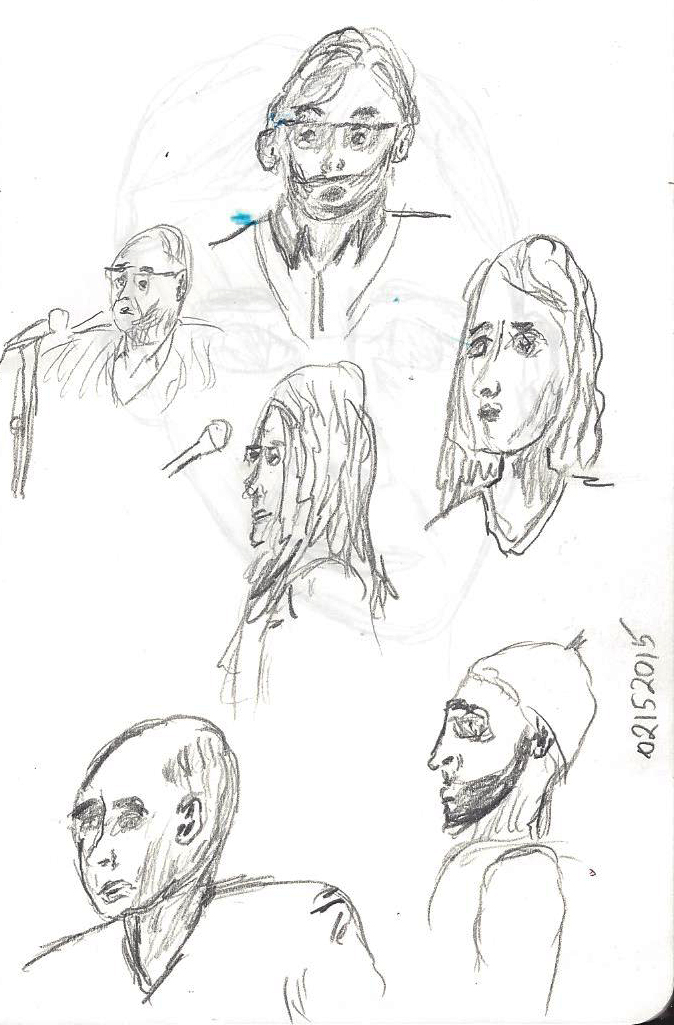
I still start with a circle.
Not so simple because of the confusion that sets in as we try to translate real world scenes into a two-dimensional representations. To set aside the sun as a happy face in the upper right corner means I must look at how the sun reflects off, well, everything. To look at a face and see that—no, there is no outline—is off-putting. How to draw a face without starting with an oval?
This is why Edwards starts with learning to see as a precursor to learning to draw. In my 70+ days of drawing daily, learning to set aside my childish symbolic language has proved difficult. But the answer to seeing better and especially to seeing past the old symbols is to do things badly. And maybe do them badly for a long time. To do things so bad they are cringe-worthy. But that is the price one pays to learn.
I cannot help but think this life lesson and applies across the board. Learning to see and hear, and learning to form your own opinion and make your own representation applies universally. Growth from child to adult means you find new ways to interact with parents, so you set aside some (not all) the old relational cues. The ways we interact with colleagues and bosses must change as we take ownership for our work. Even the childhood symbols that directed our understanding of life purpose and how one knows God must be rejiggered. There is a template for romance we would do well to look at again. Nearly every part of life is helped by reexamination.

“Cutie Pie” + “Let’s Read” seems like a good place to land.
But make a deal with yourself : be patient and give yourself time to move beyond the immediate confusion.
###
Image credits, including dumb sketch: Kirk Livingston
Hit Send & Live With The Results
Because Isolation Won’t Cut It
There is a special frightening moment in many of my writing projects lately. I’ve had a few longish-form assignments, each with lots of moving parts. In each I’ve needed to collect first-hand information from people with diverse backgrounds and expertise, and then combine that with research from journal articles. Each interview—each assignment—was a mini-seminar where I was schooled (very quickly) on the intimate details of the situation.

Ship it, already.
Not so long ago I noted the benefits of sending work out to others and embracing deadlines. More recently I made the case for the aspirational lie, noting how one works toward telling the whole truth, mostly getting it wrong before getting it right. Both the sending out and the aspirational lie are at work in this visceral fear. There is this moment, after I’ve written my email with explanations about what my client will see, after I’ve written my caveats, after I’ve attached my rough draft, this moment where I pause.
Do I really want to send this?
Because, honestly, I could do more. It’s a visceral moment: I feel in my gut the holes in the draft. Do I really want my new client to see my argument in this shape? But budgets and timing dictate this project move forward. And the only way forward is through a reaction from someone else.
Just as I’ve noted how my dumb sketches are talking to the writing part of my life, now I see how the entrepreneurial “Just Ship It” mantra is playing into my creative side. Because there is much to be gained by getting a reaction.
###
Image credit: Kirk Livingston
When I form my own country, this will be my first water tower.
Honest: those were arrows, not a hammer and sickle.
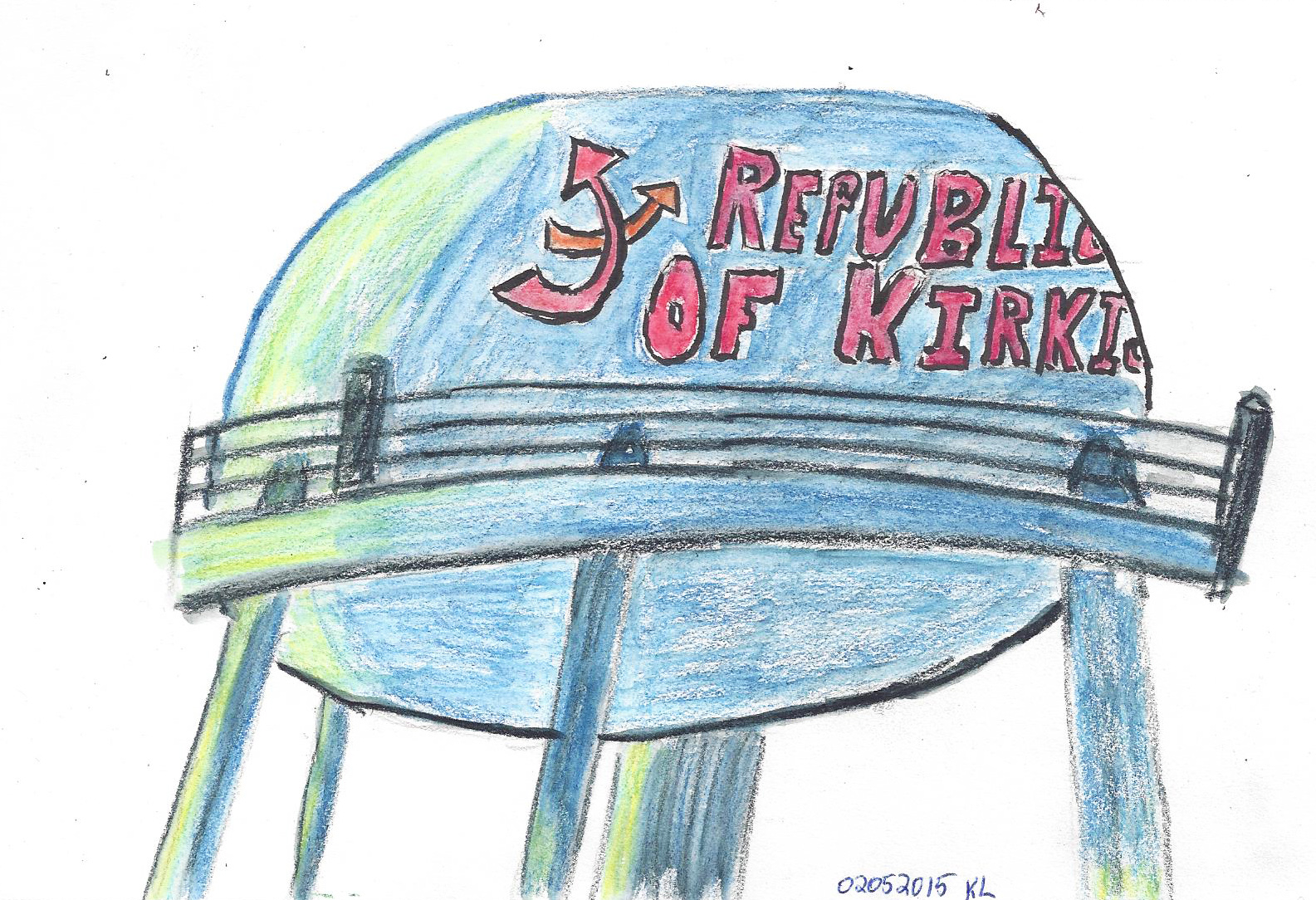
Don’t “comrade” me, brother.
Then again: Maybe I won’t install myself as supreme leader right away. I’ll start as the Minister of Agitprop.
After I release Iowa from the tyrants who were “voted in,” we’ll kick it up a notch and groove into that glorious, collective future.
Who’s in?
###
Dumb sketch: Kirk Livingston, Minister of Agitprop
In Praise of Doing Things Badly
Rough draft as collaboration tool
I keep talking about rough drafts and dumb sketches. That’s because providing something when expectations are low is such a great way to share ideas. It’s a way to tell ourselves what we are thinking. It also a way to tell others what we might think together. But with the pressure off.
It’s also a great way to learn.
Some may say, “What? That guy needs a rough draft? What a chump!”
While it is true I am a chump, it is also true that presenting a rough draft—sometimes just the stub of an idea—can have an electrical, clarifying, vivifying power to move you forward. This idea, laid bare in all its clumsy, awkward glory, may just be the beginning of something important. Something even that holds your imagination for a year or five.
The rough draft laying there—all vulnerable and wrong—brings out the best in those who look on. Often evoking pity rather than harsh, fluorescent critique. And that makes for a great conversation.
What will you do badly today and share as a rough draft with a colleague?
###
Image credit: Kirk Livingston
When Truth Sounds Like a Lie
And the lie that turns out true
Let’s make up a new term: the “aspirational lie.”
The aspirational lie is that thing that falls from your mouth before you can stop it.
- It is not quite true—that’s why you almost didn’t say it.
- But it is not quite false—something about it is true. Which is why you did say it.
That happened to me when talking to a writing class of business students. My professor friend let me come in and chat about freelance copywriting. She wanted her MBA students to see some different shades to how work gets done. In the course of our discussion we talked about how one prepares to write and about how one does the work.
I told one truth that sounded like a lie.
And I told a lie that turned out to be true.
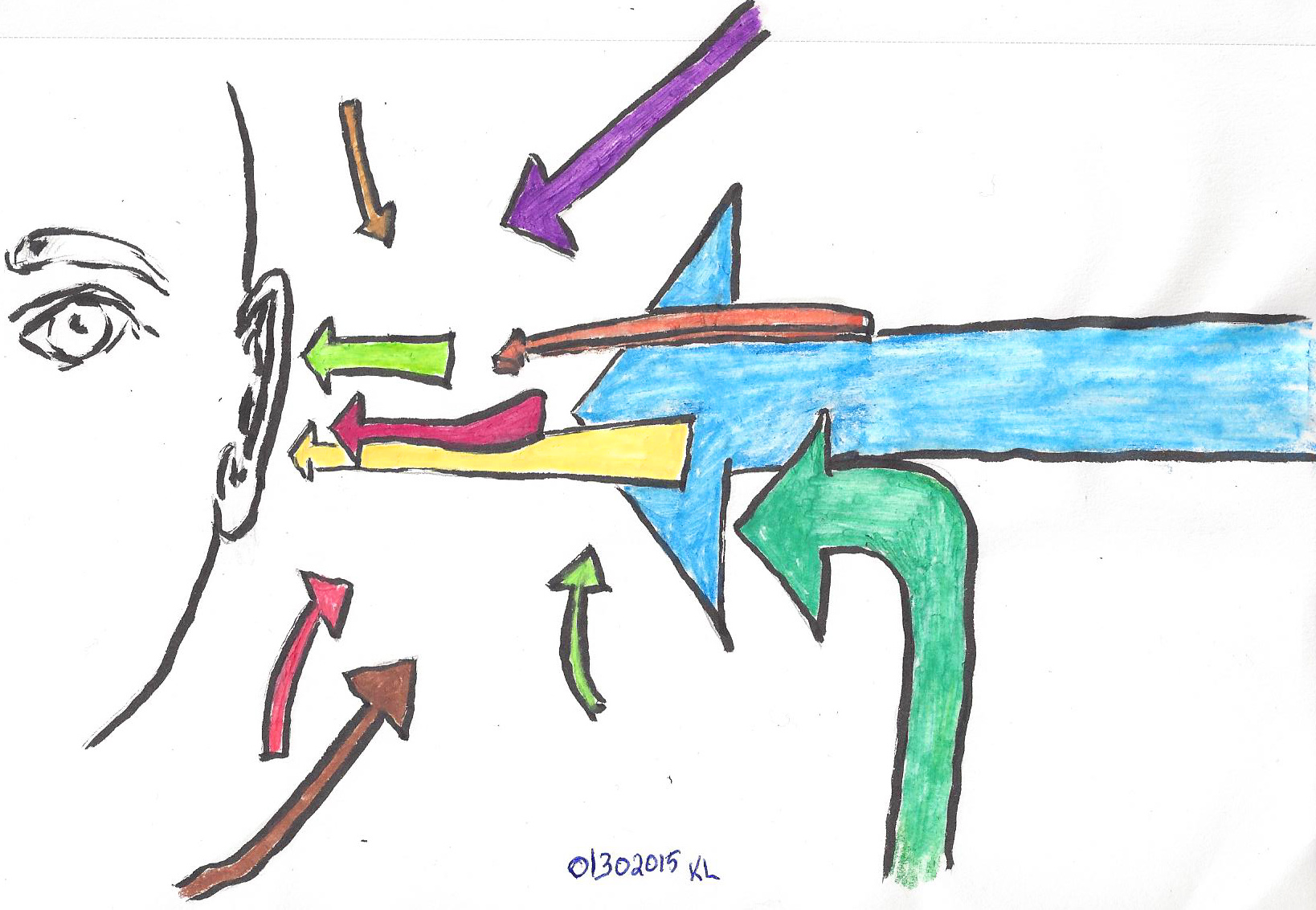
The Truth That Sounded Like a Lie
The truth that sounded like a lie was that I make a bunch of stuff up for my clients. “How so?” wondered the class. It’s like this: the writer’s work is to think forward and then tell the story of how all the parts fit together. Whether writing a white paper, a journal article, an advertising campaign or refreshing a brand, writers do what writers have always done: make stuff up. They grab bits and pieces of facts and directions and fit them into a coherent whole. As they move forward, they gradually replace false with true and so learn as they go.
That is the creative process.
You fill up your head with facts and premonitions and assumptions. Many are true, some are false. But the process itself—and the subsequent reviews reveal what it is true. Writing is very much a process of trying things on for size and then using them or discarding them. And sometimes we used facts “for position only,” as a stand-in for the real, true fact on our way to building the honest, coherent whole.
The Aspirational Lie
We also talked about backgrounds and how one prepares to write. I explained how degrees in philosophy and theology are an asset to business writing. Yes: I was making that up on the spot. But not really, because I have believed that for some time, though had never quite put it in those words. Pulling from disparate backgrounds is a way out of the narrow ruts we find ourselves in. Those divergent backgrounds help to connect the dots in new and occasionally excellent ways. Which is also why we do ourselves a favor when we break from our homogeneous clubs from time to time.
Comedy writers do this all the time. I just finished Mike Sacks excellent Poking a Dead Frog: Conversations with Today’s Top Comedy Writers (NY: Penguin Books, 2014), and was amazed all over again at the widely different life experiences comedy writers bought to their work.
The more I’ve thought about the aspirational lie that philosophy and theology contribute to story-telling, the more convinced I am it is true. That’s because I find myself lining up facts and story bits and characters and timelines according the rhythms and disciplines I was steeped in during school. In philosophy it was the standing back and observing with a disinterested eye. In theology it was the finding and unraveling and rethreading of complicated arguments—plus a “this-is-part-of-a-much-larger-story” component.
Our studies, our reading, our life experience—all these help line up the ways we hear things and the ways we connect the dots. Our best stories are unified and coherent because of this.
###
Dumb Sketch: Kirk Livingston
Own Your Process
Ownership Sparks Creativity in Art & Work & Life
One key differentiator between working for the man (every night and day) and working for yourself is ownership. Working for yourself you own the beginning, the middle, and the outcome.
Especially the outcome.
Some of my favorite colleagues over the years—the very ones who advanced in whatever they worked at—found ways to own the process. These were the ones not content to follow orders. Instead they made the work their own, found their own way, employed their skill and imagination. I’ll argue that owning the work sparked their creativity to accomplish the task. And I’ll argue that ownership looked like responsibility for the outcome. So despite working for the man, they took ownership, made their own meaning and became, well, the man.
Over at Dumb Sketch Daily I’ve been producing a dumb sketch every day for the last 39 days. I was sorta proud of this dumb sketch:

Then a commenter suggested abstracting it, which I tried, given my limited art understanding and abilities (here):
You can see the result is…simple. But it is my own (not that anyone is lining up to take credit). The commenter’s comment helped me continue my odyssey toward learning to see.
My only point is that developing new skills requires a certain elasticity. We try new stuff and get it wrong again and again and again. And we keep failing until maybe, one fine day, it turns out sorta OK.
A lot happens when we take ownership for developing our own skills. And a lot of good can come from taking responsibility for our client/boss/friend’s desired outcome.
###
Image credit: Kirk Livingston
The Talking Part of Writing
Talking Through the Valley of the Shadow of Death
When it comes to brand new, unpaged ideas (that is, not yet written), J.K. Rowling is right:
But at some point every idea needs to make contact with an audience. Writers want their idea fully-formed with beautiful plumage before they exhibit it to anyone (lest someone call my baby ugly). Copywriters know this is not possible when it comes to collaborative writing—writing that serves some mission or purpose for an organization or cause—which needs client eyeballs as a part of the process.
Because Lillian Hellman is also right:
And Nora Roberts is especially right:
There’s the writing. And then there’s the fixing. I often think of the fixing as equally creative as the original writing. Great and wonderful things happen at the fixing/revising stage.
There is a point in every copywriting project where it must be discussed. It must be read aloud. And the key is—especially with new clients—fail faster.
I recently made a category error with a new client and I’m wondering how high a price I’ll pay. Rather than insisting on an early reading and sharing first thoughts when the bar was low, I let my content slide through several holidays until the deadline is an approaching storm and the bar is high for the copy to be right on the first reading.
Which it isn’t: it’s full of questions.
Which is almost always the case with a new client. Especially if the topic has a lot of moving parts.

So lesson learned (again): insist on failing faster and earlier.
###
Image credit: Kirk Livingston
“…shouldn’t give away your pie with breakfast—it makes you look cheap.”
The Reading Pulls the Funny from the Words
The Diner is an old Saturday Night Live skit (1989-1990/Season 15/aired 21 April 1990) with the late Jan Hooks and Alec Baldwin. It is a bit of genius in the way the language does double-duty, pointing at meaning far beyond the sublimated exchanges. The characters and their inevitable conflict are showcased in the writer’s words (read the transcript here). But it’s the words exchanged between Hooks and Baldwin—words that seem almost physical—that move the skit forward.
![[Click to play.]](https://conversationisanengine.space/wp-content/uploads/2014/12/alecbaldwinsnlthediner-12262014.jpg?w=700&h=477)
[Click to play.]
[https://screen.yahoo.com/brenda-waitress-000000407.html]
Read the transcript. It does not come across as powerful as it does in the hands of Hooks, Baldwin and the rest of the cast.
But that holds for lots of things.
Words come to life when spoken or acted on by a human. If that seems too philosophical, consider how much copy you read that is lifeless because you cannot hear any human voice. This is why press-release quotes from CEOs sound so wooden. No human speaks that way. On the other hand, some books remain in our lives precisely because they capture the human voice so well. For me, the old poet-king and the gospel writer John portray the human voice so accurately that I return to them daily. Ian McEwan’s Atonement also did that for me recently.
What words will you act on in 2015?
###
Image Credit: SNL/Yahoo
Please Say More, My Radical Lesbian Feminist Friend
Mary Daly: Voice from the Fringe
Well, “fringe” for me.
I’ll confess: I’ve not been so conversant with feminist theology or philosophy. And this: it had not even occurred to me to think about it.

Sometimes a different perspective helps cut the fog.
But then I read our daughter’s college paper on Kierkegaard and his potential exclusion of women. Our daughter’s reference to the self-described radical lesbian feminist Mary Daly and her Beyond God the Father: Toward a Philosophy of Women’s Liberation (Boston: Beacon Press, 1973) was something like click-bait for me and I had to order the book. I’m glad I did. Mary Daly’s voice has been a playful, combative, eye-opening excursion into seeing things differently. I’m only a chapter in, but already she has named patriarchal theology and turned it on its ear. Ms. Daly has suggested all sorts of thought-exercises that would never occur to anyone living in the usual theological/philosophical grid system:
For example, women who sit in institutional committee meetings without surrendering to the purposes and goals set forth by the male-dominated structure, are literally working on our own time while perhaps appearing to be working “on company time.” The center of our activities is organic, in such a way that events are more significant than clocks. This boundary living is a way of being in and out of “the system.” (43)
You don’t have to be a theologian or philosopher (or even a radical lesbian feminist) to appreciate the different way of seeing things Ms. Daly offered. A quick glance through her Wikipedia entry suggests there was personal a cost to seeing things differently—especially in the male-dominated structures she worked within.
What I like about this particular quote is how it points beyond authority to the organic or self-directed work each of us knows as our own. Much has changed since Ms. Daly wrote this in 1973. We still have male-dominated structures and maybe those are changing, though too slowly for many.
But think about “structures” for a moment.
Reading the quote as a freelancer and entrepreneur, I cannot help but notice how exactly her description fits anyone with a growing sense of their own work or mission—especially where that work or mission differs from the work or mission handed down from authority.
Regardless of gender.
The point is not to agree with everything Ms. Daly said. The point is to begin to hear. And to begin to see—so then we can begin to name the framing system we live within. By noticing and naming, potential solutions may begin to appear.
###
Image credit: Kirk Livingston

 conversation is an engine