Archive for the ‘Collaborate’ Category
Can You Engineer a Conversation? (How to Talk #2)
Depends: Are you looking for control or insight?
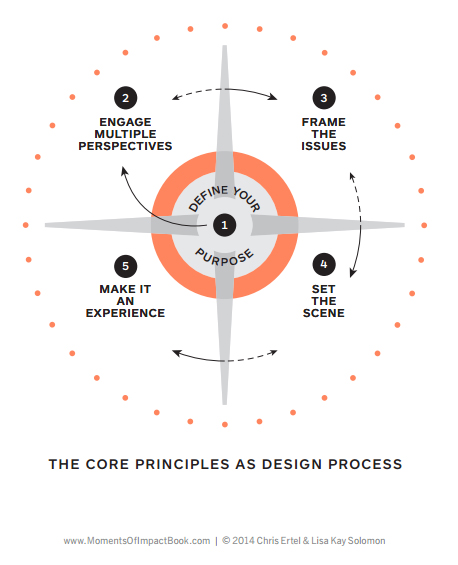
In Moments of Impact: How to design conversations that accelerate change (NY: Simon and Schuster, 2014), Chris Ertel and Lisa Kay Solomon argue that some of our most productive conversations come from deciding ahead what we want from the interchange. Their book presents a system of on-ramps that will be particularly useful for anyone charged with gathering a group with the intent of going further than the old, fallow brainstorming sessions allowed.
Conversation, as everyone knows, can be far from benign. For those looking to control a conversation, unless highly skilled, the better (and far less productive) option may be to continue with monologue.
Because a strategic conversation consists of live interactions between people with different perspectives and passions, you can never predict exactly where it will lead. (41)
That is the beauty of conversation: the whimsy factor can drop participants in places they never expected to arrive. That is also the danger—especially in corporate settings where a particular outcome has been strongly hinted at, if not guaranteed.
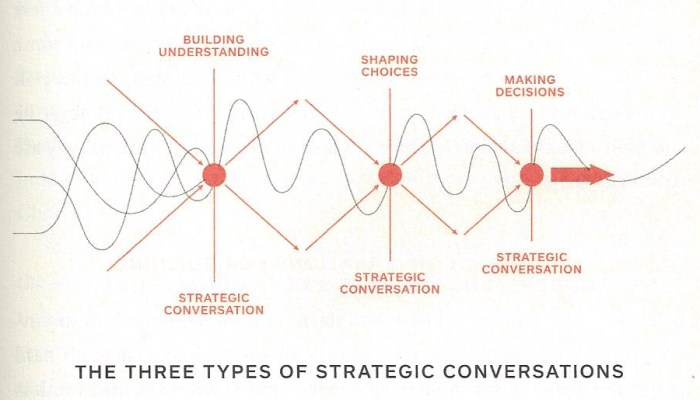
For those daring souls willing to let go, but who still retain a preferred outcome, Ertel and Solomon’s notion of a “strategic conversation” may just fit the bill. Start by sorting what you are trying to accomplish: build understanding, shape choices or make decisions. And then employ divergent and convergent thinking and other group exercises as necessary.
What I appreciate about Ertel and Solomon’s work is they have built a framework around the basic serendipity of conversation and brought it as a tool into even very hierarchical structures.
I am convinced we’ll find strategic conversations a formidable tool indeed, especially as we create brand new stuff out in the world.
###
Image credit: http://www.momentsofimpactbook.com
Wait—English Majors Win in the End?
Start Writing Your Own Future
- Announce your goal to lose weight and chances are better the pounds will flee.
- Sign up for NaNoWriMo and chances are better you will actually write that novel (no matter how badly it turns out).
What we tell each other has a way of happening. What we tell each other about our preferred futures has a way of guiding next steps.
- Write a letter to your collaborative, inventor friend about a business idea and find yourself planning concrete marketing and distribution steps at Spyhouse Coffee.
- Write a business plan for your startup and suddenly remember your friend who became a venture capitalist. And then remember the friend who bootstrapped her idea.
See the pattern? Each step forward started with communication. You may say,
“No. the idea came first.”
True—maybe.

Create in real time as you go.
But consider: the communicated idea created a spark. And—given the right collaborative conditions—the spark lit a fuse. And the fuse burned, gathering other ideas until the explosive, disruptive future no one had considered.
What if English majors learned entrepreneurship and began to see their talent for orderly, persuasive, deeply-rooted writing as a way to help themselves imagine new futures and chart forward-movement for others? What if they learned to solve real-world problems with story and emotion and analytics? Their solutions would drop-kick the spreadsheet & PowerPoint crowd. What if some English majors created Lake Wobegon while others created the next Google?
What if English majors learned business lessons alongside the standard fare of reading and writing? What if they were expected to serve up the occasional business plan or marketing strategy along with the usual essay, short story and poem?
If that happened, English majors would connect earlier in life that art and work and commerce and fiction and meaning-making all fit together in the same world. And they would begin to write their own future vocation.
By the way: 16 Wildly Successful People Who Majored in English
###
Caveat #1: I was never an English major.
Caveat #2: I teach English majors. They are smart, innovative people.
Image credit: Kirk Livingston
Why Work Out Loud?
Living out loud—even at work
Way back when our first child was born (lo these many years ago), back before there was language, when crying and inchoate grunts were the sum total of signals this small being could muster (along with unblinking stares), a strange communication pattern emerged in our household: narration.
Mrs. Kirkistan and I both found ourselves narrating in real-time to this youngster. His wide eyes and (relative) silence seemed enough to make us think he was curious about, well, whatever. We narrated pacing the floor at 2am (“We’re walking back and forth because someone is crying. But we’re not pointing fingers. No sir.”). We narrated cooking and cleaning. We talked about sitting on the couch and driving in the car. We told the story of outside—every window had a story.
It seemed to work if only because it was met with silence which we took for interest. Eventually he started narrating back at us.

Thank you, Veterans.
I’m reminded of this as I read John Stepper’s blog and anticipate his book, Working Out Loud: How to build a better network, career & life (Due Feb, 2015). Mr. Stepper makes the case that we do ourselves a favor when we “work in an open, generous, connected way.” The benefit is to ourselves and to others. Check out his “5 elements of working out loud.”
Lately I find myself talking more with clients about how they communicate internally and externally. I continue to see the emphasis wrought by free and open social venues (Twitter, bloggery, Facebook) working their way backwards into the way organizations conduct business. I predict more collaborative encounters and less monologue from a guy with a tie and a pen to sign your paycheck.
Stepper’s “working out loud” codifies some of that collaborative energy that rises like Spring sap with honest and open communication. I think of it as another perspective on the “dumb sketch” approach to life.
Narrating our day, asking for input, remarking on a remarkable idea—it’s all part of human contact and cannot be separated from the business of making meaning.
###
Image credit: Kirk Livingston
About the Node Not Taken
Steady There, Young Philosopher
My hardworking, entrepreneurial colleague surprised me in conversation the other day:
Sometimes I wonder what it would be like had I stayed in the corporate world—what would I be doing now?
My friend was in one of the periodic slumps that happen to anyone building a business of their own. Those slumps squeeze out long-suppressed questions. These are the questions that precipitate momentary crises of faith for those constructing wings as they plummet.

No. Really. Is there an actual “Afton State Park”?
Young philosophers like to ponder the “What ifs” of life:
- What if I had dated that person rather than this person?
- What if I had taken that job rather than this job?
- What if I had studied engineering rather than philosophy? (One certain answer: the world would have to cope with a very bad engineer.)
- What if had dived 12 inches to the left and missed that rock in the lake?
One problem with our casual “What ifs” is that they often assume a straight line from the point of decision. You go this way. You go that way. Two roads diverging in a yellow wood.
But what if our lives are composed of nodes that become roads? What if each decision is followed by another so that our paths are constantly changing in real-time?
Another problem with casual “What ifs” is they forget the tiny but forceful pinpricks of relationship and conversation and motivation that accompany every choice. Thousands of tiny insights and histories and dreams contribute to each action as well as each subsequent action.
Personally, I cannot help but wonder if the nodes that become roads all lead to the place/people we were meant to be in the first place. Wait—don’t call me a determinist yet. Stick with me: what I mean is that whether we stayed in the corporation or went on our own or dropped everything to join the circus, would we end up as the kind of people we were meant to be?
This is not a perfect thought: we build things into our lives, good and bad, by daily habit. We grow, or not, because of those habits and subsequent opportunities. Admittedly, the determinist take on choice has holes.
But I’m reminded of that inveterate letter writer who wrote his friends about walking in the “good works” begun in them.
Today I’m looking for nodes and roads.
And I hope to step in a good work along the way.
###
Image credit: Kirk Livingston
MIT Media Lab: Exactly When Do You Collaborate?
Tod Machover & A More Beautiful Question
There are times, especially early in the creative process, when I want to slow down and think about a challenging question by myself,” he said. (At such times, he retreats to the solitude of a barn converted into a music studio.)
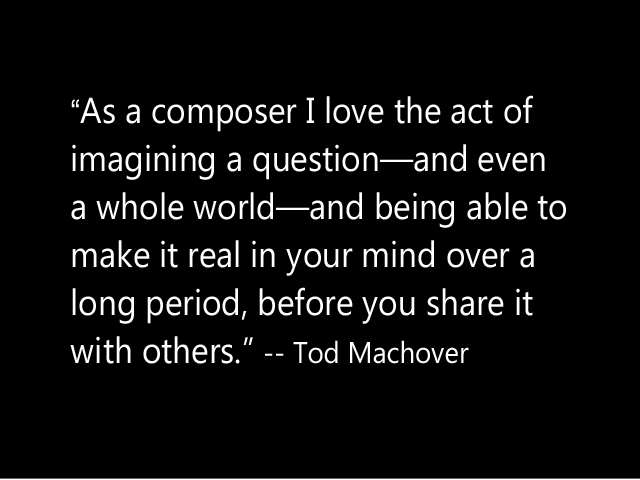
But there’s also a time, he said, when you must take your question “out of the barn” and begin to work with others. The Media Lab is designed to be an ideal collaborative environment, bringing together people from a wide range of disciplines. “Everyone is comfortable saying to others in the lab, ‘Here’s something I’m passionate about—would you help me think through this question?’”
–Quoted from Warren Berger, A More Beautiful Question (NY: Bloomsbury, 2014) 130-131.
###
Moments of Impact: Making Work Conversations [actually] Work
This third kind of work conversation involves divergent thinking
In Moments of Impact: How to design conversations that accelerate change (NY: Simon and Schuster, 2014), Chris Ertel and Lisa Kay Solomon make the case that we need a third kind of conversation at work. Here’s how Solomon and Ertel categorize most work meetings:
- Typical meeting where someone stands at the front blathering on with slides while attendees multitask with Facebook, Twitter and occasionally, actual work.
- Brainstorming meeting where people attend to think brand new thoughts (and to eat donuts). But brainstorming meetings are routinely dismissed today as producing far fewer ideas than if the attendees sat in isolation producing ideas before coming together.
- Strategic Conversations. This is Ertel and Solomon’s new kind of conversation. Rather than engaging in the typical presentation/multi-tasking meeting, they want attendees to deeply and viscerally engage in a compelling question.

Mindful like a hungry hawk.
Moments of Impact is all about how to make this third kind of conversation happen. The book develops five points to help make strategic conversation an experience versus another bout of human downloadment:
- Declare objectives/define the purpose
- Identify participants/engage multiple perspectives
- Assemble content/frame the issues
- Find a venue/set the scene
- Set the agenda/make it an experience
Nothing earth-shattering so far, right?
And yet, as it is so often, our connections provide the earth-shattering stuff, rather than any consultant’s formula. Where we connect—with 100% attention—that’s where the magic happens. In connection there something mystical that lies beyond engineering technique and management principles. Moments of Impact is about setting the stage for that connection.
One thing is becoming clearer very day: when we employ mindfulness rather than pursuing mindlessness, we find ourselves deeply engaged rather than seeking more distractions.
Mindfulness in the service of creating an experience also seems to honor humans as human (versus as corporately-owned human capital to be rejiggered at will).
That old attitude may have worked for an assembly line (doubtful), but for our volatile, uncertain, complex and ambiguous world, we need the best each of us can bring.
###
Image credit: Kirk Livingston
Collaboration in Real Life: The Book Cover
Self-promotion is stinky poop
This week I spoke with a copywriter who writes plays and novels on the side. But he doesn’t work too hard on promoting his finished bits of literature. He prefers to stick to the writing part (who doesn’t?). This copywriter is not atypical on two counts:
- If you don’t need to get your message out (that is, move product to earn the feeble coin a book represents) you can let it languish.
- Copywriters are bad at self-promotion.

Roger’s cover
Not all copywriters, and probably not the copywriter I spoke with. But many are bad at self-promotion. It’s funny because while copywriters have insight into the psychology of business problems and use divergent thinking to solve those problems, they have a hard time turning that insight onto their own projects.
And that is true for all of us.
It’s not just because self-promotion has the feeling of swimming in a septic tank. It is also because we are truly blinded to the very things we are most passionate about. We’re typically deep inside those passions, and we have no clue what it all looks like from the outside. That’s why we need to tell others and get the outside insight that telling affords.
A client and friend provided a quick insight that has proved far better than anything this insider could produce. My first book, ListenTalk: When Conversation is an Act of God, is on its way through this marathon called publishing. Encapsulating the message into an image and a few words has proved daunting to me. Roger’s cover, with the fire, well, most people love it better than my covers. I’m not bitter, I’m grateful: grateful to have people around who can offer very tangible insights. These insights regularly, well, cover my arse. And I’ve always maintained that I am neither a designer nor photographer.
I thank God for people with such quick insight.

My covers.
A word about ListenTalk versus “conversation is an engine”
If you’ve dropped by this blog, you may have noticed I hit on different topics as they relate to conversation. Business and the business of writing, and the business of how faith and craft and work fit together are key drivers for me as I write.
My first ongoing project along these lines was to develop a sort of practical theology of persuasion—something I was desperate to understand as a copywriter who regularly trusts in God. That is what ListenTalk represents. It takes some topics from “conversation is an engine” but develops them specifically for people of faith. Here’s the draft copy from the back cover:
“Talk is cheap.”
So we say, but deep down we know different.
We know talk is a potent engine for war and love and all that lies between. Talk is our entertainment and our tool for exploring every relationship. Talk is an economic engine. Lives change—culture changes—when we talk together. In many ways, the future is patterned after our speech.
And this: even God responds to talk.
Yet we pay scarce attention to the working parts of conversation: the listening, the words used, and the intent behind the words. And we hardly think about God’s purpose in speaking, and how God speaks today with fierce desire for reunion—and how that desire motivates all God says and does.
Every day, people work out God’s desire in thousands of ordinary ways. Not so much through sermons and high-minded programs as through the ordinary conversations among themselves.
ListenTalk will help you to re-think what God accomplishes in even your smallest, most ordinary conversations.
“ListenTalk is a wonderful book with deep wisdom, practical advice, and heart-warming encouragement. Read it, converse with it, and share it with others.” –Dr. Quentin Schultze, Calvin College
“In our contemporary world where words and ideas seem to divide far more than they unite, ListenTalk provides an antidote of balance and sanity. ListenTalk reminds us of a power that can lead to greater understanding, intimacy, collaboration, and even personal transformation…culminating in deepening our life with God.” –Judith Hougen, University of Northwestern—St. Paul
Hey—wait a second. You could buy ListenTalk!
###
Image credit: Kirk Livingston

 conversation is an engine