Archive for the ‘Communication is about relationship’ Category
Tip #9: Launch Your Idea. Don’t Detail It.
We all repackage our stories for the best effect
Writing copy can be disorienting—especially for English majors. Rather than grading on how they develop an argument and how well they follow particular usage rules, they are graded on how well their copy meets a marketing need. They are graded on how well their creativity pulls in the target audience—and how quickly. Each exercise and assignment becomes more about the big idea and the execution of the idea rather telling all the detail in an orderly fashion.
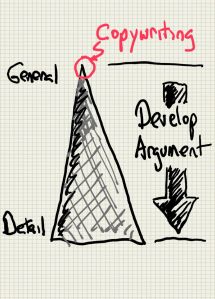 It can be disorienting because we might have mistakenly thought copy was just emotional marketing hype, the (nearly invisible) stuff that abides in much of our current messaging (“clutter,” you might say). Copywriters just toss any word in an ad, like “new” or “organic” or “protein” to get people to buy in, right?
But copywriting is more like a lab where you boil down the raw material to get an essence. Then you adjust the pheromones in that essence to get the behavior you want in the audience you seek.
Wait—that sounds manipulative.
If it is, it is a common trait and practice shared by all humans. We’re all packaging and repackaging our stories in real time. We constantly change-up our experience and knowledge and opinions as we deliver them to friends and family, prospective mates, acquaintances and strangers. It’s not a purposeful misleading, it’s just that the human condition is constantly changing and we see things differently at any given point. And we all want to be heard, so we change how we say things.
Mind you—orderly telling is still critical for copywriting. But audiences don’t make time for essays (sadly). And developing an argument is still critically important—it’s all just very, very fast.
The key is getting—and holding—attention.
Eight other copywriting tips for English majors here.
###
Image credit: Dumb sketch by Kirk Livingston
Why Name a Problem?
“They won’t recognize a great solution until they see how big the problem was.”
Along the way to becoming a copywriter one must learn to name problems. This is an essential skill for anyone trying use their creativity out in the world of real people and real issues. Because when you present your bit of inspired copy to a prospective client (as one does when planning for serendipity), they will not see how inspired it is until you tell the problem the copy solved. Once they understand the problem, they can begin to appreciate the genius of the solution you created.

Naming a problem is best done in story form: there was this nasty condition and people worked around the nasty business in this way, which was inconvenient and bad. But we saw that this could be done, and so I created this. Which seemed to work and everyone was happy. Problem solved.
But naming a problem can sometimes be uncomfortable. Not usually after the fact, when everyone can easily see that it was a problem. But before: if you are the first one to notice a problem it takes a bit of courage to say it out loud to others. What if you got it wrong? What if you just don’t understand? If you name the problem, will you be responsible to fix it?
Here’s where a lesson from work fits back into real life as a human: naming a problem is the first step toward fixing it. That is true with my clients and it is true with students and it is true in all sorts of relationships and life situations. To name something is to register that a problem exists. It puts the problem on the radar and communicates to others that there may be an issue.
Until you name a problem you have very little opportunity to address it.
Naming is a bridge to fixing.
###
Image credit: Kirk Livingston
Tag:
Best Work Direction Ever: “Avoid giving the impression of diligence…,”
Said the boss to the worker:

Hermann Hesse, The Glass Bead Game (Magister Ludi) (Holt, Rinehart, Winston, 1969) 158.
###
Image Credit: Kirk Livingston
Bah: Who needs “personality”?
Give me your risk-averse, your bland spinners of boredom.

Two days ago I talked with a marketer trying to sort exactly what space his brand occupies in social media. His brand generally takes a clear position against the competition and owns 15 to 20 percent of the market. Their messaging is mostly working and they see only growth ahead.
But that growth needs a kick. Getting their brand noticed in social media requires more than mere facts. For instance, when it comes to tweets—what tone to take?
They’ve studied their demographic relentlessly. They know, for instance, that edgy won’t cut it with their particular audience. That’s a shame, because “edgy” tweets attract a lot of attention. My friend pointed to @DiGiornoPizza and the (often hilarious) tweets that set them apart. Their tweets fit their audience.
But my friend was not trying to meet the needs or get the attention of that edgy demographic. Plus, my friend’s brand was lodged within a behemoth of company that has traditionally favored corporate, risk-averse language over “fun” and “personable.”
What to do?
This is a question many companies will face as social technologies advance further and further into the selling cycles. Social media will always be about more than facts. People come back to particular tweeters or blog posts or updates because of the personality represented and the personalities’ take on whatever. We come back again and again because we want to hear what Letterman (or Colbert) or Jimmy Fallon will say about this or that. There is an expectation. And there is an emotional connection. And it never hurts to be fun.
I predict even business-to-business will succumb to personality and human speak.
How can a risk-averse corporation that deals in corporate-speak begin to talk human and engage in conversation with other humans? This is a complicated question that calls for creativity beyond the numbering of facts and features. It calls for a viewpoint or perspective. And those companies willing to move their tone off bland and toward standing for something that matters to their audience will be the early winners.
###
Image credit: TaylorTay via morguefile.com
Custom Answers to Personal Perplexities
What does a good conversation look like?

###
Image Credit: Kirk Livingston
Collaborate is the New Black
Listening looks good on you
Work often looks like a flavor-of-the-month shop. Depending on which consultants get the ear of those with a budget for adjusting corporate culture, we could be talking about mindfulness, or total quality commitment or getting the right people on the bus—there is no end to the analogies and training seminars and tightly-packed sessions to buy.
Always these programs promise change. Sometimes they deliver.

Here’s why you should care.
But the constant impetus behind these attempts is employee engagement. The days of just showing up to stand on an assembly line or sit in a cubicle are long gone. Putting in hours is not enough—was it ever enough?
Engagement is tricky, of course. Employees work with BS filters set on high, which is why suggestion boxes rarely worked. Everyone knew putting a well-reasoned argument on a slip of paper and dropping it in a box went exactly nowhere.
No—the will to listen, which is near the heart of collaboration—must come from within rather than without. There must be a kernel of mission that speaks to listening to the good people you’ve brought in. The trick is to find that kernel. Engaged employees have done that work, usually on their own time.
I’m excited about a particular client of mine with a compelling, collaborative mission. They’ve invested millions in a particular process that is doing something brand new in the world. My client is lining up eager collaborators from industry and from academia. They are just now setting up systems to deepen their collaboration with researchers across the globe.
But how far are they willing to go with collaboration?
Working and learning together is the stated center of their mission—and this organization lives it out in countless ways. But are they willing to make messages that reach out and pull people in—even with ongoing research? Are they willing to set themselves apart as leaders willing to share knowledge in endlessly accessible research bites that are media and social media ready? After all, my client is partnering with an industry known for its secrecy, so what will collaboration and the inevitable transparency look like with these steely customers?
All that remains to be seen.
But one thing is certain: the will and gifts and curiosity of engaged, collaborative partners and employees is the only thing that will help this move forward.
###
Image Credit: Kirk Livingston
Audiences Read an Actor’s Use of Space
Keith Johnstone: Impro

May Day Parade, South Minneapolis, 2013
When I was commissioned to write my first play I’d hardly been inside a theatre, so I watched rehearsals to get the feel of it. I was struck by the way space flowed around the actors like a fluid. As the actors moved I could feel imaginary iron filings marking out the force fields. This feeling of space was strongest when the stage was uncluttered, and during the coffee breaks, or when they were discussing some difficulty. When they weren’t acting, the bodies of the actors continually readjusted. As one changed position so all the others altered their postures. Something seemed to flow between them. When they were ‘acting’ each actor would pretend to relate to the others, but his movements would stem from himself. They seemed ‘encapsulated’. In my view it’s only when the actor’s movements are related to the space he’s in, and to the other actors, that the audience feel ‘at one’ with the play. The very best actors pump space out and suck it in, or at least that’s what it feels like. When the movements are not spontaneous but ‘intellectual’ the production may be admired, but you don’t see the whole audience responding in empathy with the movements of the actors.
–Keith Johnstone, Impro: Improvisation and the Theatre (NY: Theatre Arts Books, 1979) 57
Actors act on something the rest of us respond to without knowing why.
###
Image Credit: Kirk Livingston

“Just Exactly What Are You Up To?”
Then ask: “What is your point?”
We ask this of each other constantly: “What’s your point?”
We also ask it of poems and movies and op-ed pieces and windy monologues and sermons and sacred texts and profane screeching. Is this desire to quickly get to the nub a peculiarly American trait?
 Maybe.
Or maybe it’s just a sign of these fast-paced, self-important times. Unfortunately, the question allows little room for dilly-dallying with ambiguity or gray.
Because we got stuff to do.
We want the point. And we want it now. So we can reject it. Or, possibly we’ll agree (but with provisos. Naturally).
Authors and friends who take time to really get to know a subject or to get to know another person’s thought are great counterweights to this tendency. Mortimer Adler’s How to Read a Book comes to mind, with his intense working-over of a text so as to master it. This is the opposite of reducing this to that. And I’m lucky enough to have people in my life who listen carefully without reducing. I’m trying to learn from them to do the same
I’ve just begun a book by Joseph Harris, Rewriting: how to do things with texts (Utah State University Press, 2006). Mr. Harris’ book has lots of wise and useful things to say about how to handle other people’s thoughts in ways that allows you to hear them, while allowing room for moving the topic forward. He advocates a generous approach with a text: trying to understand. The generous approach to another person’s thought reminds me of Wayne Booth’s notion of listening-rhetoric: looking for similarity of thought before blindly reducing and striking back with counter-arguments.
“Pursuing truth behind our differences,” is how Dr. Booth would say it.
One thought Mr. Harris puts forward is that rather than forcing a text to get to the point, it might make better sense to ask, “What is the author’s project?” This question is about the intention behind the text. What was this poem/movie/op-ed/monologue/sermon/text trying to accomplish? Why did [whomever] write it and what did they hope to persuade the reader of? After you guess at that you stand a better chance of understanding their point (if there is one point). And this is particularly helpful when an author is presenting multiple points—like in the back and forth of a conversation, when someone is trying an idea on for size. This appeals to me because I’ve sat through too many meetings and preachments where the speaker’s point was forced out of a text that had zero to say about the topic. I have also been guilty of this violent approach to a text.
I like the notion of being generous with the texts we read and the conversations in our lives.
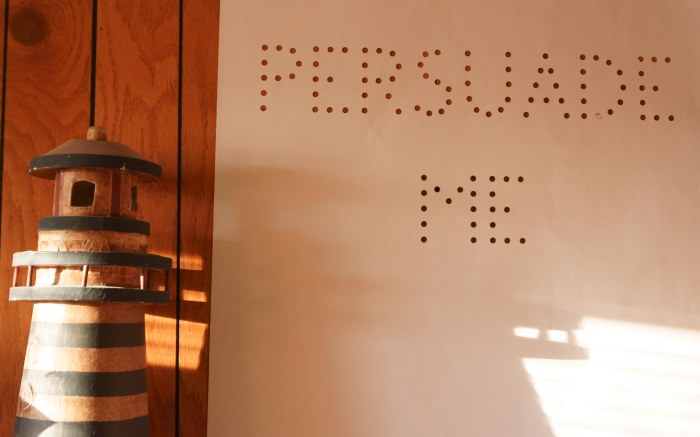
I am also persuaded we are all in the business of persuading each other all the time. We all have projects.
###
Image Credit: Kirk Livingston
Turn Your Message Away.
What might happen if you spun your story outward?

###
Image Credit: Kirk Livingston

 conversation is an engine