Archive for the ‘Communication is about relationship’ Category
Talk as an Economic Tool
Flesh out your own opportunity
Grandad was a salesman. Talk was his tool. Talk and presence. He showed up with people to help them locate a house they could own. I doubt he talked many people into buying because he was careful about the economics of the deal. He dealt in houses long before our recent mortgage troubles. He sold houses back when mortgage interest rates were well over 10%. He depended on people keeping current with payments, and they did, mostly. At Grandad’s funeral more than one person told me how the opportunity to own a home had been out of their reach except for his help (which was cool).
Grandad talked his way through a house with a client, through a friendship, through a cribbage game, through dinner. Talk was his tool for getting stuff done, to the occasional exasperation of his wife and daughters. Talk made stuff happen for Grandad.
I’m gearing up for a couple classes that help college students take their writing out of the classroom and into the workplace and Grandad’s example comes to mind. What had been a rather solitary passion for these students—working out stories, poems and arguments for themselves or some instructor—can be made to have broader use in the world they’ll graduate into. This is my argument: enterprising writers use their writing/thinking/talking skills to serve others and actually find it satisfying. Even illuminating: it turns out that looking out for ways to serve others is also as much a knowledge-producing endeavor as the scouring of personal experience and/or feelings that become grist for a poem or story.
Moving writing from an inward to an outward focus begins with a firm grasp on what they can offer—a sort of inventory of one’s communication skills. And then comes some thinking about how those skills may help push forward an organization’s marketing objectives. And just like Grandad’s conversations, writing itself is the route in and the outcome. But it starts with hearing about a need, and that takes a different kind of dedicated listening.
###
Image credit: un-gif-dans-ta-guele via 2headedsnake
It’s Better to Have the Conversation Than Not
Assumptions are a cul-de-sac. Admissions, an autobahn.
A fast-moving project I’m on pits the changing need of the client with the frantic response of the agency. I’m writing copy and providing strategic direction for a moving target, which has (literally) kept me up nights.
One truth that has proven itself to me several times over the past few weeks is that it is simply better to have a conversation than to not. That may seem obvious to you. But it’s taken me years to come to understand this. I’m too easily put off by the gruff manner or the fly-off-the-handle personality. It’s too tempting to put my head down and just do the work. But the way forward—especially when the task and deliverables are murky—is to talk together about what we understand. Naturally it is embarrassing to admit I know only this much (thumb and forefinger stretched) when I imagine those who wrote the scope of work know this much (from here to the wall, say).
But admit I must.
It is the only way forward. And sometimes it is the only way to get to the place where you can put your head down and do the work. Admitting what I know is also the best way forward: anything I can do to get the team on the same page, whether that means showing my rough draft copy or my quick dumb sketch of what I think the interactive designer just said. And by admitting what I know, others can feel free to admit what they know. That’s usually when I come to find out someone heading up the whole thing is just as baffled. But when we talk openly about what we know and especially what we don’t, a measured response can emerge and we assemble our next steps. At least until the next client meeting.
There is something of an art to getting people on the same page. Some personalities fall into this easier than others. Getting open discussion is aided by vulnerability: the admission. The confession. I suppose the question is: how badly do you want to move forward?
See also Seth Godin’s commentary about fearing the fear vs. feeling the fear. It may give you courage for your task.
###
Image Credit: Mark Brooks via 2headedsnake
(Please Write this Book) Busted, Berated & Celebrated: The Job for Anyone
Is Job the Michael Bluth of the Bible?
Now the story of a wealthy family who lost everything and the one [man] who had no choice but to, well…. It’s arrested development—with a twist: It’s Job’s tale, but with the focus shifted from his unjust suffering to a character trait everyone depended on.
He brokered peace for others.
Job had a habit of conciliating for his kids: after every round of feasting and drinking, he offered sacrifices, reasoning that just in case his kids cursed God, maybe his own intervention (which looked a lot like pleading) could help out. Just in case. This was Job’s habit.
And in the end, it worked. More on that in a moment
Would someone write this book? I want to read about how this habit of seeking help for others is more than just a pleasant idiosyncrasy of a hurting old man. Please unravel the mystery of this central piece of the story. I’d like know more about how Job’s habit of conciliation served as bookends to the entire story-with the Almighty making himself available (at least partly) because of Job’s habit. I’d like to read about how the right-sounding-but-flawed arguments delivered all the way through only reinforce how blinded we get in our self-righteousness. And how even the self-righteous need help in the end. I’d like someone to belabor the connection between what it means to care for others when you yourself are broken—wait, maybe Henri Nouwen already wrote that.
Please write Busted, Berated & Celebrated: The Job For Anyone.
I’ll read it.
I may even buy it.
###
Image credit: Wikipedia
Repeat, I say, Repeat Others’ Words
Weird Kid’s Trick that Boomerangs (Boomerangs!) in Your Own Brain
Someone told me about Lifehacker not long ago and I’ve been trying all sorts of the suggestions that flow through their stream of articles. But Melanie Pinola’s recent article “Make Better Conversations by Repeating the Other Person’s Words” caught my attention both for what she wrote and how the Lifehacker community responded:
If you want to be great at making and continuing conversations, you have to be a good listener. Barking Up the Wrong Tree’s Eric Barker points out one way to do active listening that hostage negotiators use to build rapport: repeat the last few words your companion said.
She goes on to give a very few specifics about repeating the last two or three words–it is enough to make you think about your own conversations. But the commentary that pops up after the article is almost as compelling as the article itself, with different folks chiming in by parroting the last two or three words. It’s actually not that easy to differentiate true interest from sarcastic banter. It’s all sorta hilarious.
Of course, kids learn repeating words early as a way to drive parents and siblings to the hard edge of sanity. I did it. My kids did it to me. But the surprise is that repeating others words—when not done with ill will or as a bit of customer service trickery, is quite cyclical: what you say again and again finds its way back into your own brain.
I have a client meeting today and I know that at some point I will repeat what my client says. Aloud. It almost always happens. It’s a basic part of understanding—it lets the other person know I am listening and it also gives me a chance to try on the words/concepts my client offers, to see if they make sense coming from someone else’s mouth.
We need more active listening in this world—but less repeating as a parlor trick.
###
Image credit: crazytales562 via Lifehacker

Thad Starner: Multiplex Don’t Multitask
What Personal Protocols Do You Observe?

Long before Google Glass, there was Mr. Thad Starner and his wearable computer. Clive Thompson in Smarter Than You Think tells the story of how Mr. Starner, a Georgia Institute of Technology professor and eventual developer of Google Glass, put the computer together himself and devised a discreet keyboard he could hold and use without drawing attention. Mr. Starner’s computer did not visually record all that was happening around him (making this less likely), but it did give him the ability to quickly query any question before him and take notes on his conversations.
Mr. Starner has been making notes on conversations for upward of two decades. Through experience Mr. Starner found that he needed to “obeys strict social protocols” around his wearable computer:
He uses it his wearable only to look up information that augments a conversation he’s having. If he’s talking with someone about the Boston Red Sox, he might pull up statistics to sprinkle in, but he’s not secretly perusing cute-cat videos. (p.142)
And he definitely did not check email while in conversation with people. That would be bad. Really bad. Anyone with a smartphone should know: bad form to check your email with in conversation with the human before you.
Mr. Thompson’s point in Smarter Than Your Think had to do with “transactive memory,” how sometimes we offshore our knowledge to a reference book or Google—or to other people. We come to depend on the knowledge of a professor or spouse or friend because we know they will indeed hold on to that information. And they’ll release it so us if we ask. So we need not try to remember it. Transactive memory is a pretty big deal when thinking about learning communities and organizations. Transactive memory is helped by free and open dialogue. Transactive memory is short-circuited by members of an organization who hold a knowledge-is-power ethic.
I like how Mr. Starner’s ethic developed over time: as he witnessed how his own computer searches took him offline from humanity. I also like how he reframed his searching to look like multiplexing rather than multitasking. Still: one person’s multiplex may well look just like multitasking.
###
Image credit: lacedartillery via 2headedsnake/generic–eric)
50 Years Later We’re Masters of Industry
Look how far we’ve come
 50 years ago, give or take, Herbert Marcuse and others struggled to understand where industrial society was taking us. He and others saw dark overtones in corporate goals and increasing standardization.
Would industrialization harness men and women? Or would it be the other way around?
Could it be the other way around?
“The industrial society which makes technology and science its own is organized for the ever-more-effective domination of man and nature, for the ever-more-effective utilization of its resources. It becomes irrational when the success of these efforts opens new dimensions of human realization.”
Herbert Marcuse, One-Dimensional Man: Studies in the Ideology of Advanced Industrial Society, (Boston: Beacon Press, 1964)
Social media is one place where technology has seemed to thwart efforts at ever-more-effective domination. Collaboration is increasingly common, and with collaboration, more instances of human realization. So the humans won, right?
Wait. The story’s not done.
###
Image Credit: Kirk Livingston
70 Sheets. 700 Signals.
My $1.25 Grist Mill
For years I’ve kept notes on conversations with clients.
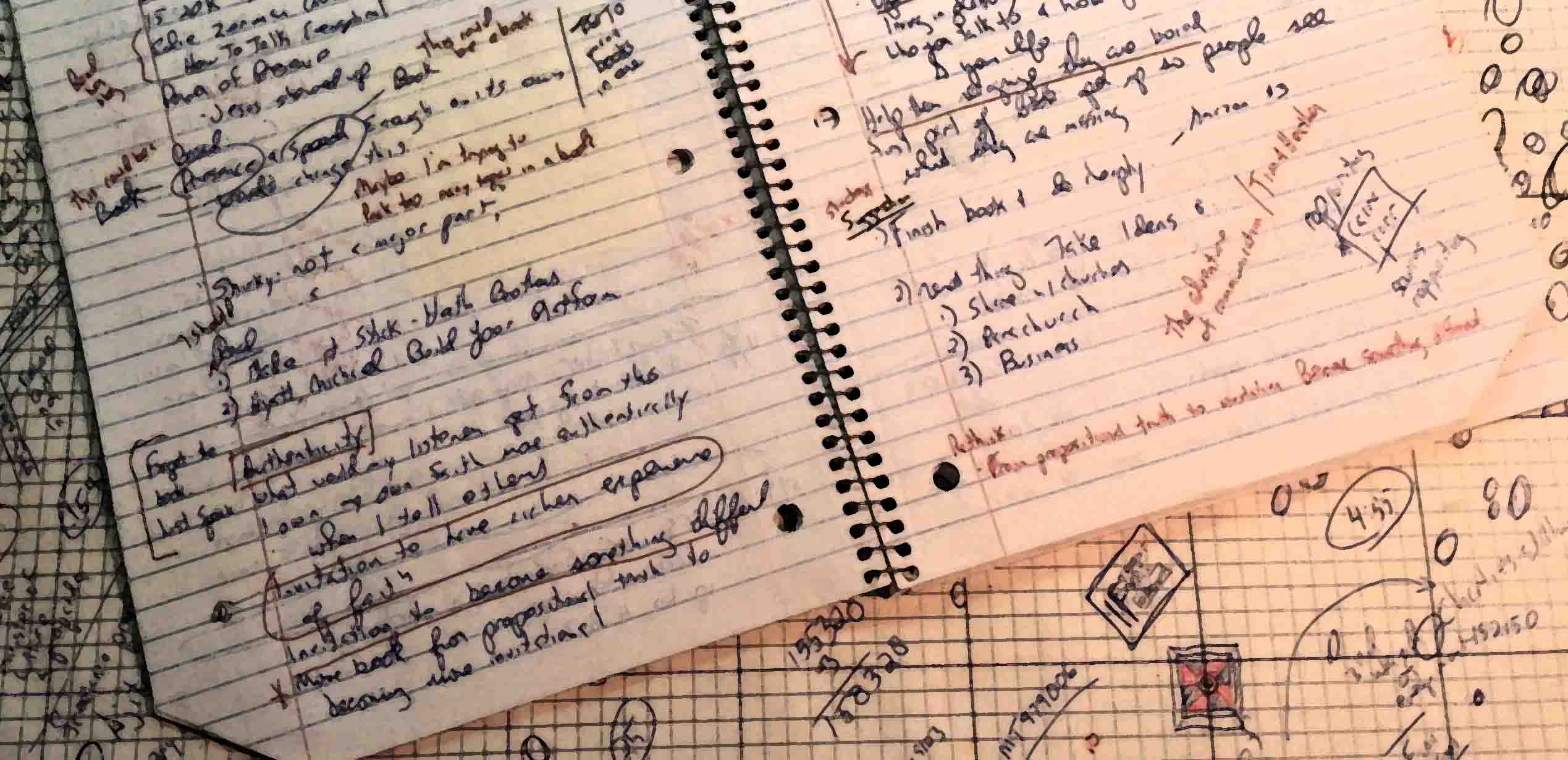
Anyone in business (or anyone in the business of getting something done) knows the value of accurate notes from a conversation. These quick jottings record promises made, delivery dates, special circumstances and conditions.
As a copywriter, I’m also poised to record quotes from my client or team: small summary statements, overview quips, self-proclaimed “dumb” analogies and tangential jokes. These little asides often prove valuable to solving the communication or marketing problem we’re gathered to work on. It’s curious how often the seed for the solution is in the conversation we had that defined the work we would do to solve the problem.
I know this because I often look back through my notes. I go back using a red pen and highlight notes that are proving critical (that’s right: reviewing notes in real-time is productive. Reviewing notes after the work is done is even more illuminating.).
Just today I found myself paging back through my notes looking for a particular conversation and stumbled on another conversation I had forgotten. And that forgotten conversation announced in red ink the precise answer to a communication question I’ve been asking for the last six days.
What good fortune!
###
Image credit: Kirk Livingston
Westgate Centre: The New Old Face of Affliction
Jihad, Jabs, Jobs and Job

Affliction is the bad stuff that happens. Today affliction looks like Westgate centre in Nairobi. It also looks like colleagues laid off after five, ten, 35 years of high-performance work for a company. Affliction can look like old age, like a shoulder with a pinched nerve, like legs becoming less-than-steady. Affliction looks like a chronic condition (heart, pain, fatigue). All the stuff that showers down on individuals and groups. All the bad and regrettable stuff, minor and major. All the stuff we would never choose (in a million years).
My new favorite old guy is Job. I’ve been dwelling with the story of his life and times and find his persistence, presence and engagement remarkable. One of Job’s friends, in a fit of knowing what to say (which passed for all the players in this drama) said this about Job’s affliction:
[God] delivers the afflicted by their affliction and opens their ear by adversity. He also allured you out of distress into a broad place where there was no cramping, and what was set on your table was full of fatness.
Elihu, the young buck who waited for all the old guys to finally shut up, also didn’t get it right. His words did not adequately describe the complex of Job’s predicament. Still his words (quoted above) contain wisdom: looking for deliverance in the middle of the affliction. In the end, his words proved true: Job sat at that table. And Job was thoroughly changed when he did so.
Is there deliverance in the horribleness at Westgate centre? I’m praying so. Is there deliverance after a loyal career? Yes, though the former careerist will be changed in the process. Is there deliverance from pinched nerves, unsteady legs, chronic conditions? Is there deliverance from old age? No. And Yes. And ultimately…yes.
And justice? That’s the very large conversation Job insisted on having—right up to where he fell silent. But affliction: is it somehow a way forward?
###
Image credit: Philipp Igumnov via MPD
When Twitter Visited Third Baptist Church
What Church can learn from Business #1: Acknowledge the Pain
Scene from a Sunday Service
Pastor Smith: We’ve jumped into the 21st century today with our projector up there tuned to the Twitter Channel! Today: don’t silence your smartphones. And you Twitterites, dial in your Twitter smart app and shoot your questions, comments and tweets to At ThirdBaptistRightNow. And remember to use the hash ticket number sign SubmitAndLove!

Acknowledge questions to unlock the door you’ve invited your audience to walk through
Pastor Smith: Open up your Bibles to Ephesians 5 and let’s get right down to the text and how wives need to submit to their husbands and husbands should love their wives.
@ElderEli: You’ll acknowledge how the passage has been abused for years, right? ThirdBaptist is just as guilty as anyone.
Pastor Smith: Now let’s start reading right from verse…what’s that? AtElderEli—I sort of mention that, but I’ll not spend a lot of time on it. Wait—let me see if I can work that in. Now, let’s start with verse…
@SingleSally: Go to the Bahamas in my mind or the coffee shop with my feet? Either way is more interesting than another sermon about marriage.
Pastor Smith: Now you stick around AtSingleSally, I can promise you’ll find something interesting in…
@ILikeBigBibles: Preach it! Submit and love!
@MsBankCEO: Before you go all gender-wars, can you at least acknowledge that in Christ there is no male or female (Gal 3.28). Seems worth mentioning.
Pastor Smith: Well now, AtMsBankCEO, this passage is pretty specific about the ancient household code, but, well. Let me think for a moment how that verse from Galatians might augment my comments about roles. But turn to verse 22 and…
@BlancheWife: You’ve got to start with 5:21! Mutual submission turns your old role argument on its head!
@BlancheWife: All that follows is an outworking of 5:1-21! Please at least acknowledge that!
Pastor Smith: Hoo boy. Preaching and Twitter make an uneasy couple. Let me do something different today. Blanche, why don’t you come up here and let’s start with an old-fashioned conversation. Just you and I and the microphone and all these fine friends out here. Let’s do something new and get your perspective…
@ILikeBigBibles: No! That’s not right. The brother should preach!
@SingleSally: You have my attention.
Consider Starting with People Rather than Texts
This is not heresy. This is basic pedagogy: when explaining an ancient text, gently help people over the hurdles by showing what it meant as well as how it has been understood over the years. Because your audience is thinking these thoughts already.
Twitter is a huge help in the work of naming the things people are already thinking. While churches are not likely to employ Twitter for anything beyond amplifying their monologue, they should begin to see that the conversations they once directed are happening without them.
Learning to listen and then getting at the truth together—that’s worth exploring.
###
Image credit: Kirk Livingston

 conversation is an engine