Archive for the ‘Communication is about relationship’ Category
Wait: Can we talk too much?
Feed your existential intelligence
I’m gearing up to teach again: freelance copywriting and social media marketing. My understanding of communication and writing and the volunteer social-media tethering we do continues to evolve. I can talk and teach and speculate about what works for communication and how to provide what a client needs. I can talk about how we need to help our clients think—that is a piece of the value-add a smart copywriter brings to a relationship. But these days I’m seeing more limits and caveats—especially in the promises inherent in social media.
These are English students and communications and journalism. Some business students. Juniors and seniors. Many are excellent writers. Many, if not most, have worked hard to develop an existential intelligence, as Howard Gardner puts it. I teach at a Christian college, and from very many discussions with students, I know they will seek a place for faith in their life and work and life-work balance. Many if not all are just as eager to make meaning as they are to find a job.
That pleases me.
That’s one of the reasons I like to teach there.
One thing I’ve learned is that work alone does not satisfy the meaning-making part of life. Nor does work itself feed the existential intelligence. Craft comes close. Especially when we grow in our craft as we seek to serve others. But work and craft and meaning-making must be purposefully-pursued.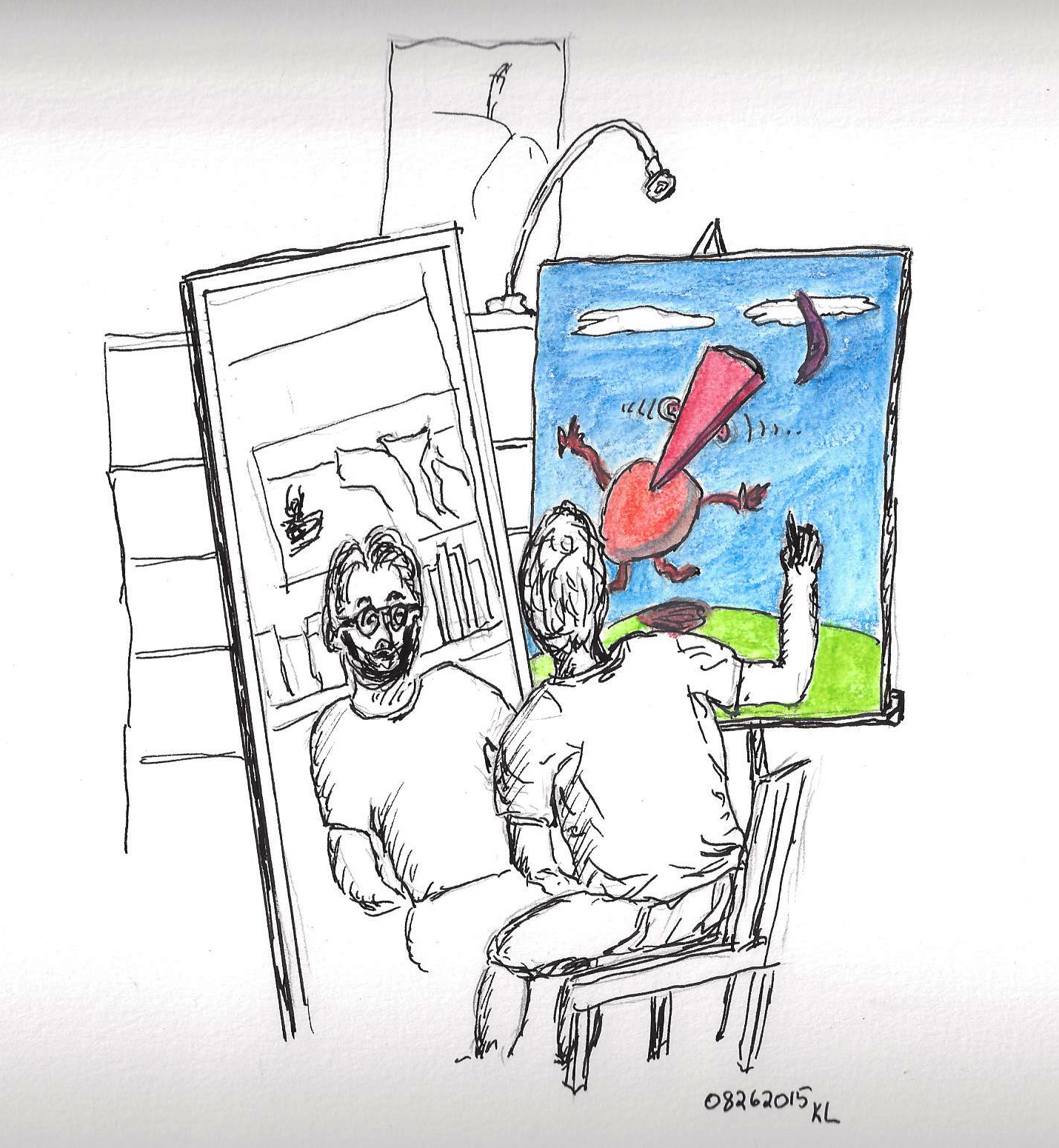
Intentional-like.
Because if we don’t pursue them, we fall prey to entertainment. We gradually anesthetize ourselves and starve the existential intelligence with the well-deserved zone-out time in front of the big screen TV. I’m starting to wonder if some of our social media habits also starve our existential intelligence.
I wonder because I wrestle with these impulses.
No. One does not fall into meaning-making. It takes work to make meaning.
I suppose that is the work of a lifetime.
###
Dumb sketch: Kirk Livingston
Is There No Antidote for Our Perpetual Push for Power?
Some say there is
Trump wants power, of course. So do each of the Republican candidates for president. Just like the Democrat candidates—every candidate wants power and pledges to do right by those who grant them power. We are no different from those candidates: We all want power. We want colleagues to listen to us, spouses to bend to our will, children to follow our directives.
We want what we want. Especially because what we want is good and pure and right, holy and God-ordained.

di Rosa Art Museum
One ancient writer thought there might be a different way. Old (dead) Dr. Luke quoted Jesus as saying you are better off finding a way to help the helpless then you are arguing over who is most powerful. Helping those who have no way to pay you back opens doors to a different sort of life that has very little to do with amassing power.
In fact—all that energy you spent manipulating and maneuvering into power—it’s not likely to lead you to the kind of solid ground that matters most.
What would our presidential politics look like if candidates thought about serving rather than voicing shameful prejudices that pry power from blocks of fearful voters? Likely that would not be covered by the media, because there is no story in that.
The institutions and organizations that own the candidates would not like that.
But humans might actually flourish in those conditions.
###
Image credit: Kirk Livingston
Hold On: Let’s Talk About That
Getting things right requires triangulating with other people.

Wait, let’s triangulate for a moment.
Getting things right requires triangulating with other people. Psychologists therefore would do well to ask whether “metacognition” (thinking critically about your own thinking) is at bottom a social phenomenon. It typically happens in conversation—not idle chitchat, but the kind that aims to get at the bottom of things. I call this an “art” because it requires both tact and doggedness. And I call it a moral accomplishment because to be good at this kind of conversation you have to love truth more than you love your own current state of understanding. This is, of course, an unusual priority to have, which may help to account for the rarity of real mastery in any pursuit.
–Matthew Crawford, The World Beyond Your Head: On Becoming an Individual in an Age of Distraction (NY: Farrar, Straux and Giroux, 2015) 63
###
Image Credit: Kirk Livingston
5 Ideas that Will Change How You Talk Today
3 Philosophers, a Rhetorician and a Social Media Expert walk into a bar…
Since writing ListenTalk, I’ve continued to hear these voices echoing in my conversations at work, at home, at church, in the street, at the curling club (I made that up. I don’t curl. Nor do I hurl.).

Here’s what these voices say:
- We have responsibility for others. That’s why we greet people and learn names and acknowledge presence. Our responsibility can do deeper—or not. But it is there from first sight and we all know it. (Emmanuel Levinas)
- People are not objects. So when we treat people as objects, we devalue them and strip ourselves of excellent relational opportunities. People becoming objects can happen in the workplace: it can happen when the CEO looks down on the vast army of minions. It can happen in the home. But it shouldn’t and we do well to defy this narcissistic pull. (Martin Buber)
- Words have incredible power. We can say things and, behold, it is so. Like pronouncing a marriage. Or deciding on a goal. This may not seem so, given the river of words we issue, the mundane, seemingly meaningless conversations that make up 99% of any particular day. Despite the great volume of words avalanching through our lives, they do—at times—hold incredible power. That’s why we hang on the last words of a dying person. That’s why we want to hear the words behind our favorite writer—we want to hear them explain how their story or argument came about. You can probably recount a handful of life-changing words right now, words someone spoke to you at just the right time. (JL Austin and John Searle)
- Our best talk comes when we’re not out to win a conversation. Humans are persuasive beings—we’re constantly trying to convince each other of things. But our best thinking and talk comes when we listen as well. And our worst conversations look like monologue—when someone preaches at us without listening. Those also tend to be short conversations. (Wayne Booth)
- Say what you will. Unless you live in North Korea or Russia, you generally have the capacity to say what you want. Yes, the current Facebook effect seems to be to say only what our tribe wants to hear, but we can find and build new tribes using social media. This is very important, because the old institutional voices are veering from truth more and more frequently. We need those new voices. We need your voice. (Clay Shirky)
Do you see how any one of those five ideas might impact your conversations today?
###
Image credit: Kirk Livingston
Our Best Conversations Satisfy and Anticipate
They can satisfy a question we didn’t know we had.

They can anticipate a question still on the horizon.
###
Image Credit: Kirk Livingston
How Does Anyone Change Direction?
Living with Questions
I met a preacher at a wedding recently. He had just officiated the ceremony, which was a beautiful thing—two people creating a great beginning. Afterwards, making small talk, the preacher told me how a few people in his congregation had changed. I was curious, because I had been reading Howard Gardner’s Changing Minds: The Art and Science of Changing Our Own and Other People’s Minds. In these highly partisan days, where we carefully surround ourselves with our tribe who speak our language, agree with our view of the world and where we ingest the news biased toward our agenda, I’ve been wondering how anyone ever escapes their own personal echo chamber.

“God did it,” he said. “In quite miraculous ways. Real change. 180 degrees.”
The preacher’s story of change had to do with someone coming into his congregation and how their life was different now.
“Wow,” I said, because change is remarkable. And because I like to hear stories about God doing stuff in real life.
“Sometimes I wonder,” I said, “Whether God does stuff or whether people change to fit the new club or group they’ve joined. Because I’ve noticed that the things we attribute to God can sometimes be explained by communication dynamics—how this new club or group satisfies a question someone has. Or perhaps the group dynamic meets an impulse they have, and they are more than happy to abide by the rules and unspoken ways this tribe works. And that looks like change. And perhaps that’s where change takes place: as we adopt a new moral code and sort of work ourselves into it.”
Was the preacher backing away?
“Which is not so say God is not in it,” I added, quickly.
“Hmmm,” he said.
“Because I absolutely believe God works through ordinary conversations in very big ways (now’s when you would mouse over and order a copy of my new book ListenTalk. Or just click here.)
“But I’m just sort of eager to cite the proper authorities when we talk about change,” I said. “Because change seems more nuanced, more a response to the questions we carry with us.”
Was he nodding in agreement?
Wait—where did he go?
What questions do you carry into everyday life? Those very questions may be the beginning of change.
###
Image Credit: Kirk Livingston
Recast Your Story
Melt. Turn. Form. Repeat.
More and more of my work is recasting. Telling an old story in a new way: finding the locus of interest for today, for these people, living right now. These people who don’t care how the story used to be told—it meant nothing to them and seemed irrelevant if not invisible.

My industrial-controls client wants a new way to talk about a neglected product. I write to find the words and the approach to make it interesting for today’s audience. My medical client wants to recast the backbone of their selling proposition with proper science and citations (versus just their own internal studies, which were not wrong, just limited). A consulting client wants to turn their expertise into a broader story that pulls in people outside the narrow audience with which they’ve been successful.
My process is to play with the story element. That’s why writing often seems like play or goofing off. It must be so: that’s where key discovery happens. Sort of like the process in my daily failures at Dumb Sketch Daily. I don’t know what’s right until I draw it wrong.
It occurs to me this recasting process is going on all over my life. Writing and faith and parenting and exercise are all changing before my eyes. A new story keeps getting told about each and it is important each story is told—telling and retelling the story helps me understand life. Maybe the retelling is all about making meaning.
What’s changing in your life and what story do you need to recast or retell? And who might benefit from that retelling?
###
Image credit: Kirk Livingston
“You Disappoint Me” & Other Nonstarters (DGtC#30)
Don’t Make Everything a Crisis Communication
Regular old talk has a way of lining things up. Steady, routine conversation between spouses, friends, family, neighbors, and colleagues can have a gentle, restorative quality.
Does that sound like an overpromise—especially given the mundane nature of so much of our talk?

Regular talk helps grow people along similar lines
It’s true in this way: like keeping roads open for traffic. We depend on open streets to drive to the grocer or to pick up our returning student from the airport. And sometimes we use those roads to race our pregnant wife to the birthing center.
Hard conversations are hard because of some urgency. Something needs to be said right now or else bad things will happen. Often we put on our formal language when we intend to communicate some crisis point:
- “I’m disappointed in…X” is a way corporate managers temper the screaming in their skulls.
- “We need to talk….” Is the time-honored way spouses bring up all sorts of unpleasantness.
But if those conversational roads have been open for traffic for some time, and relationships have been established, sometimes those formal words need never make an appearance. Talking about things can be handled on the fly, in normal conversation, in small bits. That’s because trust builds with the word traffic. And those conversational roads can carry quite a lot of weight.
Talking is a wonder.
Who would have guessed?
###
Image credit: Kirk Livingston

 conversation is an engine