Archive for the ‘conversation’ Category
How to catch elusive thoughts
Tell someone. Or just tell yourself.

Check your web of relationships early and often, before those thoughts vanish.
###
Image Credit: Kirk Liviingston
If you order my book, I’ll kiss you.
No I won’t.
But I’ll be grateful.

Another friendly sculpture from Lakenenland Sculpture Park
A friend emailed today that he ordered my book and thought my title and description worked well. I felt like hugging him. Mind you, I’m not a big hugger. Nor a big kisser—apart from the lovely Mrs. Kirkistan.
But there is something about finding people who resonate with my story that makes me weak at the knees (figuratively). I’m fascinated by all the crazy wondrous stuff that happens in even the most mundane conversations and now I’m starting to run into others willing to be fascinated as well. People are now telling me about the big life direction changes that came from random (seeming) conversations.
As I start to look for venues to talk about the book: book clubs, radio shows, churches or small groups, I am grateful for the opportunity to have conversations about, well, conversation.
###
Image credit: Kirk Livingston
How to Talk to Yourself for Fun and Profit (DGtC#29)
How can you learn something?
It seems like teachers stand and teach. But the truth is more like teachers stand and talk. Teachers try to arrange words so students will grab an idea and monkey with it themselves. The learning is in the student, not the teacher. Same with preachers and CEOs: when they blather on endlessly, chances of some party line changing anyone’s mind diminish greatly.
Copywriters and artists and comedians and sculptors and storytellers know this. So they trim their words/images/jokes/granite/story to the bare essentials. Among those bare essentials must be something that resonates with your experience. Something among those bare essentials must ring true—otherwise you won’t listen and you’ll go back to playing Angry Birds. Those few bare essentials stand the best chance of actually engaging you to work with the idea and even try it yourself.

Talking to yourself can build a way to let light in.
Successful communicators want you to talk to yourself. They want you to ask questions and to question assumptions and to wonder how your old behaviors fit your old assumptions. Working with an idea is part of processing an idea. The end result of processing an idea is a change in behavior.
But it comes back to talking to yourself. Even when talking with a friend or spouse or family member, you are also talking to yourself: testing words to see if they are true. Processing life stuff. You are even listening to and learning from what you say.
People who find a way to hold a conversation with themselves about what they see, think, hear and believe are some of the most interesting people you can run into. They are interesting because their self-talk and interior questioning boomerangs out to project a different way of looking at those things we thought were a done-deal. Their self-talk often resonates with the questions ambling about in our own minds.
Where is self-talk leading you? And with whom does your self-talk resonate?
###
Image credit: Kirk Livingston
See Also: Dummy’s Guide to Conversation
Q: My friend has lost all desire and curiosity.
What can I say to bring him to life again?–Lazarus’s friend
Dear conversation is an engine
My friend has lost all desire and curiosity. What can I say to bring him to life again?
–Lazarus’s friend

Dear Lazarus’ Friend:
Your friend may be depressed. Does he look at his smartphone a lot—that could be a sign. Tell your friend to hie unto a physician for a thorough physical–because it could be physical. It could require a counselor or mental health professional.
But from a friend’s perspective, find ways to be present. Take your friend out for coffee and get him to spill the beans: what’s going on? Friendship is about talking all the way through your friend’s understanding of life just now. Touch on what he fears and what he hopes. Touch on what next steps he might. This will take time—maybe many cups of coffee over a long time. Or take a long walk together–do something that takes the pressure off talking.
Being present with your friend may look like conversation. Or it may sound like silence. But being there, whether or not words show up, that is the first point.
Start there. Because showing up may be just the glimmer your friend needs.
###
Image credit: Kirk Livingston
Have That [fearful, painful, embarrassing] Conversation
It’s how humans move forward
We find all sorts of ways to not say something important.
I do this all the time: there are things I need to say to several people in my life—but I hold back, fearful of how my words might be received, questioning where the conversation will lead. Am I able to follow where this potential conversation might go? Do I even have the emotional capacity to stick with that conversation? Will I fall into weeping or fly into a rage?
I’m not talking about drive-by conversations that release a damning monologue and then run away. I’m talking about those sustained conversations with people we are close to, conversations begun with a desire to say and hear. True dialogue about something important—where our thoughts are modified by someone else’s—and something new arises.

Atul Gawande’s book Being Mortal: Medicine and What Matters in the End (Metropolitan Books, 2014) has reminded me of the need to get very specific when talking about end of life stuff—though the entire topic is crazy difficult. One simply does not know how much time anyone has left.
But it is not just death and life stuff that wants a conversation. There is life-direction stuff, talk about fears and hopes and dreams. Talk about how we understand something: what we think of faith now compared to what we thought 30 years ago.
Does that sound like a heavy conversation? It sure could be. But, in fact, we release bits and pieces of this stuff all the time. In conversation with those close to us we always find ourselves talking about these things. But sometimes those conversations need to be ramped up.
A couple years ago I wrote that it is better to have the conversation than not. More and more I think that is true. When we bring up a topic with a friend or family member or colleague, great things can happen. We can find new resolve, or new intimacy. Sometimes the talk conjures raw emotion. But on the other side is a movement forward.
What do you need to say today—and to whom?
###
Image credit: Kirk Livingston
“ListenTalk: Is Conversation an Act of God?” Get it at Amazon.
How do ordinary conversations change the course of your life?
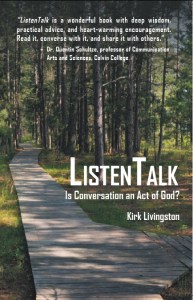
Now available at Amazon and other book sellers.
The smallest things you hear and say have the power to alter the trajectory of your life.
But you know this—just look back at a few of the most innocuous conversations you’ve had—the ones that led to a school and a life partner, or to the career you love, or to breaking with some substance.
ListenTalk rereads some old Bible stories for what God expected in conversation with women and men. A few wily philosophers show up in the book to quiz God—and us—about the power and promise of ordinary talk.
Read ListenTalk and you’ll come to look for and expect big things from even the most ordinary conversations that populate your day. Because ordinary conversations lead to far deeper connections than you’d imagine in your wildest fever dreams.
Feel free to give the book a 5-star review at Amazon.
Take me to Amazon this very instant with this link so I can order this odd but interesting book.
###
Teach Your Institution to Speak
Developing a Bias Toward Dialogue
Dogs don’t talk, but they are great communicators.
We know what they want, mostly because they want the same things at the same times every day. They’ve trained us in exactly that way: Go outside. Eat. Rub my ears.
Dogs have conditioned us well.
In the same way our corporations and organizations and institutions train us to speak in certain ways. One company I worked for required a high level of sarcasm to get through the day—it was just the way employees interacted—all the way to the top dog. Another firm with a gossipy culture built impenetrable walls of mistrust and politics between colleagues, cliques and departments—walls that interfered with work and mission. One brave boss arose from the nattering class with a zag to the well-entrenched zig: when Employee A came with a screed about Employee B, this boss would immediately summon Employee B to the office and engage their complaints together. So before Employee A went off the rails about Employee B, they had to deal with the issue together, face-to-face. This became the beginning of a solution. People stopped gossiping to the boss, for starters. But they also found new ways to talk with each other. People picked up on the message that unhinged rants about colleagues will not do—at least with this boss.

Can you spot the Ole in this photo?
You might think that the only way to get an institution to have open, revealing, useful forward-moving conversations would be from the top down. If the big boss does dialogue, then everyone else does—so goes the thinking. But in fact, culture does not always move from the top of the pyramid to the bottom. Sometimes it starts in the middle. Sometimes it starts at the bottom.
And that is good news for the 99 percent of us without a bully pulpit.
A person who demands more of conversation will butt up against others who are not so demanding, and sparks will fly. Or not. If you cannot find a place for forward-moving conversation in your organization, chances are good you will leave to find an organization where your voice will be heard.
But there are not a lot of good reasons to put up with less than genuine conversation.
###
Image credit: Kirk Livingston
A Confederacy of Onces
What could a national conversation look like?
Once upon a time mom and dad and kids gathered in the evening in front of the television to be entertained. This family, sitting patiently and expectantly, had three channels to choose from. Plus the boring public broadcast channel. Back when everyone watched the same variety show or mini-series or disruptive news special, national conversations occurred. Broadcasts that enraged or engaged would spur citizens to remark to each other. And since everyone watched the same channels, national conversations were born. So we talked about Selma or Vietnam or the moon landing or the most recent episode of “Roots.” Sometimes, not often, we talked about what was happening in Washington.
Before TV, radio did the same. Before that newspapers. Media has a way of spurring national conversations, though the attention lasts only so long, because the job of media is to immediately bring the next new thing. Day after day. That’s their revenue stream and business model.

When consolidated media ran the news business, it seemed to have more of a black and white/good or bad characteristic. With good guys and bad guys, a much better story emerged. And better stories sell more newspapers or generate better Nielsen ratings.
Social media removes some power from the established media. By hearing from different voices, context can be provided. Or not: Sometimes flame-throwing trolls dominate our inbox, just like on Fox News. The smart ones among us find ways to hear different voices, so we can see different ways to connect the dots. The rest of us relish getting riled with righteous rage by the people in our tribe who serve that function.
Lately for me and others, social media has connected dots and has turned a series of media one-offs into a bona-fide “thing.” Many find themselves paying attention and then cannot help but remark. Topics like the statistics around black deaths with police. It was blogs and tweets that explored nuance and connected the series of “onces” to show there is more—much more—than just a few one-offs. It was social media that kept the topic on the radar, not the established media.
Kerry Miller, on a recent The Daily Circuit, said she doesn’t like to use “national conversation” because it never happens. That is (I think she meant), national conversations never materialize. But I would argue that more and more often people are adding up the “one-offs” and putting them together in ways journalists and authorities had not predicted. It blindsided me that the Confederate flag flying over the South Carolina capital would prove a lightning rod. Gay marriage has taken the nation by storm right up to the point where it became the law of the land. And it was the call for statistics to be reported about deaths occurring in police custody. All of these have been explored by social media in detail.
All of this has proven fodder for national conversations. That is, new topics that we may never have dreamed we’d find ourselves talking about are now falling from our lips at the coffee bar or on the drive to work. And here is perhaps where today’s national conversation differs from those conversations mediated only by established media. Social media allows for nuance. It need not be black and white because we’re not selling newspapers here (some are, of course). But the nuanced voices are helping us talk without forcing one way or the other.
I see these conversations developing every day. And they move from online to offline to online again. I also see smart journalists from established media finding ways to bring in nuance at just the right time.
###
Image credit: Kirk Livingston
Judge Not: On Moralistic Judgments
#That’sJustTooHard: Think Before Speaking

There’s no stopping a word spoken.
One kind of life-alienating communication is the use of moralistic judgments that imply wrongness or badness on the part of people who don’t act in harmony with our values. Such judgments are reflected in language such as, “The problem with you is that you’re too selfish.” “She’s lazy.” “Their prejudiced.” “It’s inappropriate.” Blame, insults, put-downs, labels, criticism, comparisons, and diagnoses are all forms of judgment.
–Marshall B. Rosenberg, Nonviolent Communication (Encinitas, CA: PuddleDancer Press, 2005) 16
Which is not to say we do not have values and make judgments based on our values. Of course we do. But what if held back our knee-jerk spew of moralistic judgment about someone we’ve never met? What if we first talked with them?
A conversation could show us how wrong we were—or confirm our suspicions.
But…hear first.*
###
*Of course I am pointing to my own failure at this before pointing anywhere else.
Image Credit: Kirk Livingston

 conversation is an engine