Archive for the ‘copywriting’ Category
How to Wait Like a Boss
Where does Fallow Fit in Your Work Calendar?
You’ve pulled all your levers, called in your favors, phoned the usual suspects and still, nothing.
You’ve checked and rechecked your inbox.
Nothing.
This is the freelancer’s periodic plight: No matter how busy you were last year, last month, last week, today is a different day—subject to the vagaries of clients, markets, time and creative flow. And there’s nothing you can do about it except wait.
Waiting is not the worker’s lot. Employees have no end to work and the seeming ability to remain busy. It’s only when the busy employee steps away from a job (voluntary, lay-off, fired) that she or he realizes that they might have benefited from stepping off the treadmill earlier. A bit of perspective may reveal their busy productivity didn’t really add up to much they can take with them.
Waiting is also the job-hunters dilemma. The job-hunter taps her toe waiting for the wheels to turn, for the right people to review the resumes and the interviews to be scheduled. Waiting for an offer. Waiting for a “thanks-but-no-thanks.”
No one likes waiting. You want productivity 24/7 and let’s start being productive this instant.
Waiting is a complete waste of time.
But is waiting a complete waste time?
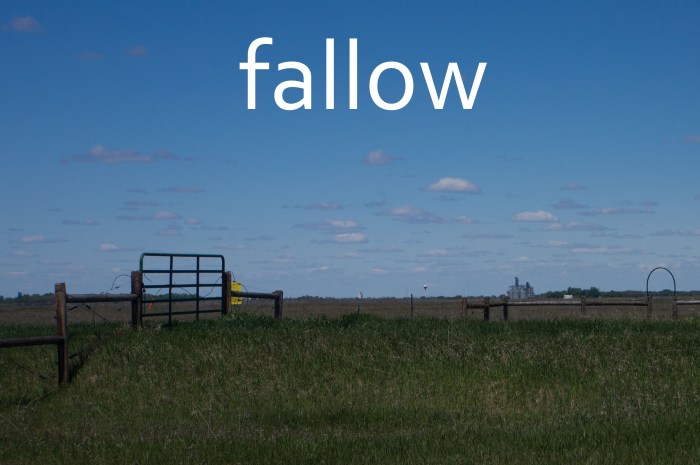
In fact, waiting pulls back the curtain on our fallow ground.
Kathleen Norris, in her book The Quotidian Mysteries, wrote about the infinite prairies to which she returned to focus on writing. All that land—miles and miles—seemed so unproductive. And that unproductive land was also a reflection on her mood. It took time, but she eventually saw that there was actually pretty big stuff happening in those fallow fields—all largely unseen. Norris learned to sit with her own fallow, unproductive times knowing that hidden gears were turning and new avenues were opening:
No small part of the process of writing is the lifting up into consciousness of what has long remained in the basement, hidden, underground, as in a tomb.
Maybe you are crazy busy and fallow/unproductive/waiting time has no place in your schedule. Please reconsider. Take that vacation. Rethink your time between jobs. Look deep into the underground and pull out the life what was entombed years ago.
That’s how you wait like a boss.
###
Image credit: Kirk Livingston
3 Ways to Strengthen Your Next Think-Piece
Leadership is an emotional action story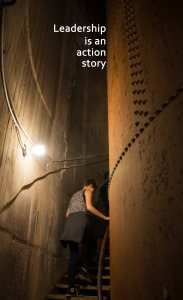
Most of my clients see themselves as thought-leaders. These clients really are leaders in their industries: their scientists and engineers labor to create new ways of approaching old markets even as they open new markets. A think-piece is an outward-facing story of their leadership in the light of a market problem or need.
Some clients assume their brochures and web copy can be repurposed into a think-piece. One of my tasks is to help them understand that a think-piece takes a position on a problem, spins out a story that shows the problem resolved in an emotionally satisfying way. That is typically a larger frame of reference than their current brochure or web copy.
Other clients want to say something without revealing anything. They worry about competition in their tight market. But they don’t realize how a generous spirit is another kind of selling (especially in this sharing economy), and giving something-not-everything away is a mark of true leadership. But it’s just too big a task (they say) and it will “only distract our scientists and engineers.”
Sharp clients understand that thought-leadership presents a story that is immediately recognizable, universally understood (by their target audience) and easy to digest. They also understand that the best stories carry a useful thought with an emotional element.
My favorite thought-pieces typically have these three elements:
- Story: A story is threaded together with real people doing real things. There is emotion in a story—just like life—and real people talk in human rather than PR speak. Real people with real problems that unlock real emotion both before and after the solution appears.
- Visual: There’s no question that words simply take too long for most of us. We still read, of course, but our short attention spans move us toward images and video. Some say visual is the primary way social media will present in coming years. We can put that visual bias to work today with words that paint pictures. That has always been the novelist’s forte: creating scenes. That ability must find a home in today’s think-pieces. Gone are the days when an interested audience member might happily read your brochure. Now you have to catch them when they are not looking or thinking about your product or industry. This is not an easy task, but the more visual the better. Visual also has the advantage of being immediately understood.
- Speak Human: Every discipline has its own secret words. Every industry uses lingo and code words to show they know their stuff as well as out of sheer laziness. It’s just easier to say the same things as everyone else. Plus it’s a badge of the tribe, so why wouldn’t you? But insider language is inherently toxic for anyone outside. It’s a buzz kill for an outsider looking in. Speaking human means words cleansed of jargon, words that can shine through a clear story.
The best think-pieces don’t appear to be think-pieces at all. They can be read so effortlessly that we take every step with the author to the intended conclusion. And we find ourselves happy to be there, taking action with the hero.
###
Image credit: Kirk Livingston
The Joys and Sorrows of NeuroMarketing
My Will be Done—in Shops as it is in Spreadsheets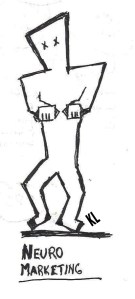
If you wonder why the prolonged absence from posting, it’s because I’ve been trying to write and submit articles and short stories to various markets. Since last year’s NaNoWriMo, I’ve fallen into the great fun of writing stories.
I’m currently writing “The Joys and Sorrows of NeuroMarketing™” in less than 2000 words. I’ve also been writing to find out what happened to the neurosurgeon, the failed theologian and the copywriter in The Naked Copywriter. Sadly, a medical device marketer in that story has gone rogue to develop a neuromarketing app.
In case you wondered.
###
Dumb Sketch: Kirk Livingston
Hey—You Can’t Say That
On Students Subverting Form
Some of my copywriting students were eager for more direction on how to use the forms of communication. Some were eager to go species-by-species and list out the formulas for producing them: How to write a print ad. How to write a direct mail. How to script a broadcast ad. How to write and then say the magic words that get you hired.
I taught that class a few years back. It was all about working through the various forms of corporate communication and learning to write in just that style and toward just that end. I taught it for years until I realized everything inside me was shouting for students to run, to break with the form and find a new way to say what they need to say.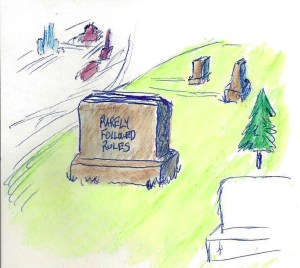
For today’s copywriting students I was able to point to my beloved copy of Alastair Crompton’s The Craft of Copywriting (long out of print, I believe). Mr. Crompton offered lots of rules that probably worked well in 1979 and some of which still apply. Various copywriters have offered sets of rules over the years. Some stick. Some don’t. Bernbach, Burnett, Ogilvy and Reeves all visited our classroom from time to time in written and oral form. They each had a golden rule or two. And, of course, James Webb Young’s old Technique for Producing Ideas.
In truth, there are some general notions and guidelines and, well, forms (if you must) that apply. But over the years I’ve thought of those as only the receptacle of the really important thing: the idea. It is the idea I’m fixated on and I tried to communicate that to students. Ideas come from grappling to combine something old and something new, something borrowed (from an audience need or desire) and something that can woo. As far as I can tell, there are no formulas for producing ideas, only the setting up of conditions that may lead to ideas.
But, you know, no guarantees.
As many of my students said, “You can’t manufacture ideas.” To which I would always respond, “Or can you?”
Forms and formulas are there and they can be useful. But forms and formulas don’t carry much life. And mastering the forms and formulas, for a beginning copywriter, seems like a starting point. But is it a good starting point? I don’t think so.
The writer’s task is to breathe life into an old form or subvert it or discard it. The key is always and forevermore to put life on a page.
Forms and formulas will always bow before life on a page.
###
Dumb Sketch: Kirk Livingston
On Creating: “Hello Problem, Please Sit with Me”
From Distraction to Focus
We stare at the problem until we can’t think straight. And when blood runs from our ears, then we have just begun.
This quote from a Minneapolis copywriter describes the creative process that drives his role in the industry. What does it take to come up with a creative solution that is beyond the first 5, 10 or 20 thoughts that pop into anyone’s head? What is creativity, anyway, and why should I care?
- First the bad news: creativity requires deep focus.
- And now the good news: you are capable of deep focus.

“Look Again: Expanding Feminist Possibilities,” Groot Gallery, St. Olaf College
In our age of near constant distraction, how does anyone slip into the focus-cave? How does anyone keep distraction at bay, apply sustained attention, and lose track of time in the process? It turns out there are solid answers to those questions. Those answers arrive from a mix of personal experience from people who create regularly, from a bit of theory, and then from experimentation with what works for you.
One thing is certain about focus: it can bring a healing wholeness with it. Just ask any person who regularly creates, and hear them talk about “flow” or the zone or getting into that space of just doing it.
Creating is not for the faint of heart. Because to create is to dwell with ambiguity: could be this. Could be that. If you change this piece—or flip the entire story or image—everything looks different and maybe even makes more sense. Very little is defined when creating and, in fact, you are doing your own defining
A group of students and I have turned a corner this week. We’ve gone from feeding the internet with content that builds communities to feeding creativity that can solve real-world problems. And just like when we work different muscles with cardiovascular versus weight training, this move from rapid creation to deep problem-solving wants a different set of brainwaves. We’re moving from intense listening and rapid creation to sitting with a problem and iterating our way out.
One of our bigger tasks is to train ourselves not be satisfied with the first, easy solution. We’ll learn how to bend time and write fast while you still know nothing, and how to lift and separate and how to map your way around a problem and how to start at the top again and again. And how to grind through to get to a better solution.
But all that needs focus.
And focus means not picking your phone up for 60 minutes.
And that is a struggle.
###
Image credit: Kirk Livingston
On Writing: Is This Where The Magic Happens?
“…and then a cascade of miracles occurs…”
Yesterday I heard myself spinning a tall-tale to a quiet cluster of skeptical students.

as if
I told them of a magical place they can go were writing connects the dots in a mysterious and inexplicable fashion. It is a place you arrive mostly clueless about what will happen next. But then you begin marking a blank page and words form into sentences and dots arrive and connect. The not-knowing of this place takes a bit of courage to sit with, but the payoff of processing your not-knowing is immense.
These were writing students, so many regularly visit this place. Some nodded in agreement. Some stared back blankly, though I suspect this tall-tale was their own experience as well. Some stared blankly refusing to participate no matter what—which is, of course, that great student default-setting.
John Cleese spends his retirement talking about this place (try here or here. And especially here). He characterizes it as more of a time than a place—which I completely agree with. A time away, which becomes a space bordered by time limits. I use timers to get to that place. This place where the magic happens is also called “flow” or “in the zone.” I’m certain you’ve experienced it as well.
For the working writer, I’m convinced that this place is bordered on one side by strategy and analysis and research. And on the other side is marketing or talking to an editor or pushing “Send.” But in between: this magic layer where creation happens. It’s a place equally daunting and exhilarating.
Is there really such a place?
I believe so—see for yourself.
###
Image credit: Kirk Livingston
How to be an Object of Pity
Hint: Grow a gray beard and present folding-money
Twice now young women have bought me coffee at the coffee shop on the campus where I teach. Just standing in line like everyone else—minding my own business—I pull out my $2 (cash-money) and the young woman in line behind me says, “Just put it on my card.”
I resist: “No! I wouldn’t hear of it,” I say. “You can’t. You must look after yourself with that—or at least spend it on your friends.”
I went on in that vein, until the cashier reached past my $2 (cash-money) for the woman’s card.
“She’s not going to spend it all anyway,” said the cashier, repeating what the woman said.
So. Free coffee. Thanks profusely offered.
Yesterday: same thing. I pull out my $2 (cash-money) and the young woman behind me says, “Just put it on my card.”
I resisted. This time with less velocity. Free coffee. Thanks profusely offered.
 I’ve puzzled over this phenomenon. What I know for certain is that the students here are some of the kindest people you’d ever hope to meet. And earnest. Looking around I also see that I have landed from the planet “old guy.” Though I know even recent grads feel that way when revisiting their alma mater. Still, it’s been a long time since I was an undergrad.
But I think it’s the folding money that triggers the pity. What kind of a person uses cash-money on campus? Clearly someone in need and, frankly a bit out-of-touch. We all use cards.
You must not be from around here.
“Let me help you.”
The other day a student reflected on her community-building work in our social media marketing class:
“It’s also important to create a presence that encourages interaction,” she said.
I can’t get her comment out of my mind, partly because of getting two free coffees and partly because of the riddle of how to write in a slightly-unfinished, slightly-needy way.  Like how Columbo conducted investigations: you pity the unkempt, needy fellow until you realize he is canny like a fox.
I’ve long puzzled over the magnetism of a dumb sketch. Stepping up to the white board and drawing something badly as a way of explaining an idea is a sure-fire way to invite others in. And they step up—not to correct, just to collaborate. Because it’s sorta fun to draw badly and without the pressure to create art. And it can be fun to think together. And, like presenting folding-money in debit card economy, you clearly need help.
What are you willing to leave unfinished to draw others in?
###
Image credit: Kirk Livingston, The-Toast.Net
Tell Me a Story
On the Mindfulness of Listening
Listening is such a simple thing. How hard can it be?
But we all know that listening is harder than it appears, because listening means we have to shut up. And good listening means not just shutting up but also not using someone’s moments of speech as a time to plan counter-arguments.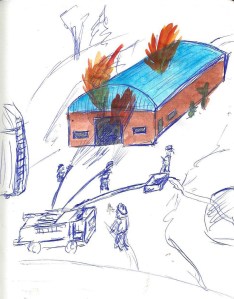
Real listening happens nine hours into a car trip, after you’ve exhausted the common topics and celebrity gossip and a silence settles. For miles. Which can feel weird. And then you pass a broken down Quonset hut and your spouse/friend/acquaintance/ride share starts in on early memory of a fire at her parent’s farm, and how all the kids huddled in blankets watching the barn in flame and hearing the gas tanks in the tractors explode one after the other and how the firemen pumped water from a pond into a little pool they created and then onto the barn. And how the whole thing left her feeling sad and, well, bereft.
It had been a kind of turning point, she says, now that she thinks about it. And then she collects memories of what was different with her family after that and how it was different. She has very specific points.
And you have not said a word. Because the fire story had and entirely engulfed you as well. You were there—as she told her story—shivering on the side and hearing the pop of gas tanks.
Most listening is not that dramatic. But sometimes it is.
We’re talking about how to listen in our social media marketing class. How to listen to the audiences and communities we want to interact with. We want to hear the concerns and the jargon and the voices and the rhythm of those voices.
It occurs to me that we listen in stages. Or perhaps we hear—or comprehend—in stages. When new to a community, we hear the words and perhaps can make out only the broad outlines of the bigger story. The more we listen, the more we hear specificities and nuance The more we listen, the more stories we hear the emotion and motivations that bind a community together.
Good listening means sitting with and through the stages so that we burrow into understanding the people of the community. Our best friends are often great listeners because they sat through the bursts of story that followed silences.
Most of us have little time for listening.
Pity.
###
Dumb sketch: Kirk Livingston
Forget Content Strategists: We need Village Storytellers.
Begin the Begatting!
“Content strategy” has such a corporate feel to it. Such strategized-promotional-content-puzzle pieces, dreamed up in isolation, will move forward whether or not anyone cares. But here is exactly where strategy and art must date, marry and get busy begatting fecund stories.
No human will be interested otherwise.
No amount of strategizing can actually make that happen. Art must take over. Art connects with emotion. Art is a human meaning-making activity not easily controlled by a corporate agenda. If controlled too-tightly, art quickly becomes something less than art.
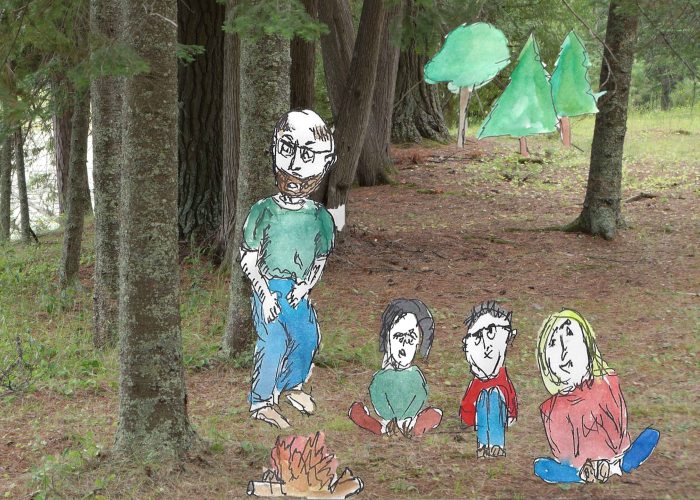
I’m working with a group of writers who need to understand this. Their task is to pull people into the causes they have begun to champion. They will identify their mission and purpose, complete with telling details about their target audiences. They will strategize about content and assemble editorial calendars, but in the end, it is the art of storytelling that has the power to pull anyone forward.
My theory is that strategy works best as a beginning point. You do your best to get a strategy in place, but then you move forward. As a writer, I know from experience that stories and strategies grow up best together. Each talking to the other. That is because the weaving of the story actually makes new strategy elements available (and vice versa). Elements appear that would not be apparent except that the artist has accessed that deep subconscious, chaotic place where connections are made and much foolish talk swirls around very bad ideas before anything worthwhile appears.
Sometimes when I get stuck in the analytical side of strategy, I set it aside to tell stories just to open possibilities. I am not alone in that practice.
There is a push for strategists today. But I would rather work with their more human cousins: story-teller strategists.
###
Image credit: Kirk Livingston
Stephen Fry’s Voice Serving Heathrow
Please speak human
Copywriters try to harness voice to say their client’s message. There’s lots of talk about being on brand these days, and for copywriters that means speaking in the voice of the brand. But voice must always be human to be heard. That’s why press releases and spokespeople are so easily dismissed—they generally don’t sound human.
John Cleese felt he could perform Basil Fawlty for Specsavers because the voice they wanted was true to the character he had created. He had refused many opportunities because unfunny scripts deviated from that character.
Check out how Stephen Fry voices a gentle, unhurried, humorous take on a place that launches an airplane every 45 seconds.
###
Via Ads of the World

 conversation is an engine