Archive for the ‘copywriting’ Category
Hey: Where did that voice come from?
Don’t be stung by inauthenticity
Some in my class are English majors and don’t mind wading into the waters of how words work. So when Content Rules (Handley and Chapman) talked about voice, a close reading ensued. Handley and Chapman lobby for authenticity in voice: voice is your own way of corralling point of view and word choice and rhythm (meter?) and pressing it all into service. Voice is making language work to express your words in your way. Voice is what you sound like when you talk (and we’re aiming for conversational writing in this class, so writing and talking sort of blend).
But voice is also something that gets companies and organizations all hepped up. To give your brand a personality by adopting a particular point of view (which leads to word choices/meter and etc.) is what companies and organizations seek these days. Voice helps a brand stand out from the crowd.
And one must stand out.
But this:
How can you write with an authentic voice when you are adopting the voice of the brand?
Good question, English-major-friend. Two answers come to mind:
- Sometimes we use voice in the service of some larger purpose. So we might submit our voice to the larger brand purposes and adopt as best we can the machinations of the brand voice. Some people may naturally embody a brand voice. The rest of us have to work at it. This adding and adopting is part of serving the larger goal you believe in (at best. At worst: you adopt voice to make coin for rent). This is the collision of craft, faith and service.
- If you find yourself stinging with inauthenticity as you write for your brand—look for a different job.
I’ve maintained all along that when people add their voice to a project, new things happen. Sometimes a new voice provides new electricity and a new approach to a time-worn topic. Even old-timers can learn stuff from new voices.
Of course, people must voice up.
If you don’t say what you’re thinking, the new thing just around the corner will sit there in silence—just around the corner.
###
Image credit: red-lipstick via 2headedsnake
Do The Dumb Things I Gotta Do (They Might Be Giants)
Memo to Myself: I cannot control what others think
Tell me again: why did we think we could?
Maybe you are a fan of They Might Be Giants (TMBG). Maybe you are not. I’ve just stumbled onto a wiki that attempts to decode the (typically) obscure lyrics of the two Johns.
Songs by TMBG should never substitute as sacred texts but, “Put your hand inside the Puppet Head” has something to say to those would begin to organize a community. That’s the task we’re starting this week in our social media marketing class and I’m trying to help us understand the old command and control ways of marketing have fallen by the wayside. By the way, it’s those old command and control notions that led to the monologues that made us think whatever we said was also what people heard. That has actually never been true—people will always hear my words in the context of their lives, which means mostly hearing what they want to hear.
In short, there is no puppet head. In this social media world there are transparent people who write from passion and experience. People who build communities because they want to. People who invite others in—but never force others in (a phrase that is almost nonsense today). What we can do is to assemble a clear picture of the people we want to join our party. And we can have an image of how these people interact, where they show up on the web, how active or inactive they might be in their webby habits. And from that we can begin to sort how our social media contributions might serve them and pull them toward this community we want to build. That’s the task today: Who are these people and what do they need?
By the way, there certainly are social media puppets out there: people without transparency who bark out some corporate message or ideological pap. But the blogosphere is not kind to them, because nobody out here likes being the victim of a drive-by monologue.
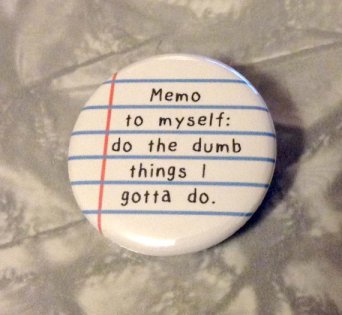 Transparency gets heard and gets a toe-hold in people’s psyches. We’re shooting for transparency and the credibility it builds.
###
Image credits: TMBG via Vimeo, Button via UnrehearsedKickline
Ahh: Back To Work
ListenTalk: The Promise. The Mission. The Chapters.
Dear Reader: A word, please.
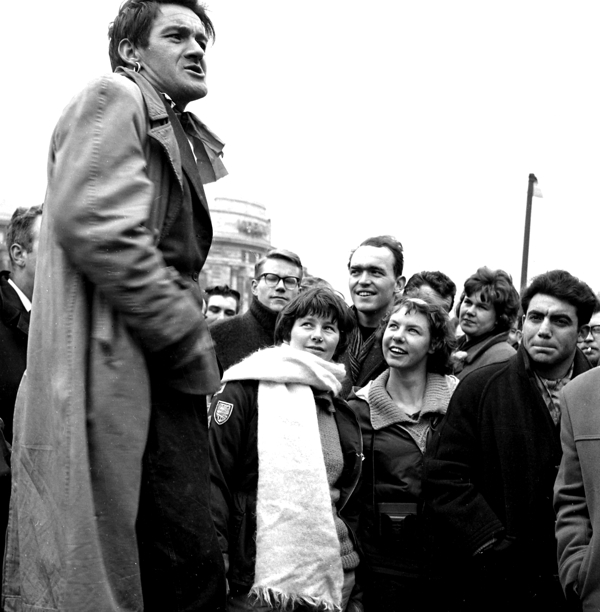
Speakers’ Corner, London, mid-1960s
Over the next few months I’ll be writing in response to a couple classes I’m teaching at the University of Northwestern—St. Paul. That means I’ll be dealing with questions and ideas that pop up in class. The classes tend to be quite collaborative and the students have interesting contributions that I may work out in this forum.
I’m also trying to work out how the notion of ListenTalk applies to the different audiences I work with as a copywriter. ListenTalk: Conversation is an Engine is built on a theological basis and is first a meditation on a new (or—I maintain—a very old) way of looking at how we spend time with each other. Over the course of the year I hope to enlarge the argument to help workers talk with bosses (for instance) and vice versa. I’d like to enlarge the argument so conservatives and liberals can put down their label (and libel) machines to engage in productive talk. I hope to work out the notion of commercial conversation so companies can begin to talk with customers in a way that treats people as rational collaborators versus emotive flesh-encased ATMs.
But first, and to bring a bit more focus on this initial argument, I present the promise and mission of ListenTalk, as well as the chapter synopses:
ListenTalk Promise:
Read ListenTalk and you will be stimulated to reconsider how even your smallest, most ordinary conversations are part of a much larger story.
ListenTalk Mission:
ListenTalk was designed to help individuals in faith communities see how God works through the most ordinary and common conversations—and to see how those conversations transform everything from personal calendars to cultural mandates.
ListenTalk Chapter Synopses:
- The Preacher, Farmer and Everybody Else. What do you expect from a conversation? Preachers preach and hope for the best. But farmers work the soil in a studied way that collaborates for growth. Meet five thinkers who have studied the ways and means and opportunities hidden under the surface of ordinary conversations. These five show that ordinary conversation is full of collaborative potential and regularly turns into some of the most important, creative and lasting work we can do together.
- Intent Changes How We Act Together. If we enter a conversation itching for a fight, that’s just what we’ll find. But we can change our intent. And one thinker shows a better way to engage in persuasion, while the apostle Paul shows God’s intent to pull us toward Him without a fight.
- How To Be with a God Bent on Reunion. The first thing to know is that conversation with God is not limited to a lifetime. Second: talking with God over a lifetime tends to change a person. Third: what does it look like to befriend, follow and serve a God whose full energy is spent on connecting with people?
- Your Church as a Conversation Factory. Peter found a way to incorporate God’s old words into a very new situation. Conversations among believers do the same, person to person, with world-changing results. How conversations emerging from within a church change everything outside the church.
- Extreme Listening. Extreme listening opens us to live in a larger story: Just ask Hannah. Five misconceptions about listening. Become an extreme listener by adopting three attitudes, four motivations and three strategies.
- A Guide to Honest Talk. How to walk your talk in three steps: 1. Show up. 2. Know this about people. 3. Join in and move out.
- Prayer Changes Our Listening and Talking. What really happens when we engage in conversation with God? Conversation with God as our model for talking with each other.
- Go ListenTalk. We are most alive when helping others see the true thing inside us. Marching orders and opportunities.
###
Image credit: Moyra Peralta via Spitalfields Life
Taking Direction from Clem Fandango
A Year of Great Clients
I’m counting my blessings these days because I’ve had a year of clients who have been a joy to work with. Which is to say: they let me alone to do the work we’ve agreed on. And then we come together, talk parts through and make the work better.
All in all, there’s been very little Clem-Fandangoing.
And for that I am grateful.
###
Via Sell!Sell!Blog
Groundswell Plus: Please Write a Plus-Sized Book about Today’s Social Media Opportunities
Beyond Li & Bernoff’s Groundswell
Groundswell was published by Charlene Li and Josh Bernoff in 2008 (Boston: Harvard Business School Publishing). I’ve used it a couple times to frame this new opportunity and give social media marketing students a sense of the possibilities of communication beyond liking a snarky comment, link or photo on Facebook. I’ll use the text again but I’m also prowling about for newer texts.
Groundswell is a grandfatherly text by today’s standards. Published (counting fingers: 9-10-11-12) more than five years ago and much has changed. I like the book for the authors’ optimism about building and maintaining communities. And that is precisely where it is starting to wear thin. It turns out building communities is a much more complicated endeavor that works best when flesh and blood people talk with flesh and blood people. The social media piece is a nice and useful add-on, but students need to see a larger picture.
I’ve got other texts that give details about best practices and content strategy. We’ll certainly discuss the disciplines of editorial calendars and fine-tuning their understanding of their audience and tightly defining what their audiences need/want. And, as always, we’ll write and share and write and share and learn what works for ourselves.
Groundswell is firmly focused on taking full advantage of business opportunities. That’s why I first started reading it and it may be why I end up with something else next time. My students tend to be a devoted bunch: they attend this Christian college and their writing (most are English students with a professional writing focus, plus a few journalism and business majors) bubbles up from deep theological streams. Many will say they have no interest in business right up to the point where they realize they actually have to pay off their school loans. That realization attenuates their post-college work vision. One my teaching goals is to help students start to see just how much those deep theological streams can pour through the world of work with all sorts of happy results (an income comes to mind, but also making a difference in real life).
What I’d really like is a Groundswell Plus. I’d like a version of Groundswell that paints a larger picture of the community-building opportunities. Perhaps Groundswell Plus tells stories from the Arab Spring (for instance) or Ai Weiwei and points readers toward organizing for social change. Maybe this plus-sized version of Groundswell could point readers toward unearthing social problems (along with business opportunities) that might respond to collaborative energies.
Because in the end, students want to give themselves to things that matter.
Just like the rest of us.
###
Talk as an Economic Tool
Flesh out your own opportunity
Grandad was a salesman. Talk was his tool. Talk and presence. He showed up with people to help them locate a house they could own. I doubt he talked many people into buying because he was careful about the economics of the deal. He dealt in houses long before our recent mortgage troubles. He sold houses back when mortgage interest rates were well over 10%. He depended on people keeping current with payments, and they did, mostly. At Grandad’s funeral more than one person told me how the opportunity to own a home had been out of their reach except for his help (which was cool).
Grandad talked his way through a house with a client, through a friendship, through a cribbage game, through dinner. Talk was his tool for getting stuff done, to the occasional exasperation of his wife and daughters. Talk made stuff happen for Grandad.
I’m gearing up for a couple classes that help college students take their writing out of the classroom and into the workplace and Grandad’s example comes to mind. What had been a rather solitary passion for these students—working out stories, poems and arguments for themselves or some instructor—can be made to have broader use in the world they’ll graduate into. This is my argument: enterprising writers use their writing/thinking/talking skills to serve others and actually find it satisfying. Even illuminating: it turns out that looking out for ways to serve others is also as much a knowledge-producing endeavor as the scouring of personal experience and/or feelings that become grist for a poem or story.
Moving writing from an inward to an outward focus begins with a firm grasp on what they can offer—a sort of inventory of one’s communication skills. And then comes some thinking about how those skills may help push forward an organization’s marketing objectives. And just like Grandad’s conversations, writing itself is the route in and the outcome. But it starts with hearing about a need, and that takes a different kind of dedicated listening.
###
Image credit: un-gif-dans-ta-guele via 2headedsnake
Corporate Voice Meet Shiny Plastic Food Tray
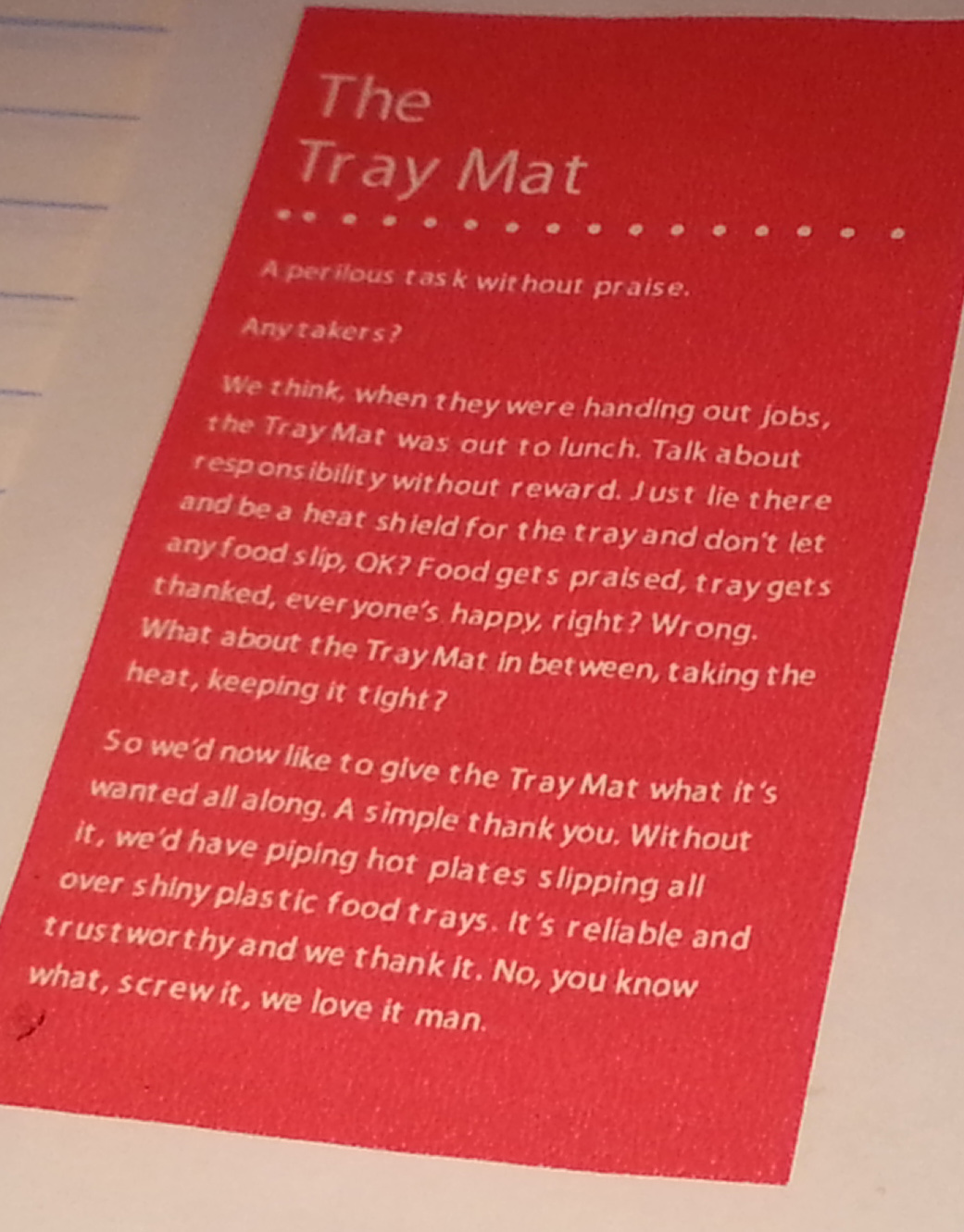
“No, you know what, screw it, we love it man.”
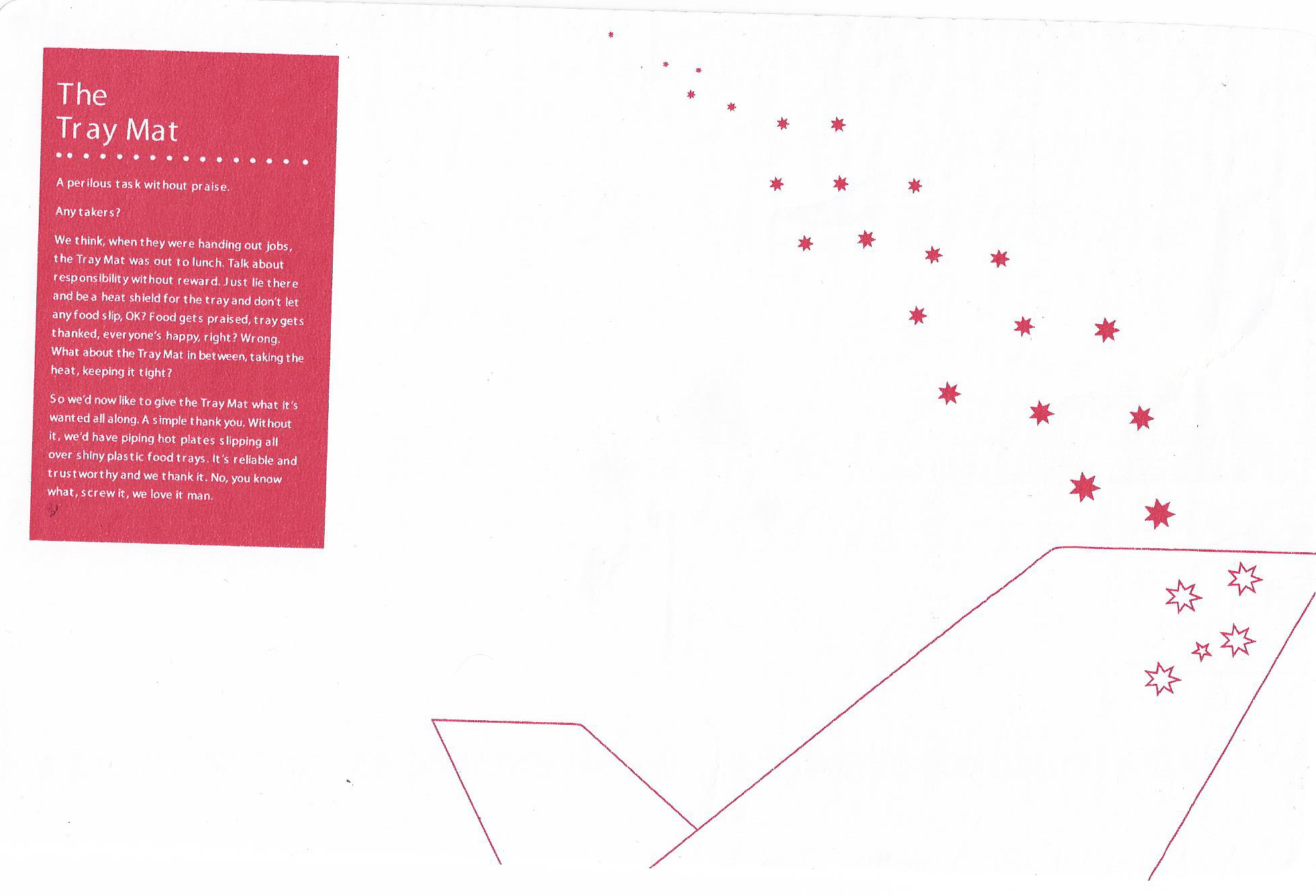
Recent conversations set me to thinking about corporate voice. Clients uniformly want to be heard with bold authority but then the lawyers and regulators find the [fresh/spicy/freaky] copy and emasculate it with sharp strokes.
But let’s not just point at lawyers and regulators, let’s admit that bold is a dangerous position. Bold words might fail. Or be seen as stupid. Bold words may pin me to a promise: uncomfortable!
Voice has always taken courage. Being heard has always been a risky endeavor. Especially when what you have to say goes against the grain. Think Elijah calling fire from the heavens. Think John the Baptist nailing the authorities as vipers. Think Richard Branson. That’s right: He of the airlines and music and phones and whatever else his Virgin Group encompasses. He of the bold statements. Maybe Sir Richard Branson is no Elijah or John the Baptist, but his company did produce this airline tray mat, which is at least a tiny voice crying in the wilderness of corporate voice.
 ###
###
Image credit: Kirk Livingston
It’s Better to Have the Conversation Than Not
Assumptions are a cul-de-sac. Admissions, an autobahn.
A fast-moving project I’m on pits the changing need of the client with the frantic response of the agency. I’m writing copy and providing strategic direction for a moving target, which has (literally) kept me up nights.
One truth that has proven itself to me several times over the past few weeks is that it is simply better to have a conversation than to not. That may seem obvious to you. But it’s taken me years to come to understand this. I’m too easily put off by the gruff manner or the fly-off-the-handle personality. It’s too tempting to put my head down and just do the work. But the way forward—especially when the task and deliverables are murky—is to talk together about what we understand. Naturally it is embarrassing to admit I know only this much (thumb and forefinger stretched) when I imagine those who wrote the scope of work know this much (from here to the wall, say).
But admit I must.
It is the only way forward. And sometimes it is the only way to get to the place where you can put your head down and do the work. Admitting what I know is also the best way forward: anything I can do to get the team on the same page, whether that means showing my rough draft copy or my quick dumb sketch of what I think the interactive designer just said. And by admitting what I know, others can feel free to admit what they know. That’s usually when I come to find out someone heading up the whole thing is just as baffled. But when we talk openly about what we know and especially what we don’t, a measured response can emerge and we assemble our next steps. At least until the next client meeting.
There is something of an art to getting people on the same page. Some personalities fall into this easier than others. Getting open discussion is aided by vulnerability: the admission. The confession. I suppose the question is: how badly do you want to move forward?
See also Seth Godin’s commentary about fearing the fear vs. feeling the fear. It may give you courage for your task.
###
Image Credit: Mark Brooks via 2headedsnake
3 Moments of Unexpected Joy in this VW Spot
“Was that me? Was I singing?”
Building in order of sheer happiness:
- Joyful Moment #1: The soundtrack. I’m not sure who this is but it reminds me of the Moody Blues and so the late 70s/early 80’s come rushing back in all their triangular, puffy-shouldered wonder.
- Joyful Moment #2: When our man mouths the lyrics and they dance. Love it!
- Joyful Moment #3: “Was that me? Was I singing?” That guy nailed it. Let’s have more corporate meetings with that guy.
GC/BC says the idea has been done before. I’m sure it has. But I can’t stop watching it. And I feel more favorable toward the power of German engineering.
###
Via GC/BC
PostScript:
Well—I’ve been schooled. This entire concept is lifted from the 80’s band a-ha. Here’s their official Take On Me video. I vaguely remember the mid-80s. One thing I was not doing was watching MTV. So I missed it. Whatever: now I’m all caught up.
Oy! Getting a history lesson from advertising.
What next?

 conversation is an engine