Archive for the ‘Creativity’ Category
Here’s the Story of a Man Named Quady
Who was living with three alloys of his own
Yesterday I met Quady* for coffee. I was impressed all over again by the executive function of his brain: how he seems to effortlessly order complicated systems and businesses and talented people and even his own life. Quady** told me how he was weaving consulting with business acumen with creativity. I could not help but be impressed with the forward motion the guy exuded.

…and here’s the dumb sketch you ordered.
In fact, it was about ten years ago I met Quady at (yet) another Dunn Brothers on another side of Minneapolis to talk about how he grew the business he was running at that time. He was president of a firm that placed creative people in creative positions and his firm was on fire (that is, busy). At the time he gave me some solid advice which I resisted for years until embracing it fully: make a daily/weekly habit of reaching out to make contact with varieties of people.
And listen to them.
These days Quady is weaving together a consulting life that draws on his outsized executive function and his creativity plus a desire to walk alongside people. He’s a kind of CEO-for-hire and he’s currently working some high-level gigs. It’s the melding of these three threads that seems to open doors for him: the organizing gene plus the creative gene plus the people-smarts gene. Because he understands the moving parts of business, he can give solid, real-world advice to people. He gives the kind of advice that encourages from some deep place: the sort of advice like,
“Look. You’ve got this. It’s a stretch, but you can do it.”
And who doesn’t want to hear that?
###
Dumb sketch: Kirkistan
*Not his real name.
**His real name was Markothy.
Write Alone And Send To Collect. (Copywriting Tip #11)
Except for Bill Holm

Bill Holm, by Brian Peterson, Star Tribune
The late poet and writer Bill Holm spent his days teaching at Southwest Minnesota State University. In the context of daily teaching, he was too busy to write his own works. But when class finished for the semester, he wrote his poems and stories and memoirs long-hand on the back of the memos he received at school. Interestingly, he was a gregarious soul who often welcomed people into his house but continued to write at the kitchen table even as he engaged in discussions with visitors.
But for many of us, writing is a solitary activity. Oh, sure: ideas pop in conversation. Careful, committed writers take note of the idea on whatever scrap they have handy. And that scrap becomes useful when the writer is, yet again, sitting before blank screen or page.
Unless you are/were Bill Holm, it is the typical writer’s fate to sit alone.
This is not to say writers must be loners or introverts. Those are not necessary conditions, although they do often fit together.
But creating is only one part of writing. Yes, it seems like the biggest part of writing, doesn’t it? Creating and the aura around creating are certainly the most celebrated bits of writing.
But another part of writing is reading. Specifically, getting read. And that requires publishing, in one form or another. At its essence publishing is getting read by someone else. And for all the (quite true) advice about “just sitting down and writing” and “writing = butt-time-in-chair,” it seems to me there is still a missing piece: the reader at the other end of the writing. Written words need to find and land on their audience.

Here is a place where writers might learn something from copywriters. Copywriters have deadlines. They have people who expect copy at a certain time and quite often that copy is delivered verbally—often read aloud by the copywriter to the client.
Something happens when writing is read aloud to an audience. The text itself tends to shape and reshape and the writer hears it differently because of the people listening. The writer cannot help but see things differently when another person is also hearing the copy.
Many will say that some of their best writing happens during revising. I agree. Especially after having read something aloud to someone else and seen their reaction. It can be thrilling. Or depressing.
Butt-in-chair time is essential for writing. But sending your writing out—scary though it might be—is equally essential to hear how the ideas land and to revise with creativity and gusto and possibly increased motivation.
###
Image credit: Kirk Livingston, Brian Peterson/StarTribune
Tom Scharpling: “A problem never comes without a gift in its hand.”
On creating for love not profit

Everything has worked to my benefit, even the things that felt, at the time, like they were working against me. A problem never comes without a gift in its hand. You may not even be aware of it until five years later.
–Mike Sacks, Poking a Dead Frog: Conversations with Today’s Top Comedy Writers.(NY: Penguin Books, 2014) 277
###
Image credit: Kirk Livingston
Start at the Top. Again. (Copywriting Tip #10)
Tell Yourself the Story
Imagine holding a long piece of tangled fabric. You hold it high above your head because you want gravity to gradually unravel the twists and tangles. Maybe you shake it. Probably you smooth it out: starting at the top again and again and work your way down the length to get the fabric straight or flat.

Many threads to unravel.
What works for fabric also works for a complicated idea. Sometimes the only way to unravel a complicated topic is go back again and again to the beginning, flattening and shaking out the twists and turns as you retell the story.
I’ve recently finished up a complicated article about our changing health care system. The article had lots of moving parts. It was not a long article, just dense and in need of translation: from jargon-filled, industry-speak to human.
Time and again I found myself stuck in the middle and staring at the screen: so many bits and pieces to fit. Absolutely stuck and wondering how to line these parts up so they make sense (and so they are sorta interesting for the target audience). Because in the end we read one word after another. We read in a linear way, even though the story may compose itself in our brainpan in non-linear chunks.
The only way I could get myself unstuck was to start at the beginning again. Back to that very first paragraph, and work my way through. Sometimes I would modify that paragraph to fit what was next. Sometimes I would modify what was next to fit the lede. But the only way forward was through the beginning.
During National Novel Writing Month I found myself doing this, mostly as a way to find out where the story was going and how it could possibly move forward. It was a way of telling myself the story hidden in the words already written. There are one thousand ways to write the story and some will present as we retell it to ourselves. And so we pick one.
Sometimes retelling the story again and again is the only way forward, because it leads to understanding:
By the way, a wonderful book about locating the story of your own life is Parker Palmer’s Let Your Life Speak. Check it out.
###
Image credit: Kirk Livingston
George Saunders: How do you energize someone?
Sometimes it will be a word.

Bright bits among the ordinary.
George Saunders, on the odd little Zen parables he heard growing up. Told for laughs, they also carried deeper hints about how to live and what is important in life:
My whole childhood we lived next door to this family I’ll call the Smiths. We didn’t know them very well at all. At one point, Mrs. Smith’s mother, who was in her nineties, passed away. My dad went to the wake, where this exchange occurred:
Dad: “So sorry for your loss.”
Mrs. Smith: Yes, it’s very hard.”
Dad: “Well, on the bright side, I suppose you must be grateful that she had such a long and healthy life.”
Mrs. Smith (mournful, dead-serious): “Yeah. This is the sickest she’s ever been.”
My dad came home just energized from this. I loved his reaction.
–Mike Sacks, Poking a Dead Frog: Conversations with Today’s Top Comedy Writers (NY: Penguin Books, 2014), 241.
###
Image credit: Kirk Livingston
Own Your Process
Ownership Sparks Creativity in Art & Work & Life
One key differentiator between working for the man (every night and day) and working for yourself is ownership. Working for yourself you own the beginning, the middle, and the outcome.
Especially the outcome.
Some of my favorite colleagues over the years—the very ones who advanced in whatever they worked at—found ways to own the process. These were the ones not content to follow orders. Instead they made the work their own, found their own way, employed their skill and imagination. I’ll argue that owning the work sparked their creativity to accomplish the task. And I’ll argue that ownership looked like responsibility for the outcome. So despite working for the man, they took ownership, made their own meaning and became, well, the man.
Over at Dumb Sketch Daily I’ve been producing a dumb sketch every day for the last 39 days. I was sorta proud of this dumb sketch:

Then a commenter suggested abstracting it, which I tried, given my limited art understanding and abilities (here):
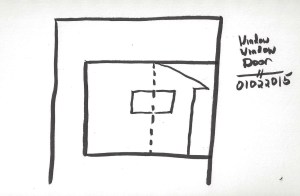
You can see the result is…simple. But it is my own (not that anyone is lining up to take credit). The commenter’s comment helped me continue my odyssey toward learning to see.
My only point is that developing new skills requires a certain elasticity. We try new stuff and get it wrong again and again and again. And we keep failing until maybe, one fine day, it turns out sorta OK.
A lot happens when we take ownership for developing our own skills. And a lot of good can come from taking responsibility for our client/boss/friend’s desired outcome.
###
Image credit: Kirk Livingston
The Talking Part of Writing
Talking Through the Valley of the Shadow of Death
When it comes to brand new, unpaged ideas (that is, not yet written), J.K. Rowling is right:
But at some point every idea needs to make contact with an audience. Writers want their idea fully-formed with beautiful plumage before they exhibit it to anyone (lest someone call my baby ugly). Copywriters know this is not possible when it comes to collaborative writing—writing that serves some mission or purpose for an organization or cause—which needs client eyeballs as a part of the process.
Because Lillian Hellman is also right:
And Nora Roberts is especially right:
There’s the writing. And then there’s the fixing. I often think of the fixing as equally creative as the original writing. Great and wonderful things happen at the fixing/revising stage.
There is a point in every copywriting project where it must be discussed. It must be read aloud. And the key is—especially with new clients—fail faster.
I recently made a category error with a new client and I’m wondering how high a price I’ll pay. Rather than insisting on an early reading and sharing first thoughts when the bar was low, I let my content slide through several holidays until the deadline is an approaching storm and the bar is high for the copy to be right on the first reading.
Which it isn’t: it’s full of questions.
Which is almost always the case with a new client. Especially if the topic has a lot of moving parts.

So lesson learned (again): insist on failing faster and earlier.
###
Image credit: Kirk Livingston
Please Say More, My Radical Lesbian Feminist Friend
Mary Daly: Voice from the Fringe
Well, “fringe” for me.
I’ll confess: I’ve not been so conversant with feminist theology or philosophy. And this: it had not even occurred to me to think about it.

Sometimes a different perspective helps cut the fog.
But then I read our daughter’s college paper on Kierkegaard and his potential exclusion of women. Our daughter’s reference to the self-described radical lesbian feminist Mary Daly and her Beyond God the Father: Toward a Philosophy of Women’s Liberation (Boston: Beacon Press, 1973) was something like click-bait for me and I had to order the book. I’m glad I did. Mary Daly’s voice has been a playful, combative, eye-opening excursion into seeing things differently. I’m only a chapter in, but already she has named patriarchal theology and turned it on its ear. Ms. Daly has suggested all sorts of thought-exercises that would never occur to anyone living in the usual theological/philosophical grid system:
For example, women who sit in institutional committee meetings without surrendering to the purposes and goals set forth by the male-dominated structure, are literally working on our own time while perhaps appearing to be working “on company time.” The center of our activities is organic, in such a way that events are more significant than clocks. This boundary living is a way of being in and out of “the system.” (43)
You don’t have to be a theologian or philosopher (or even a radical lesbian feminist) to appreciate the different way of seeing things Ms. Daly offered. A quick glance through her Wikipedia entry suggests there was personal a cost to seeing things differently—especially in the male-dominated structures she worked within.
What I like about this particular quote is how it points beyond authority to the organic or self-directed work each of us knows as our own. Much has changed since Ms. Daly wrote this in 1973. We still have male-dominated structures and maybe those are changing, though too slowly for many.
But think about “structures” for a moment.
Reading the quote as a freelancer and entrepreneur, I cannot help but notice how exactly her description fits anyone with a growing sense of their own work or mission—especially where that work or mission differs from the work or mission handed down from authority.
Regardless of gender.
The point is not to agree with everything Ms. Daly said. The point is to begin to hear. And to begin to see—so then we can begin to name the framing system we live within. By noticing and naming, potential solutions may begin to appear.
###
Image credit: Kirk Livingston
Dormant Versus a Bias Toward Action
The Shroud of Tuesday
What if your work stopped—on purpose?
We celebrate and expect constant productivity gains in our culture. Wall Street rewards those gains as they decrease the expense line of any business. We congratulate those people in constant motion who have momentum and trajectory.
But is constant forward motion sustainable?

Sure: looking back over the arc of our life we can cobble together a story about how we were always moving toward this invention or position or conclusion or achievement. That bit of personal cinema we learned from the biographer’s art.
In the moment, however, there are dormant times: work goes south, dries up, gets boring. There are times when it is not at all clear what to do next, which way to go, or even if this work will succeed at all. Doubts interfere. Even if you have a boss telling you what to do, there can be internal fallow times where you silently rethink your commitment to this job or that project or that leader.
We hate those times when work goes dormant.
We love movement and purpose, followed by lots more movement.
But dormant is not the same as death, despite how being laid-off feels like a mini-death. And when a work-stoppage happens it is hard to believe the rejuvenating effects of a release from movement. And yet, most of us do make it out the other side. And typically we have a new grasp of where we need to go and what we need to do.
I’ve always wondered how any living thing survives the bitter cold of the northern United States. Every winter I am amazed that cars start and water flows and life continues at 20 degrees below zero (F). Then March and April bring thaws and by May that dead-looking Maple blooms all over again.
Every year.
Maybe the cycles outside my window are a better analogy for work: there are ebbs and flows. And maybe it is worth building up a bit of patience with slower times, and even to embrace them and allow them to do their hidden work.
Even on a Tuesday.
###
Image credit: Kirk Livingston

 conversation is an engine