Archive for the ‘Credibility’ Category
When will Your Mission become Mutiny?
Look Boss: It is Written
One of my favorite bosses, when privately presented with a wallet-sized card imprinted with the corporate mission and asked what he thought of it, pretended to use it to wipe his derriere.
Was my boss in open rebellion?
Not in the least.
My boss was responding to a ridiculous communication tool. At that point in the history of that particular medical device company, it was all mission and everyone knew it. Patients and physicians were front and center and no one needed reminding. We were all directly involved in the mission and to think otherwise was to dismiss the conscious and vocal choices people made to work there.
Then again, perhaps the communication tool was a bit prophetic. It wouldn’t be long before many in the firm started taking their eyes off the mission to focus instead on quarterly profit goals to the exclusion of patients, physicians and common sense. These things happen when big bonuses are at stake.
But it need not be that way and you may well be the one to say so.
Unless you simply wanted a job and any job would do, you likely joined your firm because of mission. You found yourself in some level of agreement with the firm’s vision and wanted to help move this thing forward. For many of us, the mission is a motivating and ennobling force, even if we may not think of it constantly.
We know that even the best-intentioned organizations stray from their intended goals and go rogue with evil intent. This happens at high and public levels. It also happens at day-to-day levels, in quick decisions and in small furtive meetings among colleagues. For-profit companies do it. Non-profits do it. Churches do it. Hobby clubs are also capable of it.
That’s when any of us needs to come back to the mission and openly ask whether this quick decision or that furtive meeting is accomplishing our shared mission. Sometimes our best and smartest move is to reprise the mission openly, verbally and with gusto. We all need reminding of our purpose and mission from time to time.
If you care about your organization’s mission, you may need to lead a mutiny today. You’ll want to count the cost, of course, because mutiny can be very expensive.
###
Philip Seymour Hoffman and the Human Character
How To Bring Words Alive
Philip Seymour Hoffman’s death over the weekend is one of those shocks we’re both used to and entirely powerless before. Any death is a shock, but for an actor at the peak of his powers, his sudden absence seems a stunning reversal of expectations.
I watched films where Mr. Hoffman appeared partly because of the topics and partly because he was in them. I knew his powerful portrayals would be riveting. And they were. How he could play both the higher-ed slacker David Davis in “Twister” (1996) and then authoritative but ultimately corrupted Lancaster Dodd in “The Master” (the 2012 Scientology send up) boggles my mind. His list of films and other work is extensive—far larger than I imagined.
As writers and communicators we think a lot about how to pull an audience toward and ultimately into a story or argument. It seems Mr. Hoffman’s answer to that question would be to explore the character beyond the monochrome rendering. Lancaster Dodd seemed good until he was clearly not. Doubt’s Father Brendan Flynn had diabolical layers and was a chilling portrayal given the current round of scandals. David Davis was an exact portrayal of many of the meteorology graduate students I’ve known.
Playing out the full-color, full-orbed, fully human version of a character remains an elusive goal. Fully illustrating a notion so it comes alive is something Mr. Hoffman was gifted in.
I’ll miss Philip Seymour Hoffman.
###
Hey: Where did that voice come from?
Don’t be stung by inauthenticity
Some in my class are English majors and don’t mind wading into the waters of how words work. So when Content Rules (Handley and Chapman) talked about voice, a close reading ensued. Handley and Chapman lobby for authenticity in voice: voice is your own way of corralling point of view and word choice and rhythm (meter?) and pressing it all into service. Voice is making language work to express your words in your way. Voice is what you sound like when you talk (and we’re aiming for conversational writing in this class, so writing and talking sort of blend).
But voice is also something that gets companies and organizations all hepped up. To give your brand a personality by adopting a particular point of view (which leads to word choices/meter and etc.) is what companies and organizations seek these days. Voice helps a brand stand out from the crowd.
And one must stand out.
But this:
How can you write with an authentic voice when you are adopting the voice of the brand?
Good question, English-major-friend. Two answers come to mind:
- Sometimes we use voice in the service of some larger purpose. So we might submit our voice to the larger brand purposes and adopt as best we can the machinations of the brand voice. Some people may naturally embody a brand voice. The rest of us have to work at it. This adding and adopting is part of serving the larger goal you believe in (at best. At worst: you adopt voice to make coin for rent). This is the collision of craft, faith and service.
- If you find yourself stinging with inauthenticity as you write for your brand—look for a different job.
I’ve maintained all along that when people add their voice to a project, new things happen. Sometimes a new voice provides new electricity and a new approach to a time-worn topic. Even old-timers can learn stuff from new voices.
Of course, people must voice up.
If you don’t say what you’re thinking, the new thing just around the corner will sit there in silence—just around the corner.
###
Image credit: red-lipstick via 2headedsnake
Taking Direction from Clem Fandango
A Year of Great Clients
I’m counting my blessings these days because I’ve had a year of clients who have been a joy to work with. Which is to say: they let me alone to do the work we’ve agreed on. And then we come together, talk parts through and make the work better.
All in all, there’s been very little Clem-Fandangoing.
And for that I am grateful.
###
Via Sell!Sell!Blog
What Matters? Whatever She Says.
Ideology tells me all I need to know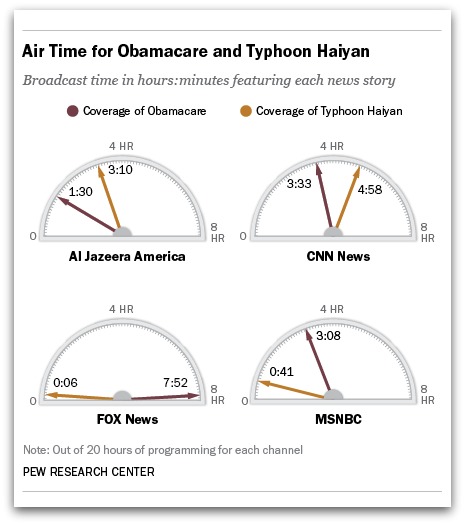
One curious thing about today’s entertainment mix is that we pick and choose where to get our news. And by “news” I mean the stuff happening in the world we want to know about.
Once upon a time the woman on TV with the engaging smile told me what was important at 10pm every night. Back in those old days the headline on the front page of the StarTribune also pointed at the critical big stuff of the day. And the people standing around the coffee machine at work confirmed what was important by talking about it.
Today we make our own choices—and unless we’re careful, we end up with a skewed version of the world. The Pew Research Center released a study of 80 hours of programming from four channels from Nov. 11-15:
The two channels with strong ideological identities in prime-time—liberal MSNBC and conservative Fox News—spent far more time on the politically-charged health insurance story than the overseas disaster. And the two organizations that built a brand on global reporting—CNN and Al Jazeera America, an offshoot of the Qatar-based Al Jazeera media network—spent considerably more time on the tragedy in the Philippines.
The panic machine called Fox News demonstrated that the Affordable Care Act rollout was much more important than the typhoon that claimed lives and property in the Philippines. MSNBC followed suit but with a bit more discipline. Al Jazeera America took a more fair & balanced approach to the two topics. You might argue that each organization was simply building their brand and giving their audiences what they sought. I agree. And I also think each organization continues to train their audience in what to want and what is important.
Humans are subjective beings so opinion and ideology always enter and inform our thinking and conclusions. Maybe the best we can do is to doggedly seek out alternate source of news, which is to say, purposefully hear from others (especially those different from us) about what is important. And given today’s multiplicity of channels, it would be a shame to think one organization can give a truly full perspective.
###
Image credit: Pew Research Center via The Future Journalism Project
Chris Armstrong Just Said Something Insightful About Work
Your Actions Keep Shouting To Me
Which is no big surprise—Dr. Armstrong, Professor of Church History at Bethel Seminary, often says insightful things.
But in the Fall 2013 issue of Bethel Magazine (if it were available online, it would be here) he pinpointed a theological missing link: that while people of faith think lots about God and Jesus the Christ and Heaven (and Hell), we have not thought much about what happens between the beginning and the end. Which also happens to be where most of us spend most of our time (that is, we’re all at various points between the beginning and the end).
Work is a key feature of what we often call “life.”
So we have Creation, Incarnation, and New Creation. But most of us are pretty fuzzy on these three key parts of the Bible narrative. And because we’re fuzzy, we super-spiritualize our faith. Faith is about the stuff we do on Sunday, at church. But darned if we knew how it’s supposed to connect with our Monday-to-Saturday life, most of which involves work. The only biblical way to get past this is to reconnect with Creation, Incarnation, and New Creation.”
(Armstrong, Chris. A Theology of Work. Bethel Magazine, Fall 2013. pp. 22-24.)
I like what Dr. Armstrong says and would encourage you to read the entire article. He draws on insights from Tim Keller’s work on work and points out, for instance, that Jesus the Christ had a first career as a contractor (building with wood and probably stone too) before he turned to the Christ business. Or this: the Christ part of his career was there all the time but latent for the first 30 years.
Allow me to adjust Dr. Armstrong’s insight with this: it’s actually our faith spokespeople who direct us toward beginning-and-end thinking. That’s where their expertise lies. You might say pastor/theologian types have (limited) authority and a free pass to talk about that stuff (especially what happens when you die). And so they do. Week after week.
But it’s up to the people living the life and doing the work to talk about what Incarnation says about, say, copywriting. Or craftsmanship. Or selling or surgery or teaching. Or digging wells (or graves). Or caring for kids or forests or the earth itself. And maybe we should look for action rather than sermons from each other, because that is how most of us talk: through the work we do.
I would go on to wager that most of us regularly draw from quite a collection of eloquent life-statements about meaning and work: both how to do it and how not to do it.
###
Image credit: Via Frank T. Zumbachs Mysterious World
Going to Church Today? Consider This.

expect a conversation that will help sort things
Probably someone will speak to the group—that’s typically what happens. And there will be singing. Prayers will be offered. You’ll shake a few hands. Maybe you’ll learn something new. Maybe you heart will be lightened. Your load lifted.
If heart-lightening or load-lifting happens, stop and think why. Was it because of magic words spoken from the pulpit? Not likely, as there are no magic words. But there are words that find a home in a person’s conscious thought and get absorbed there to do some work. One of the tests the old church fathers used to determine if a letter or text should be included in the Canon (our Bible today) was whether it had the power to change people—did the text speak with authority into a people’s lives? Did something happen because of hearing the text? When those old words get uttered from the pulpit today—they are not magic—but their truthiness has sticking power.
Just as likely: you meet someone who says something that affects you. Makes you think. Makes you reconsider an impending decision. And perhaps that same heart-lightening or load-lifting occurs. Sometimes we meet people who speak truth and it has the same effect.
And consider this: perhaps you go into that time expecting to hear something. What I mean is, sometimes we move into a situation actually expecting to hear something that could have the power to change how we think or act. You might call this listening. Or attentive listening. Or attenuated listening. Or listening on steroids. But whatever you call it, this is the most productive penultimate approach: listening with expectation. Then you pick up the tasty truthiness from any source.
###
Image credit: Douglas Smith via 2headedsnake
Secretary of State Kerry: Please Send Dennis Rodman to North Korea to Sing This Song
It’s too late, baby, now it’s too late.
I doubt any of the Kim Jong’s have ever been “light and breezy,” though Un may be so with Mr. Rodman. But certainly they have just stopped trying.
Is it time to call North Korea’s bluff?

[Click to play]
Of course, the inbred regime may actually believe the rhetoric they spout—that is the danger. Un may well be unhinged enough to push the button—no one really knows.
On the other hand, is there a way to keep pressure while allowing them a face-saving out. Some way to move toward dialogue while not giving in?
###

 conversation is an engine