Archive for the ‘curiosities’ Category
Dormant Versus a Bias Toward Action
The Shroud of Tuesday
What if your work stopped—on purpose?
We celebrate and expect constant productivity gains in our culture. Wall Street rewards those gains as they decrease the expense line of any business. We congratulate those people in constant motion who have momentum and trajectory.
But is constant forward motion sustainable?

Sure: looking back over the arc of our life we can cobble together a story about how we were always moving toward this invention or position or conclusion or achievement. That bit of personal cinema we learned from the biographer’s art.
In the moment, however, there are dormant times: work goes south, dries up, gets boring. There are times when it is not at all clear what to do next, which way to go, or even if this work will succeed at all. Doubts interfere. Even if you have a boss telling you what to do, there can be internal fallow times where you silently rethink your commitment to this job or that project or that leader.
We hate those times when work goes dormant.
We love movement and purpose, followed by lots more movement.
But dormant is not the same as death, despite how being laid-off feels like a mini-death. And when a work-stoppage happens it is hard to believe the rejuvenating effects of a release from movement. And yet, most of us do make it out the other side. And typically we have a new grasp of where we need to go and what we need to do.
I’ve always wondered how any living thing survives the bitter cold of the northern United States. Every winter I am amazed that cars start and water flows and life continues at 20 degrees below zero (F). Then March and April bring thaws and by May that dead-looking Maple blooms all over again.
Every year.
Maybe the cycles outside my window are a better analogy for work: there are ebbs and flows. And maybe it is worth building up a bit of patience with slower times, and even to embrace them and allow them to do their hidden work.
Even on a Tuesday.
###
Image credit: Kirk Livingston
What skill will you grow in 2015?
I write and I want to draw and take photos. And write.
I’ve been trying to sketch lately. My son and I started a blog called Dumb Sketch December where we try to produce one sketch a day (inspired by OneDrawingDaily). I enjoy sketching more and more and I am less and less happy with the results. Unlike writing where I have a growing sense of being able to say what I need to say, sketching seems to have plateaued at capturing very little of real life.
I’m at the point where I don’t even know what I don’t even know.
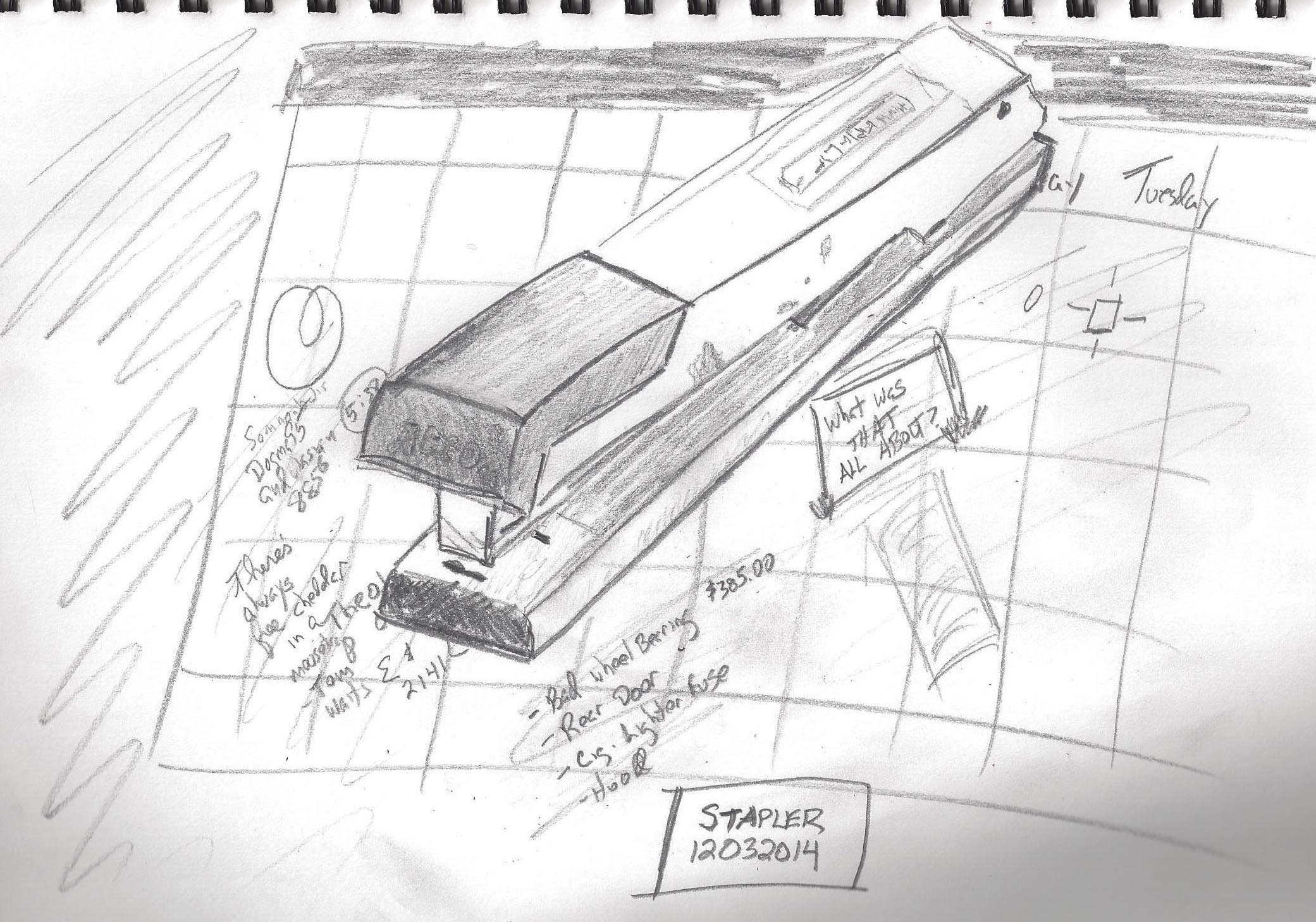
My stapler rocks. My people don’t.
Other kindly sketchers and drawists chime in with encouragements like “Keep going!” and “Huh.” Of course, I’m committed to the dumb sketch approach to life, and I can find a bit of joy in a well-capture shoulder, or when I drew something very similar to that woman’s posture or her pony-tail. I am increasingly drawn to the very black carbon laid down to hint at a clear edge. I’m trying to take lessons from Edward Hopper, though I think he would have given up on me long ago:
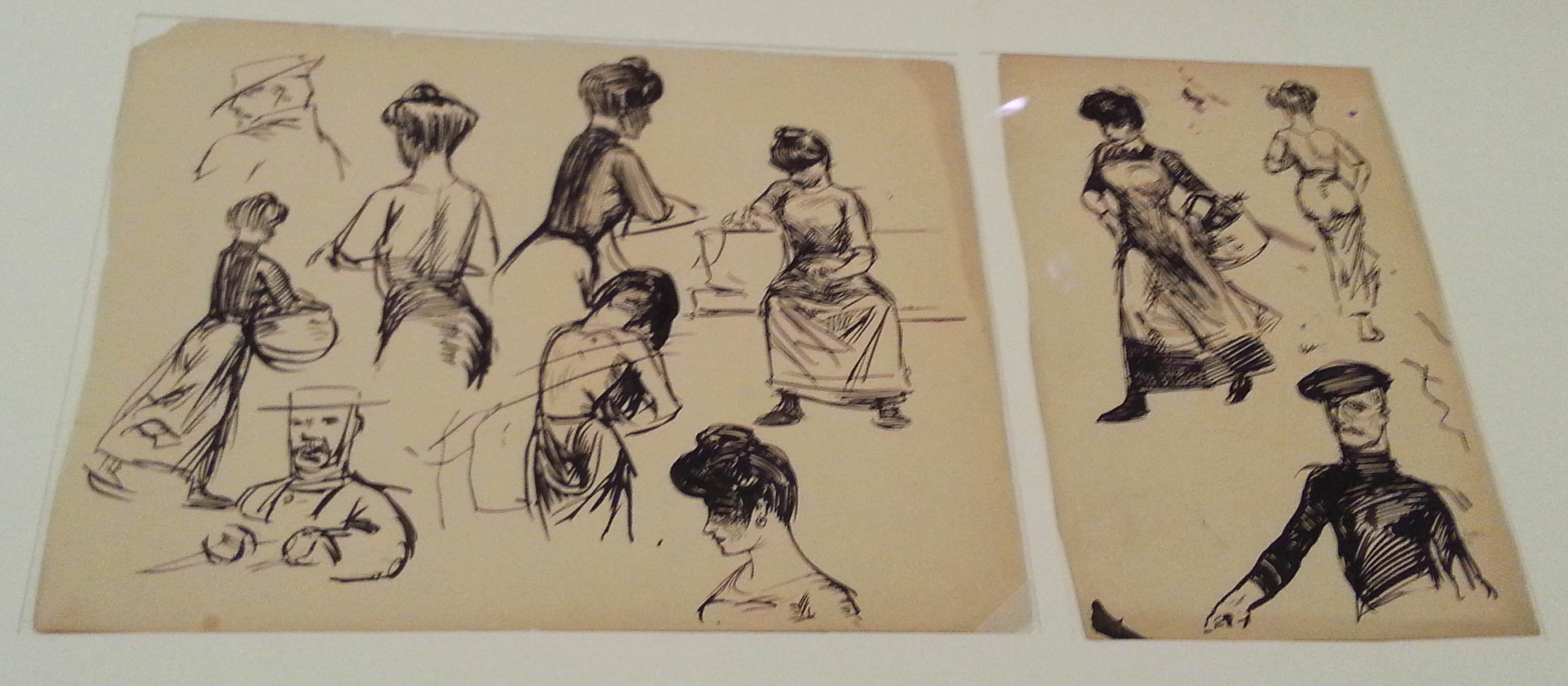
I think we can guess what fascinated Edward Hopper.
But all this to wonder aloud at skill-building. There is something about the intentional action—committed in public—that has a way of squeezing us forward. NaNoWriMo used that force, our more successful diets use that force, weddings are a celebration of the force of intentional actions publicly committed.
What skill do you want to grow in 2015?
How will you make it public so we all can take courage from your actions?
###
Kirk Livingston, Edward Hopper via The Walker Art Center
Check my article in Relevant: “3 Things Not to Do While Pursuing Spiritual Growth”
3 Things Not to Do While Pursuing Spiritual Growth
The Cost of the Silver Hand
In versus out—does it even matter?
It does in Minnesota. It’s 33°F right now—not so cold—but in less than 30 days we’ll plunge well below 0°F and stay there for a month or two. Being inside matters when the outside temperature is cold.
About “inside,” you remember high school, yes? Being an insider seemed to matter there: being part of the groovy clique seemed to say a lot about your identity. But it turned out that the cost paid for being an insider was higher than we realized.
You get inside by exploiting insider behaviors: hang with other insiders, use insider words, allow the insider frame of reference to settle on you and gradually think insider thoughts. There is a certain warmth to being inside. Sometimes it’s safe and cozy. Sometimes staying inside means forming alliances and battling for diminishing territories. A friend recently used those words to describe his years inside a large retailer based in Minneapolis—he left when the cost of alliances and battles was greater than his paycheck.
The classic insider mistake is to think inside is all there is. And that mistake is murder when the layoff discussion happens in the HR office on a bright, cold Friday afternoon. Or when you graduate high school.
But being on the inside is good when you also recognize voices from the fringe. That sort of consciousness allows new thoughts to infect the inside, possibly even countermanding the inbred thinking of insiders talking to insiders.
Lately I’ve been stimulated by reading The Power of Pull: How Small Moves, Smartly Made, Can Set Big Things in Motion, by Hagel, Brown and Davison (NY: Basic Books, 2010). In particular, their talk about what the edge person brings to the discussion seems fitting. The edge person is working at something different than the insider. The edge person is trying to accomplish something in a different way and so is asking different questions. The edge person asks questions the insider doesn’t even consider. And it turns out those questions are sometimes the very questions the leaders of the insiders wish they were asking.
My favorite scene in Canal Digital’s “Silver Hand” is at the bar when our hero tries to casually drop the Silver Hand reference.
What a lovely fail.
The smart insider acquaints herself with the habitat and questions of the edge person.
And vice versa.
###
Via Canal digital
That moment when you only want to say truth
Come, blessed ignorance.
Early in my writing life I let on that I knew more than I actually did.
You did too. We all did. We all do.
It’s part of the human condition: the word or name dropped, the subtle nod that hints we are in the know,
“…and, yes—please—carry on…certainly I get it.”
Whatever it takes to not appear stupid.

I tried to impress Madison’s potato vendors with my potato knowledge. I failed.
I learned this subterfuge early in life: laughing at my big brothers’ jokes and then stopping by the dictionary later to sort that word they used. Thankfully, there was no Urban Dictionary back then.
I squandered educational opportunities by pretending to know. Maybe my early undergrad years were perfectly set up to encourage the ignorant to remain so—and I jumped into that. It wasn’t until later in school that I went for broke and displayed my ignorance. That’s when I started learning.
One benefit of writing copy for a living is you get to ask the stupidest, most ridiculous questions. Questions to which everyone in the room obviously knows the answer. And actually that is when the fun begins, because the answers that pour forth are often strikingly dissimilar and uniformly telling, in that everyone has a different expression (and possibly a different idea) of this commonplace.
At some point stupid questions become a way of life: after you realize you’ll learn a whole lot more if you just admit you don’t know something. It turns out there’s really not that much to lose. Maybe you lose face with the boss. If so, your boss probably wasn’t that great. Maybe you gum up some well-greased process. If so, your question from the edge may actually open new ways forward.
The benefits of ignorance realized are immense:
- The dumb questions is a verbal mark in the sand. And on the other side of that mark you get to actually start learning.
- It is highly likely others have the same ignorance. You do everyone a favor by asking your question.
- Asking the dumb question often unearths brand new, productive ways of looking at something.
Please—for the sake of humanity—ask your stupid question today.
Do us all a favor.
###
Image credit: Kirk Livingston
Fresh Water Fetish (#NaNoWriMo Winner)
So. That’s what all that writing was about.
Fresh Water Fetish Synopsis
WaterCo, an ethically-challenged international water broker based in Duluth, Minnesota, anticipates the coming fresh-water wars. Water will soon be more valuable than oil. Pericles Paladin, the immigrant founder of WaterCo, has invented an app to track all fresh-water movement and ownership. WaterCo lawyers have been quietly purchasing land rights for fresh-water aquifers worldwide, with the intent of charging nations, governments and individuals for volumes of water used–no matter how small. The seeming suicide of a copywriter in Minneapolis unearths the evidence that topples the large-scale nefarious scheme.

###
Why Listen to the Odd Fringe Person?
Can the outsider say anything of interest to the consummate insider?
Every organization has concentric circles of members.
As new people come in they are indoctrinated into the ways of the tribe and so become insiders and holders of the knowledge. True for businesses, churches, non-profits, ad agencies crocheting clubs and sometimes even families.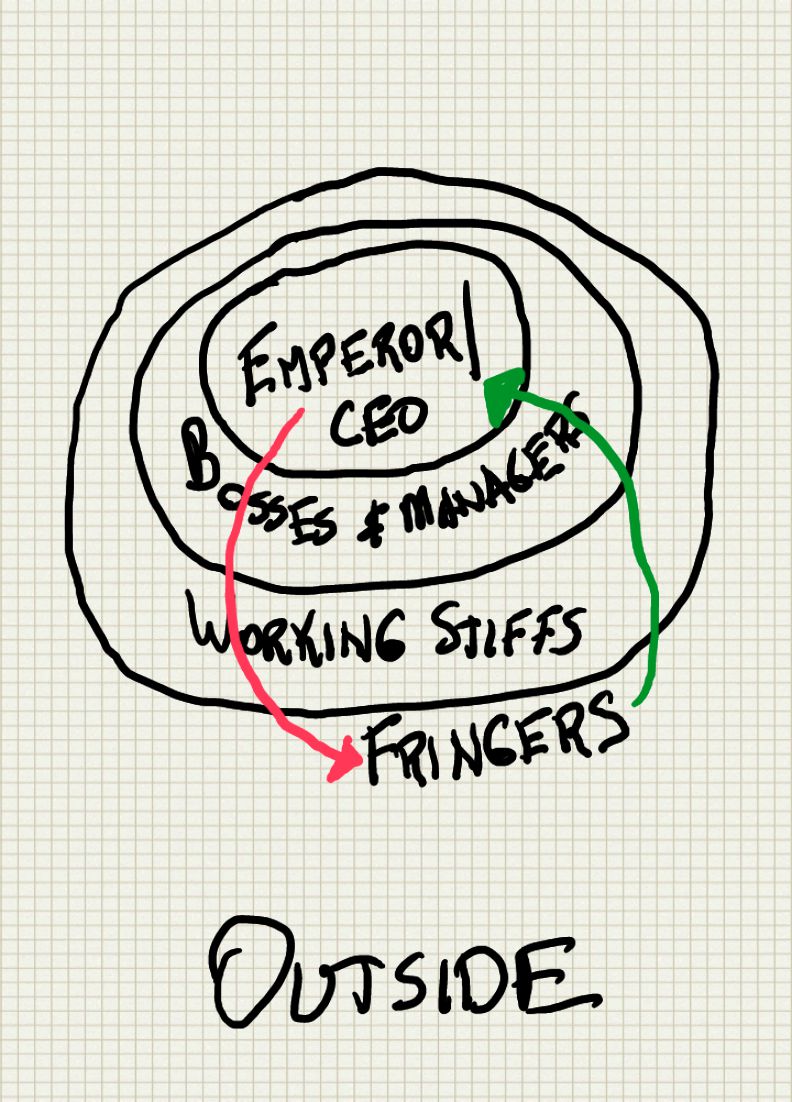
It used to be that the people on top were the ones with the power and the voice. That was back when an organization pushed its one right way of doing things down through the hierarchy. Members either did things the one right way or they walked.
But times have changed and the consummate insiders are desperate (more or less) for new ways to do things to keep the big machine moving. In fact, the big machine seems to be wheezing and seizing more often lately (think Sears or Radio Shack), unable to offer the intimate experience their audiences seek. Part of that has to do with the realizations coming from many voices that there is more than one right way to do things.
What to do?
In The Power of Pull: How small moves, smartly made, can set big things on motion (NY: Basic Books, 2010). Authors John Hagel III, John Seely Brown and Lang Davison advocate, for starters, listening to the people on the fringe. After showing examples of people on the fringe who went on to change everything—like Olympic snowboarders and Malcom McLean the inventor of containerized shipping—they observe:
It is no accident that these early examples of performance improvement come from various edges, because it is exactly at the edge that the need to get better faster has the most urgency. Incumbents at the core—which is the place where most of the resources, especially people and money, are concentrated, and where old ways of thinking and acting still hold sway—have many fewer incentives to figure out the world, or to discover new ways of doing things, or to find new information. They’re on top, and they’re ready to keep doing what got them there. But simply accessing or attracting static resources no longer cuts it. Accessing and attracting have little value unless they are coupled with a third set of practices that focus on driving performance rapidly to new levels. (18)
That is why it is starting to make more sense to listen to the person who has just signed up—they might just have a better, more serviceable idea than those invested in the status quo.
###
Image credit: Kirk Livingston
Can Hospitals and Medical Device Companies Ever Be Friends?
Maybe. If conversations start with shared goals like reduced readmissions
“…days of relying on glossy brochures while hiding unpublished clinical data are fast disappearing.”

Image by Glen Stubbe/StarTribune
And so Suzanne Belinson, executive director at BlueCross BlueShield, took the medical device community to task at the recent LifeScience Alley annual meeting, at least as recorded in yesterday’s Star Tribune (“In era of growing risk, emphasis grows on medical device data,” by Joe Carlson). The sin of selling will no longer be tolerated and hard data trumps happy smiling faces, so don’t be coming round with your “marketing presentations” and corporate pens with clever logos.
We will not be swayed.
Actually, the days of relying on glossy brochures have been gone for decades (and perhaps such “reliance” existed only in the fever dreams of ad agency execs). Most physicians have long demanded data and journal articles, most company representatives knew this. Of course, baddies in the mix will always re-interpret data (published and unpublished) to fit their promises to sales managers or shareholders.
So…data it is.
And the bigger the better. That seems to be a theme everywhere these days, from politics to education to fast food. We are gonna get to the truth of things by sifting the data. Because data does not lie: especially if your group “lives and breathes data.”
Of course, there will always be persuasion. If not glossy brochures, then the recommendations of thought leaders or interpretations and caveats of naysayers. There will always be data sources we pay attention to and data sources we dismiss. But we’ll be the judges as we do the numbers.
Two things strike me:
- We (the big collective we, as in everybody) need to pay attention way more than we do today to do an adequate job on the numbers. Can we all dive into the data to properly satisfy ourselves? Not likely. Life is just too busy.
- There must be trust at some point. Even those doing the numbers need help doing the numbers. And so we come to trust the white-smocked number-keepers to tell the truth. Do we really have time to not trust?
Maybe this is a place for “both/and” not “either/or.”
Let’s do the numbers as best we can and learn to trust, too.
And here’s a step toward trust: reducing hospital readmissions together is one very obvious data point.
The ACA penalizes hospitals if too many patients “are readmitted with 30 days after being hospitalized and discharged.” As hospitals and medical device firms approach the same goal, each from their perspective, we’ll find that “sharing risk” is likely to cause each party to spill a bit more of what they know. It is the transparency we foster in our conversation, as we both move toward the same goal, that will build trust.
###
Image credit: Glen Stubbe via Star Tribune
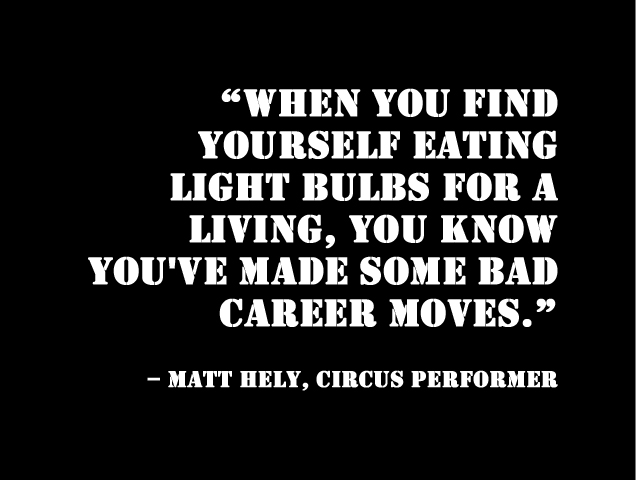
Bad Career Moves: Eating Light Bulbs
Always sound advice: Stop and notice which parts of your work you enjoy.
###
Quote Via Star Tribune News of the Weird, 5/24/2001, p. E5
Tom Dimock: Work & Art & Plein Air
Do [not] Disturb
Leave me alone to do my art—and leave cash on the table on your way out.
Who doesn’t imagine free hours to focus on your art or craft?
I’ve been trying to connect with a local filmmaker to chat about how she balances art and commerce. She’s already hinted once that “Commerce wins.” And though she says that, the truth is that she keeps producing her own films, which screen locally and nationally.
At the recent Art Attack at the (ginormously huge) Northrup King Building in northeast Minneapolis I ran into painter Tom Dimock. His painting of Red Wing’s Barn bluff caught my attention—so much so I had to show it to Mrs. Kirkistan as well (making it “remarkable”). In particular, Mr. Dimock had two versions of the painting: one done outside in cool Minnesota air (plein air), one done as a re-creation from a photo. Here’s the plein air version:

As much as we want to be free to practice our art: free of financial concerns, free of time constraints, free of any obligations, I rather think all those little tugs at our consciousness find their way into the art itself. To me, Mr. Dimock’s plein air version has a different feel than the painting produced from a photo (not pictured).
All of this to hint that waiting for enough time or enough inspiration to practice our craft or art is a fool’s wager. Instead there must be something of the plein air to our craft: doing it when we can. Practicing in whatever bits of open time we find, even out in the open. I routinely wedge bits of writing between work assignments . Big expanses of time are rare and unless I am practiced at my craft I’ll just waste time on everything but the work itself.
Plein air suggests the things we create are built more realistically in the moment, right in the context of everyday life, rather than separated and isolated. Things built in the moment, out in amidst the chaos may also yield a more true light, which is one of the keys to authenticity, whether in painting or writing or photography. It’s not hard to start applying plein air to lots of life’s bits and pieces.
Maybe plein air is the difference between what we used to call ivory tower thinking and boots on the street action (if you’ll excuse my badly mixed metaphors). Maybe that is why some of the books on my shelf go unread because they are so detached from real life while others drop me in the thick of human interaction time and again (Ian McEwen’s Atonement is doing that for me recently, as is John’s gospel).
How do you manage to practice your craft?
###
Image credit: www.dimockart.com

 conversation is an engine