Archive for the ‘curiosities’ Category
The Lies We Love
How to Believe the Preacher’s Story
Let us now name this category of lie: The Preacher’s Story.
We’ve all been here: sitting in church or a political meeting or even in class. The preacher/politician/professor behind the lectern tells a story that illustrates her or his point perfectly.
Too perfectly. And we think:
Wait-that sounds almost too good to be true. So then it must be… false. But who cares? I agree with the point and I’m in agreement with that way of looking at the world. I’ll just check the “true” box for that story.

The Preacher’s Story is a quasi-factual tale the congregation wants to believe and will believe. The point of the story isn’t whether or not it is true, but whether the story advances our cause. We’ve gathered to stoke our fires and that semi-truthy story works just fine for that purpose.
I’m putting most Trump talk in the category of “The Preacher’s Story”: though demonstrably false, still believed because it stokes the tribe’s purposes. Trump’s not alone in this, of course, his preacher’s stories are just the most recent potent poison.
Writers continue to try to make sense of evangelical support for Trump. The last few days have produced several articles citing similarities between the current batch of authoritarian presidential candidates and the authoritarian leadership style many megachurch pastors exhibit (for instance, Katelyn Beaty’s opinion piece from The New York Times). Authoritarian leaders depend on the willing to turn off their fact-meters as they absorb the preacher’s stories. Evangelicals are possibly more willing because of close familiarity with this rhetorical tool.
Can we now name the downside of “The Preacher’s Story”? It appears we’ve been groomed to be gullible.
###
Image credit: Kirk Livingston
How to Talk with a Republican
Break with Talking Points: Talk about fears one by one
The Donald Trump phenomenon is fueled by fear—this we know.
Now that the Wait-This-Is-A-Joke period is over and the Fascists-In-Training period has begun, would we be better served addressing those fears head-on rather than pointing again and again to the incoherence of the candidate?
Mano a mano, as it were.
What are the fears lodged in the Republican brain? We hear them from all the candidates: out of control immigration, an economic and political system rigged to benefit plutocrats, Christendom (as a geopolitical/cultural/social power) gasping for breath, whites are on their way toward being just another race if not minority status, the list goes on, of course.
One of the great early proponents of Christianity—a man not in favor with today’s Evangelical base—talked a lot about caring for the neighbor. Jesus said that after loving God with all your passion, the second most important thing was to love your neighbor. Could this thing Jesus said actually address fear without playing into the hand of an inchoate, would-be strongman?
A discussion about gut-level fears will descend into jobs and what it means to be treated fairly and irrational fever dreams about those we don’t know. It’s likely such talk would be politically incorrect—and we need to welcome that. On the other side of published Talking Points is a smoke-filled room where personal decisions get made even as friends and family hash out details. That’s where citizens need to hang out: telling truth as best we know it, from our perspective, not from the perspective of party bosses or mercenary haters, but from a hope-filled vision of people filled with neighborly love for all.
Naïve? Yes, of course. But sometimes naïve wins—just ask that pariah Jesus.
But look—this is gonna be messy. Let’s do this before we all start wearing yellow badges to stand with whatever group is in the crosshairs of Trump In Chief.
###
Dumb sketch: Kirk Livingston
Why Honesty is Catnip for Collaboration
In Class Today: Here’s Where I Failed
I first encountered “fail faster” in Clay Shirky’s book Here Comes Everybody. In that book it started to make sense to me that getting something right was a goal, but perhaps not the first goal. Maybe I saw traces of “fail faster” in The Cluetrain Manifesto. As a writer I knew I had to write many (verily: many, many) drafts before I started to approach the thing I really wanted to say. I also knew that the work of moving toward that thing I wanted to say was built on failure after failure, and that each failure left me with something closer to what I intended. Each step in the work shaped the next step in the work And each step in the work also shaped the one doing the work.

motivational pictures
In our Social Media Marketing class last week students presented their critique of their community-building activities (we publish content to define and attract the student’s desired target audience). Midway through these presentations I remembered why I love this day so much. There is an honesty to it. Students describe what they’ve used blogs and Twitter and Facebook (and Instagram and Pinterest and Reddit) and other tools to create for the past six weeks. They show successes. They describe failures. They talk about what they would do differently. In some cases they reimagine the entire exercise for themselves and their team. And sometimes I can see the seeds of a much larger purpose. Sometimes it is quite clear that this person’s passion will push them toward building this community for a long, long time.
And then we discuss failure. Truly, these are fascinating moments in the Q&A that follows each presentation. The great news: everyone fails. Not the course, but in building the grand vision they set out to build. Six weeks in they realize how they could have adjusted their purpose, how they could have set more clearly defined metrics to reach very specific goals. Some realize they did not give it their best shot but instead rushed through and sort of wasted their moments of contact with their target audience. Some realized they could make a solid point with 350 words when they came into the class needing at least 1000 words. Some realized their target audience lived over in an odd unlit corner of the Interweb and this other particular tool would have faithfully delivered them to this audience.
The Big Reveal: It isn’t until you try to actually build something real, with real people and real purposes toward a real end, that you realize life doesn’t not just coalesce around your pet purpose. In fact, this shouting into a crowded, noisy concert hall that is social media must be very deliberate for even the smallest thing to happen. And I mean even the tiniest purpose to move forward.
And as we detail our failures together (I have my own dozens of examples to share), new ideas pop to the surface and classmates who had not talked with each other are now offering ideas and are engaged in the purposes of this other community.
It’s the honesty bit that pulls in collaboration—the telling it like it is. The missing the high mark in a major way that when shared, evokes collaboration rather than pity.
That seems like a solid life lesson to me.
###
John Clease: How to Make God Laugh
“Tell Him Your Plans”
Listen to the entire interview here: http://www.mprnews.org/story/2016/02/12/john-cleese-business-creativity
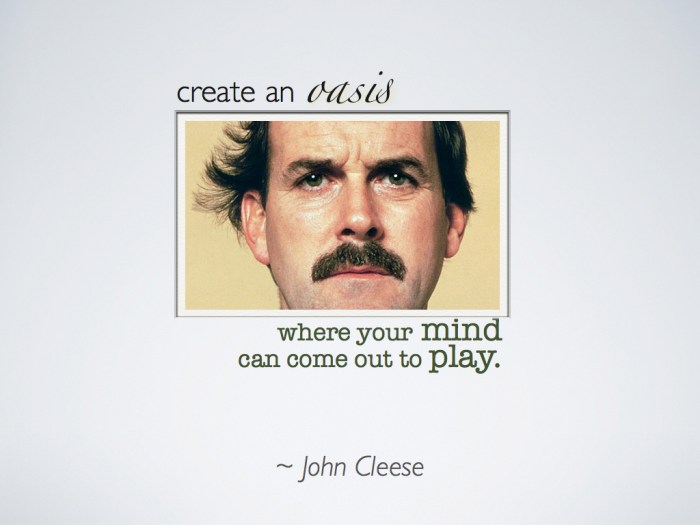
Via MPR, QuotesGram.com
Is it Better to Sound Smart or to Communicate?
Please stop me before I commit an act of literature.
We had this discussion in class. A literature student was talking about how writing for social media was different than, say, literature. Popular writing—so our discussion went—is aimed at a different audience (here we picked our way around classist terms), and is not as, well, interesting, as literature. All her other classes required a compacting of ideas into sentences that grew rather long. Sentences that required a fair amount of attention. Sentences that required grappling with theologically heavy terms, or the whimsy of philosophers who felt compelled to make up words for their new ideas. Or writers who committed acts of literature in the most tortured fashion.

I maintain that writing for social media requires that we let go of jargon and the complex sentences that shout “College!” or “Graduate School!” At our best, our writing is nearly transparent: leading right into the topic without stopping to say “Look at me.” Does that mean we use dumbed down ideas and language? I’ve said no to this several times. Erasing our jargon so smart people from different disciplines can understand us is not the same as dumbing down. And, in fact, when we do the work of translating our tribe’s jargon into regular English, we are poised to find a certain elegance and cadence that sounds more human, more fresh and less like the forced and predictable tribal language.
Respecting the reader is central to this project of communication—this bridge-building activity. If you think the reader is an arse, that comes through in your word choice. If you think the reader cannot be trusted, that shows. If you think the reader is intelligent and can handle the topic in words any human would understand, your reader will know.
One irony of the discussion is that many of the writers we celebrate as having written literature were themselves seeking for the simplest way to say things. Countless writers talk about kill your darlings and omit needless words and how nearly anyone can write to confuse. But the real artist takes a meaningful notion and makes it clear to someone else. And this: we are more likely to say something memorable and possibly even elegant the farther we get from our tribe’s insider language.
Will you commit an act of communication today?
###
Image credit: Kirk Livingston
How to be an Object of Pity
Hint: Grow a gray beard and present folding-money
Twice now young women have bought me coffee at the coffee shop on the campus where I teach. Just standing in line like everyone else—minding my own business—I pull out my $2 (cash-money) and the young woman in line behind me says, “Just put it on my card.”
I resist: “No! I wouldn’t hear of it,” I say. “You can’t. You must look after yourself with that—or at least spend it on your friends.”
I went on in that vein, until the cashier reached past my $2 (cash-money) for the woman’s card.
“She’s not going to spend it all anyway,” said the cashier, repeating what the woman said.
So. Free coffee. Thanks profusely offered.
Yesterday: same thing. I pull out my $2 (cash-money) and the young woman behind me says, “Just put it on my card.”
I resisted. This time with less velocity. Free coffee. Thanks profusely offered.
 I’ve puzzled over this phenomenon. What I know for certain is that the students here are some of the kindest people you’d ever hope to meet. And earnest. Looking around I also see that I have landed from the planet “old guy.” Though I know even recent grads feel that way when revisiting their alma mater. Still, it’s been a long time since I was an undergrad.
But I think it’s the folding money that triggers the pity. What kind of a person uses cash-money on campus? Clearly someone in need and, frankly a bit out-of-touch. We all use cards.
You must not be from around here.
“Let me help you.”
The other day a student reflected on her community-building work in our social media marketing class:
“It’s also important to create a presence that encourages interaction,” she said.
I can’t get her comment out of my mind, partly because of getting two free coffees and partly because of the riddle of how to write in a slightly-unfinished, slightly-needy way.  Like how Columbo conducted investigations: you pity the unkempt, needy fellow until you realize he is canny like a fox.
I’ve long puzzled over the magnetism of a dumb sketch. Stepping up to the white board and drawing something badly as a way of explaining an idea is a sure-fire way to invite others in. And they step up—not to correct, just to collaborate. Because it’s sorta fun to draw badly and without the pressure to create art. And it can be fun to think together. And, like presenting folding-money in debit card economy, you clearly need help.
What are you willing to leave unfinished to draw others in?
###
Image credit: Kirk Livingston, The-Toast.Net
Abscence
Teaching season is in full swing.

And all my words are going toward the course.
I’ll be back.
The Alchemy of a Thought Remembered
Follow the Instinct to Say Again
We talk endlessly about the question “What is remarkable?” in my social media class. I am convinced that the bits of life that we remember to tell someone else are the very things that make for great conversations. It is that instinct that also powers engaging social media.

Say I run into an old friend and remember I finally read that book she told me about two years ago. Why did I wait so long? “The chapter about the train ride through the Alps was unbelievable and may have changed my life,” I say. I just remembered all this when I saw my friend and she said “train.” I can see that she is happy I read and enjoyed the book—one of her favorites.
Curiously, it is the running into the friend that pulls the trigger on the remembered thought. That instinct to pull from memory a thought stored for a particular person is one to follow. But maybe I did not store a thought for a person. Maybe I just registered a reaction to the book and I’ve been telling anyone who will listen—simply because I think they might find it interesting
Three things about this instinct to remark:
- We often remember for someone—we know they will like this thing and so we tell them.
- In a simple remark, we break complex thoughts into pieces and parts that can be verbalized. We want to be heard so we anticipate the questions our friend will say and pepper our talk on the fly with the answers they seek.
- The connection powers the thought and the communication. And so this memory or thought that becomes a remark goes on to cheer or enlighten or delight our friend.
The answer to “What is remarkable?” has its roots in a mystical intersection of connection, remembering and communicating. We might wish for such connection in our social media practice. The model for true connection is our plain old remarks to friends.
###
Image credit: Kirk Livingston

 conversation is an engine