Archive for the ‘curiosities’ Category
Wendell Berry Wrote Death Right
The Memory of Old Jack: Is it passion or habit that overtakes us at the end?
Now he feels ahead of him a quietness that he hastens toward. It seems to him that if he does not hasten, his weight will bear him down before he gets there. He reaches the door of his room and opens it….
He goes slowly across the room to his chair, an old high-backed wooden rocker that sits squarely facing the window. This is his outpost, his lookout. Here he has sat in the dark of the early mornings, waiting for light, and again in the long evenings of midsummer, waiting for darkness. He backs up to the chair, leans, takes hold of the arms, and lets himself slowly down onto the seat. “Ah!” He leans back, letting his shoulders and then his head come to rest.
For some time he sits there, getting his breath, grateful to be still after his effort. And then he rises up in his mind as he was when he was strong. He is walking down from the top of his ridge toward a gate in the rock fence. It is the twilight of a day in the height of summer. The day has been hot and long and hard, and he is tired; his shirt and the band of his hat are still wet with sweat….
He does not know why he is there, or where he is going, but he does not question; it is right. Under the slowly darkening sky the countryside has begun to expand into that sense of surrounding distance that it has only at night….
Slowly the glow fades from the valley, the sky darkens, the stars appear, and at last the world is so dark that he can no longer see his legs stretched out in front of him on the ground or his hands lying in his lap; he has come to be vision alone, and the sky over him is filled and glittering with stars. Now he is aware of his fields, the richness of growth in them, their careful patterns and boundaries. In the dark they drowse around him, intimate and expectant.
And now, even among them, he feels his mind coming to rest. A cool breath of air drifts down up on him out of the woods, and he hears a stirring of leaves. He no longer sees the stars. His fields drowse and stir like sleepers, borne toward morning.
Now they break free of his demanding and his praise. He feels them loosen from him and go on.
(Wendell Berry, The Memory of Old Jack, excerpted from Chapter 9)

This is the only way Jack’s story could end. Though, of course, this is not where Jack’s story ends. Pick any story by Wendell Berry and you’ll find the dead very much alive in the memory of the living—just like in real life.
The Memory of Old Jack is another immersive reading experience from Wendell Berry. I’ve never been to Port William (no one has, as far as I understand fiction), but I feel like I grew up not far from there. Mr. Berry presents a way of life that lies just on memory’s periphery for many of us—toward the far end of what we once knew. For others, there will be no memory of such a way of life. It will seem like pure fiction.
One wonders whether memory does not come flooding back in just this way, more real than our many screens today, until in the end it simply overtakes us. I think something like that was behind Dallas Willard’s comment on death.
I hope someone told him.
###
Image credit: Mark Peter Drolet


50 Years Later We’re Masters of Industry
Look how far we’ve come
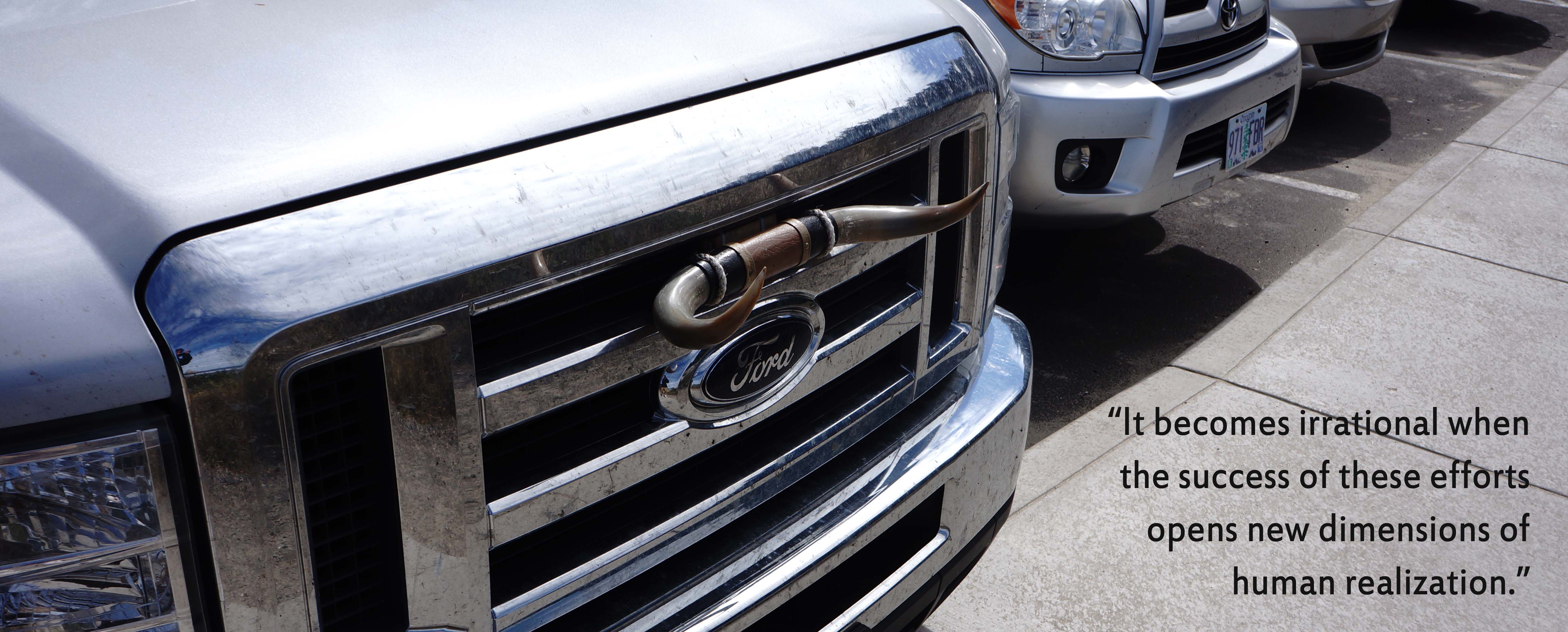 50 years ago, give or take, Herbert Marcuse and others struggled to understand where industrial society was taking us. He and others saw dark overtones in corporate goals and increasing standardization.
Would industrialization harness men and women? Or would it be the other way around?
Could it be the other way around?
“The industrial society which makes technology and science its own is organized for the ever-more-effective domination of man and nature, for the ever-more-effective utilization of its resources. It becomes irrational when the success of these efforts opens new dimensions of human realization.”
Herbert Marcuse, One-Dimensional Man: Studies in the Ideology of Advanced Industrial Society, (Boston: Beacon Press, 1964)
Social media is one place where technology has seemed to thwart efforts at ever-more-effective domination. Collaboration is increasingly common, and with collaboration, more instances of human realization. So the humans won, right?
Wait. The story’s not done.
###
Image Credit: Kirk Livingston
Show Your Work
In which Richard Feynman and Charles Weiner politely disagree
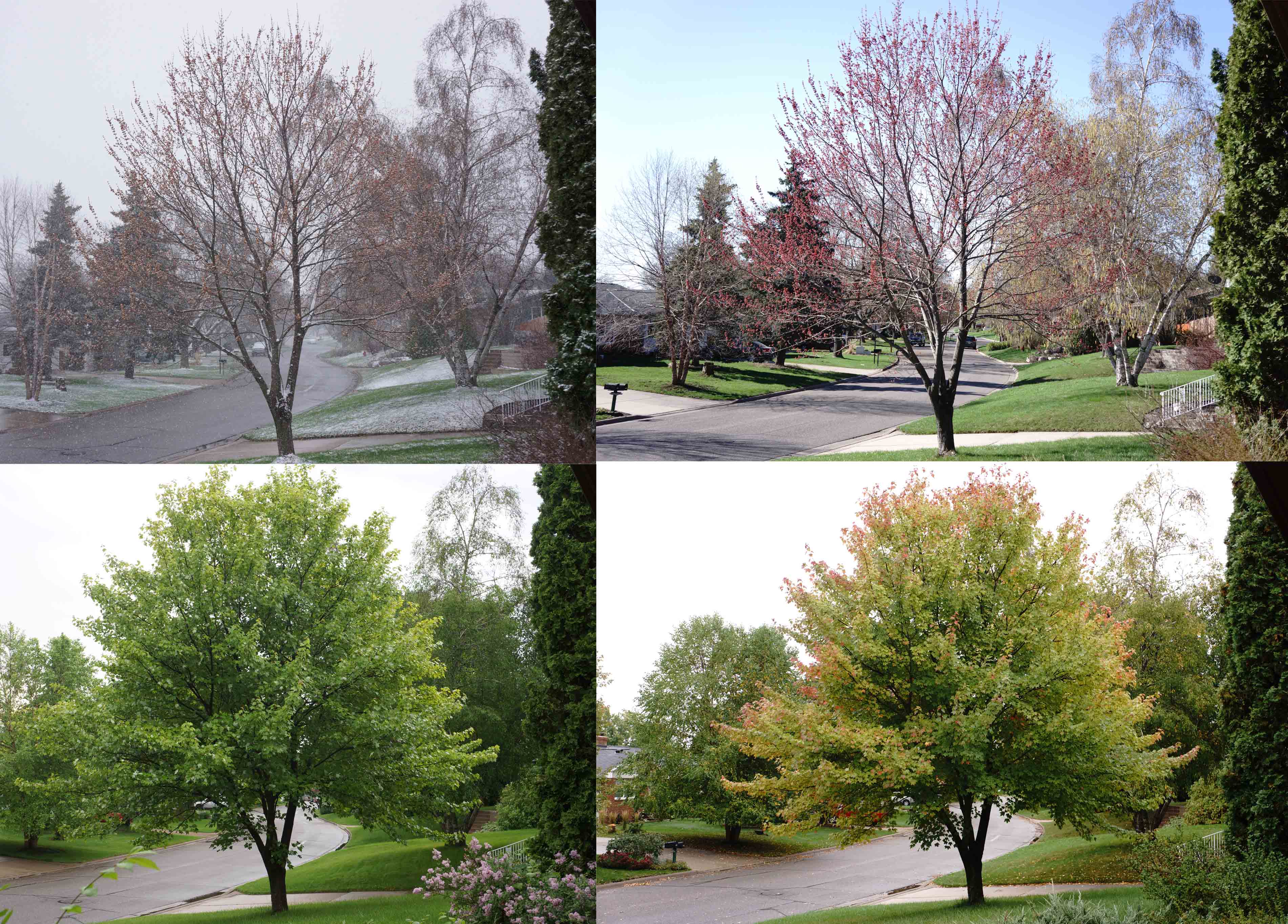
Hey–that’s my tree.
The physicist Richard Feynman once got into an argument [about the belief that genius breakthroughs come from our gray matter alone] with the historian Charles Weiner. Feynman understood the extended mind; he knew that writing his equations and ideas on paper was crucial to his thought. But when Weiner looked over a pile of Feynman’s notebooks, he called them a wonderful “record of his day-to-day work.” No, no. Feynman replied testily. They weren’t a record of his thinking process. They were his thinking process:
“I actually did the work on the paper,” he said.
“Well,” Weiner said, “the work was done in your head, but the record of it is still here.”
“No, it’s not a record, not really. It’s working. You have to work on paper and this is the paper. Okay?
Every new tool shapes the way we think, as well as what we think about.
From Clive Thompson’s [quite excellent] Smarter Than You Think: How Technology Is Changing Our Minds for the Better (NY: The Penguin Press, 2013)
###
Image Credit: Kirk Livingston
Tell Me What You Know. Wait: Mime It Instead.
Nancy Dixon & Is there a best way to transfer knowledge?
Lecture is not effective.
As one who has lectured and been lectured unto, I’ll insist that listening is hard work when seated before a droning human. Sermons are the same species. Occasionally sermons are more spirited than lectures but both have roughly the same effect. Maybe there is a continuum for lecturing: previous generations felt ripped-off if the person in front did not speak at length and without interruption. For the generations I teach, 15 minutes is the absolute maximum before reengaging with questions or activities or just standing and moving chairs around the room.

Working alongside someone is amazingly effective at transferring knowledge. To have a common task with a colleague or mentor bypasses much of the resistance and passivity that comes with the classroom “listen-to-me-I’m-the-expert” experience. The focus is on the doing and learning takes care of itself.
Nancy Dixon in her Common Knowledge: How Companies Thrive by Sharing What They Know (Harvard Business School Press, 2000), breaks the transfer of knowledge into manageable buckets as she shows how organizations do the work of helping teams and individuals learn. She starts by making a distinction between tacit knowledge and explicit knowledge: tacit knowledge is what we just sort of know. It’s the multiple bits of knowledge that would be difficult/impossible to write down. Explicit knowledge is written: it’s explicit in the sense that someone could pick it up, read it and know. Dixon cites five ways teams have successfully transferred what they know:
- Serial Transfer: team does a task and then does the same task again in a different location/venue. The team collects and discusses what they learned between, so each time they do the task a bit more efficiently.
- Near Transfer: Transferring knowledge from a source team to a receiving team doing a similar (routine) task.
- Far Transfer: Transferring tacit knowledge from a source team to a receiving team doing a non-routine task.
- Strategic Transfer: Knowledge transferred impacts an entire organization rather than just a team. Maybe that knowledge comes from the entire organization.
- Expert Transfer: Team facing problem beyond scope of its knowledge reaches out to an expert or expert team.
 I like how Dixon positions the expert as a sort of higher-order transfer: where the audience is engaged and invested and eager for the solution. I also like Dixon’s discussion of knowledge as both dynamic (knowledge is less of a warehouse and more of a river) and also becoming more of a group phenomenon.
Working alongside learners and experts is a great benefit of day-to-day work, though we don’t always appreciate it.
###
Image credit: exploitastic via 2headedsnake
Wedding Photo Rumble: Marquette’s Presque Isle
Just before the fisticuffs: punks versus glams
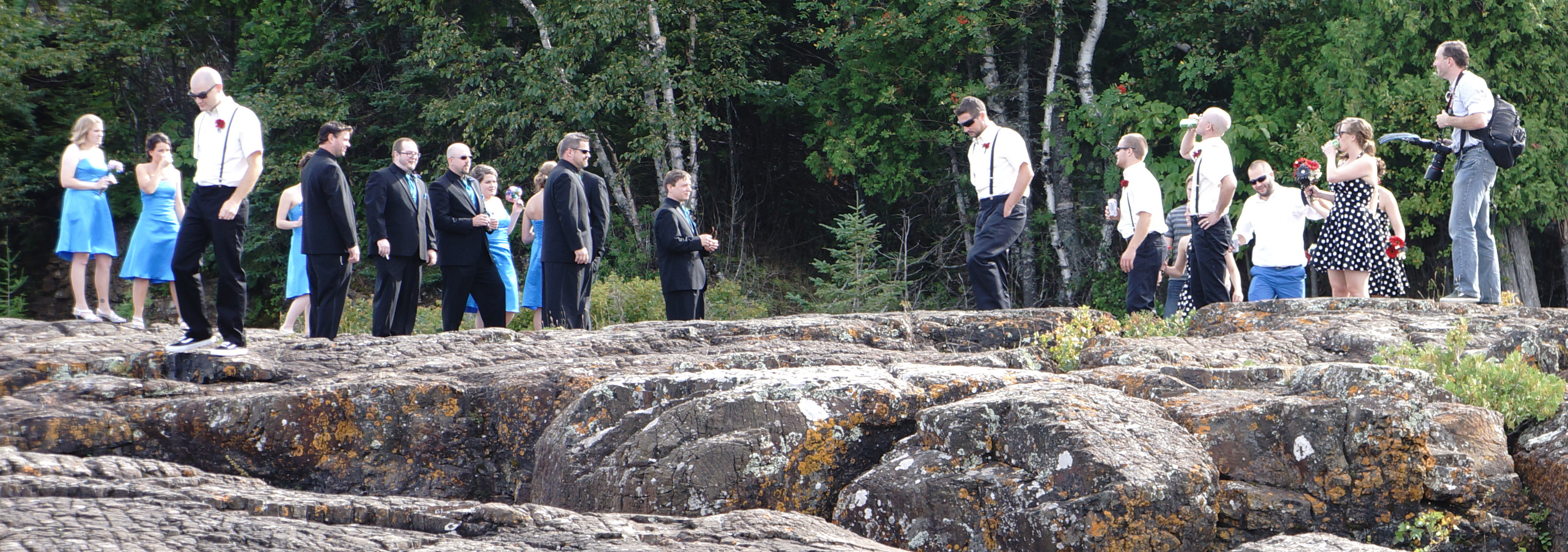
The aggressive eye contact.
The squared-off stance below the bridesmaid dress.
The feigned nonchalance.
The photographer’s clenched fist.
I should have called the cops earlier.
###
Image Credit: Kirk Livingston
70 Sheets. 700 Signals.
My $1.25 Grist Mill
For years I’ve kept notes on conversations with clients.
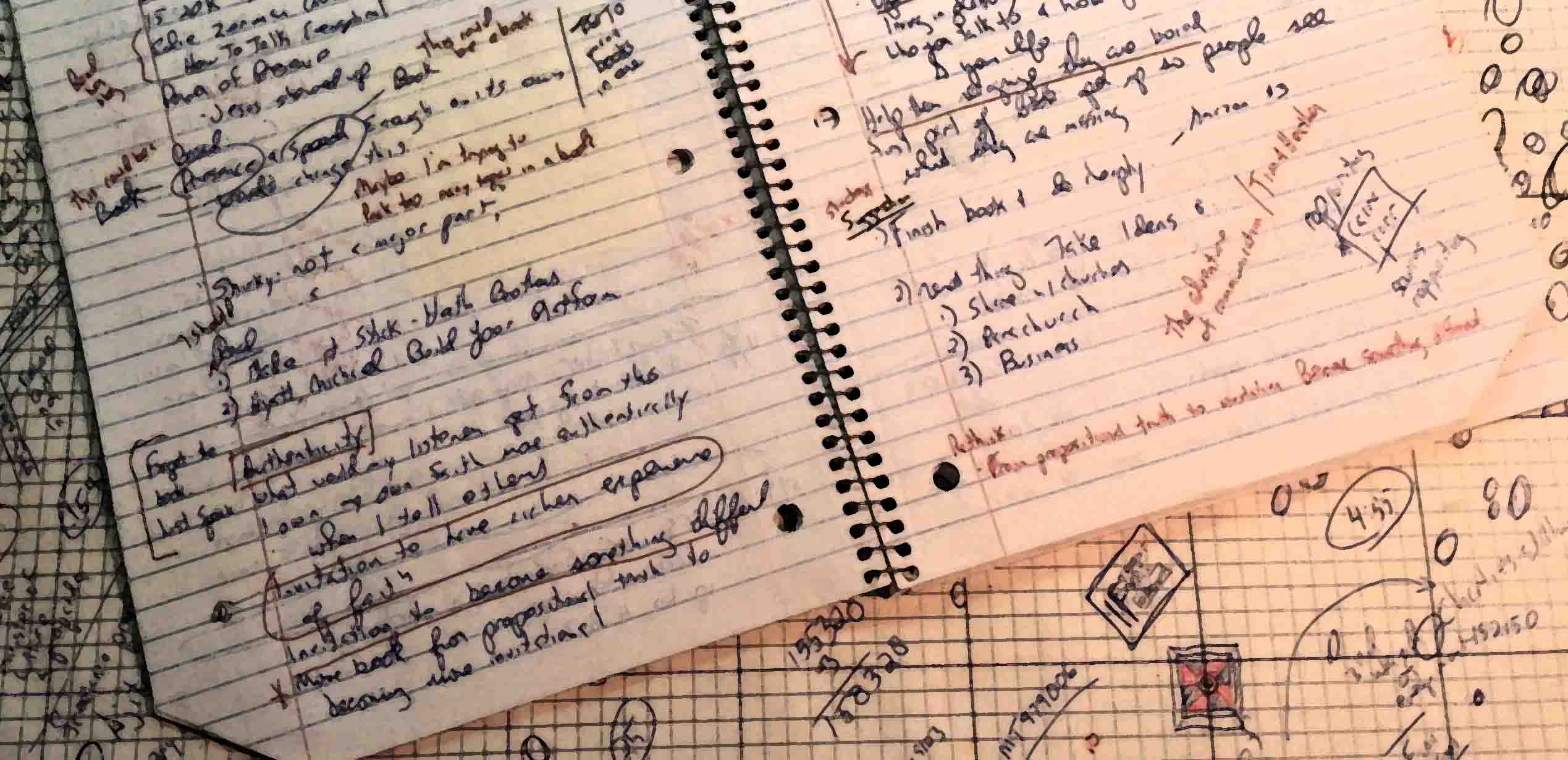
Anyone in business (or anyone in the business of getting something done) knows the value of accurate notes from a conversation. These quick jottings record promises made, delivery dates, special circumstances and conditions.
As a copywriter, I’m also poised to record quotes from my client or team: small summary statements, overview quips, self-proclaimed “dumb” analogies and tangential jokes. These little asides often prove valuable to solving the communication or marketing problem we’re gathered to work on. It’s curious how often the seed for the solution is in the conversation we had that defined the work we would do to solve the problem.
I know this because I often look back through my notes. I go back using a red pen and highlight notes that are proving critical (that’s right: reviewing notes in real-time is productive. Reviewing notes after the work is done is even more illuminating.).
Just today I found myself paging back through my notes looking for a particular conversation and stumbled on another conversation I had forgotten. And that forgotten conversation announced in red ink the precise answer to a communication question I’ve been asking for the last six days.
What good fortune!
###
Image credit: Kirk Livingston
When you lose your job you step into the space between
Movement toward “What next?”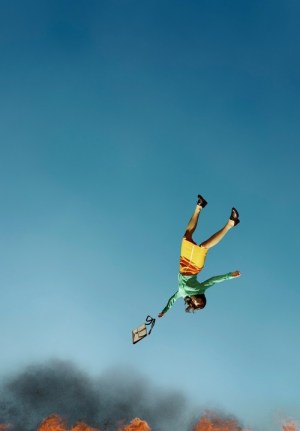
A batch of colleagues lost their jobs in a fit of corporate downsizing. Smart, talented, loyal people who invested years are now asking “What next?”
Same old story for my generation. Happens all the time. Rarely pleasant.
I believe standing on the corner scratching your head and saying “Now what?” is a great place to be. Granted: few of us ever choose to go there. Most of us prefer what we’ve been doing. Even if we hate what we had been doing, it beats not knowing what’s next.
Over at Coracle Journeys, Judith Hougen has a lovely, timeless essay on liminal space—that place we move through when we leave the concrete and known and venture forward. Her entire essay is exceptional, short and worth the read:
Catholic priest and author Richard Rohr explains liminal space: “It is when you have left the tried and true, but have not yet been able to replace it with anything else. It is when you are finally out of the way. It is when you are between your old comfort zone and any possible new answer….These thresholds of waiting and not knowing our ‘next’ are everywhere in life and they are inevitable. If you are not trained in how to hold anxiety, how to live with ambiguity, how to entrust and wait, you will run…anything to flee this terrible cloud of unknowing.”
Job loss is one step toward liminal space. It turns out there are many, many routes to the corner and “What now?” Graduating, moving to a new city, loss of relationship, aging. It’s a long list that parallels anyone’s list of top ten most stressful life events.
This “terrible cloud of unknowing” is only a distant, rumored threat when you are 19 and invincible. But each decade is a corner that provides more and closer glimpses of the cloud. It’s all part of the package deal that is the human condition.
Read the full essay at Coracle Journeys.
It will encourage you.
###
Image credit: Alex Prager via 2headedsnake

 conversation is an engine