Archive for the ‘curiosities’ Category
Take this Word to Rehab: “Out”
A Meditation Beyond Gay
 A few days back I posted There’s Something About Out (Out Always Informs In) and noticed a slight uptick in hits. My theory: the uptick had to do with the word “out” in the headline and subhead, a signal word for the LGBT community. Walk with me as I argue the value of “out” is beyond ownership by any particular set of people and is useful for anyone trying to communicate to those outside their immediate peers.
One lesson to be learned these days is the walls that traditionally provided sharp borders for any community are falling quickly. Social media opens a rolling window into nearly any group—if you know the right search keywords. With keyword searches we expose what poets and writers are doing, what glass-blowers and comic-con enthusiasts and copywriters and geocachers are up to. The corollary is that if you are in a tightly-delineated group with high walls, there has never been a better time to begin to explain yourself to those outside, because someone is likely peering in.
Out is more and more important—especially since we battle xenophobia (fear of strangers) on so many different levels: acute and generalized, nationally, locally, in Congress and on the street. Fear of strangers ought to be decreasing given increasing frequency, but it seems the opposite is happening.
In my copywriting practice I often help clients organize their thoughts for those outside the organization. How difficult can that be? Good question. The truth is that we all get caught up using shorthand, insider terms that have less to do with communication and more to do with identifying others who are part of our tribe. Real communication happens when we make our ideas and ourselves accessible to those not from our neighborhood or company or tribe or sect.
The challenge of “out” is communication beyond our self-inscribed language borders. First we need to identify the borders (and possibly our tribe). Then we need to know what’s important and remarkable that someone outside would care about. The challenge of “out” is to step outside our circle with honest, clear language that also happens to make us vulnerable. But those things that are important to us are worth sharing.
Other words in need of rehab: fellowship, strategy, and maybe “lovingkindness.”
###
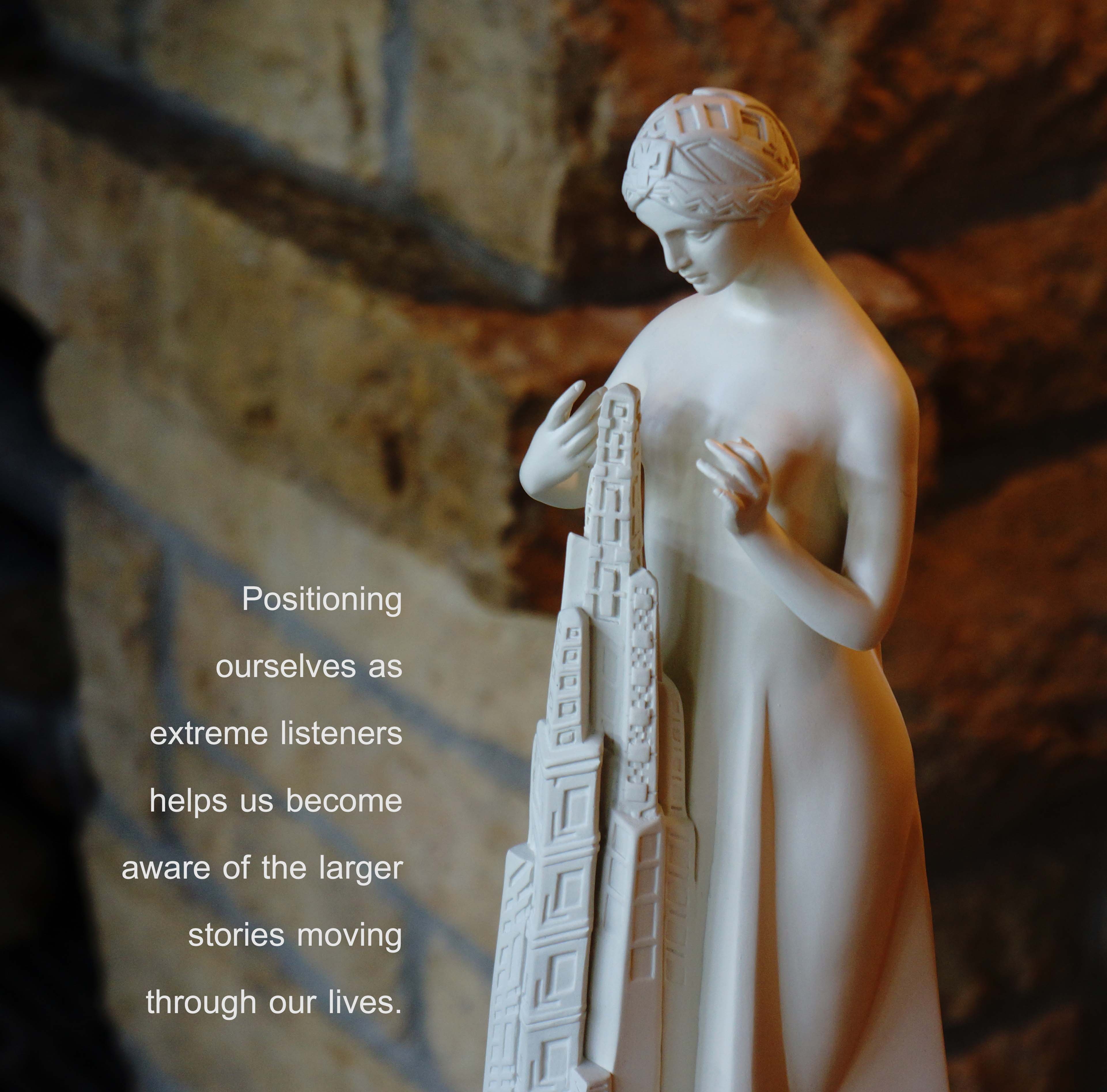
Image credit: Corrado Zeni via 2headedsnake
The Genius of Aldi OUS
“I don’t like tea.”
I’ve been on a jag of watching Aldi commercials lately. A couple days ago I posted this. And then there’s this odd man with his peculiar fondness. But this is one of my favorites:
Does Aldi in the US make commercials?
###
Hopper Early Sketches
Where does an idea come from?
Sketching shows the beginning of an idea.
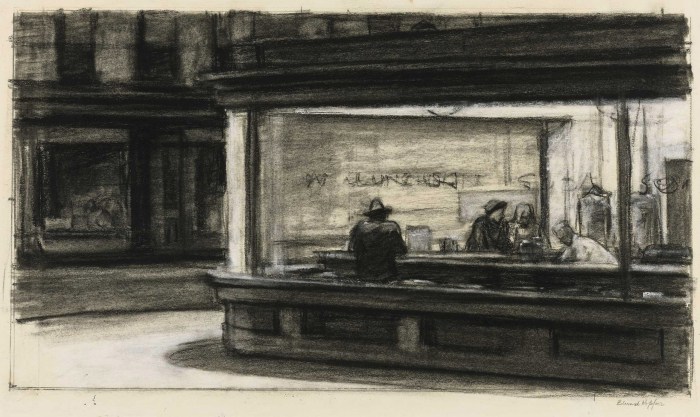
Over at lines and colors, Charley Parker highlighted an exhibit at the Whitney that promises a look into Edward Hopper’s process.
###
Joe Sacco Journalism and the Heights Silent Movie
Hijacking Old Forms
Joe Sacco’s Journalism is a sort of graphic-novel-meets-global-reportage. It’s cartooning with a deadly serious purpose that hijacks both reporting and cartooning and drops both at a new place. Mr. Sacco actually does several new things with this book: sketching out the story, inserting reporting into cartoon bubbles, publishing reporting that looks like a graphic novel. But chief among these new things is Sacco inserting himself into the story he was reporting. Most journalists work hard at writing objectively, that is, without bias. Though that is an impossible task, news readers want to feel they are hearing more than one side of a story.

Sacco went the opposite way: he inserted himself as reporter, sketched right into the panels of the action. We see him ask the uncomfortable question and record the answer while the action goes on—the medium allows for this in an extraordinary way.
The result is a book that is difficult to stick with because the war and refugee experiences depicted are shown in such a raw manner. I think this is exactly what Sacco was after: reporting that grabs you and forces you to interact. He is driving home the difficult stories of our day—and they are hard to see.
Sacco offers no apology for hearing from just one side. The feel of the book is a newspaper as told by your troubled, immigrant neighbor. You want to ignore it (as we do with so many difficult stories) but the whole thing is laid out right before you.
Speaking of being dropped at a new place, last night Mrs. Kirkistan and I attended the remastered The Thief of Baghdad at the Heights Theater, a silent movie complete with the mighty Wurlitzer emerging from the floor. Organist Karl Eilers did a masterful job of providing a continuous soundtrack for two and a half-hours (Oy!) of screen silence. What struck me was how different this experience was from my typical movie-going experience. Because sound incorporates, Eilers’ organ-playing and the response of the crowd (mostly laughter at what was once amazing special effects) were much more prominent. And it took the entire crowd (indeed, the theater was nearly full) to respond to Douglas Fairbanks’ dramatic wind-milling responses to most any situation—it must take a lot of physical energy to communicate without words.
What old form should you revitalize today?
###
Image credit: Joe Sacco, Kirk Livingston
How To Soil Yourself: American Travel Check Voucher
Budgeting for the Aggressively-Uninformed-and-Desperate Niche
 I’ve had this direct-mail sitting on my desk for a number of days. It is so brazenly bad I cannot bring myself to throw it away. It looks like a check. It is not a check: it’s an invitation to (probably) a 90 minute high-pressure sales meeting followed by (likely) more invitations to waste hundreds if not thousands of dollars in fees for the free tickets—at least according to Erica Duecy and Rachel Klein at Fodors.com. American Airlines and the Better Business Bureau have disowned and warned against the scam. Various news teams and scores of writers have been noting this bit of ugliness out of Scottsdale, Arizona for years.
To me this represents the worst of all possible communication events. It plays on one’s innate thrill of getting something for nothing, takes unfair advantage of anyone in desperate financial straits and provides an open door into a cesspool of bad money decisions. It’s probably not illegal, just really, really stupid.
And not just stupid for anyone who tries to cash it.
Stupid for the company paying for the promotion: by this point most of us are trained to Google anything that looks too good to be true. When you Google it, “scam” pops up right away and appears in nearly every entry. One would need to actively disregard obvious warning signs to take advantage of this. And yet, there must be enough aggressively uninformed people who are just desperate enough to fall into the deception. In other words, the few desperate people buying-in keep the swindle going. So—smart for the company to prey on desperate people—and entirely void of care for humans.
The sadness in this direct-mail is how it poisons the water for honest communication. It’s just another example of hucksterism showing up in my mailbox.
Ugly. I’d hate to have this in my portfolio.
###
Image credit: News 8
Cartier-Bresson: Zoom Lens is the Work of the Devil
To See. To Learn to See.
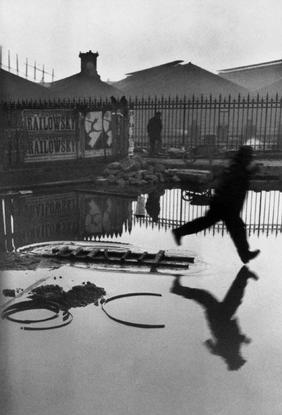
HCB must have framed this and simply waited for the decisive moment.
I’m not sure if Henri Cartier-Bresson actually said that about the zoom lens, but it would fit with his aesthetic. He spent his life getting close to his subjects with a small Leica and its 50mm lens (which he used all his life). That camera and lens brought him in close and kept him there. Someone recently described the big zoom lenses available today as akin to hiding and shooting as a sniper.
What impresses me about the photographs of Henri Cartier-Bresson is his ability to capture something deep in people. A moment of reflection. He called it “the decisive moment” and it was gone as quickly as it appeared. Cartier-Bresson could irritate people because he would sometimes take a photograph before his initial bonjour. But he also spent time just hanging around with his camera. People grew used to seeing it (the Leica) and him and he was quick to bring it up to his eye and put it down again: no big deal.
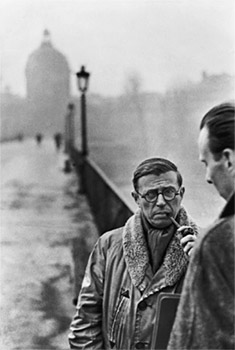
HCB caught Jean-Paul Sartre being Jean-Paul Sartre
In my quest to learn to see, Cartier-Bresson is a valuable guide. He photographed lots of famous folks (thinkers, artists and politicians—he shot Gandhi 15 minutes before Gandhi was, well, shot) and he captured lots of regular people—in a way that reveals a stunning beauty. Here’s a lovely collection of his Magnum photos. Two quotes from this remarkable man:
To me, photography is the simultaneous recognition, in a fraction of a second, of the significance of an event.
For me, the camera is a sketchbook, an instrument of intuition and spontaneity, the master of the instant which, in visual terms, questions and decides simultaneously.
Seeing takes work and practice.
###
Image Credit: Henri Cartier-Bresson
Fascinating: How Stanley Cavell Was Fascinated by JL Austin
Gimme a bigger brain. I’ll settle for a bigger trigger of fascination.
Stanley Cavell’s uneven memoir about becoming a philosopher (Little Did I Know: Excerpts from Memory) is interesting and boring and interesting. Like a lot of philosophy texts, it calls to you days and weeks after you’ve put it down and made peace with never finishing it. I’ve checked it out twice and twice have not finished it—usually a signal I need to actually buy the book with cash money.

Today I’m rethinking Cavell’s descriptions of sitting under the teaching of JL Austin when he visited UC Berkeley from Oxford. Cavell’s descriptions of Austin are not always becoming or charming. JL Austin was a brilliant philosopher but also a bit of a cad, it turns out. But what’s of particular interest is how blown away Cavell was by Austin’s “A plea for excuses.” It’s a pedantic text—like a lot of Austin’s writing. But for Cavell it was full of clarity and win and entirely energizing. Just based on Cavell’s enthusiasm, I’ll reread Austin’s paper.
Enthusiasm is humanity’s secret weapon. The boring teacher is the one unimpressed/unmoved/unchanged by the subject matter she drones on about. But the enthusiastic cheerleader for speech act theory or a particular camera lens or the lobster roll at The Smack Shack is enough to move me to action. As a copywriter I think a lot about how to present this priority or that piece of information so an audience will become interested. But human enthusiasm cuts through all technique and strategy, like sunlight burning off fog. Maybe that’s why word of mouth is the pot of gold every marketer seeks today.
###
Image credit: Lia Halloran via 2headedsnake

 conversation is an engine