Archive for the ‘curiosities’ Category
Outside Voice
Recalibrate Your Tribe to Grow
 One of our kids was loud. When this particular child was quite young, Mrs. Kirkistan and I spent lots of time distinguishing an inside voice from an outside voice. This particular person (not naming names) did not sort out the difference until a certain age had been reached. But then it became clear to [Child X] why you might not shout your happiness with the world at 5am, for instance. This person still has the capacity to be heard—which I admire.
Patrick R. Keifert’s, “Welcoming The Stranger : A Public Theology Of Worship And Evangelism” (Minneapolis:Fortress Press, 1992) is a sort of outside voice/inside voice book for an organization. Yes, he’s a pastor writing to pastors. But his topic is much larger and dovetails with all sorts of human groups. He tells stories and redacts around the notion of how off-putting our insider language and idiosyncratic group behaviors can be to new people—those not of the tribe. It happens in a church. It happens in a family (I still do not have the courage to ask my new son-in-law what peculiar behaviors he notices when our family is gathered). It happens in a business. It happens on Minnesota interstates: drivers resent others trying to merge into traffic from an on-ramp. Is that peculiar to Minneapolis/St. Paul drivers or is it a Minnesota thing?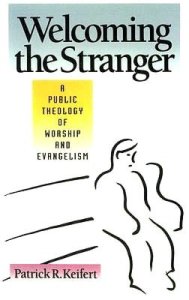
I’m enjoying Keifert’s book because he makes a compelling case for why we should listen to the stranger. He traces the roots of this listening to deep theological places and hints at how we were made for this very kind of interchange. But he also notes there are dangers in hearing the stranger (“Wait—what is this guy up to?”). He points out my unthinking refusal to let focus slip away from me as the all-consuming center of the universe. The end game is that I typically hear the stranger saying only those certain words that fit my view of the world. And we all have experience with that.
But hearing the outside voice in our family, church or company can help us get unstuck—especially when we don’t know we’re stuck.
###
Image Credit via 2headedsnake
Of Gertrude and Mitt and Barack and Gertrude. Gertrude.
for this is so because
Maybe we’re mistaken about our political discourse.
Maybe the shout of half-truths is
Itself a deconstruction—
A mimicry
Of conversation.
Since we now listen with our eyes
To the form that
Comforts
Us
Most.
###
Image Credit: Gertrude Stein Reading “If I Told Him”
Romney’s 47% and Why The Rich Are Meant To Be Rich
Entitlement Cuts Both Ways
I’ve been puzzling over Romney’s comment that 47% of the country is not paying taxes, dependent on the government and freeloading (my paraphrase). Everybody from Jon Stewart to local pundits have been breaking it down and taking due umbrage. Everybody except Fox News, of course.
A thoughtful New Yorker piece (“Why Do America’s Super-Rich Feel Victimized by Obama?”) gives more background on Romney’s comment. It turns out the super-rich, like Leon Cooperman (billionaire founder of the Omega Advisor hedge fund), are feeling unappreciated if not vilified by Obama. They feel they are the targets of increasing class warfare and they are not going to take it anymore. But the piece by Chrystia Freeland also argues the paradox that the super-rich have done well under Obama’s administration, for example, with “ninety three percent of the gains during the 2009-2010 recovery went to the top one percent of earners.”
So—tell me again—how are Romney and his rich friends victims?
It turns out the supposed sense of entitlement works both ways. The super-rich accuse the 47% of freeloading and expecting the system to supply all their wants. But the super-rich themselves have learned to take advantage of the system to live extraordinarily well—something perhaps they also feel entitled to.
Romney’s comment shows me again why no one candidate or party fits fully within the rubric of “Christian.” We’ve painted compassion for the poor with the broad brush of entitlement and freeloading while failing to examine why and how the system rewards those who have assembled it. And then we douse the whole subject with an indignant tone.
We need a new way of talking.
###
Here’s to the Restless.
The quirky quibblers.
 Who eschew easy answers.
The questioners—hand up among silent spectators.
The marchers who break stride to banter up the bystander.
Here’s to the people who take a long look.
And another.
The ones crafting their own theory.
Long may they live.
###
Image credit: Jeremy Miranda via thisisnthappiness
[With apologies to Chiat/Day]
Asking New Questions: the Shropshire Iron Bridge
Could questions fuel personal and corporate goals?
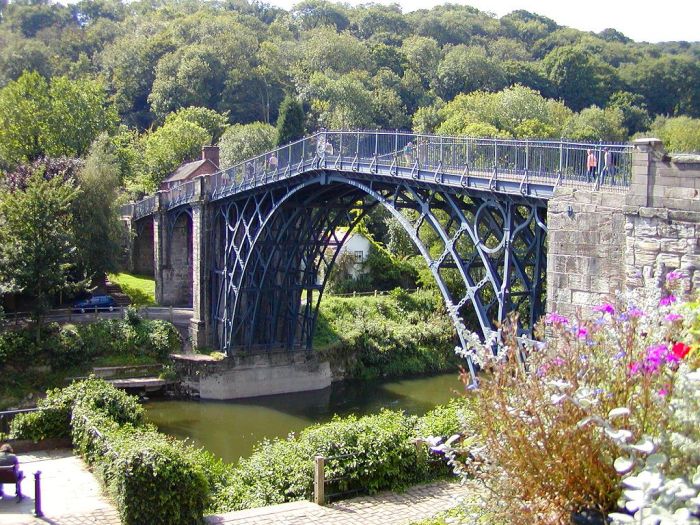 Toward the end of Free: The Future of a Radical Price (NY: Hyperion, 2009), Chris Anderson cited an example of a bridge in Shropshire, England (p. 213). This bridge was built at the beginning of the Industrial Age (1779), just when builders were shifting from timber to iron as a construction material. But the thinking had not yet shifted to where builders realized iron could be used differently than wood. As a result, the bridge was “wildly overdesigned,” made with iron elements cast separately, and thousands of metal planks fastened and bolted together after the fashion of wooden structures. The bridge is still around today, though much reinforced over the years.
The builders didn’t realize this new material required a very different approach to bring out its strengths. Iron cast in larger sections could take advantage of natural strengths. Small iron castings fitted like wood negated those strengths.
Anderson used the bridge and the bridge-building techniques as an analogy to understand Free. The entire book is a masterful (and thoroughly readable) argument for why the free-to-many-and-paid-by-a-few model works for so many companies today. Anderson also dived into the history of free, along the way citing Lewis Hyde’s The Gift, (a favorite of mine) which describes how gift economies work (hint: gifts tap our genetic pre-disposition toward reciprocation, that is, giving back).
Leaders Lead. Followers Follow. Will Followers Lead?
The point is that new materials, just like new tools, invent or allow or conjure new ways of working. And rather than trying to do the same old things but with newer stuff, we need to sniff out the new goals and new methodologies. In particular—given social media tools—I’m curious how leaders and followers will connect on shared goals.
We’re now well beyond telling each other how to use social media—we’re thumb deep in using all sorts of apps for personal communication. And those tools are quickly working their way into commerce (I nearly always read reviews of products before I buy), into travel, into politics and into our work lives. I would argue the new tools change the way our faith lives work, especially in relation to leading and following.
I keep returning to a phrase I ran into earlier this week, from Dassault Systemes:
Wise leadership looks for game-changing questions. And those questions come from anywhere—from up, down or outside the organization. It is these questions we’ve not yet addressed that will help us understand the new tools, methods and (even) goals and direction.
###
It Turns Out Time Is Not So Flexible
My Wife Demonstrates Use of a “Clock”
 I’ve always joked that I live in a time warp. Time actually moves backwards as I drive to my next meeting (which is not a confession of speeding, please understand).
I am of the tribe who refuses to leave what I’m doing to get to the next thing. In my mind—as I remain at my keyboard—myriad mental time and distance calculations convince me that of course I have plenty of time to get to that meeting. My watch is set ten minutes ahead so I am only five minutes late to things. (That’s a reasonable margin, right?) Of course there will be green lights. Certainly there will be no traffic—I count on it. Naturally I can shower/shave in five minutes and be ready. Absolutely.
As it turns out, my wife is able to use a clock. And she timed my five-minute shower. And then she asked me if I could take a shower and eat breakfast in five minutes.
“Yes,” I said. “Of course.”
“Twenty minutes,” she said.
“What’s that?”
“Yes.”
So, here’s my new deal with the universe: I’ll give myself thirty minutes to shower and eat breakfast. And not just because my wife has had something to say about this for 27+ years. Perhaps peace with Mrs. Kirkistan—in this area—would be useful.
Yes.
I’ll get started right away.
Just let me finish this thought.
###
Image Credit: Ryan Todd via thisisnthappiness
Two Inane Commercials. One Purposefully So.
“Perfect place to build a town” defies believability
The folks at Casual Films tell the story behind making one of the dumbest commercials I’ve seen in a long time. In their work for Dassault Systemes, the filming is cinematic, the visual effects are stunning, the soundtrack and entire setup is urgent and important. But in the short form of the clip, when the supposed explorer speaks, the bottom drops out of the story. Her words—and her delivery from the top of the dune—flip the believability switch that says: this is utter fiction.
If we could supply fresh water this really would be the perfect location for the new town.
Her words send me to this set of questions: Really? You’ll build a town in the desert? And you think people will come because you have fresh water? Have you really studied what it takes to build a planned town—has it ever worked? Who wants to live in such a place? And then I start thinking about colonialism and all the unsustainable projects my country has initiated over the years.
Maybe Dassault Systemes really is going to do this and icebergs in the desert really will supply nomadic tribes for years to come. I hope they are changing the world. But the actor’s long sentence yelled across the desert—heard perfectly despite the distance and the howling wind—made everything suddenly seem like a middle school play. In fact there are a couple other points where the supposed conversation sounds like a PR flack talking to schoolchildren.
Wexley School for Girls: Take Me to Copper Mountain Now
Compare what Casual Films did with what Seattle’s Wexley School for Girls did for Copper Mountain. They hammered the silly button with no pretense at believability and completely own my attention. I don’t even ski, but I want to go a place with this sense of humor.
See a fuller set the Wexley commercials here.
By the way, I find the Dassault Systemes tagline pretty compelling:
If we ask the right questions, we can change the world.
###
Via Adfreak
Sunday’s Most Dangerous Infection
Hope is a worm working its way into your week
It spreads like a yawn. Involuntary. It taints the way you see everything. Like being in love. Hope is a realization working backward from the future to infect this very moment and infuse it with
Better.
 I’ve been reading Jürgen Moltmann’s The Coming of God. Moltmann is an Austrian theologian who writes about eschatology (a look at last things, or end of times). Don’t be put off by the churchy/theological word: Moltmann’s take is not the “let’s read the Book of Revelation as a blueprint for the future” way. That old way often ended by damming up life here and now so as to burst in a final damnation on everything. With believers flying the coop just before. So why worry about this world?
Moltmann’s point is that a future hope has a way of wending its way back into the scrub and din of everyday life. In fact, it is the Christian hope of resurrection that feeds a very different way of looking at life:
Just as death is not only the end, but an event belonging to the whole of life, so the resurrection too must not be reduced to “a life after death.” The resurrection is also an event belonging to the whole of life. It is the reason for a full acceptance of life here without any reservation. (Moltmann, Jürgen. The Coming of God, Minneapolis: Fortress Press, 1996. 66)
To me, that is a meaty stew that feeds my yearning to live fully in the present. And engage with people in the present (as much as my sadly-abstract soul will allow). I’ve been watching this hope work backward into my unscrolling days, changing them one by one.
###
Image Credit: DKNG via thisisnthappiness
Widerøe: A Most Winsome and Persuasive Airline
Have you ever seen a more organic selling proposition?
This quote, via the Bill Bernbach fans over at Sell!Sell! seems appropriate for this piece of communication:
Advertising doesn’t create a product advantage. It can only convey it.
###

 conversation is an engine