Archive for the ‘curiosities’ Category
I’m Writing a Book called “ListenTalk”
I’m writing a book about talking and listening. I’ve become crazy about what happens in our best conversations: we come alive. We learn something about another person and in the spontaneous moment of creation as we frame up words to describe our own situation, we often suddenly learn something brand new about ourselves. Something we didn’t know before we started talking. I’ve begun to think that when we are in conversation, we are more truly ourselves. And the best conversations have a way of making us very present to each other.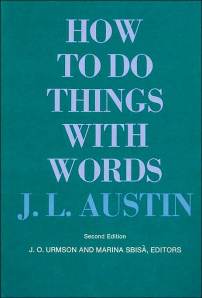
I call this book “ListenTalk: You’re Boring. Let’s Change That.” I think we were created to be in constant, deep, creative, spontaneous conversation. Not just with each other, but with God. That’s why parts of the book develop a theology of communication, starting with God’s act of creation, where His speech-act created dirt and air and giraffes and coffee beans and people, among other things. So you can see that with my book I hope to bring together something of JL Austin’s work on communication with a commitment to faith. Maybe I’m trying to do something impossible. I’m not sure. In a few days I’m scheduled to talk with a philosopher and speech-act theory expert at the University of Minnesota. I’m interested in his response to my notion of combining these things.
Two more pieces of this book project capture my attention in a big way.

Derrida and Welcoming the Other
One has to do with Derrida’s notion of welcoming the other. I recently finished James K.A. Smith’s “Jacques Derrida Live Theory” (Amazing: the book retails for $120! No wonder I cannot afford most of what I read) and was pleased to see a philosopher working from a faith perspective dealing with Derrida’s thoughts. I was impressed to see overlap between Derrida’s notion of welcoming the other into conversation and the God of the Bible’s commitment to welcoming the other. The Bible talks about reconciliation, and that definitely includes welcoming the other. What reconciliation does not mean (and here is where Derrida is particularly helpful in helping throw off some of my Christian cultural baggage) is making the other like me. We’re all tempted to make those around us like ourselves. But that effort misses the point of the kind of conversations that will sustain us.
Is Prayer a Model for Conversation?
Pulling more from theology than communication theory or philosophy on this last point, one of my chapters looks at prayer as the Bible talks about it and posits that we were meant to communicate with each other along these lines. Nothing really mysterious or unorthodox, I just wonder if the way we communicate with God (listening followed by moments of intense listening, and then very frank speech) is meant as a model for how we communicate with each other. Maybe listening is to take more of our effort than talking, which is a lesson advanced people of prayer seem to know.
Social Media is a Way Forward
This book ends with the notion that people of faith are currently presented with a rich opportunity to create and be in conversation. People of faith would do well to place ideas out in the public common areas, since there are far fewer gatekeepers, and see how people respond. This is part of the class I teach at Northwestern College called “Building Community using Social Media.”
What do you think? Would you read a book like this?
###
Seattle Pike Place Market
 Among barkers and pitches and queries over price.
Prunes and potatoes and fish packed in ice.
A tiny man sat on a low stool
Lonely notes sounded, a string his tool.
One lone string sang strength and long-life,
And crossings and family and a well-loved wife
Of war and of peace
And of work without cease
In the market and deep in the throng
I heard clearly every man’s song.
###
Honest Defense Strategy: “My client isn’t just arrogant. He’s ignorant!”
You’ve got to admire a defense strategy that highlights that Blagojevich “talked big but was none too bright.”
Of all the things Blagojevich says, his lawyer is the easiest to believe–at least on this point.
Maxed Out: Good Scared
Within ten minutes of starting Maxed Out, I began thinking of cutting up my credit cards. The documentary sets out to expose the predatory practices of credit card companies. Like you might guess, the film is full of the pathos of people in over their heads. It’s gut level film that left me eager to do anything to avoid contributing to any credit card company’s bottom line.
Eye-opening moments:
- The film names the big national banks we recognize and trust that actually front the high-interest storefront cash advance businesses that prey on the poor—and make lots of money doing it
- Efforts to curb predatory lending by enacting national laws were thwarted again and again by the banks and their lobbyists
- George W. Bush encouraging the nation to go out and spend. I still remember my disgust when he was saying that, but capture in film brings it all home again
So—solid fun for a documentary and well worth watching. But please watch it with your brain engaged: watch for the rhetorical tricks that lead directly to your visceral reaction. The film presents one side well, and matches up faces and sad stories with the purpose of exposure. I would have liked to hear the other side. Not because I love credit card companies and bankers, but because there are occasional legitimate purposes for credit. I would also like to hear something about personal responsibility.
The film succeeded in scaring me—yet again—about easy credit. Yikes!
###
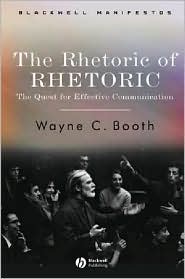
The Rhetoric of Rhetoric: The Quest for Effective Communication by Wayne C. Booth
Readable.
Wayne C. Booth’s The Rhetoric of Rhetoric: The Quest for Effective Communication (Malden, MA: Blackwell Publishing, 2004) was published in a series called “Blackwell Manifestos.” Booth’s passion is equal to the series’ task, whether he is preaching the gospel of “listening-rhetoric” (really getting at underlying truths in conversation versus “bargain-rhetoric” where your goal is to mediate a truce or “win-rhetoric” where your goal is to engage in monologue and so browbeat the conversation partner into submission) or ranting about the rhetorical missteps of the George W. Bush government, there is no lack of passion.
But perhaps the clearest message and the one I take with me is the notion that every piece of communication carries (furthers?) some rhetorical purpose. Every communication has a purpose. And to sit passively receiving without considering what the author/rhetor hopes to accomplish is to allow myself to be taken advantage of. Whether I’m watching a commercial on TV (even a good one), listening to a sonata, hearing a preacher or even reading the prophet Amos or some other ancient text, I’m at my best when I consider—and possibly reject or even accept—the message coded into the communication.
A text wants a response.
###
We Need Your (Creative) Briefs

Unsettle the brain and spirit to move forward.
Don’t just paste in your purpose from the last creative brief. Don’t fill your creative brief with numbers and trivia that aren’t sharpened to make your point. Especially don’t dump in the jargon your client prattled on about. Make your brief work first as a communication tool and then as a community-building tool, because (you know this already) you’ll get the best work from your creative team by engaging them with more than facts. You’ll want them excited. Not excited about a tactic, but excited about what this communication (and what this product) will accomplish out in the world.
Don’t let your creative brief be just another check mark on your ever-expanding list of things to do to get a project started (and thus off your desk). Make your creative brief a thing of beauty and curiosity, like Cicero made his speeches: put in an exordium to get the team riled up about the opportunity. Put in some narrative that explains the full scope of the issue at hand, but sharpen it so your copywriter feels the pain the audience feels (and also feels the opportunity revving up your client). Confirm the why of your point: what are the salient details your copywriter can use? Then refute your point: what reasons will your detractors trot out to show how wrong you are? Then send the team off with a stirring conclusion (peroratio) that sums things up and blends pathos (emotion), ethos (your own sterling character) and logos (reason) in the most unsettling way. I always write my best copy when something isn’t sitting right in my soul.
Some of these ancient guys (like Aristotle and Cicero) have a few things to tell communicators today. How to rouse a team to action is one of those things. We need that.
###
What Does it Take to Listen? Amos on Hearing.

The power was in the message not the prophet.
For several weeks a few of us have been talking our way through an ancient text written by a shepherd named Amos. He came to the task of writing with no credentials and claimed only to be articulating stuff the Almighty had been roaring.
Like a finger circling a map before punching hard on the destination city, Amos’ started with a talking tour that included cities and regions where residents had stepped away from honoring God. But eventually Israel was the focus of this roar. And by the middle of chapter two, it’s clear the relationship between God and people was broken. The prophet prompted the people to remember how the Almighty had acted in their lives: destroying enemies as they made their way from slavery through a wilderness to a place of promise. The Almighty even equipped them with people specially tuned to hear more of what He was saying: Nazirites and prophets. But the actions of the crowd drowned God’s voice. The nation happily trampled the poor if it meant more money for them. They damaged their marriages and invented their own gods. Whatever worked.
That the people thought this was no big deal was key to what happened next.
Stuff happens for a reason, the shepherd/prophet said (Amos 3.3-8) and present sufferings will give way to something much worse, so now is the time to return. The predictions only get more violent as the book progresses and Amos does not spare the detail. That the nation collapsed within the generation puts even more muscle behind Amos’ words.
By the end of chapter four, the people had refused to hear and continued to invent their own terms of engagement.
What I learned:
- If I want to hear something bigger then myself, I need to listen beyond my own desire. It’s a matter of pulling out of the evil I’m participating in (a prophet worth his or her salt would say “Repent!”) and “returning” (which occurs five times in Amos 4) to God before being forced to meet Him on much less ideal terms (compare Amos 4.6-11 with 4.12-13).
- It’s good to remember the milestones and turning points God creates in your life. In our family, we’ve got dozens of places where we’ve sensed a divine hand reaching down and turning the course of our lives. Those times make for good stories—plus they actually inform present dark times with hope and light.
- God does stuff to get our attention. It’s better to develop a listening spirit than not.

Start listening at 5:15
###
Great Moments in Rhetoric: Climate Change and the IPCC Mission

Good communicators are transparent about their purpose.
The Wall Street Journal reported yesterday on the Intergovernmental Panel on Climate Change (IPCC) mission to take “sophisticated and sometimes inconclusive science, and boil it down to usable advice for lawmakers.” The article speculates (via scientists working with the IPCC) that institutional bias toward oversimplification is what lies behind the erroneous projection that Himalayan glaciers could melt by 2035.
If there is anyone out there who still believes in truly objective science—or truly objective anything—I’d like to meet them. It should surprise no one that we constantly arrange facts to meet our pet goals. And we infuse those facts with the urgency that fits our purpose rather than an urgency arising from the facts themselves. This is a human trait and we should expect it in every communication. Facts are facts, yes. But facts are also small pieces of a rhetorical puzzle that can (and will) be built together in a number of different ways. Is there ever a time when we experience facts in isolation—without some rhetorical flourish—that is, without some political aim that wishes to move us toward a favored action?
No.
But persuasion is not wrong. It is a necessary piece of human life on this planet. All our actions, all our thinking, all our communication, all our learning, all of most everything is organized by political pulls. That’s not overstatement: even the best among us are always motivated by partisan or self-serving objectives. Rather than resist this fact of human life, it makes more sense to look closely at the objectives that drive us. Of course, there are two sides to every story, including this large story on climate change. Sure the WSJ is written from a conservative perspective and this article was meant to shine light on hypocritical methods of their opponents, which always makes for good reading and sells newspapers.
It’s just important that we keep in mind what stake our communication partners have in moving us one way or another. And perhaps as communicators, we do best when we state our goals early. In fact, I think our audiences are put in a positive state of listening when they hear our disclosures up front.
###

 conversation is an engine