Archive for the ‘curiosities’ Category
Best Case: Stable Health + Quick Decline + Death
Reading Atul Gawande’s “Being Mortal”
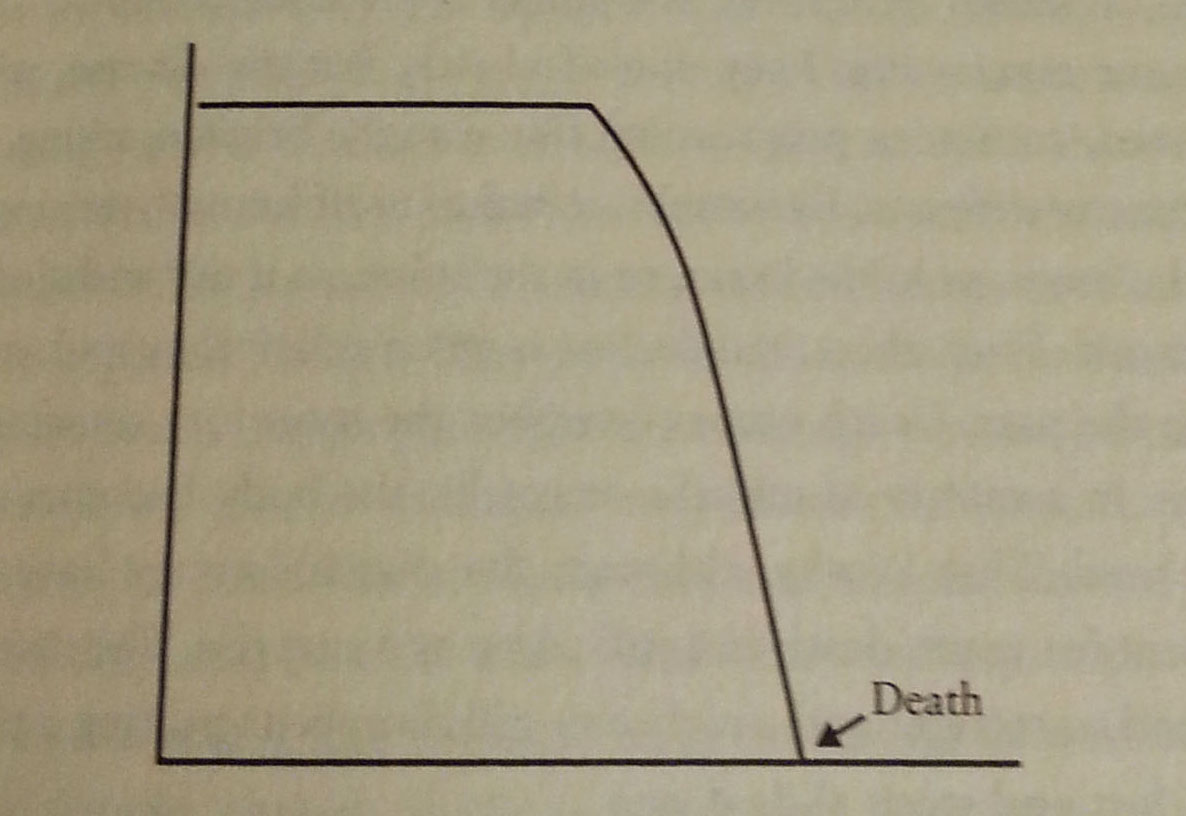
Another happy illustration from Atul Gawande’s “Being Mortal.”
Mr. Gawande is a surgeon and medical professor and writer for The New Yorker. His recent Being Mortal is a long conversation about how humans face death. Or, more to the point, how medicine and our own optimism interact to keep us from planning for this known, finite end.
This is not something you think about at 18 or 28. But it is a wedge topic that soon starts to butt into life. At some point you notice aging people appearing all around you. And then you do the math and start to think you may be aging as well—though we’re all hard pressed to say where the time has gone. Like a favorite, recently-passed in-law said not so long ago, “In my mind, I’m still 18.” No one agrees to aging and few self-select as “old.”
Still, there is this inevitable endpoint.
Mr. Gawande’s book does the reader a favor by naming the moving parts of this process. That is, the slower and slower moving parts. From the shrinkage of the brain to why it is that older people seem to choke more to the insult of not driving to the big fear of dementia. One of my favorite characters in the book is the groundbreaking geriatric physician/researcher who was active until he, well, became old. And then, in a clear-eyed fashion, detailed his decline, his motivations with caring for his wife of 70 years who became blind then deaf, and then broke her ankles. It’s a happy/sad love story of a couple who were active into their 90s.
 As a believer in the God who resurrects, I do not think of death as final. But as aging continues (which I don’t feel but suppose is acting on me even now), my reading of the gospels and prophets and psalms finds me looking for clues that point beyond what medicine says and beyond what my own senses say. I find a good bit of hope in what I read.
Wendell Berry explored this topic with extraordinary care. His The Memory of Old Jack is a solid antidote to our collective denial.
###
Image credit: Atul Gawande, Kirk Livingston
Judge Not: On Moralistic Judgments
#That’sJustTooHard: Think Before Speaking

There’s no stopping a word spoken.
One kind of life-alienating communication is the use of moralistic judgments that imply wrongness or badness on the part of people who don’t act in harmony with our values. Such judgments are reflected in language such as, “The problem with you is that you’re too selfish.” “She’s lazy.” “Their prejudiced.” “It’s inappropriate.” Blame, insults, put-downs, labels, criticism, comparisons, and diagnoses are all forms of judgment.
–Marshall B. Rosenberg, Nonviolent Communication (Encinitas, CA: PuddleDancer Press, 2005) 16
Which is not to say we do not have values and make judgments based on our values. Of course we do. But what if held back our knee-jerk spew of moralistic judgment about someone we’ve never met? What if we first talked with them?
A conversation could show us how wrong we were—or confirm our suspicions.
But…hear first.*
###
*Of course I am pointing to my own failure at this before pointing anywhere else.
Image Credit: Kirk Livingston
“Sure, that’s an outdoor restroom,” he said.
“Just go right in there.”

He lied.
###
Image Credit: Kirk Livingston

“Dude looks like a lady.”
Is gender fluid?
Over at my public confessional (Dumb Sketch Daily) I did a drawing so bad that all my sketchy companions are ganging up. Well, OK, that’s an overstatement—they are uniformly kind and encouraging.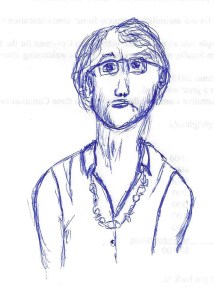
It was a quick sketch of a delightful woman sitting across from me at an evening meeting. But the sketch went haywire. In attempting shadow I accomplished a beard. She did not have a beard. She does not have a beard. Even at the time I recognized I had gone too far. So I made sure to sketch her necklace. But the critique of one artist still rings true:
Dude looks like a lady.
I agree with another sketchy commenter, that my unrealistic drawing is perhaps a “sign of the times.” Indeed, not a day goes by without a photo of the current Caitlyn Jenner/former Bruce Jenner and a story in the StarTribune or on MPR about another facet of transgender life.
Gender as something rather fluid is a relatively new thought for me, just as it is for a whole bunch of people. It’s an observation that creates an opportunity to go back and reread ancient texts and ask how I understand them. It’s also an opportunity for a whole series of (sorta uncomfortable) conversations. And the circle of topics included in those conversations gets wider and wider, taking in more ground. For starters: volumes of assumptions about gender, a reviewing of the binary nature of gender I had assumed for so long, questions about identity and self. It actually sounds like a fascinating discussion, if it weren’t all so awkward.
But this is another conversation we’re moving toward.
So gird your loins. Or not.
###
Dumb sketch: Kirk Livingston
How to Tell Yourself the Truth (Hint: Start with an insult)
Where’s John the Baptist when you need him?
John’s task was to prepare the way of the Lord. That looked and sounded like insults to a crowd already well aware of the law and prophets and how to navigate the ancient texts. It’s just that the crowd’s navigation allowed them to do what they wanted while ignoring the invigorating spirit of the texts.
Thus John’s insults.

It’s easy and natural to take insults as insults (that is the intention, after all). But to see them as opportunities? That actually happens to most of us: insults become opportunities…ten years later. It takes ten years, or maybe twenty, to see the truth of what that busybody meddler said. And then in conversation with a friend or your grown-up kid or spouse you find yourself saying, “They were actually spot-on, though I denied it at the time.”
A few days ago an acquaintance called me out on one my typical innocuous and benign conversations about copywriting and communication—he resisted my assertions and would not back down. His insult landed wide of the mark and made no sense to anyone else either, but it got me thinking about my approach to a particular set of clients I work with. In fact, my acquaintance’s sharp barb started to reveal a truth about my approach that has since proved quite useful.
This is atypical.
I usually spend a decade stewing on an insult and devising comebacks and elaborate retributions. But what would life be like if I/we could be more open-handed about criticism?
That might help us grow beyond our blind spots—which might prove useful.
###
Image credit: Kirk Livingston
Counterintuitive: Listening Beats Talking?
Persuader Vs. The Persuaded

The Russian polymath Mikhail Bakhtin—one of the titanic minds of the twentieth century, though too neglected now—believed that in a dialogue the position of primacy is with the person who listens rather than the one who first speaks. After all, he said, we do not speak unless we anticipate a response; and we shape what we say in light of possible reactions.
–Alan Jacobs, The Pleasures of Reading in an Age of Distraction (NY: Oxford University Press, 2011) 55
Without some listener—you see—there would be no words launched.
###
Image credit: Kirk Livingston


 conversation is an engine