Archive for the ‘Dialogue Marketing’ Category
How do your tools shape you and your customer?
We work with tools. Tools work back.

Current Tools Train Us to Expect Collaboration
It is not precisely true that our tools train us. More to the point: our tools sometimes wake dormant skills. Our tools help us exercise muscles we’ve not used so much: for instance, my running shoes help me exercise a different set of muscle than my bicycle typically requires. I know this because I have different pains after using each. An axe requires differing coordination skills than a hammer, which is also different from a ratchet.
Current social media tools exercise our collaboration muscles. From Facebook and Twitter we began to see that collaborating is fun. And we start to look forward to working together. It now feels good use those muscles and skills. It feels productive.
So when we require each other to sit silently in a long meeting, well, that doesn’t feel so good anymore. Or when we tell our employees or our congregation to go do this thing without asking for their input and experience—that just won’t fly anymore. And if we expect our customers to buy whatever we sell with no questions, well, that model has been dead for some time (the cult of Apple comes to mind as one exception).
David Straus in his practical and interesting How to Make Collaboration Work (San Francisco: Berrett-Kohler Publishers, 2002) rightly labels this a matter of human dignity:
People who are directly affected by an issue deserve to be able to express their opinions about it and have a hand in formulating a solution. (46)
How are the current tools changing the expectations of your client, customer or congregation?
###
Image Credit: Inkdrips via thisisnthappiness
Gay Marriage and the Desperate Times/Desperate Measures Argument
People of faith can do better
 Amy Bergquist’s powerful editorial (“This man shouldn’t get the last word on gay marriage”) in today’s StarTribune makes a strong argument about treating people as adults. Read the comments (59 as of 10:10am, 135 as of 2:50pm) and you’ll be reminded of what a lightning rod issue this is for our culture. Setting aside the lightning and the working parts of Christian conviction in a multi-religious nation for a moment, I believe Ms. Bergquist is exactly right about Frank Schuber/Schubert (The Strib printed his name both ways) methods:
Running emotion-driven ads at the last minute does not give room to debate, discuss or even engage one’s mind. It’s all visceral. It’s all knee-jerk reaction—which is the point: We all know that every institution and cause, from the Axis to AIDS, has played on emotion to move people to action. We each tune out countless of these messages every day.
As a copywriter and a student of persuasion and a Christian, I question Mr. Schuber/Schubert’s tactics: while his ads may move the vote, they do not promote transformation. Transformation happens as people engage with an issue and think it through and talk it through (and pray it through). On a personal level, it is one-on-one conversation that makes things happen. The notion of ambush communication tactics may give short-term gains in Jerry Falwell’s culture wars while leaving the nation’s current inhabitant’s thumbing their fact-checkers as they walk away.
I know these tactics well as a copywriter. But anyone can see that advertising and marketing communications are moving away from the trick-you-into-buying mentality. The marketplace is much more conversational and becoming more so every day.
As a sometime faculty member at Northwestern College where Mr. Schuber/Schubert was interviewed weaving his emotional magic, I wonder if the faith community that supports the college can call for better, more mature, truly Christian communication. I doubt the college sanctioned Schuber/Schubert’s particular work, though clearly the marriage amendment would have a lot of support from the evangelical-minded folks aligned with Northwestern College. But I would challenge the community to find ways to engage people in conversation—sort of like Jesus and Paul did—rather than supporting more rapid-fire emotional outbursts.
Let’s grow up.
Together.
###
Image Credit: Famous Movie Quotes via thisisnthappiness
How to Sap Energy & Steal Creativity: “Just Execute”

Don’t think. Just do.
A talented strategic friend chatted with the vp of marketing at a medtech startup. What was the company looking for in their posted marketing hire? They just wanted someone to execute. Just execute? My friend was floored. You want to hire someone and not use their entire brain? You want to disengage the emotion that arises from thinking through a problem? You have such knowledge of the market, you’ve considered every angle, you know all there is about your target audience, you are so confident you don’t need anyone else thinking this through? Or—was the pressure so great to show results that they could not waste time on strategy. Either way, the entire conversation pointed out this was a company to avoid.
“Just execute” is corporate bully language for “Do it because I said so.” Nearly every human benefits from knowing the “what” and “why” behind an order. And even God entertained modifications to His plan while Moses verbally worked through the mission as they chatted around the burning bush.
Don’t misunderstand: there is absolutely a place for “just execute.” Stuff gotta get done. Yes. But long term, stuff gets done much more effectively when we enlist whole people to work with us. And that means bringing people along with us as we process our mission. Just say “No” to the smoky backroom where highly paid C-suiters work out the details and then send a courier with decrees out to the rank and file.
This authoritarian tendency looks even worse in a volunteer organization like a church. Because money is not a factor there—it’s all about feeding motivation. Avoiding rich conversations about “why” short circuits the process and makes whole people flee.
Whatever your position, do yourself and your organization a favor by helping people see the big picture. Helping them form and reform and personalize the big picture. Whether you are a manager, a volunteer coordinator, a pastor or lead worker on an assembly line. This is what leaders do.
And know this: Those who won’t share or budge on the big picture will not attract or retain talent. But they will find themselves starting from scratch again and again.
###
Image Credit: C-front
What does a “social” church look like?
What Does a Social Anything Look Like?

hey-let's unlock our solipsism
We talk a lot about “social” but often marketers and corporate communicators practice the same old monologue and one-way messaging characteristic of the last century—they just shrink and divide their messages into packets of 140 characters and broadcast them through the channels people happen to be listening to at the moment.
For most of us “social” means only broadcasting through relatively new channels. We mostly don’t get the listening part of dialogue. This deafness comes from a deep place: this human tendency to see ourselves and our thoughts—our messages—as the axis for all that happens in the world. How could it be otherwise, given that we experience every part of life through our senses: the world comes to us as images, sounds, tastes, feeling and odors?
Certainly that is the case with profit-seeking entities like corporations. We monologue because we want people to buy our stuff. Same with churches: leaders broadcast what they want followers to hear and act on. Same with any organization.
3 Lessons and a Revolution
I’ve just finished my third run at teaching Social Media Marketing at Northwestern College and yesterday was my favorite day: when the students present what they learned from their social media excursions and community building activities. They learned:
- That the most tautly-orchestrated rhetorical strategy falls apart pretty quickly in the face of the opinions and interests of their audience. Students become completely captivated by hearing others respond to their words and ideas. These responses are especially enticing after years of writing papers only for the professor’s eyes.
- Try-Fail-Adapt was a motto we took from our texts and nearly universally adopted. This is the way forward with building communities using social media.
- That vague “interesting” titles and headlines don’t pull readers nearly as well as solid simple titles and headlines. And that putting a number in a headline produces a bit of magic. Something women’s magazines have practiced for decades.
One notion that threaded its way through the presentations was this subversive, revolutionary aspect of working with social media. When you look beyond today’s tools as just more broadcast channels and see that people are given a voice, the world starts to tilt differently. People with a voice. A voice that agrees with leaders. Or not. Voices that speak back to power. We’ve already seen those voices collecting around the Arab Spring, Putin’s Russia and our own Occupy movements. What will that look like as people slip into ownership of the church? Because it is sure to happen there as well. Will leaders learn to lead collaboratively and by pulling people toward them? Or will leaders rely on pulpits and authority structures for their power? And how long will that tactic last?
###
Image credit: Neatorama
Occupy…billboards: “This Space Available”
“I feel it is wrong to be treated as a consumer every place you go.” Gwenaëlle Gobé
When Writing is More than Writing: The Idea Writers by Teressa lezzi (Review)
Your invitation to a new way to persuade
 As editor for Advertising Age’s Creativity, Ms. Iezzi has a daily, close-up view of the trends in the creative world and the people behind those trends. The surprise in the book comes with the affection Ms. Iezzi has for the discipline of copywriting and the practical nature for those seeking to grow in the discipline. It is readable, informative and filled with stories about advertising heroes and insights into current campaigns. I plan on using it as text in my next class on freelance writing.
Ms. Iezzi begins by framing the story of copywriting with a look at the ground-breaking work of legends like Bernbach, Ogilvy, Reeves and others back in the 1960s. Their work was fresh in relation to what was going on around them. Indeed that decades-old work formed the basis of many of our current communication trends. Ms. Iezzi uses the legends to reinforce the importance of storytelling, which these guys got right. Storytelling is the concept that best binds together The Idea Writers, as Ms. Iezzi issues a kind of challenge to today’s batch of copywriters to push into the new ways of communicating.
Two powerful notions emerge from The Idea Writers:
- Copywriting today is much more than only writing. Maybe writing was always more pure than writing. Today’s copywriters will sketch designs, draft scripts, work out the voices of a cartoon and a blog persona. They will pitch ideas because they are closest to the energy behind the idea and because organizations run much flatter. This book helps break through the silos that are already on their way down.
- Today’s copywriters help guide brand development following new methods of persuasion. In this new age, people buying stuff have unprecedented control of brand. Today’s copywriter recognizes the stories that honor the people doing the purchasing while smartly positioning the brand as a kind of conversation partner.
Ms. Iezzi’s book is the first copywriting book I’ve read that does justice to the emerging notion of the switch from corporate monologue to personal dialogue. The only lame part of the book came when she trotted out her personal list of tiresome cliché ad ideas. Her list of six included things we all instantly know, but to say those ideas will never work again seems like a challenge. The list also invalidates the notion that we beg, borrow and steal good ideas constantly—it’s just that those ideas are more or less recognizable in a different arena.
###
Verbatim: Tell Other People’s Stories
In which I learn from my students

We see better together
We just finished our Social Media Marketing class at Northwestern College. One of my favorite assignments was when the students critique their own social media efforts: their Facebooking and Tweeting and especially their blogging. Each student established their own direction at the beginning of the class complete with written goals and objectives. All for the purpose of establishing a community in just a few short weeks.
Students learn great lessons. They learn about how details and minute specificity can help their work be found by search engines (that is, by people using search engines). There is always a moment of triumph when they get their first non-class participant. They learn that a number in a headline pulls in readers. They learn how commenting on other people’s work is another way of polite conversation that also helps expand their reach. Of course I am being reminded and learning afresh all the same things. My favorite learning this time:
“I began by writing about what interested me, but I’m learning to let my audience guide the topic choice by what they comment.”
This is a mature understanding. She went on:
“I’m realizing that this blog is not about what I know and can provide, but about what the community of writers can share with each other.”
Writing our commonality has a way of inviting others in. It is a way of telling a story together. We talked about “psychic income,” which we defined as the intrinsic reward we get from helping someone else and how that helps others participate to build the story and the community.
Her comment also speaks directly against the notion of a self-absorbed generation. Here’s a person learning to put the needs and interests of others ahead of her own. Not that she was any more self-focused than any of us: we’re all struggling to fathom how to set aside our personal, angsty issues to see what’s going on in others. Telling other people’s stories is precisely the beginning of drawing together a community.
###
Photo Credit: xplanes.tumblr.com
There’s Power in Connecting. Yet Most of us Remain Spectators.
The Stakes are Higher to Trigger Action
It’s easy to get all optimistic about how social media can changes things. That’s where Clay Shirky was when he wrote Here Comes Everybody. He cited (among many examples) how people organized using social media to demanded accountability from the Catholic Church hierarchy as the priest sexual abuse scandal opened (turns out the 60’s were to blame, and the church is all beyond that now, thank you. Somebody bought some great research!). Shirky’s book carried an optimistic tone that continually wondered at what was possible when we start connecting.
And many of us are training ourselves to read reviews of products before we buy. The thinking is that the opinion of several people we don’t know is more accurate than product advertising issued by the marketer. So smart marketers are learning to plant negative reviews along with positive.
And, of course, we’re watching people organize in Iran, Tunisia, Egypt and Syria to oust the corrupt leaders. So it’s just one small step to thinking about the awesome power we have when we connect: power to overthrow decades old monarchs, power to hold authority accountable, power to see through marketing hype.
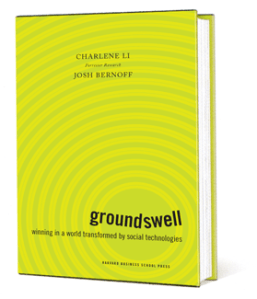
But Groundswell by Li and Bernoff helps cool that optimism to a more realistic pitch. Their Social Technographic Profile lets you pick a demographic and get a hint of how they interact with social media. And what you’ll see is that most people are spectators, independent of demographic profile. Most of us watch. From the sidelines. Which surprises no one: take any organization and you’ll find most people watching.
 The lesson is not to despair of our tendency to be spectators. The lesson is to find and create an irresistible magnetic pull around the things that are most important.
The stakes are much higher for getting and retaining attention.
###
Schwarzenegger, Total Recall and the Offspring of Error
How does sharing mistakes affect our relationships?

Sharing can be painful
Today’s shocking revelation takes the form of a ten year old child as part of the reason for Arnold’s impending divorce. It seems the Governator worked a bit too closely with the hired help. Not that the child is at fault—and I fear for the child’s unwanted celebrity status. And this: divorce and broken relationships are not good and no child should be hidden. But there are lessons to learn.
Recently in our Social Media Marketing class we discussed how sharing failure draws readers toward us. Failing at preparing a particular facial mask, for instance helps us sympathize with the beauty enthusiast. Negative reviews at a website help offset glowing reviews and hint that the positive reviews might not just be cherry-picked. Poised to buy some spendy item, we look closely at the negatives to balance the positives. On a personal level, sharing our failures has a way of redeeming our relationships and drawing others toward us, though who knows what that might look like for Mr. Schwarzenegger and Ms. Shriver.
One of the underlying themes as we move toward this social sharing world is that companies no longer control the monologue because the monologue is now a dialogue, whether they like it or not. Letting go of control will mean less pleasant communication about our product or service will certainly surface. The question becomes how we deal with those negatives. We won’t be able to play Terminator. Instead we’ll need to share our true lies.
###
How Could this Book be More Interesting?
I’m about to go fishing with my Listentalk book proposal (via www.ChristianManuscriptSubmissions.com). How could I make the summary (below) more interesting? Be honest. People respond to these posts by email, on Facebook and occasionally right here at “Engage.” Vent your spleen. I’m listening.
 Listentalk: How Simple Conversation Changes Your Life Every Day
Why does one conversation make you scan the room for escape while the next sends you breathless to register to run a marathon—though you hate exercise? Listentalk: How Simple Conversation Changes Your Life Every Day shows how humble, mundane conversations have the power to turn our life direction every single day, by:
- Reminding us of the pivotal conversations that have shaped and sculpted our own lives. Like the chance comment to your 18-year-old-self from an acquaintance about a “school you should check out,” which sent you a direction that ended in law school, marriage and being appointed as a judge (true story).
- Showing how God purposefully composed the human condition so that while we are limited, we are limited together. Conversation has a way of bumping out our human limitations in extraordinary ways, so that my lack of understanding leads to a discussion that sheds light on a key topic but also opens an opportunity to pursue the work I love.
- Exposing the component parts of listening and talking so we can better understand how God speaks to and through us
- Providing practical insights into how we can listen and speak for powerful good every single day—including wise use of social media
Today’s incendiary and vitriolic talk leaves people feeling weary and soiled. Listentalk refreshes Christian adults, Sunday School classes, small groups and college students by reminding them of the wonder, curiosity and serendipity that have been part of the deep verbal connections that have shaped their lives. These deep connections have often sprung from the unlikeliest of mundane conversations.
Listentalk tells stories of conversations that both suggest and model an extraordinary set of expectations and outcomes for ordinary talk. Listentalk helps people see verbal, visual and other-sensory conversational episodes as the powerful shaping tools they are—and provides suggestions for making them even more powerful. Unlike possibility-thinking, self-help books, Listentalk is grounded in the nature and actions of the conversing God of the Bible who expected and realized world-changing outcomes from each conversational episode. Listentalk frees readers to see daily conversation in a very different light by inviting readers to reach out in trust to each day’s conversational partners—an ever-expanding set of partners due to changing attitudes (about communication, authority and the loss of gatekeepers) and developing technologies.
Listentalk offers a primer on navigating the growing social media space as redeemed conversational partners. Creating communities of target audiences is the new marketing strategy. Leading public conversations by reaching out with dialogue that gifts and blesses is not only supremely Christian, but supremely strategic.
###

 conversation is an engine