Archive for the ‘Dumb Sketch’ Category
In Praise of Doing Things Badly
Rough draft as collaboration tool
I keep talking about rough drafts and dumb sketches. That’s because providing something when expectations are low is such a great way to share ideas. It’s a way to tell ourselves what we are thinking. It also a way to tell others what we might think together. But with the pressure off.
It’s also a great way to learn.
Some may say, “What? That guy needs a rough draft? What a chump!”
While it is true I am a chump, it is also true that presenting a rough draft—sometimes just the stub of an idea—can have an electrical, clarifying, vivifying power to move you forward. This idea, laid bare in all its clumsy, awkward glory, may just be the beginning of something important. Something even that holds your imagination for a year or five.
The rough draft laying there—all vulnerable and wrong—brings out the best in those who look on. Often evoking pity rather than harsh, fluorescent critique. And that makes for a great conversation.
What will you do badly today and share as a rough draft with a colleague?
###
Image credit: Kirk Livingston
“6 things I learned after drawing 319 drawings in 4 months and 13 days”
Especially #6. Buy Why Does #2 Work?
I follow One Drawing Daily in my attempts to produce my own Dumb Sketch Daily. But whether you’ve made it a point to draw or paint or sketch or shoot photos (or write essays or verse or reflections) there are some curious things about developing and sharing daily habits.

Read One Drawing Daily’s whole post (please!) but I’m particularly interested in #6: “Draw whatever you feel like.” Much of art—like much of life—seems to be about absorbing the sensibilities of the taste-makers among us. Critics, media, famous artists. Famous people who are famous for being famous. There is a subtle pressure to like what they like and do what they do. But uniformity is not the great thing about the human condition. One of the great things about the human condition is that we all have a slightly different take on things. I love seeing different people’s perspectives. And developing your own perspective takes time and attention. But out of the habit of time and attention come a point of view.
And #2 still enthralls me: “Share everything you do!” How is it that the simple act of sharing something can have so much impact? It’s true with writing, true with making dumb sketches. It’s true with our ordinary conversations and when we confess some secret to someone else. It’s true with my clients: as they come to understand the power of sharing expertise and passion, all sorts of things start to happen in their business. It’s still shrouded in mystery for me, this sharing thing, but I’m pretty sure it triggers something in us that simultaneously wakes us up and fine-tunes consciousness.
What habits are you building?
###
Image credit: One Drawing Daily
Here’s the Story of a Man Named Quady
Who was living with three alloys of his own
Yesterday I met Quady* for coffee. I was impressed all over again by the executive function of his brain: how he seems to effortlessly order complicated systems and businesses and talented people and even his own life. Quady** told me how he was weaving consulting with business acumen with creativity. I could not help but be impressed with the forward motion the guy exuded.

…and here’s the dumb sketch you ordered.
In fact, it was about ten years ago I met Quady at (yet) another Dunn Brothers on another side of Minneapolis to talk about how he grew the business he was running at that time. He was president of a firm that placed creative people in creative positions and his firm was on fire (that is, busy). At the time he gave me some solid advice which I resisted for years until embracing it fully: make a daily/weekly habit of reaching out to make contact with varieties of people.
And listen to them.
These days Quady is weaving together a consulting life that draws on his outsized executive function and his creativity plus a desire to walk alongside people. He’s a kind of CEO-for-hire and he’s currently working some high-level gigs. It’s the melding of these three threads that seems to open doors for him: the organizing gene plus the creative gene plus the people-smarts gene. Because he understands the moving parts of business, he can give solid, real-world advice to people. He gives the kind of advice that encourages from some deep place: the sort of advice like,
“Look. You’ve got this. It’s a stretch, but you can do it.”
And who doesn’t want to hear that?
###
Dumb sketch: Kirkistan
*Not his real name.
**His real name was Markothy.
Own Your Process
Ownership Sparks Creativity in Art & Work & Life
One key differentiator between working for the man (every night and day) and working for yourself is ownership. Working for yourself you own the beginning, the middle, and the outcome.
Especially the outcome.
Some of my favorite colleagues over the years—the very ones who advanced in whatever they worked at—found ways to own the process. These were the ones not content to follow orders. Instead they made the work their own, found their own way, employed their skill and imagination. I’ll argue that owning the work sparked their creativity to accomplish the task. And I’ll argue that ownership looked like responsibility for the outcome. So despite working for the man, they took ownership, made their own meaning and became, well, the man.
Over at Dumb Sketch Daily I’ve been producing a dumb sketch every day for the last 39 days. I was sorta proud of this dumb sketch:

Then a commenter suggested abstracting it, which I tried, given my limited art understanding and abilities (here):
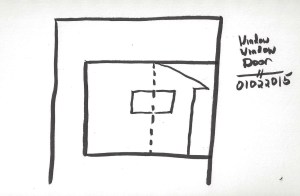
You can see the result is…simple. But it is my own (not that anyone is lining up to take credit). The commenter’s comment helped me continue my odyssey toward learning to see.
My only point is that developing new skills requires a certain elasticity. We try new stuff and get it wrong again and again and again. And we keep failing until maybe, one fine day, it turns out sorta OK.
A lot happens when we take ownership for developing our own skills. And a lot of good can come from taking responsibility for our client/boss/friend’s desired outcome.
###
Image credit: Kirk Livingston
Not Resolutions: New Year’s Experiments
What will you try next?
Another way to approach the beginning of the year.
Science constantly tries to rid experiments of bias and prejudice. Medical researchers set up double-blind, randomized studies in an attempt to remove personal bias and to avoid the temptation to game the results according to how we want to see them. Bias always and forever creeps in—it is part and parcel of the human condition.
But what if, instead of looking for work-arounds for our basic subjectivity, we embraced our very human bias and used it to move forward? Not so much in science experiments and medical trials, but in our personal lives?
A theologian tweeted the other day about the lack of research and experiments in theological studies. He was right, in theological research you do not see big multi-center clinical trials running across the country. Partly because pharmaceutical companies are not lining up to fund such studies. And when they do, we’ll have an entirely new class of worries about drug-induced faith.
But, in fact, we each experiment constantly. Each of us in our own way. We experiment with ways of living. We experiment with belief systems: trying this or that to solve those deep questions. We allow ourselves to be deeply affected by what our friends, family, colleagues and neighbors believe. These experiments are a simple fact of how the human condition works. We game the system all the time and it works.
Or not (and even then, we know something new).
Some of us make resolutions this time of year. Others of us try to set direction (versus resolutions) for the year in an attempt to avoid the dismal reality of resolutions quickly broken.
But how about running your own set of experiments this year?
My friend suffers acute anxiety. It’s not a clinical condition, just solid worry as a way of life. She would like to not be such a worrier. My suggestion was an experiment in trust. Pick up nearly any of the poems by the poet-king and simply do what he did. In plain, persistent, passionate language, exclaim and define with agonizing precision the current situation and ask for release. Or help. Or mercy. The poet-king talked frankly to God—which seems like a solid experimental idea for any of us.
Experimenting with our dissatisfactions is not that bad an idea. Last year I tried to write a novel in a month (National Novel Writing Month) and I tried to make a sketch a day. Both attempts were wildly unsuccessful. But as experiments they announced solid directions by the end: write more fiction and keep practicing drawing. Last year I also experimented with following the poet-king’s example. My subjective results were mixed and positive and pointed in a direction: more trust. And more gratitude.
What subjective experiments will you run this year on your guinea-pig self?
###
Image credit: Kirk Livingston
Suhita Shirodkar: Sketching The Everyday
Seeing for the first time again
I’ve made a dumb sketch every day so far in December. Maybe I’ll continue the discipline through 2015. My hope is that these dumb sketches progress from “negative” to at least “0”: from “dumb sketch” to just “sketch.” But if nothing else, sketching provides a few moments of seeing things in a different way. I am inspired by the work of OneDrawingDaily (a regular commenter and daily sketcher). I am also inspired by the work of Suhita Shirodkar, a sketcher in San Jose, CA.:

Sketching the everyday makes me look at it closely and appreciate it more than I otherwise would.
Lots more little everyday sketches here on flickr,
–Suhita Shirodkar
A sketch catches something different from a photo.
###
What skill will you grow in 2015?
I write and I want to draw and take photos. And write.
I’ve been trying to sketch lately. My son and I started a blog called Dumb Sketch December where we try to produce one sketch a day (inspired by OneDrawingDaily). I enjoy sketching more and more and I am less and less happy with the results. Unlike writing where I have a growing sense of being able to say what I need to say, sketching seems to have plateaued at capturing very little of real life.
I’m at the point where I don’t even know what I don’t even know.
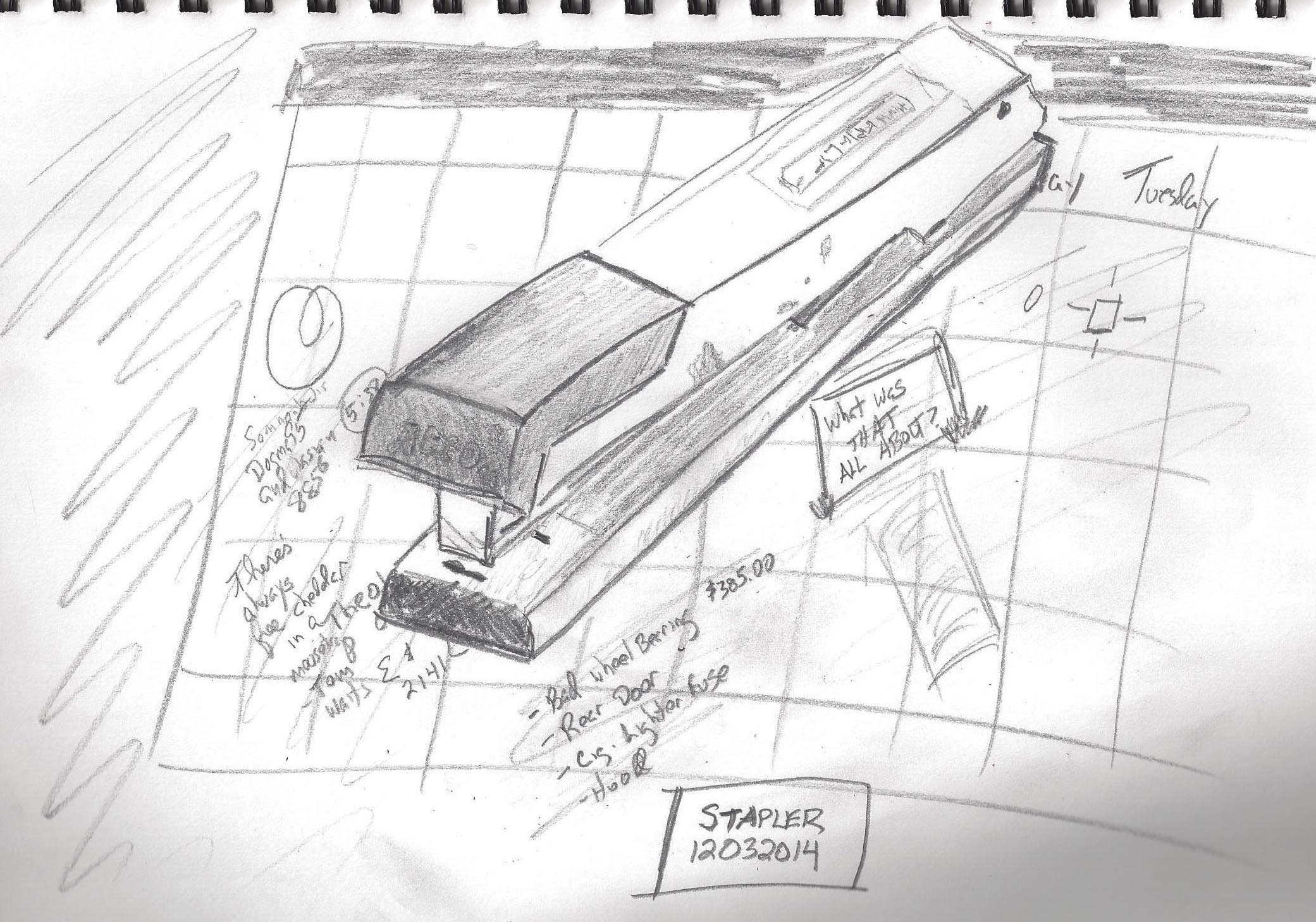
My stapler rocks. My people don’t.
Other kindly sketchers and drawists chime in with encouragements like “Keep going!” and “Huh.” Of course, I’m committed to the dumb sketch approach to life, and I can find a bit of joy in a well-capture shoulder, or when I drew something very similar to that woman’s posture or her pony-tail. I am increasingly drawn to the very black carbon laid down to hint at a clear edge. I’m trying to take lessons from Edward Hopper, though I think he would have given up on me long ago:
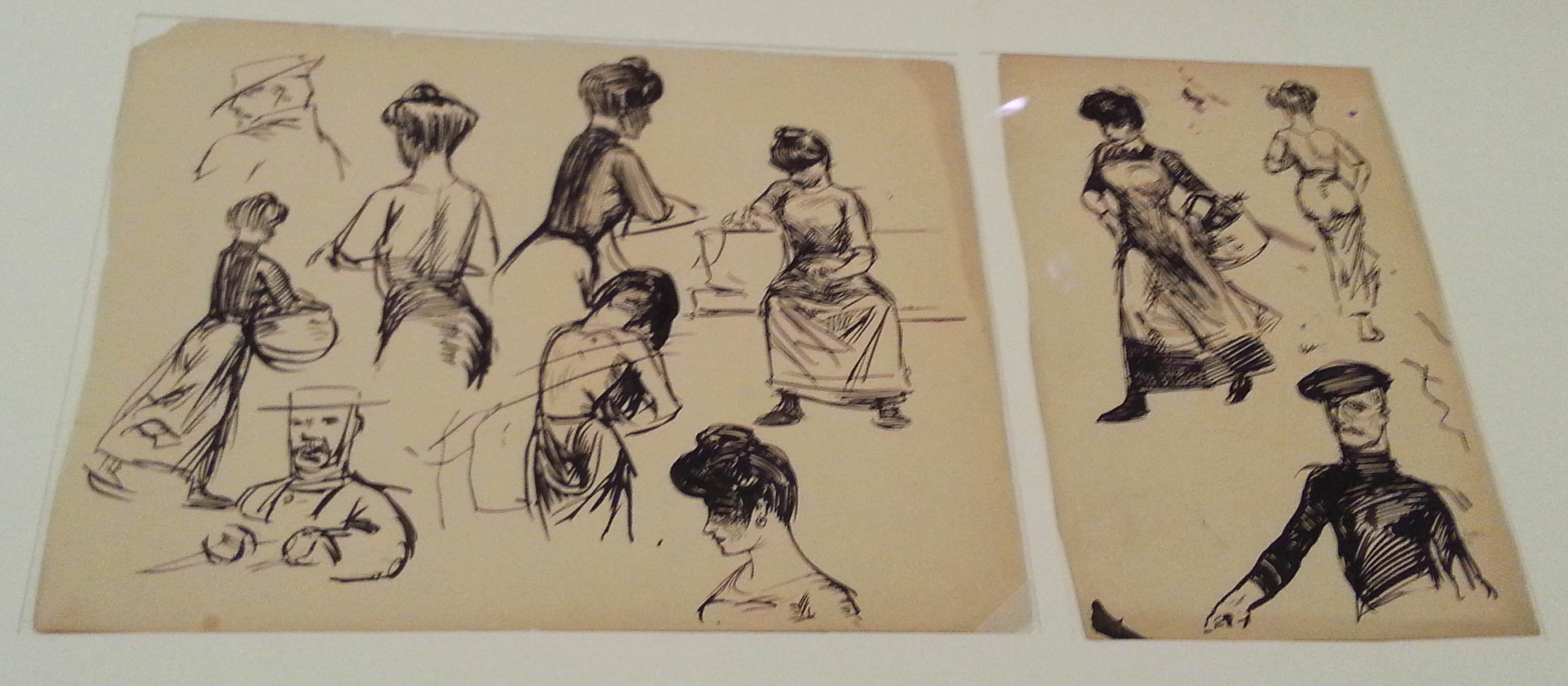
I think we can guess what fascinated Edward Hopper.
But all this to wonder aloud at skill-building. There is something about the intentional action—committed in public—that has a way of squeezing us forward. NaNoWriMo used that force, our more successful diets use that force, weddings are a celebration of the force of intentional actions publicly committed.
What skill do you want to grow in 2015?
How will you make it public so we all can take courage from your actions?
###
Kirk Livingston, Edward Hopper via The Walker Art Center
That moment when you only want to say truth
Come, blessed ignorance.
Early in my writing life I let on that I knew more than I actually did.
You did too. We all did. We all do.
It’s part of the human condition: the word or name dropped, the subtle nod that hints we are in the know,
“…and, yes—please—carry on…certainly I get it.”
Whatever it takes to not appear stupid.
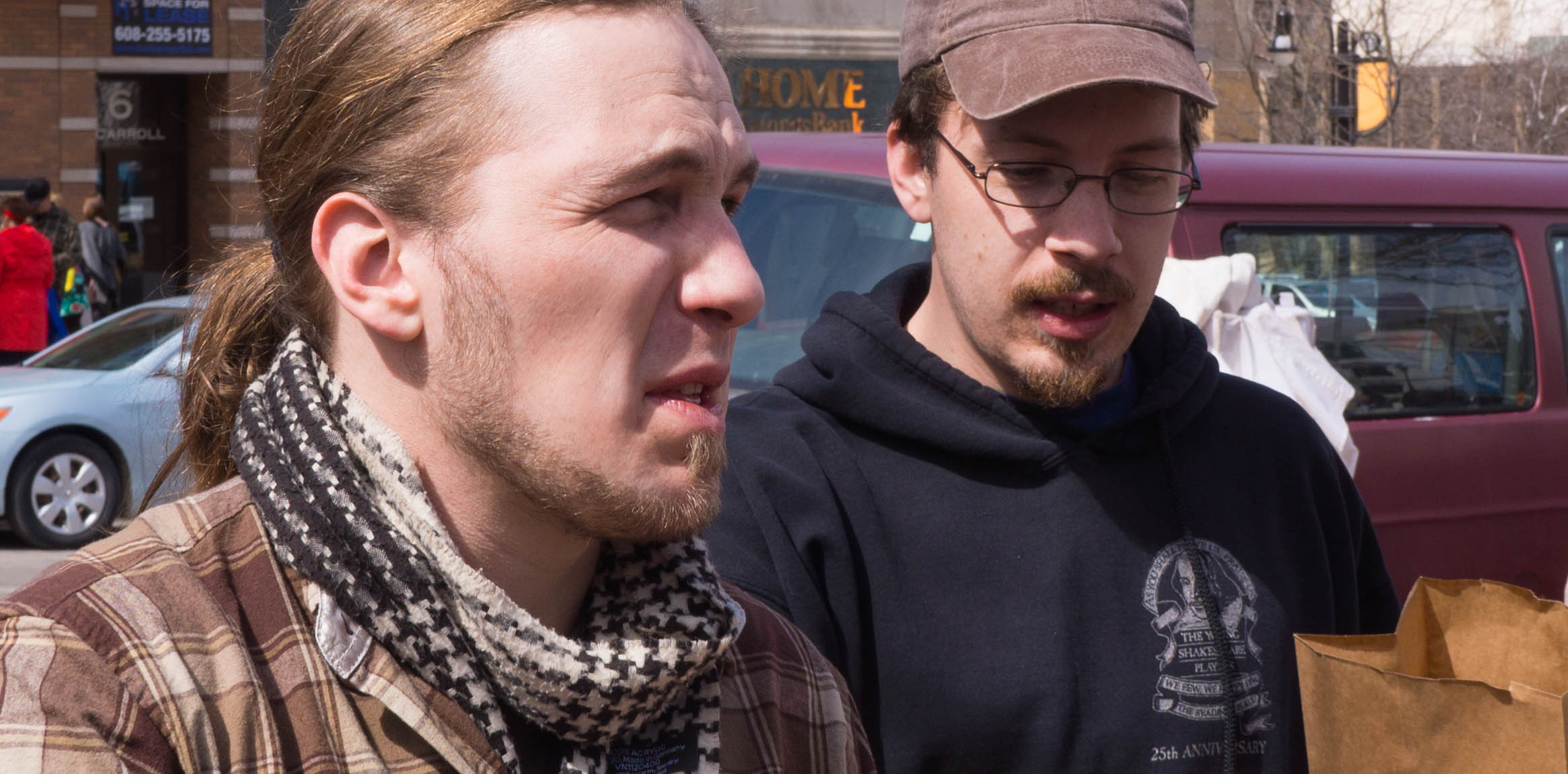
I tried to impress Madison’s potato vendors with my potato knowledge. I failed.
I learned this subterfuge early in life: laughing at my big brothers’ jokes and then stopping by the dictionary later to sort that word they used. Thankfully, there was no Urban Dictionary back then.
I squandered educational opportunities by pretending to know. Maybe my early undergrad years were perfectly set up to encourage the ignorant to remain so—and I jumped into that. It wasn’t until later in school that I went for broke and displayed my ignorance. That’s when I started learning.
One benefit of writing copy for a living is you get to ask the stupidest, most ridiculous questions. Questions to which everyone in the room obviously knows the answer. And actually that is when the fun begins, because the answers that pour forth are often strikingly dissimilar and uniformly telling, in that everyone has a different expression (and possibly a different idea) of this commonplace.
At some point stupid questions become a way of life: after you realize you’ll learn a whole lot more if you just admit you don’t know something. It turns out there’s really not that much to lose. Maybe you lose face with the boss. If so, your boss probably wasn’t that great. Maybe you gum up some well-greased process. If so, your question from the edge may actually open new ways forward.
The benefits of ignorance realized are immense:
- The dumb questions is a verbal mark in the sand. And on the other side of that mark you get to actually start learning.
- It is highly likely others have the same ignorance. You do everyone a favor by asking your question.
- Asking the dumb question often unearths brand new, productive ways of looking at something.
Please—for the sake of humanity—ask your stupid question today.
Do us all a favor.
###
Image credit: Kirk Livingston
#NaNoWriMo Update: Twin Cities—15 Million+ Words in 15 days
24449 are mine
Nobody claims their words are any good—just to be clear. It’s all quantity over quality—so take that, Mr. Internal Editor. Anyway, that is the whole point of National Novel Writing Month.
I will say an unexpected suicide started the whole thing and now I think I see resurrection on the horizon. Loyalty and romance have turned up, plush a flash of skin and a skinny guy unafraid to take two jelly-filled donuts even with everyone watching. My main character is a strong, passionate woman who can make a CEO bite his lower lip–oh, and she’s been dead for at least a week. Did I mention the oracle named Franklin Delano Sjogren? I’d like to get a coffee with this guy and ask him my most vexing questions. My hometown of Stoughton, Wisconsin took a hit sadly. City fathers will not be pleased.

As always, I have no clue how (if?) this will all wrap up. But for now I’m rooting for a couple characters as I move toward 25000 before midnight. But I sense danger.
Does this count as working out loud?
###
Image credit: National Novel Writing Month

 conversation is an engine