Archive for the ‘Dumb Sketch’ Category
Should You Make Your Boss Cry?
Just draw me a picture
In a conversation yesterday my new friend self-identified as one who enjoys the “messy work” of helping groups get on the same page. To that I say: may her tribe grow. Because that is messy work indeed—fraught with bruised egos, sullen colleagues and cross-purposed tasks.
I maintain there is a fair amount of artistry involved in helping a group begin to move forward. Those who help others catch a vision for a project or cause have a knack for painting pictures. These pictures help team-mates understand just what is at stake. Those pictures may be dumb sketches or verbal images. The word “picture” here is important because an image conveys emotive content often missing with words alone. Without the emotive content of a picture, we are back to just using our intellect. And intellect only carries us so far. We can know the reasons behind a purpose, walk through spreadsheets and examine data without ever getting our emotive selves involved.

For many of us, real meaning has an emotional nexus. Pushing forward together springs quite naturally from that place where reason and care have linked arms.
The picture my new friend painted drew people from different business units in her organization—each armed with very different purposes and possibly their own rhetorical axes to grind—into a shared objective. The painting of the picture and telling of the story helped gradually align those cross-purposes.
What pictures are you sculpting for those around you today?
###
Image credit: Kirk Livingston
Obviously.
To spell out the obvious is often to call it into question.
–Eric Hoffer

Though “obviously” can never be rehabilitated.
###
Image credit: Kirk Livingston
Tip #9: Launch Your Idea. Don’t Detail It.
We all repackage our stories for the best effect
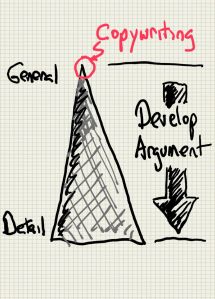
Writing copy can be disorienting—especially for English majors. Rather than grading on how they develop an argument and how well they follow particular usage rules, they are graded on how well their copy meets a marketing need. They are graded on how well their creativity pulls in the target audience—and how quickly. Each exercise and assignment becomes more about the big idea and the execution of the idea rather telling all the detail in an orderly fashion.
 It can be disorienting because we might have mistakenly thought copy was just emotional marketing hype, the (nearly invisible) stuff that abides in much of our current messaging (“clutter,” you might say). Copywriters just toss any word in an ad, like “new” or “organic” or “protein” to get people to buy in, right?
But copywriting is more like a lab where you boil down the raw material to get an essence. Then you adjust the pheromones in that essence to get the behavior you want in the audience you seek.
Wait—that sounds manipulative.
If it is, it is a common trait and practice shared by all humans. We’re all packaging and repackaging our stories in real time. We constantly change-up our experience and knowledge and opinions as we deliver them to friends and family, prospective mates, acquaintances and strangers. It’s not a purposeful misleading, it’s just that the human condition is constantly changing and we see things differently at any given point. And we all want to be heard, so we change how we say things.
Mind you—orderly telling is still critical for copywriting. But audiences don’t make time for essays (sadly). And developing an argument is still critically important—it’s all just very, very fast.
The key is getting—and holding—attention.
Eight other copywriting tips for English majors here.
###
Image credit: Dumb sketch by Kirk Livingston
Boss: With this ping, I have now pled
Think Globally. Act Tactically.
Sometimes we just do our job.
Sometimes we think bigger thoughts and help our boss sort out what next—long before being asked.
I maintain our best work comes from that place where we think strategically and act tactically. Our best work comes from big thinking harnessed to this moment’s need.
Today in our copywriting class we talk about relationships with clients. My line on this is to cherish, honor and protect your client—which starts to sound like a marriage—not quite the right analogy.
Then again, maybe it isn’t far off.
Clients are people who trust us to handle their message. They’ve hired us to do something they cannot do. This is a privilege. Our favorite clients know the best work comes from well-articulated need and parameters followed by the freedom to go and do. And sometimes our clients depend on us to help articulate those needs and define those parameters—simply because we get very close to the need.
This is where the copywriter’s outside perspective helps immensely. It’s also where we deploy our skill of listening into the deep waters of what our client eats/sleeps/breathes/knows. Because sometimes what seemed like only tactical work can turn into an opportunity even the client didn’t realize was before them. And we need to say so.
Such is the opportunity with collaborative teamwork and trusting work relationships. And that’s why it is important copywriters always think Grande or even Venti rather than Short.
Here’s to clients! (Jaunty raising of the ice water glass)
Long may they…, well. Hire.
###
Edward Hopper: How to Talk to Yourself
Can a conversation result in art?
The answer can only be “Yes!”
Not every conversation, mind you. But some will.
Last weekend Mrs. Kirkistan and I (plus our art-student daughter) wended our way through the sketches and drawings by Edward Hopper currently on display at the Walker. As a nation we’re quite familiar with Mr. Hopper’s drawings and paintings—today they seem perfectly obvious explanations of life in America. But I was intrigued by how he got there. What was his process for producing such enduring images? How did he see what he saw?
His sketches look like conversations with himself. Look how he developed the frame for his (well-beloved, much parodied) Nighthawks at the Diner. His sketches add layer to nuance to layer. It’s almost as if he were explaining something to himself with one approximation and then another and then another. Sort of like conversations with our best friend where we allow each other to say it wrong even as we pursue saying it right.
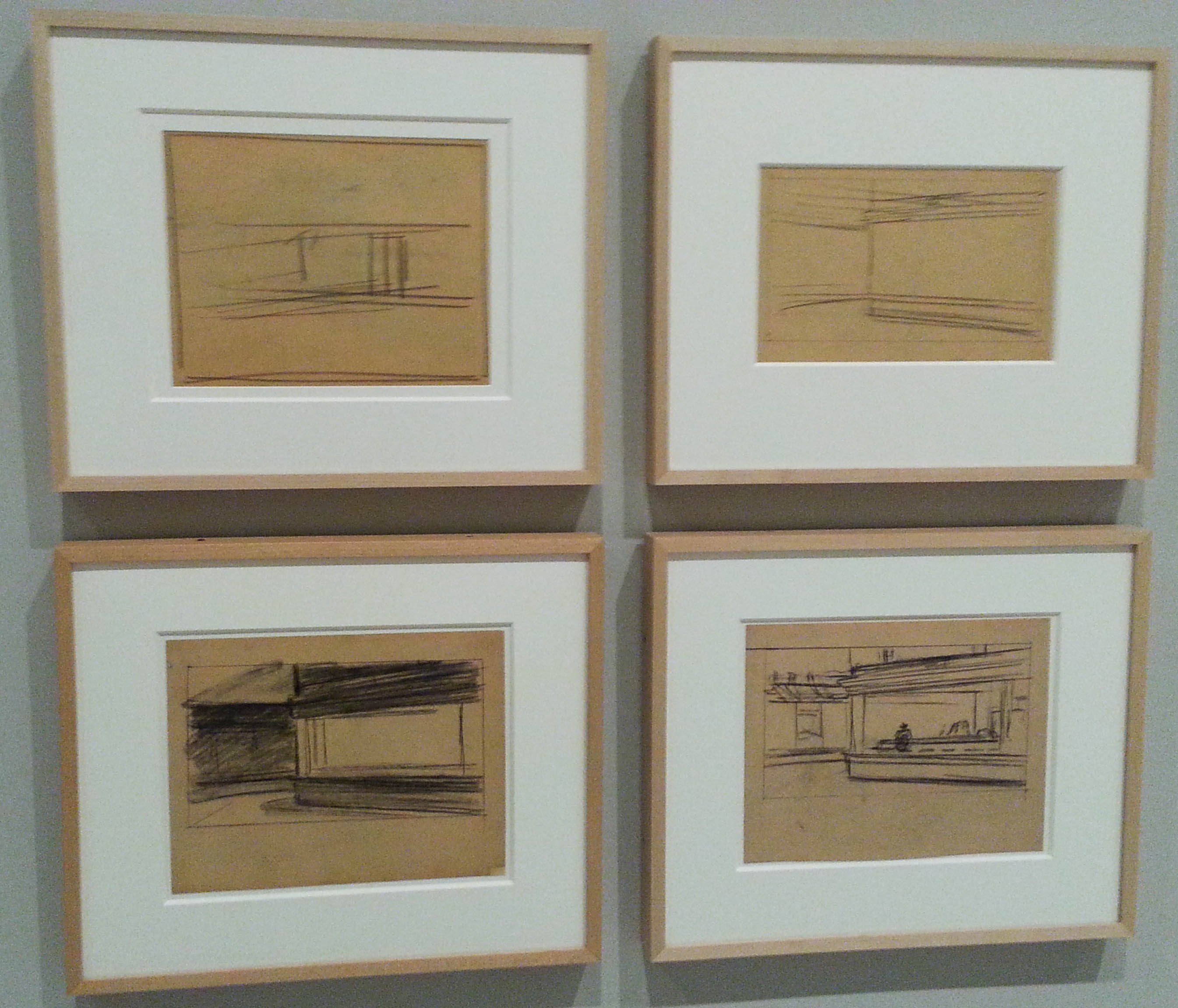
Hopper was a man given to observation and keen on interpreting detail. With quick strokes he captured form and mood and motion. And there’s no question he had an eye for the ladies:
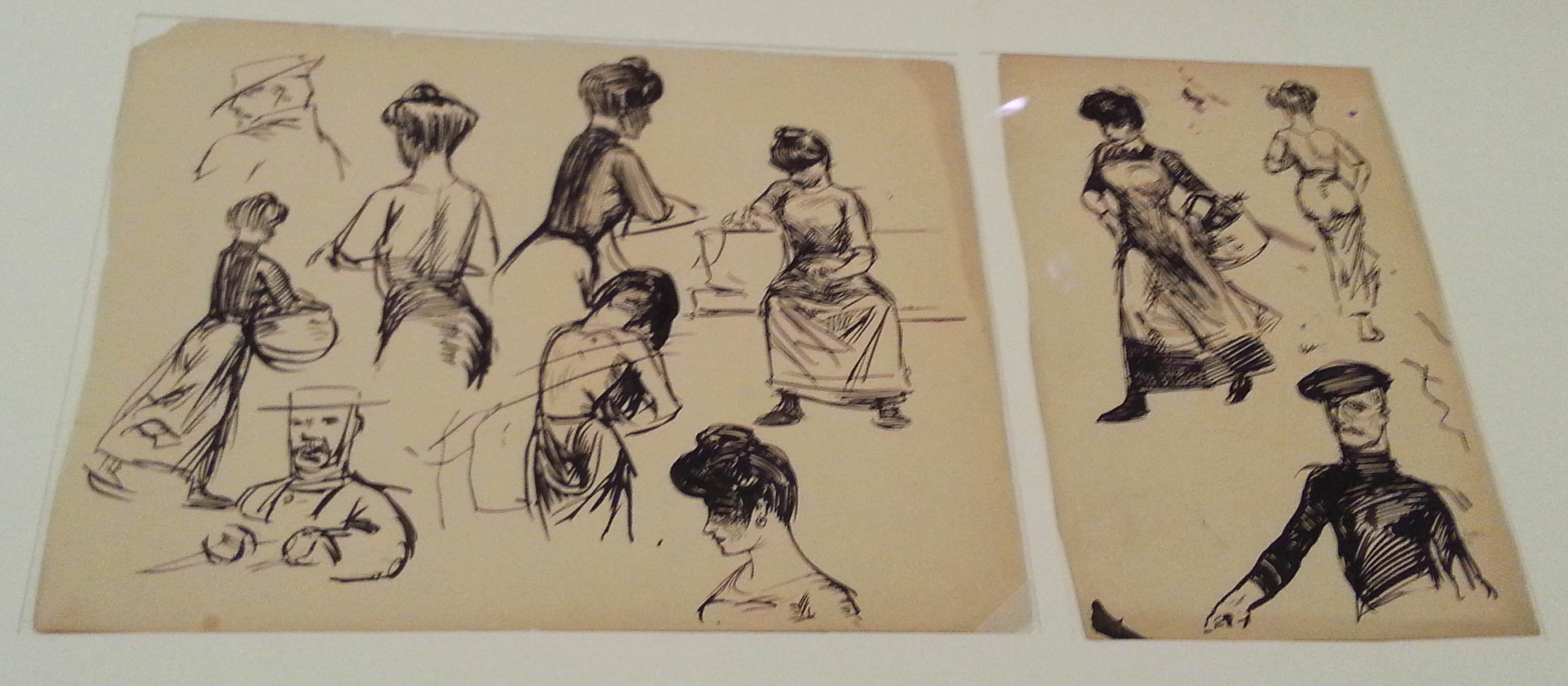
Hopper seemed to never stop observing and capturing. Again and again and again. He spent hours sitting at favorite locations and sketching and perhaps waiting. This quote from Mr. Hopper hints at his process:
My aim in painting is always, using nature as the medium, to try to project upon canvas my most intimate reaction to the subject as it appears when I like it most….
I’ve been a fan of sketches for some time because they give a behind-the-scenes picture into how someone’s mind works. The Hopper exhibit at the Walker does not disappoint. And I cannot help but think how sketches provide such a rich analog to our collaborative conversations.
###
Image credit: Kirk Livingston photos taken at Edward Hopper exhibit, Walker Art Center
“Nothing Cheers Me…Like a Great Pair of Ears”
I like reading blogs because…detail
In regular life you might never hear the word combinations that people reveal in blogs. Bloggers can answer questions you’d never dream to ask—and suddenly you are enriched by some comment outta nowhere.
Like this quote (above) from Roz Wound Up.
I recently started following Roz Wound Up, a Minneapolis artist/sketcher/writer (designer/illustrator/teacher at the Minnesota Center for Book Arts) because of the detail she includes about how she practices her craft. A few days back she wrote a fascinating post about the ethics of sketching people in public. Hint: wear a large duck-billed hat so people cannot see your eyes. Today’s delightful post fixates on ears:
I’ve been watching tattoo shows again—Best Ink is the one that’s on right now. It was late, the day had been a complete wash up. Then this kid was standing there being judged on the show and I simple fell in love with his ears.
Read any of her posts and you’ll find in yourself a growing affection for pens and paper and seeing. Specifically:
- Pentel Pocket Brush Pen
- Fabriano Tiziano (8.5 x 11 inch sheet of cream)
- And this: the way the pen feels going across the paper. Especially that.
I once thought a pen was a pen and paper was just something you grabbed from the drawer on the copier (and money’s just something you throw off the back of a train—thanks for sticking that in my brain, Tom Waits).
No longer. Sketching is a sensual art. Maybe seeing is too. The focus of Roz Wound Up has piqued my interest. And with the little sketching I’ve done I’ve started to have a sense of the way my pencil graphite feels across the fine tooth surface of my sketch pad. Now seeing has a sensual element—it’s something I do with a pencil and paper in hand.
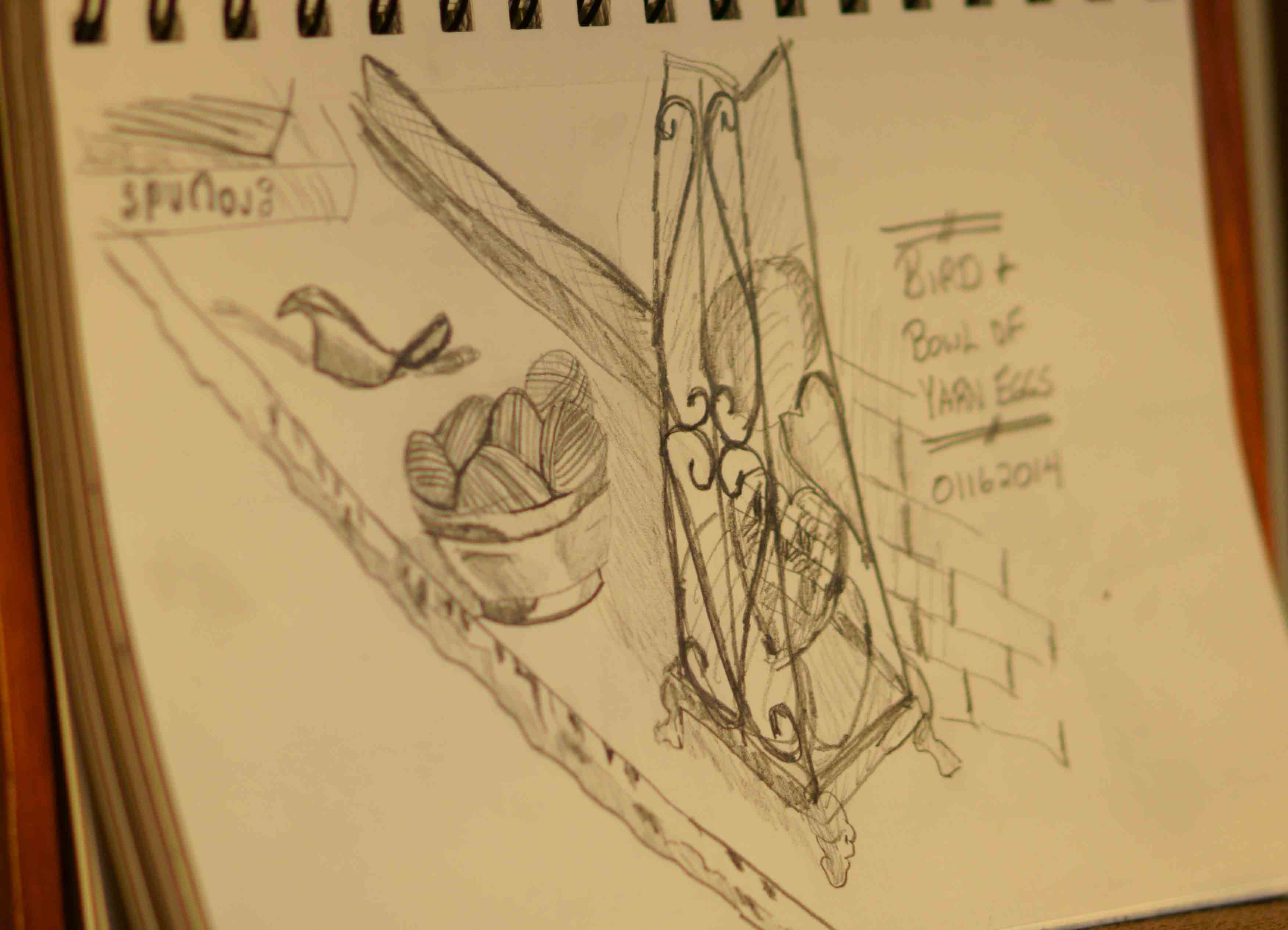
Seeing rocks. I hope to do more of it.
###
Image credit: Roz Wound Up, Kirk Livingston
First Boule
A conversation between flour, water, yeast and salt. At 450 degrees F.

I think I’m going to like Artisan Bread in Five Minutes a Day (Hertzberg & Francois)
###
Image Credit: Kirk Livingston
A better way to set goals
1000 words: from goal to discipline
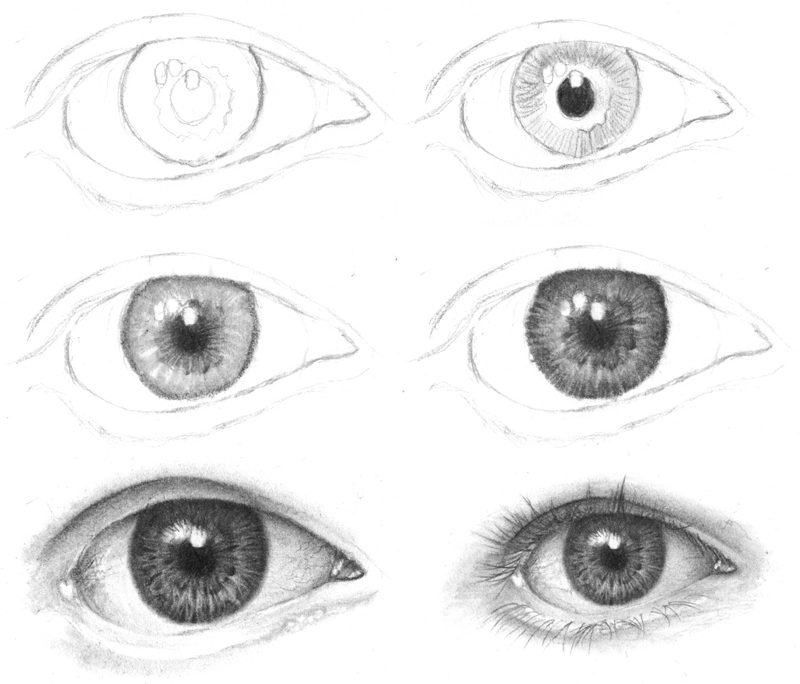
Revisit and add detail as you go forward
Mrs. Kirkistan and I talked up goal-setting with our good friends over New Year’s Eve. Goals get a bad rap these days and I know why.
Looking back at my 2013 goals, I see they were too ambitious and without proper milestones. Even so, they served as directionals that propelled me forward as I revisited them over the course of the year. Mrs. Kirkistan and I will take an hour or so and talk through and pray through our goals before the weekend. Then I’ll post them on the back of the door into Suite 102 of the Livingston Communication Tower (high over Saint Paul).
As I labor to expand and then trim back my personal, business and spiritual goals, I realize more than ever this is not a static process. Much like the sketch above, I’m sort of blocking out broader desires and expectations while adding in definite dates and details for only a select few. But some of these goals fit better as disciplines than goals with timelines attached. For instance, the discipline of writing 1000 words a day has served me well over the past few years (thank goodness I never stipulated they had to “good” words—that kind of pressure would gum the works). That goal has turned to a discipline, which is great—the day feels wasted if I’ve not written 1000.
I have a goal of publishing ListenTalk: Conversation is an Engine early this year (that’s right, Juxtapose: How to Build a Church that Counters Culture is back to the original title, for those who follow such things), and I have a few milestones with dates attached to help make that happen. Last year’s goal helped me finish the book and get it to and back from an editor, though I severely underestimated how much time it would all take.
But some things just work better as disciplines, like ongoing exercise and the daily ground-breaking conversations with colleagues and potential collaborators.
How does goal-setting work for you? Rather than give up on goals because they are too hard, is there some useful piece you can take and make work for you?
By The Way: Check out this meditation on goals from The Pietist Schoolman: I like his challenge to focus out, rather than just in, on personal goals.
###
Image credit: changethethought.com via 2headedsnake

 conversation is an engine
