Archive for the ‘making mistakes’ Category
Please Read Dave Eggers: The Circle
In a world where everyone sees everything…
If you’ve ever wondered where complete transparency might lead—as I have—consider reading Dave Eggers’ excellent novel The Circle.
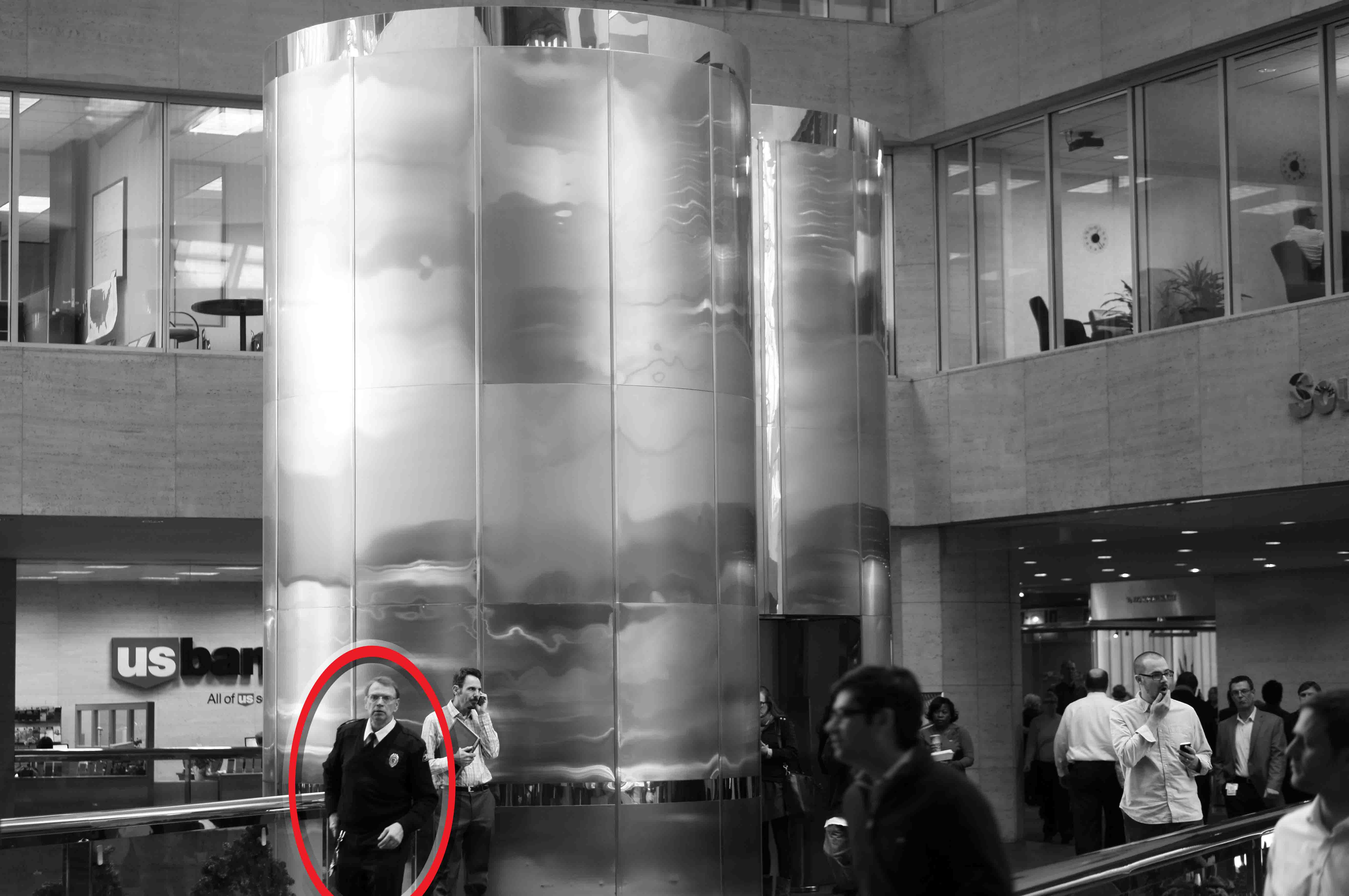
Don’t worry–no one’s watching.
Mr. Eggers has created a very comfortable world (for some) of deep collaboration, where everything is provided to those lucky enough to work for the Circle. The Circle, the corporation at the center of the story, looks more than a bit like our most celebrated high-tech companies brimming with smarts, cash and outsized ambition. Think Google or Apple or what Microsoft once was—and then add in a cast of characters each with an overweening and boundary-less high EQ—and you’ve got a world that is totally supportive—as long as you move in the same direction. The novel traces the story of Mae Holland as she “zings” (tweets) and “smiles” (likes) her way from outsider to the inner circle.
The story gets uncomfortable at times, especially when it shows the intent behind the use of social media and the social pressures applied. Especially when you start to recognize product placement on a very, very personal level.
Mr. Eggers has me rethinking my eagerness for employees up and down the corporate ladder to use their outside voice. I’ve been advocating, among my clients and when teaching Social Media Marketing, that helping employees reveal their work to interested outsiders is a move toward a new kind of marketing that looks less like selling and more like a conversation among interested parties. I still think that is a good move, but Mr. Eggers has explored the boundaries of that notion, and it is a bit, well, totalitarian.
I will consider using The Circle as a supplemental text for my next class on Social Media marketing. Well-written and consistently engaging, Mr. Eggers’ book is well worth your time.
###
Image Credit: Kirk Livingston, just before a recitation of photography rules within a non-public space
Planning for Moments Vs. Mapping a Strategy
The 5-year plan is dead. Long live the 5-year direction.
Once upon a time teams of corporate lackeys spent months writing strategies for one-, two-, and five-year plans. They smoked unfiltered Camels and crunched numbers and drank stale coffee to help guess about future sales, using only the flimsiest of data points. They produced thick binders full of prose and charts and graphs and tables of numbers that anticipated revenue and profit. It’s quite possible someone even read those binders. More likely: those in the C-suite who ordered it all just listened to the executive summary and nodded in agreement.
As one does.
 Those binders went on to live rich, full lives on sacred shelves. Silently wise and knowing. Until, over time, the strategies gradually got it wrong more often than getting it right (had anyone read them to notice). Predictions have never been a strong suit for ephemeral beings like humans. Especially today when technology seems to refresh every few months—complete with a new set of expectations and parameters. Especially as the economy rises and falls like sea swells.
Where does that leave strategy today? It is impossible to see into the future so we got good at guessing. And we told ourselves to make the future the way we wanted it—as best we can. To step toward the future we’d like and maybe that future will meet us halfway.
Today there are far fewer teams guessing what will happen in five years. But those organizations doing well have taken the forward-looking aspect of planning and planted it as a direction. Given our direction of travel, what moments may arise that we can take advantage of?
Today our smart friends are planning for moments that occur along the path they’ve penciled in. Everything subject to change, of course. But if all goes well: this is where we want to be.
Today we must plan for serendipity.
###
Image credit: Kirk Livingston
Turn Your Message Away.
What might happen if you spun your story outward?

###
Image Credit: Kirk Livingston
To My 19-Year-Old Self: Embrace the Timer
This Permission Tool Will Calm and Kick You
Look—I know you get all fidgety about the stuff you’ve got to do: the papers to write, the group projects to complete, the hours at work and the woman you’re trying to work up the nerve to ask out. Finals coming—have you even read the chapters? Plus all the pressure to assemble a plan for the rest of your life. Get on that! (Ha! Here’s a hint: your plans will scatter like water on a hot skillet. Again and again. But you still have to plan.)
That’s why I’m writing, lo from across these many decades.
Behold: the timer.
Like an egg timer only with more time and without the eggs.
The timer is a permission tool you can employ today. The timer will grant you focus and peace of mind. The timer will calm your fidgety, anxious self. The timer puts an end to the ridiculous argument that you can do several things at once. You may find this hard to believe, but in the decades to come people routinely kill others while driving and opt out of deep life-changing conversations because they “multitask” (big word in twenty years). Wacky, right?
Here’s how the timer works:
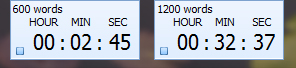
You’re not gonna believe the free stuff on this thing Al Gore invented called the “Internet.” Oh: buy Apple stock.
- Look at the big pile of stuff you’ve got to do.
- Pick the most important thing. Just one thing.
- Set the timer for 60 minutes.
- Start the timer.
- Do that one thing.
- Do that thing for 60 minutes. Don’t get coffee. Don’t talk to your roommates. Don’t daydream about that beautiful woman. Don’t stare out the window. Do the one thing.
- When the timer rings, get up and do all that other stuff.
- In fifteen minutes, pick the next thing, set the timer and repeat the process.
Sound simple? It is!
Listen, Mr. 19-year-old Kirkistan: this is how you are going to get stuff done for the rest of your life. Even enormous projects tremble when the timer shows up. Almost everything in life can be broken into manageable segments.
And this: You emerge a happier person when the timer goes off. Because you actually did something.
I think you have a timer on that big plastic watch of yours.
Try it.
Now.
###
Can A Question Trump A Script?
Don’t Prepare. Just Show Up. Improv Wisdom by Patricia Ryan Madson
A confession: it’s hard for me to break free from notes when speaking.
Maybe notes are a crutch. But I think there is more to it. I spend my days writing so I have an affection and affinity for words on pages. And this: there is specificity to writing that is not quite so available for speaking. It’s a specificity that allows me to work an idea and move the parts around even as I deliver that idea to my audience.
Speaking does not allow that.
Or so I thought.
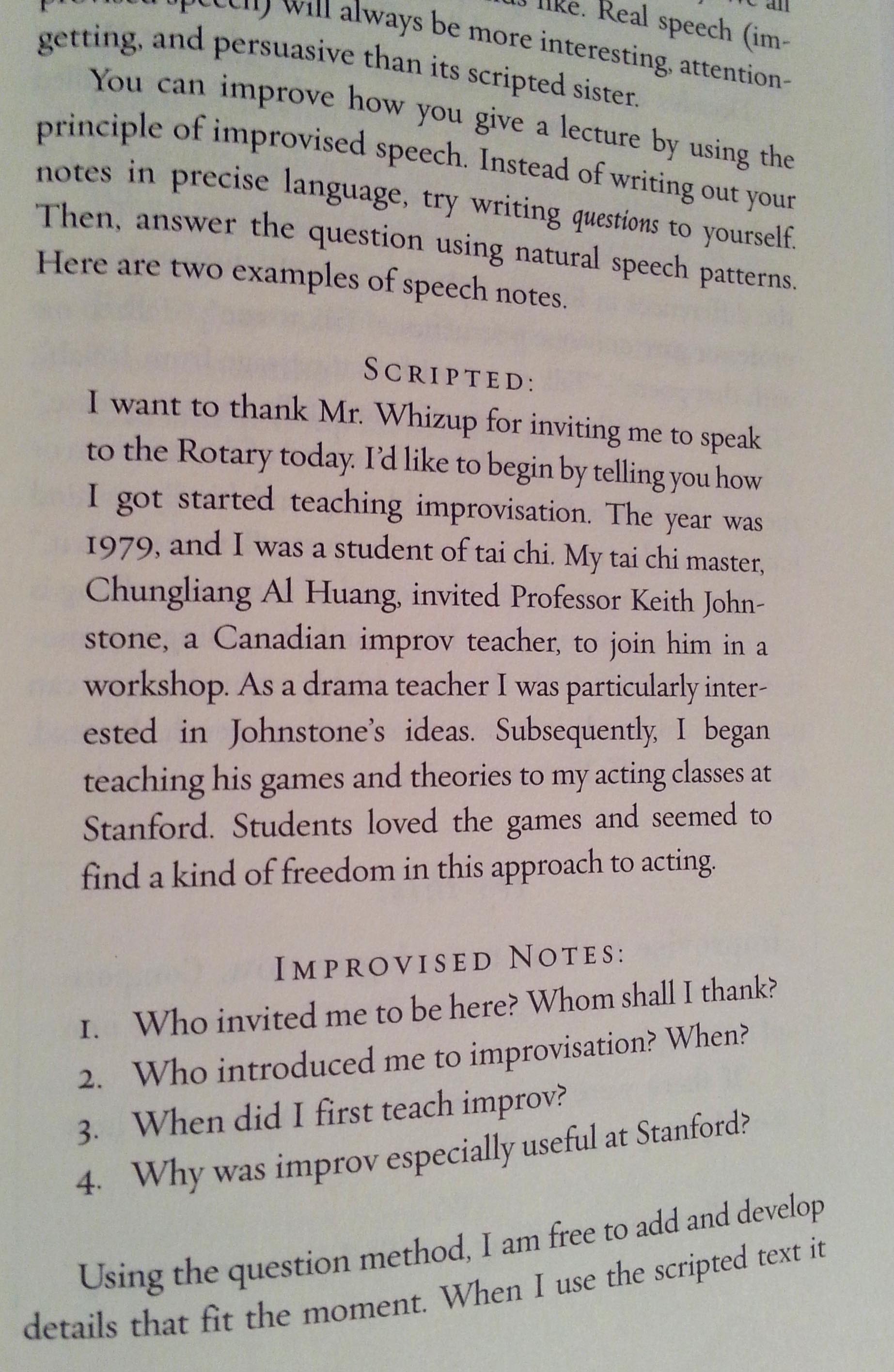
Patricia Ryan Madson’s Improv Wisdom is helping me see things differently. This well-written, easily digestible book (NY: Bell Tower, 2005) is full of all manner of notes about how to move off the page. In particular I’m struck by how Ms. Madson deftly turned scripted notes into an opportunity for spontaneity.  Check out the photo below, where she reformats scripted remarks into a series of prompts—questions—that result in something alive and conversational versus the usual bad voice-over quality that comes from reading a script.
The result of her work and approach is spot on with all we’re trying to do at Conversation is an Engine: live out loud with each other, mistakes and passions all available to each other as we show up. Day after day.
Here’s Ms. Madson speaking at Google (Authors@Google) on her notion of just showing up. I cannot help but notice that she put lots and lots of time preparing before she just showed up. Plus: I am completely taken with Ms. Madson’s willingness to make mistakes in public.
Patricia Ryan Madson may be my new aural hero.
###
This Weekend: Superb Owl
Will you be dancing to the rockabilly stylings of…

Oh. Wait. I misread my calendar.
Super Bowl.
Of course you’ll be there: Commercials!
###
Image credit: via semilost
Lou Gelfand: No More Complaints
How do you love an impossible task?
In darker moments I wonder what good lies in all the words produced, day after day—especially my own words. But if words serve only to remind or tell again the story of a bright spot someone saw, then maybe that is enough. Because bright spots shine a bit of hope.
Lou Gelfand was a bright spot for me.
I am a casual newspaper reader. I read the StarTribune and various news sources on-line. But the StarTribune has been my go-to, privileged (and sometimes angering) source for many years. Lou Gelfand was the long-suffering ombudsman/readers’ representative. For nearly 23 years he listened to complaints and reader’s rants and charges of bias (a countless number, surely). And then he calmly worked it out with words on paper.
Mr. Gelfand’s “If You Ran the Newspaper” columns were a must-read for me because he seemed fearless in taking colleagues and readers and the process itself to task. He aimed for resolution and made everyone mad as he did it. But there was something satisfying in his assessments. His words produced a sort of end-game where conflict and anger were addressed, if not always resolved.
Here’s Mike Meyers, former Strib reporter and friend of Gelfand, on the mood created by Mr. Gelfand’s assessments:
“He was a guy who often ate alone in the cafeteria because reporters were so damned thin-skinned,” Meyers said.
Mr. Gelfand was a kind of pivot point between audience and the communication machinery that was the daily newspaper. It was a no-win position from the beginning—an impossible assignment—which Mr. Gelfand moved forward with aplomb, sympathy and spirit.
His son called him “relentlessly fair” and Gelfand surveyed his own columns and found he split about evenly between backing the paper and the complaining readers.
Read Mr. Gelfand’s obituary here.
###
Image Credit: via Frank T Zumbachs Mysterious World

 conversation is an engine