Archive for the ‘Opportunity’ Category
The World Needs You—Ms./Mr. Verbal Processor—Annoying As You Are
Silence can be nice sometimes, too
I know a few people who process life verbally. I’m not naming names, but to be with them is to sit before an open window through which you hear internal debates, sharp intakes of breath in response to a new stimulus, and general narration about turning left or standing up or “I think I’ll eat a jelly bean.”
People process life in all sorts of ways, of course. I don’t know what I think until I write it down. Others might sketch a response to a life event. Others process a life event over the course of a three-hour bicycle ride. James Thurber could hold 1000 words in his head as his eyesight failed, processing and editing in his brain-pan and seeming to spit out a fully-formed essay or story.
And some talk it out: declaring boldly and then backing up to change direction. And then boldly declaring the opposite. They settle on a position over time (often). Sometimes it’s fun to engage in their internal debate. Sometimes it is maddening to witness the ebb and flow.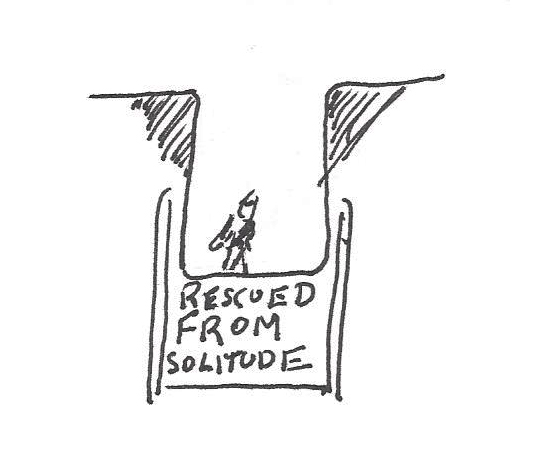
The ways we process life are not mutually exclusive, we might each do all of the above to figure out what is going on. It may take many conversations and many bike rides and many sketches to, say, process a larger than expected tax refund (ha), or a job loss. Or a death.
But the verbal processor plays a unique role among us. They are the ones who quickly spout a response to a question. They tend to be more comfortable in a group, or , perhaps this: for the groups they are comfortable in, they are even more verbal. The things they say become a sort of conversational/processing rudder against which we agree or disagree. But it is something nearly tangible (as tangible as words ever get) we can react to. The verbal processor does everyone a service by putting something out there for the rest of us to respond to. Their initial, fast response is a word that can rescue us from our solitude. Their quick work can help us avoid sitting passively while inside we are furiously yelling to get our heads around some new situation.
Kudos to the verbal processor.
Their out-flowing attempts to sort things pull the rest of us in as well.
###
Dumb sketch: Kirk Livingston
Dubious Conversation Skills: Skepticism and Fault-Finding
Pivot Your Conversation on Some Fresh Hope
One dubious skill I learned early in corporate life was that skeptics and fault-finders earn respect at a conference table. If you are not presenting the idea (and thus less invested in making it work), you’ll win experience-points with others by blowing holes in whatever the group is discussing. Finding fault won’t cost you much and could win you a more exalted place in the world of that organization. Plus: you need know next-to-nothing about the idea or context to find some loose thread to pull and hope for collapse.

Please walk this way
Yesterday I sat around a conference table with a group of skilled, opinionated, driven people who had a brand new idea. All around the table were invested because they had been working different parts of the idea for some time. The hero directing the conversation skillfully wove a bit of verbal fabric above us by hinting at how these disparate work groups were—quite possibly—creating some brand new category. I’ll not be more specific because of non-disclosure agreements, but what was remarkable to me was the intent of the verbal dreaming and the way it resonated with a group that could have been contentious.
Yesterday’s meeting reminded me that fresh hope is a disarming thing to bring to a group of seasoned people.
By the way, my book ListenTalk: Is Conversation an Act of God? is moving through the publisher’s proofreading department toward an actual physical presence. Chapter 2, “Intent Changes How We Act Together” highlights the work of the late University of Chicago rhetorician, Wayne Booth, who showed three different ways our intentions derail conversations. He ended up developing a way of talking that could unite conversation partners—much like the hero in my story above. You can put your name on a list [here] to be notified when the book is available.
Randomized, double-blind studies indicate that people who put their name on that list live happier, more thoughtful lives. I just made that up. But you can–and probably should–put your name on that list.
###
Image credit: Kirk Livingston
Seeing may be the trickiest part of drawing
Instinct and childhood definitions make poor interpreters of everyday life
Take this dumb sketch (Exhibit A). I made it while sitting in the lobby at the Children’s Theatre Company in Minneapolis. Those green trees? Utter fiction. Apart from a few pine trees, there is very little green in Minnesota right now. Green won’t even think about appearing for weeks.
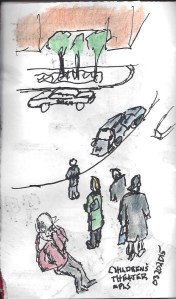
Exhibit A
Yet here we have green trees. I threw a dash of green there because trees are green. Except they weren’t green. They were brown. And scratchy and barren-looking. I commented to a drawing friend that my instinct said “green” from long use of my childhood definition of “tree.” And that slap of green was on before I even thought about it.
The gap between seeing and responding is the troublesome bit. If instinct drives my seeing, I miss pylons and electrical wires and gasoline tank farms and wireless telephone towers. All that industrial accretion I’ve seen one million times—all of it invisible. Even though it is really odd-looking stuff, jutting up into the sky at bizarre angles, like nothing in nature.
I don’t see people too: the clerk behind the counter. The janitor with the broom there, off to the side. I try to become practiced at not seeing the homeless man with his cardboard blessing at the end of the ramp. But that never works.
Mrs. Kirkistan and I volunteer at the Children’s Theater Company. It is simple duty: handing out programs. I was surprised this time by how invisible I became to children. Despite being squarely in their way so they must actively move around me to get into the theater. And when I verbally offer them a program, they twitch, suddenly surprised to see a human directly in front of them.
It’s not that I’m diminutive (I’m not). It’s because the entrance to the theater is awesome, like nothing a kid sees anywhere else. Walking through those double-doors into the dark red cavern with hundreds of seats stretching down and up into space and very strange objects akimbo on the stage—it’s hard for anyone to look away. All of that is purposeful on the part of the theater and adds to the experience.
It’s odd being invisible. And that makes me wonder how many people I miss in the course of ordinary life, simply because I have acted on instinct rather than actually believing the data from my eyes.
Instinct and childhood definitions are poor interpreters of everyday life.
###
Dumb Sketch: Kirk Livingston
Can 78 bad sketches change your life?
Don’t stunt your growth by reaching for fame
It’s funny we gauge personal success by numbers of followers. It’s as if we’ve adopted the business transaction as a model for every area of our lives.
Business wants more eyeballs for more attention for more revenue for more profit. And that makes perfect sense for our business goals.
What’s problematic is when we confuse business with what humans need to move forward: Doing what attracts attention and gathers “Likes” is often very different from the stuff our souls need to grow.

Your business factory is not a solid model for personal growth
One thing I’m learning from the artists and photographers I’ve been interacting with at Dumb Sketch Daily (currently at bad drawing #78) is that while today’s drawing is (clearly) imperfect, there is always tomorrow’s drawing. And I know what I’ll do different in that drawing. I know I’ll try this technique, or that view, or this topic. I’ll do it again and create yet another imperfect representation of the world.
And that’s OK.
Because the pursuit is about learning to see, learning how to draw, learning how to write. Learning how to tell the truth. Learning how to interact with each other. Learning how to be human. Perhaps even learning how to interact with God.
The goal is not fame, unless you really want to turn this pursuit into a business. But learning itself—whether crowds acknowledge you or whether you plod silently and alone—learning is its own reward.
But I still argue your growth is also a benefit to the humans around you.
And while I don’t think 78 bad sketches have changed my life, I can say with certainty that I see things differently than I did 78 days ago.
###
Dumb Sketch: Kirk Livingston
“Thou Art a Cad, Sir.”
May You Have Interesting Colleagues
This is the time of year when people refer to that old Irish blessing (about the road rising up and so on). But here—stuck in the middle of the work week—I want to offer you a more contextual blessing: the people around you.
Well, maybe not everyone.
But often there is someone you come in contact with who is, well, delightful. Their sense of humor, the wacko things they say over the cubicle wall, the inappropriate things they do in department meetings. The fact that they will trim your hair in the back room when the director is out of the office or dump Vaseline in the bigshot’s duffle bag or instigate rebellion at the slightest provocation. [Am I sounding like a bad employee?]

In fact, it is typically the people around (the fun and interesting ones, anyway) who make work enjoyable.
Martin Buber made a point of differentiating between how we treat objects (“I-it”) versus the way we treat people (“I-thou”). One of his points was that we should never treat people as objects: ordering them about as if they had no will of their own. Instead we should engage with each other. That’s what humans do.
Of course that very object-treatment is one of the primary sins in many of our corporations, where people become known as “human capital.” Churches are not so different when they refer to congregants as “giving units.” Hey—we even take cues from our cultural bosses and call ourselves “consumers.” Our language makes no attempt to mask this object-laden perspective.
But no so with interesting colleagues, because of our connection with them. Because of conversations you’ve had with them (some even soul-baring), because you’ve talked shop and lamented death and rejoiced in birth together, you get to know each other as fully-human. Trust and connection fit in here. And the ability to say anything.
The ability to say anything and still be heard and respected, that is the fullness of connection with another Thou.
May the “Thous” rise up to meet you today and this week.
###
Image credit: Kirk Livingston
Walker Percy: Small disconnected facts have a way of becoming connected.
Cultivate a low-grade curiosity
Two years in the clink have taught me a thing or two.
I don’t have to be in a demonic hurry as I used to be.
I don’t have to plumb the depths of “modern man” as I used think I had to. Nor worry about “the human condition” and suchlike. My scale is smaller.

In prison I learned a certain detachment and cultivated a mild, low-grade curiosity. At one time I thought the world was going mad and that it was up to me to diagnose the madness and treat it. I became grandiose, even Faustian.
Prison does wonder for megalomania. Instead of striking pacts with the Devil to save the world—yes, I was nuts—I spent two years driving a tractor pulling a gang mower over sunny fairways and at night chatting with my fellow con men and watching reruns of Barnaby Jones.
Living a small life gave me leave to notice small things—like certain off-color spots in the St. Augustine grass which I correctly diagnosed as an early sign of chinch-bug infestation. Instead of saving the world, I saved the eighteen holes at Fort Pelham and felt surprisingly good about it.
Small disconnected facts, if you take note of them, have a way of becoming connected.
–Walker Percy, The Thanatos Syndrome (NY: Picador, 1987) 67
###
Image credit: Kirk Livingston
Where Can I Buy a Fine-Art Mode?
The Beauty of Knowing Nothing
I don’t have a fine-tuning mode that tinkers with physical detail. I draw and it is mostly crude. I cut plywood and pine shelves and they are rough enough to make my craftsman-father scoff into his hand. I make dinner and it is mostly broad-stroke stuff that requires very little finessing. I will confess my popcorn is a work of art, combining yellow and white kernels, salted and buttered and mixed to a sensuous, savory smack of flavor. And I am learning how words interact on a page—though it is slow going.

How does someone get to the point of crafting from rough cuts to fine finished detail? It is possible that in this age of ordering clothes, pizza and romance from a button on our mobile devices, that some things still take time. Some things require beginning at the beginning. The question for each of us: do I have the courage to begin at the beginning? To know nothing for a time and do things badly?
The beauty about not having been taught drawing is that you are in a position of the acquirer: the process of figuring it out might take a while, and you will most likely continue to figure stuff out as you go, but that process is yours. There are no shortcuts and no tricks. Just the plain practice of drawing, screwing up, and drawing some more.
–France Belleville-Van Stone in Sketch! (NY: Watson-Guptill, 2014)
You cannot buy personal processes. Not really. You have to make them from scratch—those processes that help you make meaning in the world. And you have to begin at the beginning.
Mistake will be made.
You will make those mistakes.
And that’s OK.
###
Image credit: Kirk Livingston
Mary Oliver: “Here you are, alive. Would you like to make a comment?”
Just so.

…for always the new self swimming around in the old world feels itself uniquely verbal. And that is just the point: how the world, moist and bountiful, calls to each of us to make a new and serious response. That’s the big question, the one the world throws at you every morning. “Here you are, alive. Would you like to make a comment?”
–Mary Oliver, Long Life (Cambridge, MA: Da Capo Press, 2004)
###
Image credit: Kirk Livingston
Electricity. All Around You.
Questions About Your Grid
How much connectivity do you lose by waiting for someone else to speak your language?

What would you gain if you reached out with what little you knew of a stranger?
###
Image credit: Kirk Livingston
Gadamer: A Tormented Relationship to Writing
The Best Writing Sounds Nothing Like Writing
Good writing is where you remember nothing about grappling with words but are instead transported with images and ideas that appeared in your brainpan. Effortlessly—or so it seems.
This kind of effortless reading is exceptionally rare with philosophers, who are well-known for obfuscation in their pursuit of parsing detail and cleaving difference from sameness. And yet Donatella Di Cesare, the biographer of philosopher Hans-Georg Gadamer, claims Gadamer’s writing style is “lucid” with “striking prose.”
We’ll see about that.
The lucid philosopher is the exceeding rare philosopher.

I’ve just picked up Gadamer: A Philosophical Portrait by Donatella Di Cesare (Bloomington, Indiana: Indiana University Press, 2007). In the introduction Di Cesare shared about her process:
There is a further difficulty that a monograph on Gadamer should not avoid, and that is his tormented relationship to writing. In order to get around his Socratic resistance to writing, he preferred the form of the lecture, the talk, or the debate. It is not an exaggeration to say that almost everything he wrote is based in dialogue.
She goes on to say Gadamer is “always careful to interrogate everyday language and to avoid rigid terminology,” so I am eager to see how his prose ends up as lucid and striking rather than simply tedious.
What piqued my curiosity was Gadamer’s alleged privileging of oral over written. It seems his inquiry was largely based in discussion, between people, rather than one man alone with a sheet of 20# bond and a pen. Again: I’m just at the beginning of reading Gadamer. I’ve got his big Truth and Method on order, but I know from my own writing that dialogue and conversation have a pull that abstract philosophizing rarely reaches.
The best writing sounds like a conversation with an interesting friend. I’m eager to see if Gadamer achieves that.
###
Image credit: Kirk Livingston

 conversation is an engine