Archive for the ‘Opportunity’ Category
Tune-up the Voices Talking Inside Your (Corporate) Head
Pitch the preachy. Scrap the sing-song. And definitely lose the lingo.
Sometimes a certain tone will flip a switch for me. And all the person says next is covered in darkness because the tone pointed me elsewhere—so I miss the message entirely:
- The VP standing before the group launches into a sermon and 93% of the audience tunes out before she takes her first breath
- The newsletter from internal communications plays out cheery, one-sided copy that feels as manufactured and questionable as a tuna sandwich from the vending machine
- A poetry recitation where the sing-song voice seems to have come from a different century
- The prayer that sounds like a sermon. The sermon that sounds like a lecture. The lecture that shows no interest in connecting with an eager audience.

Each communication event is an opportunity to pass information, true. But each event is also an opportunity to deepen relationship and build trust—both of which may be more valuable than the information in transit. To squander those communication events on vacuous, preachy or condescending fare seems a waste of time, money and consciousness.
Perhaps certain situations activate your autopilot and you slip into a particular communication mode. The status meeting, the Sunday sermon, talking to an employee. Talking to a child. Maybe we even have a special voice reserved for praying with other people. We may not even realize that we adopt a slow-meter pacing, using parlor words we pull from our big-bag-of-sacred-stuff.
Our autopilot mode can learn from the practice of that old poet-king. That old poet-king had a special voice for prayer too, but it wasn’t from the big-bag-of-sacred-stuff. Instead, it was the voice of desperation, of falling and not being able to get back up, of righteous anger on the dudes who done him wrong. The poet-king’s voice was a real voice, based on real bad stuff that seemed to be happening.
The lesson from the poet-king is this: keep it real.
Employees appreciate hearing what’s really happening, not some vetted-party-line version. Use your real human voice as often as possible. Real voices—the ones that we believe—find a way around buzzwords and corporate lingo.
Real conversation with real voices is the engine moving all of us forward.
###
Image credit: Kirk Livingston
Why Listen to the Odd Fringe Person?
Can the outsider say anything of interest to the consummate insider?

Every organization has concentric circles of members.
As new people come in they are indoctrinated into the ways of the tribe and so become insiders and holders of the knowledge. True for businesses, churches, non-profits, ad agencies crocheting clubs and sometimes even families.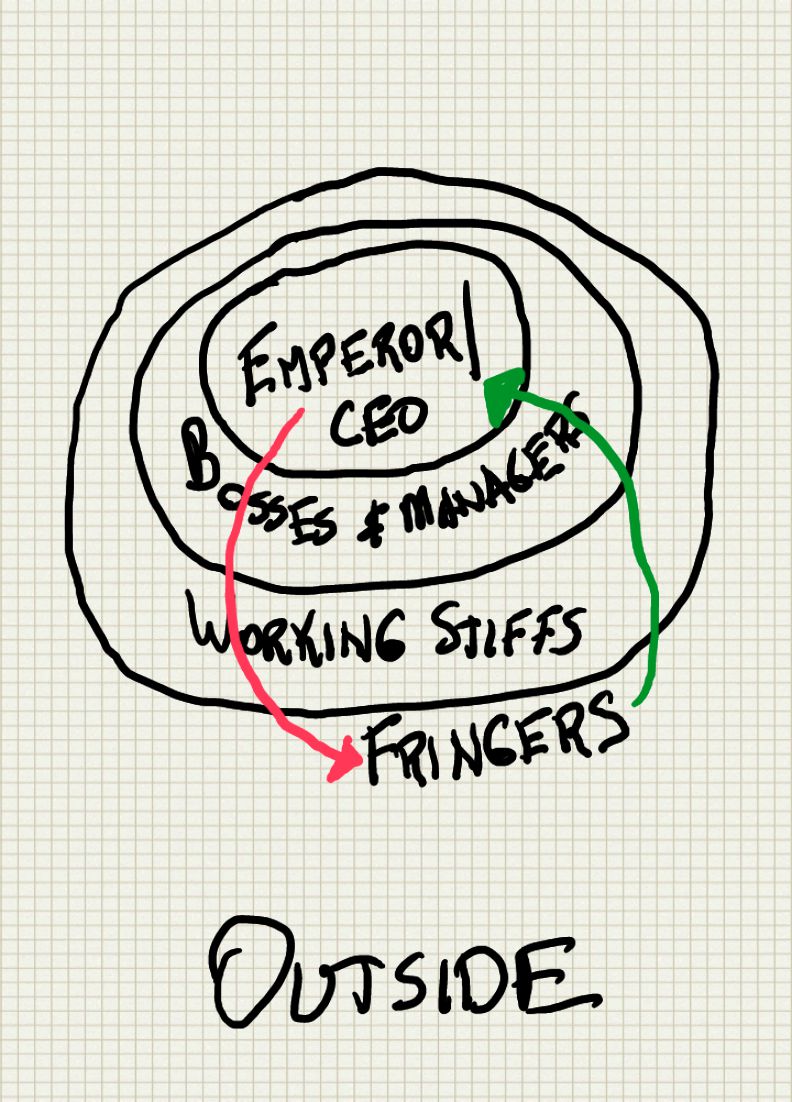
It used to be that the people on top were the ones with the power and the voice. That was back when an organization pushed its one right way of doing things down through the hierarchy. Members either did things the one right way or they walked.
But times have changed and the consummate insiders are desperate (more or less) for new ways to do things to keep the big machine moving. In fact, the big machine seems to be wheezing and seizing more often lately (think Sears or Radio Shack), unable to offer the intimate experience their audiences seek. Part of that has to do with the realizations coming from many voices that there is more than one right way to do things.
What to do?
In The Power of Pull: How small moves, smartly made, can set big things on motion (NY: Basic Books, 2010). Authors John Hagel III, John Seely Brown and Lang Davison advocate, for starters, listening to the people on the fringe. After showing examples of people on the fringe who went on to change everything—like Olympic snowboarders and Malcom McLean the inventor of containerized shipping—they observe:
It is no accident that these early examples of performance improvement come from various edges, because it is exactly at the edge that the need to get better faster has the most urgency. Incumbents at the core—which is the place where most of the resources, especially people and money, are concentrated, and where old ways of thinking and acting still hold sway—have many fewer incentives to figure out the world, or to discover new ways of doing things, or to find new information. They’re on top, and they’re ready to keep doing what got them there. But simply accessing or attracting static resources no longer cuts it. Accessing and attracting have little value unless they are coupled with a third set of practices that focus on driving performance rapidly to new levels. (18)
That is why it is starting to make more sense to listen to the person who has just signed up—they might just have a better, more serviceable idea than those invested in the status quo.
###
Image credit: Kirk Livingston
Don’t use that (brand) voice with me
Brand Voice Should Invite Not Forbid
My friend Dimitri* asked leading questions.
They weren’t the impossible questions like “What is the meaning of life?” or “Why five toes? Why not four or seven?” where you could speculate together and combine ignorance.
No, Dimitri’s questions were contrived and assembled to manipulate your emotions and response. In conversation with Dimitri, you knew he was looking for some specific answer. But he would never tell what he wanted. He engineered his question so the one plain answer was what he wanted you to say. Then he could launch into a lengthy response. That game left us weary, frustrated and eventually vetoing most of Dimitri’s questions.
Lots of firms play Dimitri’s game: their communication is guided only by a desire to sell (which is, after all, the point of corporations and not necessarily bad). But when the only conversation a company will entertain is one that leads you to buy their product, that looks more like monologue. People veto those conversations and/or walk away.

No one wants to be reduced to a number on a spreadsheet or a statistic. That’s why the used car salesman with the plaid jacket is a favorite target in our culture. It’s also why manipulative sermons and boring lectures are easily dismissed. Of course, some brands are famously annoying, like the “Save Big Money” voice of Menards and we tune it out—except for when we remember it because we want to save big money.
There is more opportunity today to invite participation instead of hijacking it. And invitation, while harder because it requires thinking about someone else’s need or desire, has the advantage of building relationship.
Monologue and the preachy/lecturey voice have limited shelf-life.
###
*Not his real name. His real name was Smitty.
Image credit: Kirk Livingston
You Gotta Find Ways to Tell Your Story
Don’t dumb down. Don’t be boring.
One client is a thought leader in her particular industry. She writes and presents papers around the world. In doing so she thinks brand new thoughts, adds to her credibility and drums up potential clients for her firm. She is disciplined about two timetables:
- Timetable #1: Industry Papers. She includes time in her schedule to research and write, which allows her to build out topics of interest to her customers. Those topics also interest editors of professional journals, so she maximizes her research and writing time to open up new venues to be heard as an expert.
- Timetable #2: Everyone is a Publisher. My client also understands that she is not just speaking to the industry-folks who crave the details she has synthesized. She is also speaking to a broader group of people—those who have a nominal but urgent interest and may benefit from what she has to say. This second, broader group of people drop their questions into the oracle of Google. My client hopes her investment in social media (her firm’s blog, Twitter, and Instagram accounts) will reach these people. She routinely takes papers she has published and breaks them up into smaller chunks that more easily relate to the rest of life.

We need your annotations.
But this second piece is less about research and more a journalistic/writerly function. This part is more about connecting the dots with the work and life and less about laying bare abstract research findings. She understands this second communication need has nothing to do with dumbing the topic down. In fact, just the opposite she employs her best writing to say things as simply as possible without relying on buzzwords and tribal knowledge.
Marketers of consumer products have long focused on Timetable #2. Academics and specialized industries have long focused on Timetable #1. How long before we all use Timetable #2 as the route to Timetable #1?
Remember: we are the gatekeepers now.
###
Image credit: Kirk Livingston
Wait—English Majors Win in the End?
Start Writing Your Own Future
- Announce your goal to lose weight and chances are better the pounds will flee.
- Sign up for NaNoWriMo and chances are better you will actually write that novel (no matter how badly it turns out).
What we tell each other has a way of happening. What we tell each other about our preferred futures has a way of guiding next steps.
- Write a letter to your collaborative, inventor friend about a business idea and find yourself planning concrete marketing and distribution steps at Spyhouse Coffee.
- Write a business plan for your startup and suddenly remember your friend who became a venture capitalist. And then remember the friend who bootstrapped her idea.
See the pattern? Each step forward started with communication. You may say,
“No. the idea came first.”
True—maybe.

Create in real time as you go.
But consider: the communicated idea created a spark. And—given the right collaborative conditions—the spark lit a fuse. And the fuse burned, gathering other ideas until the explosive, disruptive future no one had considered.
What if English majors learned entrepreneurship and began to see their talent for orderly, persuasive, deeply-rooted writing as a way to help themselves imagine new futures and chart forward-movement for others? What if they learned to solve real-world problems with story and emotion and analytics? Their solutions would drop-kick the spreadsheet & PowerPoint crowd. What if some English majors created Lake Wobegon while others created the next Google?
What if English majors learned business lessons alongside the standard fare of reading and writing? What if they were expected to serve up the occasional business plan or marketing strategy along with the usual essay, short story and poem?
If that happened, English majors would connect earlier in life that art and work and commerce and fiction and meaning-making all fit together in the same world. And they would begin to write their own future vocation.
By the way: 16 Wildly Successful People Who Majored in English
###
Caveat #1: I was never an English major.
Caveat #2: I teach English majors. They are smart, innovative people.
Image credit: Kirk Livingston
Why Work Out Loud?
Living out loud—even at work
Way back when our first child was born (lo these many years ago), back before there was language, when crying and inchoate grunts were the sum total of signals this small being could muster (along with unblinking stares), a strange communication pattern emerged in our household: narration.
Mrs. Kirkistan and I both found ourselves narrating in real-time to this youngster. His wide eyes and (relative) silence seemed enough to make us think he was curious about, well, whatever. We narrated pacing the floor at 2am (“We’re walking back and forth because someone is crying. But we’re not pointing fingers. No sir.”). We narrated cooking and cleaning. We talked about sitting on the couch and driving in the car. We told the story of outside—every window had a story.
It seemed to work if only because it was met with silence which we took for interest. Eventually he started narrating back at us.

Thank you, Veterans.
I’m reminded of this as I read John Stepper’s blog and anticipate his book, Working Out Loud: How to build a better network, career & life (Due Feb, 2015). Mr. Stepper makes the case that we do ourselves a favor when we “work in an open, generous, connected way.” The benefit is to ourselves and to others. Check out his “5 elements of working out loud.”
Lately I find myself talking more with clients about how they communicate internally and externally. I continue to see the emphasis wrought by free and open social venues (Twitter, bloggery, Facebook) working their way backwards into the way organizations conduct business. I predict more collaborative encounters and less monologue from a guy with a tie and a pen to sign your paycheck.
Stepper’s “working out loud” codifies some of that collaborative energy that rises like Spring sap with honest and open communication. I think of it as another perspective on the “dumb sketch” approach to life.
Narrating our day, asking for input, remarking on a remarkable idea—it’s all part of human contact and cannot be separated from the business of making meaning.
###
Image credit: Kirk Livingston
Thought Leadership Takes (too much) Time
And don’t be deadly-boring
In content-creation, I talk with clients and potential clients about telling their story in a way that promotes them and their business as thought leaders. Most clients have a business expertise that is poorly understood outside their niche or industry. And that is always the way: who really knows or cares how someone else spends their day?
One of the big challenges with our social appliances (Twitter, for example, and blogs) is telling the details of our story in a way that, a) shows we know what we are talking about, and b) communicates something not-deadly-boring to a casual passer-by. This is a huge challenge because most of us are interested only in what we are interested in.
Telling what we know in a way that engages the passerby is the challenge. That’s why I often use the metaphor of talking with the stranger or telling something to a ten-year-old. When eyes glaze or when they simply walk away, then you know you’ve not told your story well.
The thing is, our social appliances do not let us off the hook with the casual passer-by. Yes, we write our messages to our core audience, those are the people we seek to help and serve and engage. But those messages still must have enough hook to stop and (possibly) engage the conscious human passing by our web page/tweet/handmade sign. Building our brand, whatever that looks like: whether marketing a medical device, marketing a specific line of knowledge about medical devices/healthcare or marketing your own book—all these require that we tell our story in a way that keeps detail in focus while showing why it all matters to life on this planet.

Of course, the best way to do this is to know your topic well. Once you know your topic, mix in notions of how a stranger or passer-by would react and adjust accordingly. I find that knowing a topic and then adjusting the topic to the needs and interests of a particular audience has a miraculous effect of providing something I simply must say:
https://twitter.com/AdviceToWriters/status/529996620620763136
And that is a beginning of thought leadership: building out from what you know, day after day. It is very time consuming but if you are passionate about a topic, product or service—or a particular way of looking at life—than you can hardly keep from building the topic anyhow.
By the way, whether you write or not, everyone on earth should follow Jon Winokur’s tweets (@AdviceToWriters). His tweets should make anyone eager to create.
###
Image credit: Kirk Livingston
Making It Up Daily: 1667 Words at a Time
Do You NaNoWriMo?
It’s funny that those stories we’ve lived in since childhood were written by someone. Made up, one word at a time.
Books. Movies. Plays.
All made up.
By someone.
Writing.
Game of Thrones. Lord of the Rings. The Great Gatsby. Even Burt Dow, Deep-Water Man. All made up. Maybe they carried pieces of older stories, but someone composed them. We know the names of the authors.
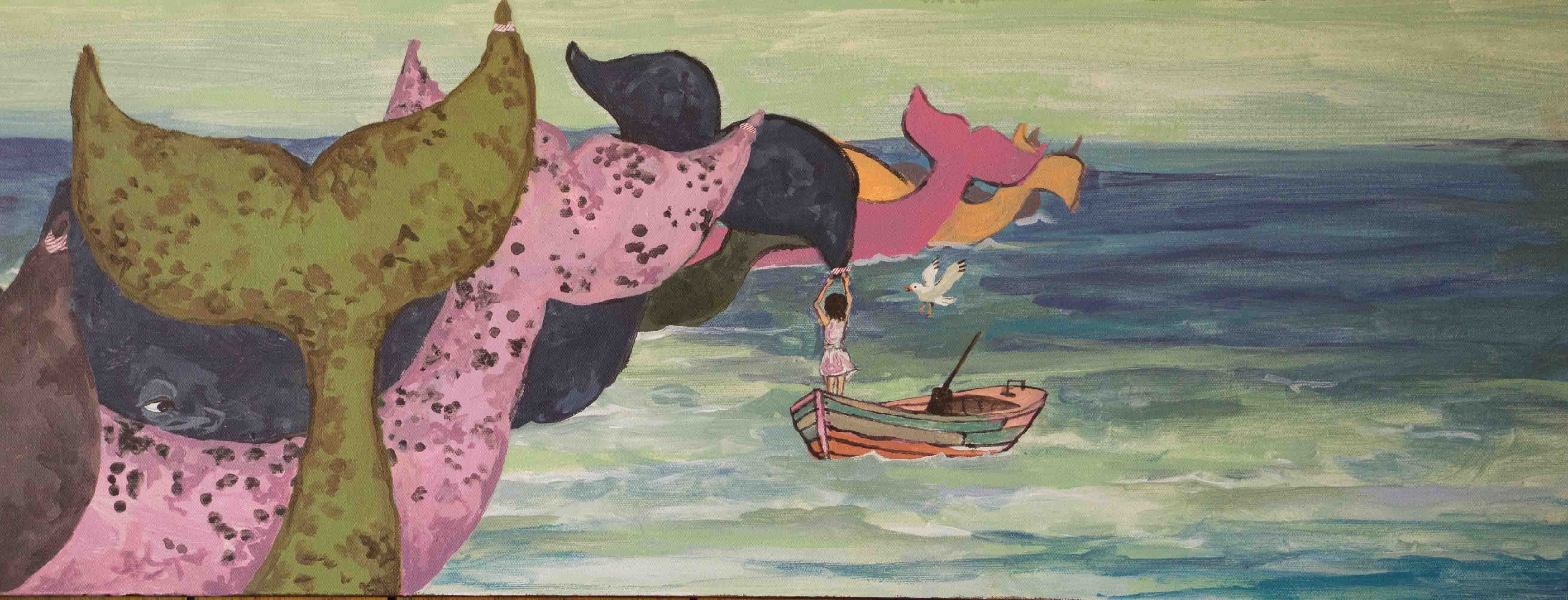
At some point in life I realized these very complete little worlds that seemed so alive were actually fiction. Funny that something made up could prove so real for so long. So concrete. But I had to pull back the curtain to realize this.
At some point—a bit later—I realized there was actually quite a lot made up: much of human interaction is made up (we call it “culture”). Oh sure, it presents as concrete reality, but behind the scenes people were literally making things up every day.
Business is a great example. Walk into a brick and mortar superstore and it seems like it’s been there forever. But we know they huge multi-million dollar inventories come and go. Same with banks. Same with restaurants—especially restaurants. Even the big institutions that are the pillars of our communities are making it up as they go. Sure, the rules of the game are there and seem to be unchanging as if handed down on stone tablets. But nothing is certain about business.
If you’ve ever been in a start-up company you’ll know that making it up as you go is expected. We need more folks willing to leap into the void of making it up. I believe making it up on paper translates to words which translates to action.
National Novel Writing Month is upon us again. And I’m joining in. It’s likely this blog will suffer inattention. But the challenge of creating a story from nothing (or more likely, from the disjointed and broken story-bits laying about in my mind and yours) is too great to resist.
National Novel Writing Month is a relatively painless way to try to produce a coherent story. Or, if not coherent, than at least something that has 50,000 words.
Where are you exercising your make-it-up muscle these days?
###
Image credit: Alli Livingston. Photo: Kirk Livingston
About the Node Not Taken
Steady There, Young Philosopher
My hardworking, entrepreneurial colleague surprised me in conversation the other day:
Sometimes I wonder what it would be like had I stayed in the corporate world—what would I be doing now?
My friend was in one of the periodic slumps that happen to anyone building a business of their own. Those slumps squeeze out long-suppressed questions. These are the questions that precipitate momentary crises of faith for those constructing wings as they plummet.

No. Really. Is there an actual “Afton State Park”?
Young philosophers like to ponder the “What ifs” of life:
- What if I had dated that person rather than this person?
- What if I had taken that job rather than this job?
- What if I had studied engineering rather than philosophy? (One certain answer: the world would have to cope with a very bad engineer.)
- What if had dived 12 inches to the left and missed that rock in the lake?
One problem with our casual “What ifs” is that they often assume a straight line from the point of decision. You go this way. You go that way. Two roads diverging in a yellow wood.
But what if our lives are composed of nodes that become roads? What if each decision is followed by another so that our paths are constantly changing in real-time?
Another problem with casual “What ifs” is they forget the tiny but forceful pinpricks of relationship and conversation and motivation that accompany every choice. Thousands of tiny insights and histories and dreams contribute to each action as well as each subsequent action.
Personally, I cannot help but wonder if the nodes that become roads all lead to the place/people we were meant to be in the first place. Wait—don’t call me a determinist yet. Stick with me: what I mean is that whether we stayed in the corporation or went on our own or dropped everything to join the circus, would we end up as the kind of people we were meant to be?
This is not a perfect thought: we build things into our lives, good and bad, by daily habit. We grow, or not, because of those habits and subsequent opportunities. Admittedly, the determinist take on choice has holes.
But I’m reminded of that inveterate letter writer who wrote his friends about walking in the “good works” begun in them.
Today I’m looking for nodes and roads.
And I hope to step in a good work along the way.
###
Image credit: Kirk Livingston
Moments of Impact: Making Work Conversations [actually] Work
This third kind of work conversation involves divergent thinking
In Moments of Impact: How to design conversations that accelerate change (NY: Simon and Schuster, 2014), Chris Ertel and Lisa Kay Solomon make the case that we need a third kind of conversation at work. Here’s how Solomon and Ertel categorize most work meetings:
- Typical meeting where someone stands at the front blathering on with slides while attendees multitask with Facebook, Twitter and occasionally, actual work.
- Brainstorming meeting where people attend to think brand new thoughts (and to eat donuts). But brainstorming meetings are routinely dismissed today as producing far fewer ideas than if the attendees sat in isolation producing ideas before coming together.
- Strategic Conversations. This is Ertel and Solomon’s new kind of conversation. Rather than engaging in the typical presentation/multi-tasking meeting, they want attendees to deeply and viscerally engage in a compelling question.

Mindful like a hungry hawk.
Moments of Impact is all about how to make this third kind of conversation happen. The book develops five points to help make strategic conversation an experience versus another bout of human downloadment:
- Declare objectives/define the purpose

- Identify participants/engage multiple perspectives
- Assemble content/frame the issues
- Find a venue/set the scene
- Set the agenda/make it an experience
Nothing earth-shattering so far, right?
And yet, as it is so often, our connections provide the earth-shattering stuff, rather than any consultant’s formula. Where we connect—with 100% attention—that’s where the magic happens. In connection there something mystical that lies beyond engineering technique and management principles. Moments of Impact is about setting the stage for that connection.
One thing is becoming clearer very day: when we employ mindfulness rather than pursuing mindlessness, we find ourselves deeply engaged rather than seeking more distractions.
Mindfulness in the service of creating an experience also seems to honor humans as human (versus as corporately-owned human capital to be rejiggered at will).
That old attitude may have worked for an assembly line (doubtful), but for our volatile, uncertain, complex and ambiguous world, we need the best each of us can bring.
###
Image credit: Kirk Livingston

 conversation is an engine