Archive for the ‘Opportunity’ Category
Year Without Pants: What’s Your Conversation Prompt?
Must Hierarchy Always Trump Collaboration?
In the excellent Year Without Pants (San Francisco: Jossey-Bass, 2013), Scott Berkun detailed his efforts to direct a team of programmers working for Automattic/Wordpress. This team was distributed around the world and gathered only occasionally. Most of their collaboration was mediated through computer screens and telephone lines. Curiously, email was not a major player. Instead, in-house blogs contained most of the collaborative communication (~75%), along with IRC (Internet Relay Chat), Skype and then e-mail (~1%). Blogs had the advantage of being entirely public (to the other players) and displaying the entire conversation. So potential collaborators could get up to speed as needed by simply reading/re-reading what had been said. And others could ignore the whole thing (which is the way of blogs).

Does your conversation prompt work?
Berkun found the prompt at the top of the collaborative blog was largely ignored—so common it was invisible (much like Twitter’s “What’s happening?”). It started with,
What’s on your mind?
and then
How can Team Social help you?
migrating eventually to:
Hi Scott: Do you know where your pants are?
That changing prompt became a way to wake up the conversation. It also demonstrated the playful nature of the team—a key factor in all Automattic/Wordpress collaborations. The prompt also turned into a good book title.
Berkun’s conversation prompt gives me hope that hierarchy need not trump collaboration. In my most collaborative projects, there was always a sense of fun/playful/silly/ridiculous that settled like a bubble over team meetings. In contrast, my more onerous jobs and projects carried a sense of duty and chain-gang attention to a boss hammering out a beat.
Creating that collaborative environment requires a light touch, a willingness to explore liminal spaces, record results and allow others access to the longer conversation. Creating collaboration also involves attention to conversation that results in replies, rather than monologue that begets numb pseudo-attention.
###
Image credit: Kirk Livingston
How LinkedIn Helps Before You Are Between Jobs
Generate The Thing Between
LinkedIn is a powerful tool for connection. But lots of people, once they land the job, put connection on the back burner. Some take it off the stove entirely—and that is a mistake, especially in this economy. I know this because many friends and colleagues are on radio silence most of the time. Until rumors of layoff float by. Then it’s connections galore.

Don’t let connections go dormant.
Connection is something that happens long before you have a need or want to generate a sale. In fact, connection is not about the need or the sale, it is something entirely different. And we make LinkedIn frenemies when we mistake connection for a sale.
For those who understand the importance of connections outside immediate work and building relationships widely, there is a great joy in getting to know people and simply seeing what might happen. It’s not even an introvert/extrovert thing. It is a possibility thing. Maybe it is a thing for dreamers, but I think not. It is for anyone who starts to wonder what is possible outside the structure that encases their days.
This openness to others—this beckoning to others, this waving them close—is the early move toward collaboration. It is the ordinary conversation that starts to generate new things between you, seemingly by magic. It is the beginning of finding common ground that eventually leads to “Wait—what could we do together?”
Curiously, openness to others has a way of working backward into our present job so that we start to see new ways of working, collaborating and connecting.
When teaching college students about professional writing, I try to help them understand that the best jobs are the ones not advertised. The best jobs open and shut before ever posted on a web page or printed as a classified ad. Those jobs are available only to connections. Those jobs are almost incidental to the connection: friends see what you do, how fun you are to work with. Their synapses fire and they say to themselves, “She might be perfect for this need we have.”
Maintaining and growing connection is not for a someday need or someday sale. It is a piece of being human and carries a glory all its own.
###
Image credit: Kirk Livingston
Getting Things Done: Better Call Agent 007-0827
Or should we call a prayer meeting?
“Agency” is a word for getting something done. In a philosophical sense, it is the capacity to act in the world. It has to do with choice-making and accomplishment and focus—especially focus. We hire an advertising agency when we need to offload some critical marketing element and make sure it happens. That agency accepts the mission and acts. And so we pay their fee.
Why hire agency? Because we don’t have the capacity to do it ourselves, whether that means talent or headcount or time or interest or focus or all of the above. But the critical thing needs to be done and must be done. So we get someone we can trust to do it. There is an entire industry set up around the notion of getting things done. Time management is always a hot topic for any gender in business or academia and in the rest of life.

But agency has a tricky theological side. Even non-theists debate determinism versus free will. And Christians, well—we’ll kill each other over our views of how the world works. Just find an Anabaptist and ask how their minority voice was received by their determinist rulers, way back when.
Why bring in theology when talking about getting things done in real life? Isn’t theology the useless opposite of getting things done here on earth?
Yes.
And, No.
Because while we can accomplish much with our time-management techniques, there is much outside our ability. Like changing someone’s mind. Or opening long-closed doors. Or protecting oppressed people from their brutal dictator. Or helping a nation care about all its citizens (versus just the privileged ones).
What the time-management industry does not answer and cannot answer is how to work with these very large questions that deal with agency in the larger world. So we back off and shut down and feel guilty.
Can we pursue agency that sees and acts on larger things? Some of my heroes are doing this and their agency consists of some combination of prayer and action and faith and presence.
###
Image credit: Kirk Livingston
When Walking To The Podium, Remember This.
Resolved: “You are gonna dig this.”
No one will argue that public speaking is petrifying. On this we all agree. Even seasoned performers routinely get the nerves before they walk on stage. In my limited experience, the one thought that calms nerves and spurs me forward is that something I’m about to say will help someone.

Next?
This occurred to me recently in working out the details for launching ListenTalk. Someone suggested a party and my first reaction was, “Ugh—I hate being the center of attention. No thanks.” But on reflection I found myself at a decision point: do I want to give my best effort toward helping this book succeed or will I follow natural impulses and just drop the published book off on Amazon’s front steps, ring the doorbell and run. Because if I do the latter, I am guaranteeing a narrow audience.
On further reflection, and perhaps with a bit of divine intervention, I realized the message of ListenTalk is much more about this hope I’m starting to entertain: that readers will begin to happily engage in and explore their own daily conversations with something of a treasure-hunter’s gusto. That’s the good thing I want readers to understand. That’s the thing people are gonna dig—once they get it.
So, for those about to engage in public speaking, or for those looking for motivation to move forward with some public task, ask yourself: How am I helping the person I’m about to engage?
It’s always good to refocus on the other person.
###
Image credit: Kirk Livingston
Mind-reading and the Perfectionist’s Dilemma
“Come here, you big, beautiful rough draft.”
You know what needs to be done.
You know how to do it.
But—given your schedule—you simply cannot attend the details. What you want is to jump to editing the rough draft—but who’s got time to create that rough draft?

This is what I’m thinking….
We could be talking about drafting an email, an article or a chapter. We could be talking about a curriculum for a class or a seminar. We could be talking about writing a memo to employees or a letter to partners or a speech to stakeholders—anything that requires focused attention for a time so you can spin out and organize the details. We’re talking about anything you need to create from scratch to deliver to others. Any communication that solves a problem you’ve noticed.
Now is when you need an assistant who can move forward without hand-holding. Now is when you need someone who knows what you know without you telling them. Now is when you need a mind-reader.
But there are no mind-readers.
Are there no mind-readers?
I won’t say copywriters are mind-readers. I will say I find myself in situations every week where my client has provided 15-25% of the details but expects our project to organize 100% of the content in a coherent, compelling fashion.
Sometimes I wonder if our close friends, colleagues and collaborators serve as near-mind-readers. With them we feel free to spit out the raw bits of what we know. And as we say it, we realize what we need to do next. To tell someone what is on our mind is the first step to accomplishing a task. Those conversations are a kind of verbal rough draft.
Don’t be intimidated by the blank page. Embrace the notion of doing something mostly wrong and partly right, which is to say, embrace the rough draft.
It is much easier to change words on a page than it is to put words on a page.
###
Image credit: Kirk Livingston
Wendell Barry: “A Little Nagging of Dread”
Your first bond with your wilderness
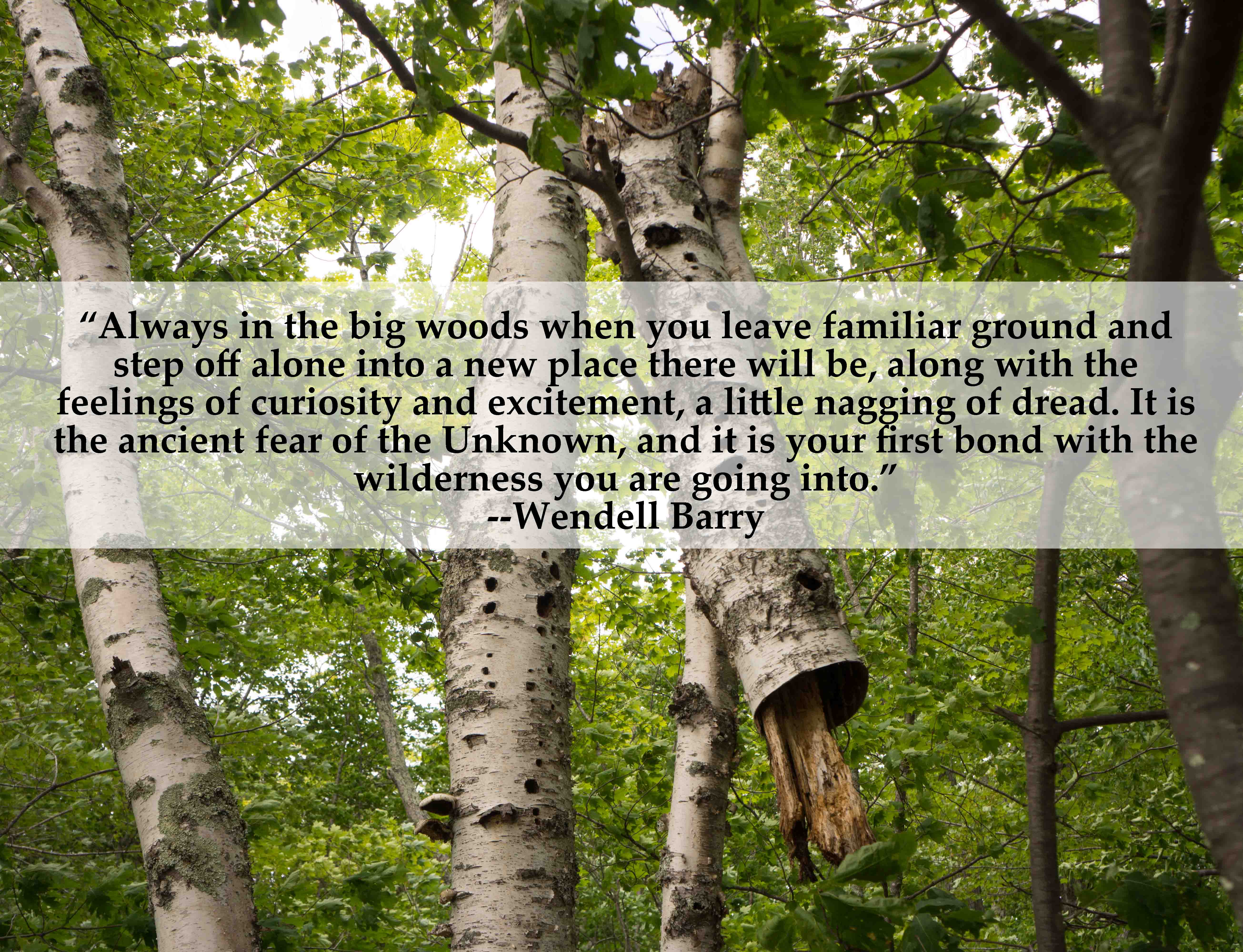
Always in the big woods when you leave familiar ground and step off alone into a new place there will be, along with the feelings of curiosity and excitement, a little nagging of dread. It is the ancient fear of the Unknown, and it is your first bond with the wilderness you are going into.
###
Image credit: Kirk Livingston
Quote via The Way of Improvement Leads Home/Relevant Magazine
Where does loyalty come from?
Gift Economy and Loyalty Programs
This is a tale about where loyalty comes from. It involves making a garbage man very sad.
The second home we purchased was left with all sorts of furniture by the previous owners. We called them and put the furniture in the yard. But they never returned and their furniture sat in our new yard for too long. Rain and sun and more rain—these people never came.

But Ace Solid Waste came. And they took it all for free. And they won our loyalty. Is this a commercial for Ace Solid Waste? Maybe, although I am not employed or directed or in any communication with Ace Solid Waste. In fact, I pay them. On time (mostly).
Their gift of removal (you might say Ace blessed us with the absence of a soggy couch and other wet furniture), is easily and quickly remembered by Mrs. Kirkistan and I, still, to this day.
In The Gift (NY: Vintage Books, 1983), Lewis Hyde described how a gift economy works: people give gifts to each other as a sort of payment. But not in the transactional way most of us expect today. One gift was not given in exchange for another gift. No, Hyde described how gifts move on. Or, you might say, moved forward. The gift you gave me, I gave to someone else, and so on in an endless cycle of giving. In the gift economies Hyde cited, trade was greased by gifts.
Of course, gifts carry with them an obligation: a sort of unwritten sense that I must pay this back, or “I owe you one.” Gifts also carry a sense of relationship. We give gifts to friends or relatives. It is a way of saying, “Hey buddy!” or “I’m thinking about you.”
One long-time strategy for business is to give gifts to woo loyalty. I buy plumbing supplies at Beisswengers because they are patient with my simplistic plumbing questions. They provide answers along with the new drain. The answers are even more valuable than the drain. All sorts of free apps become so indispensable we finally buy them. We frequent the vendor who gives away their knowledge.
A competing garbage gentleman stopped at our door with an offer of savings. When I said I wasn’t interested, he probed:
Why?
I told him my story of the furniture that wouldn’t go away and how Ace helped us out.
Will you be in debt to Ace for the rest of your life?
And here is the surprise: as I listened to my own words, I wondered at the strength of the feeling and the depth of loyalty for this good deed done to us—and the longevity. Maybe our retelling of our furniture story kept giving fresh reasons to continue.
Maybe.
And so the man of seeming excellent garbage-manship walked away sadly.
So that’s one way to build loyalty: help someone with a need. And as you help, try not to see the gift as a transaction.
###
Image credit: Kirk Livingston
Melted Crayons: What Writing Collaboration Looks Like
Not yours. Not mine. But a new thing created between us.
Years ago we took our kids on the consumerist hajj to Florida’s Disney. We’re more national park vacationers but we resolved to make the best of it. So we battled through the hucksters and scam artists on every corner in Orlando and made our way to the magic kingdom.
It was…ok.
Some of our kids were scared of the rides. Some were thrilled at points. Others (including parents) grew weary of the constant stimulation. I would not be a good spokesperson for Disney.
The most memorable part of the trip was post-Disney, on a drive through the orange groves. At one point we left the rental car for not too long a time to see some Florida oddity. We came back and found crayons melted on the back seat. It gets hot in a Minnesota summer, but I don’t recall crayon-melting hot.

Turn up the heat.
Melted crayons are not any one color. They are a new color that has no name.
Recent writing collaborations got me thinking about those crayons again. Some of my favorite clients invite me into the process by explaining what they want to accomplish with their target audience. They outline the main messages but do not hold those main messages too tightly. They point out the content and invite me to organize and hone the argument so it makes sense. They invite me to retell the main messages. When I come back to my client with something they can react to, we talk and the work gets better and more solid.
The thing is, what we create is not totally mine and not totally theirs. It’s a melted melding of motifs, which we continue to sharpen and fit to the purpose.
It’s a process I enjoy very much.
And it’s a process that is not that much different from our best conversations, where we generate some surprising new thing between us, beyond what either of us set out to say. A sort of intentional, verbal, melting of crayons right before our eyes.
###
Image credit: Kirk Livingston
But Can You Outsource Imagination?
Consider cultivating time to consider
One persistent problem in today’s workplace: no time to think.

Frank Lloyd Wright re-imagined this windmill in Spring Green, Wisconsin.
Open floor plans contribute to constant interruptions, as do the barrage of meetings we file into and out of most days. Projects have fast timelines, which do not lend themselves to fully consider ramifications—so we default to action.
And as Curtis White might say: our deep involvement in (what seem to be) sacred institutional processes precludes us from using our imagination. The way we get things done—all those guidelines and guardrails—also serve as blinders, shuttling us down the same paths again and again. We stop seeing other ways to do things. Maybe we stop seeing that there are other things worthy of our attention.
As freelance copywriter, I see this all the time: friends and colleagues embroiled in their system so deeply they forget to imagine the larger issues having just as much impact. One of the great privileges of my work is to come alongside friends and colleagues to think through an issue from a different perspective. Of course, no one hires me to think (thought that sounds like the perfect job). They hire me to write stuff. But in the process of systematically going through their marketing campaign or explaining how a product works or working through the medical literature, new perspectives pop up. Things my client has not yet considered. Small tweaks to a product or presentation that make a huge difference in the outcome.
Though your workday may seem too tight to think through an opportunity or problem, isn’t it in your best interest to carve out the time to do just that? You can off-load many project tasks, but it takes fresh imagination—possibly sparked by an hour away from your desk—to see things differently. A fresh take can make all the difference in the world.
###
Image credit: Kirk Livingston
Loose Lips Link Scripts
Open(ish) access for tight-lipped companies
Technical people can learn something from advertising people.
My creative director friend presented advertising concepts by first showing how his agency team came up with the idea. His presentations took a bit more time, but along the way he restated the problem, showed visuals of how competitors attempted to solve the problem and then revealed stumps of ideas that never really worked. Then he got to the solutions he hoped the client would pay for.
My friend’s process placed his solution in a context that helped those around the conference table understand why the solution made sense. As he spun out his process, he verbally brought these people with him so they were nodding “Yes” long before they signed off on the solution.

The boardwalk protects fragile land while providing access.
Many of my clients guard their proprietary information with fierce protections. And rightly so: their processes keep things running and bring in the coin that satisfies employees, stakeholders and shareholders. But in a search and share economy where like-minded people find each other more and more often, is a firewall surrounding all information really the best way forward?
The right information presented at the right time (that is, just when someone needs it, which typically coincides with a search for that information) affects buying decisions and brand loyalty. Interestingly, your technical people are right now busy working through the context that, if properly presented, would draw others to your product.
People are searching for your information.
If only they could find you.
My more innovative clients are finding ways to help their problem-definers and solution-makers talk more publicly. And as these discussions move outside the corporate walls, they best ones are finding ways to combat the PR department temptation to suck meaning from the words. Because sharing useful information happens person-to-person. And useful information will always have something of an unfiltered quality to it.
How is your organization preparing to share details with those who can help you move forward?
###
Image credit: Kirk Livingston

 conversation is an engine