Archive for the ‘philosophy of work’ Category
Medtronic, “Accounting Fiction” and Irish Performatives
How do you say “Fridley” in Irish?
To those who live as if words are worthless and refuse to see the role of systems in building wealth, let us now gaze on Medtronic’s deal to buy Covidien. What does $42.9 billion get you these days, besides a cohesive portfolio of medical devices and a bunch of intelligent workers and systems? Smart people are speculating it also buys freedom to spend foreign profits without worrying about more taxes, which may amount to a roughly $20 billion future spending spree.
Of course corporations will seek the best deal for making money—that is the project of corporations—and will surprise no one. Do Minnesotans worry a beloved company born and bred in Minnesota is growing up and leaving home? Of course. But the significant investment Medtronic has made in their operations in the state should cause worriers to back off a bit. A quick driving tour through Fridley and Mounds View reveal a rather permanent corporate presence.

How can you control chaos and churn?
But then—of course—stuff happens and things change. Which produces anxiety in hard-working people.
What I find interesting is that while the deal involves a significant exchange of money, it also changes a key definition that then dodges a set of tax requirements. Note this: becoming an Irish company is mostly in name only. The StarTribune quotes Eric Toder of the Urban-Brookings Tax Center as describing the newly formed Irish company an “accounting fiction.” So while Medtronic will always be a Minnesota company, it will become an Irish company. And there is money to be saved in being an Irish company. By cutting this deal—by pronouncing these words in international legal documents—a new thing happens at Medtronic that will please shareholders and worry local workers. JL Austin might call that corporate speech-act a performative. And there is no question that performative will change things in the real world.
[Full disclosure: The author has worked for Medtronic and continues to consult for Medtronic.] [At least the author did until posting this.]
###
Image credit: Kirk Livingston
Your 10,000 Hours
Trust Your Process
There are times when you don’t know the answer and you cannot see a way to an answer.
There are times when you simply cannot see what to do next. This happens constantly in my work: even today I have a project that needs a unique kind of help. Help I cannot even quite imagine.
What to do?

My writing process seems to be all about working my way into a corner or a dead end. It happens again and again. But as I continue chipping away and working at it (which is to say, I keep writing), the dead end turns out to be a way to rethink something. Getting stuck in a corner turns out to be the necessary thing, the thing I needed to actually turn the corner.
Malcom Gladwell contends that you must put in 10,000 hours to become an expert at something. He may or may not be right about the numbers, but certainly an expert has worked out a process the she or he follows—some way they use to accomplish the thing they do. They’ve sorted some way to keep at it. And whether or not the outcome is perfect, the process itself is revealing.
That’s why one keeps at it: to see what the process reveals next.
What are your 10,000 hours revealing?
###
Image Credit: Kirk Livingston
Anxiety is the experience of failure in advance–Seth Godin
There is no better apologist for freelance than Seth Godin

If you find yourself asking “What is my work?” listen to this interview with Seth Godin:
###
Via Brainpicker
Image Credit: Kirk Livingston
12 Years a Slave vs. The Wolf of Wall Street
Two Films filed under “Difficult to Watch”
One film I can’t stop thinking about. The other, I wish I could.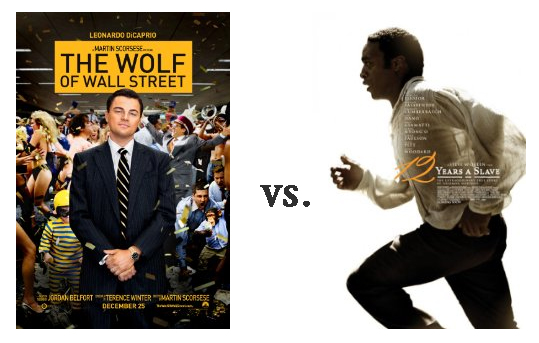
I’ll admit straight up I never finished The Wolf of Wall Street. I tried thrice. But every time I picked up where I left off, it felt like I was shimmying through a hole in an outhouse and dropping into the muck below. The movie has a corrosive effect. It’s a nudie, sex- and Quaalude-filled downward spiral of lies, idiocy and bad behavior borne from naked greed. Evidently a true story and maybe even the movie excesses were not far off from how it actually played out in real life.
 Then there was 12 Years a Slave. Also difficult to watch, but not corrosive. It was difficult because the filmmaker helped me empathize with these intelligent people living in the degrading and inhumane deep South. Their courage was breathtaking and heartbreaking and deeply affecting. Solomon Northrup, played by Chiwetel Ejiofor, is an honorable man stolen into a dishonorable system. In 12 Years a Slave, Steve McQueen brings alive a terrible period of our history. The result is clarifying and worth the discomfort: we need to recover our sense of shame at ill treatment and still—even today—we need to recognize the inherent dignity in being a person.
###
Creative Rebellion and Your DIY Career
Creativity + Freedom = Finding Your Work
We’ve finished our last session of freelance copywriting at the University of Northwestern—St.Paul. And now, after all the boring, blathery lecture stuff and all the portfolio additions and all the clever advertising we’ve seen, the bottom line is freelancing is a business of making it up as you go.

Just like no one can teach you to write (though teachers offer suggestions and direction, writing remains something one learns on one’s own), no one can teach you to rebel or to cultivate a disruptive presence in your work. Writing your way into and through creative rebellion is the beginning point to locating a solution to a problem that connects with an audience.
Freelance copywriting has by no means cornered the market on these qualities of creative rebellion. But those freelancers invited back provide value by looking at things deeply and differently. These are the folks who have organized their lives around creative rebellion and get antsy when asked to follow a party line.
Let there be more of this tribe.
###
Image credit: Kirk Livingston
Work: blessing or curse?
Make Your Own Meaning
Whether you’re on the people’s tram to join a raucous celebration with Socialist or Communist overtones or just sitting at your desk working the typical Thursday, it’s worth reflecting on the work we do every day.
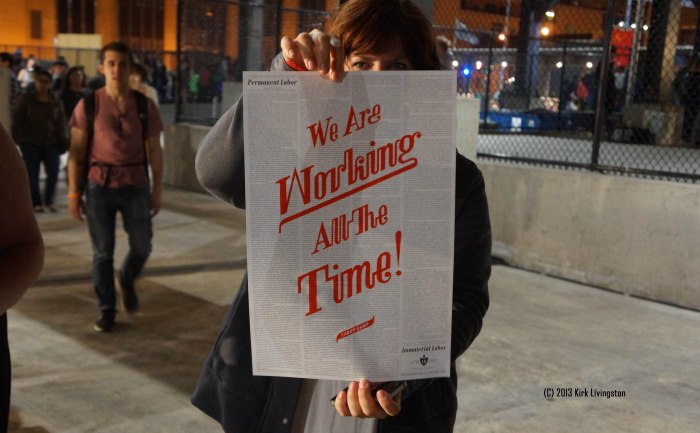 Sometimes we forget that the old story in Genesis placed work securely on the blessing side of the equation: Adam and Eve got to hang in the garden and work it. Their work had purpose. But after the curse, work changed. Painful became a key descriptive. And purposes got all crossed. It’s that painful, cross-purposed stuff we most often think on when we reflect on work.
I’m with the writer of Genesis on this one: work is way more blessing than it is curse. Learning to act in some purposeful way out in the world is a pretty good way to go through life. Picking up skills and using them to earn and help others and provide insight and move projects along—it’s all meaning-making stuff. I’m also of the opinion that we make our meaning as we go. We have to find our own reasons for working. And often those reasons come from somewhere deep inside (versus from a wallet-sized card produced by the public relations or human resources department).
When we start see how our work makes a difference, each day becomes something of an adventure.
###
Image credit: Kirk Livingston
What happens when we say stuff?
An Epistemology of Writing
I just realized I run my college writing courses in ways possibly dissimilar to how others do it. We have texts, of course, and readings. We have my dry lectures, which I try to turn to discussion (with limited success). We have examples of excellent copywriting and we talk about why they work and when they don’t. We have questions. We have answers (some from me, many from the class). We have cordial fights and the occasional snark (more remains unsaid, I think). We have yawns and longing looks at the clock.
And we have assignments.
You have my attention.
A portfolio addition due ever Saturday night, five minutes before the stroke of midnight. Way to ruin a perfectly good weekend, right? (Ahem: for the record, one need not wait to start an assignment until 10pm on Saturday night).
It’s the assignments—these portfolio additions—that are the real teachers. I try to direct. I try to offer my small ways of thinking, but the real work of this education happens deep in a student’s brain pain: where sparks fly and catch the dry tinder of panic: “What do I say—and how?”
So it has always been with me: I learn as I write. I often don’t know what I think until I write it. Or say it. Just ask Mrs. Kirkistan. But when I research a topic and begin writing about it, all sorts of synapses fire and connections meet and angels sing and the sun shines on my keyboard, where doves and baby deer have collected. Especially after three cups of coffee.
And this is what I depend on in my class: that the threads of our discussion will come together in the doing thereof—the writing of copy. This capturing of a brand, or a dream. The useful words that direct and possibly encourage as they launch into a reader’s mind.
But this: just doing an assignment dampens the angels singing. This class is less about getting my grade and approval and more about creating something you will proudly show to Ms. Creative Director or Mr. Small Business Owner who can hire your magic for their capitalistic endeavors. I can already see those who get this concept. Their work shows it.
Bless them.
And bless all the rest of us, too.
###
Image credit: Kirk Livingston
How You Say: Not Just “What” But “When”
A word is a fuse. Light the fuse.
I’m teaching a freelance copywriting class at the University of Northwestern—St. Paul. Yesterday was our first day and I wanted the students to begin the shift from writing papers for professors to writing words to make a difference. I maintain that excellent copywriting is the very opposite of spewing malarkey and hype. Especially today, when anybody who can read and/or listen and absorb marketing messages has their BS meter set on high all day long.
The best copy doesn’t call attention to itself. The best copy is nearly invisible and absorbed without realizing it. The best copy latches on to or illustrates a larger idea and leads the reader to the idea threshold. The best copy is emotive and rational. If it can be silly too—all the better.
We talked about the differences we perceive in writing for non-profit, mission-driven organizations and for-profit organizations. At first glance we might think one organization is all about mission and the other is all about money. But that is a mistaken notion: for-profit organizations can be all about mission and non-profits can be all about fundraising. Examples abound in each category.
One of the things I love most about teaching these particular students is the sensitivity to mission. They are cool with the notion of using your writing skills to help others. Many are considering starting work with non-profits, but that is not unusual for many studying the liberal arts. These particular students are often eager to trace their motivations for helping others back to some of the ancient texts that drive much of this school’s mission.
But one thing that is not so clear is that mission-driven work exists in both non-profits and for-profits. One’s mission comes largely from within. Our job—that thing we get paid for—is an outward-focus of the mission we bring with us. A copywriter with a sense of wanting to help others can find a home in any number of organizations, whether for-profit or not-for-profit. And using that copywriting skill to bring a reader to a life-changing realization can be a primary motivation for the whole task of writing.
I would like to see more copywriters with that motivation.
My go-to example is the quiet laugh from the writer in this four-minute film. Listen for the laugh. Think about what that laugh says about delivering the right words at the right time:
###

 conversation is an engine