Archive for the ‘photography’ Category
Square Lake: An Abundance of Divers
A Bounty of Lakes to Explore–Even in October
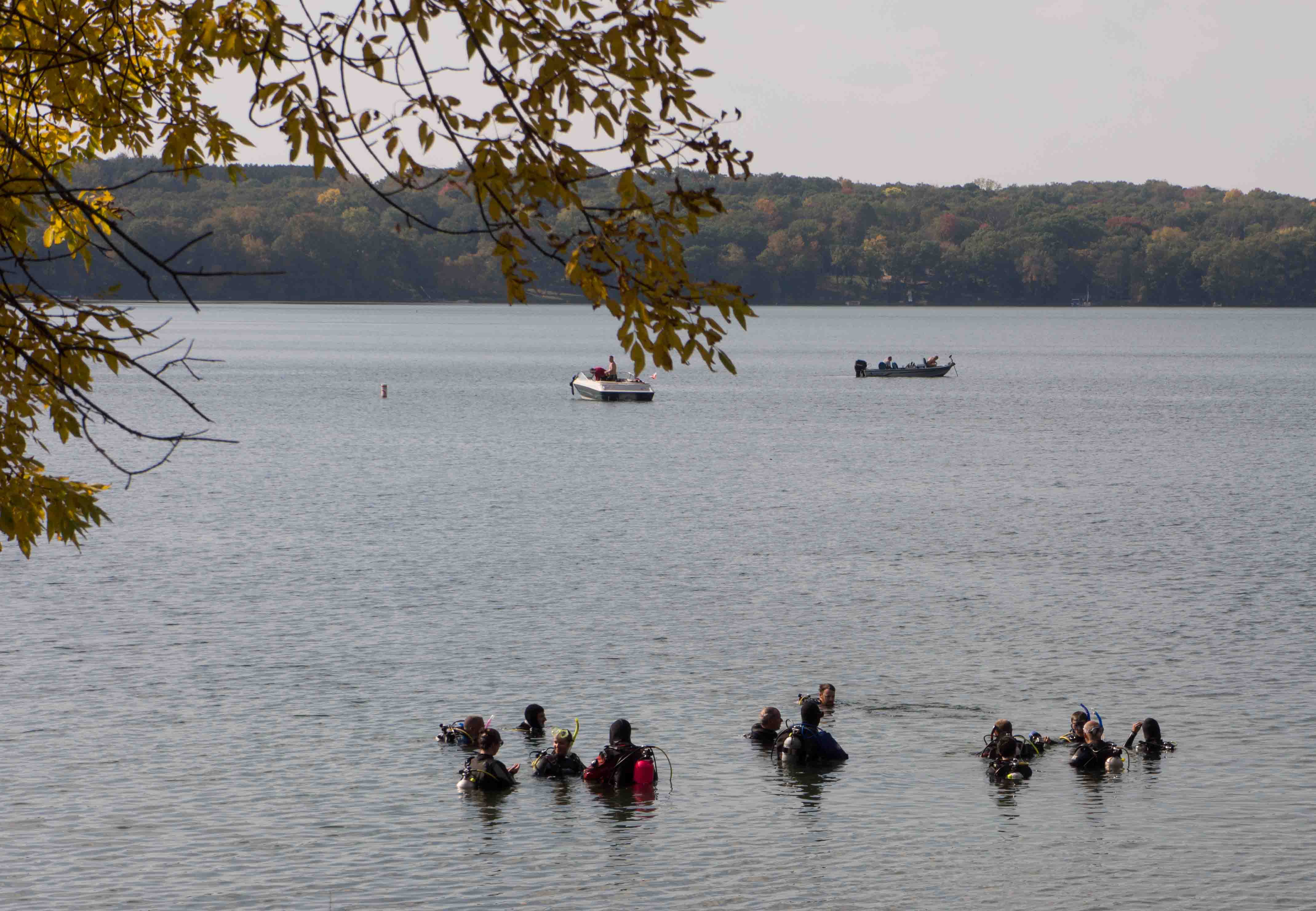
Square Lake is a diving destination because of the clear water. That water is also very cold.
More on “bountiful” here.
###
Rob Moses & the People of Calgary
“Have you ever ridden a horse?”
If you’ve had the pleasure of going to Calgary you’ll know it is truly a western city. Situated not far from Banff and Jasper National Parks, it is also quite spectacular. And rich, fueled by oil and gas money flowing into the city.
Rob Moses is a photographer based in Calgary. I follow his blog because of the extraordinary portraits he takes of complete strangers. His method is to approach someone, have a conversation, and shoot the photo. The endearing thing about this process is the conversation he has. He records it verbatim —or so it seems. His written text includes nervous laughter, indecision, and ricocheting answers. His recorded conversations sound like real conversations to my ear.

Stopping complete strangers is not easy in the best of situations. Asking to take their picture sounds like a scam, but Mr. Moses pulls it off with what seems to be a fair bit of joy. And he always asks if his subject has ridden a horse—critical information for Calgarians, evidently.
The optimism of sharing his talent with photography is not lost on me here. It’s kind of an amazing way to self-promote and, well, bless people. And for those lucky enough to find their way into his lens, they come away with a phenomenal view of themselves. Scroll through his blog and be amazed at the composition, lighting and the ease written on the faces of his subjects. If you’ve ever asked to take someone’s photo, you know it typically ends badly. Unless you are Rob Moses.
May there be more of his talented tribe.
###
Image Credit: Rob Moses
How to Make Your Message Permanent
A tip from a prehistoric consultant
First: Forget about it. Nothing is permanent—at least not in the way advertising mavens augur.
Second: OK—if you insist—make your message about someone else. Make your message give back more than it takes in. “GE” branded on a rock would never last. Even the Apple logo will be chiseled away by Microsoft rebels. But a man with jointed wings, well, who can resist that story?
![Who can resist the story about the “Thunder Being”?]](https://conversationisanengine.space/wp-content/uploads/2014/10/birdman-2-10022014.jpg)
Who can resist the story about the “Thunder Being”?
Prehistoric peoples stopped by these ancient rocks to tell their version of the human condition. So they carved/picked/incised/abraded their messages into the exposed Sioux quartzite outside Comfrey, Minnesota long before there was a Comfrey or a Minnesota or a U.S. of A. Maybe before the pyramids and Stonehenge. Ancients left messages here to direct and entertain passers-by.
Why make your message permanent? We understand marketing communications for companies—it’s about keeping the wheels of commerce turning. But you personally—what messages do you have to communicate? And why would you make them permanent? I argue that your take on the human condition comes out in the way you do your work, the way you interact with family, friends, colleagues, and even the way you see/refuse to see the homeless guy at the end of the exit ramp. And all these daily interactions amount to a carving and incising that is far more permanent than any of us imagine.

The Jeffers Petroglyphs tell a story that became a destination.
Our conversations have an enormous (cumulative) effect on the people around us. An effect that may move through generations.
What exactly is your message, anyway?
###
Image credit: Kirk Livingston
How Buzzwords Prey on the Unsuspecting (DGtC#24)
Speak up to reclaim your humanity
They’re there. Circling overhead in the hallways between C-suites.
They move in a dense cloud between boardrooms and conference rooms.
They are those words of the moment that seem scalpel-sharp. But when you stop to define them, meaning vanishes. These are the words Dilbert makes fun of most every day.
That is the way of buzzwords and lingo of the moment. Whether you are a business or a church (wait—what’s the difference?) or a university or a think tank: you have a set of words insiders use to show they are insiders. And especially in our early meetings with new clients or the new VP, we trot out these words to show we really, frankly, know our stuff.
The problem with buzzwords is how easily they come to mind. Just like any cliché, buzzwords pop to mind free of conscious thought. And to your conversation partner those words give the appearance of a genuine thoughtful reaction. But any SEO specialist will tell you that tossing a buzzword into a headline ups your clicks. Same with conversations: say the thing you heard the CEO say and, presto, you are in the club.
Do buzzwords make you less human? No. They just make you sound robotic.

Please point us back toward connection
Frequent talks with clients move toward “dumbing-down” versus “simplifying.” Those are not equivalent concepts. Dumbing-down takes out gradation and difference and nuance to present a black-and-white version of something. Simplifying hints at gradation and difference and nuance to make a piece of the complex easier to grasp. Mark Twain simplified complex stuff and generations talked about it.
Dumbing-down does not respect the audience. Simplifying recognizes that smart people are smart in different disciplines. And smart people can understand all sorts of stuff.
Buzzwords are a kind of dumbing-down that takes concepts off the table by hinting that we all know this so it is beyond discussion. Because of buzzwords many useful conversations never happen.
What if we consciously worked toward vulnerability in our business interactions? It’s scary, this notion of revealing you have no clue what the boss just said, but could she explain it again using words like other humans use?
Be the thorn in the side today, the vulnerable fool who insists on clarity.
It’s a way of ordering the chaos of your workplace.
###
Image credit: Kirk Livingston
My tree dances like no one is watching.
This year I caught it. One day at a time.
###
Image credit: Kirk Livingston
Audio credit: Cat Stevens, Oh Very Young
I’ve Already Forgotten Your Main Course
Savory sides stay in memory
Your big-name plenary speaker is the draw to your conference—certainly. But will she deliver the memorable moments your participants will take away and actually use?
Probably not.
What’s more likely is that the interactions your attendees have with new acquaintances from neighboring departments/cities/industries will leave a more durable impression. These are the folks that swap stories and shop talk and contacts. Street-level talk makes an impression that is actionable because the stories relate to our everyday experience.
A very smart client did this very thing recently. My client invited rising industry stars to be part of a conversation round-table. My client scheduled their executives to speak—but not to dominate with sermons and monologues. Instead—and this is the bit of genius I most appreciated—the executive talks were conversation-starters. And these executives actively shared their authority out. That is, they invited participation during their allotted time.
Do your thoughts invite listeners in?
And, most amazing, they paused to wait for responses.
Responses came. Too many responses which all took too much time. Time slots overran. But that was the whole point: the conversation. And true to form, sparks of insight came as the rising industry stars reacted. I left with pages of notes from the conversations and I’m certain the participants left with brand new knowledge lodged in their brain pans. That new knowledge came not because the speakers’ messages were so good, but because the participants actively connected those messages with others and their own experiences.

May it ever be so with all professors and pastors and executives and professional pulpiteers: let them stay open for the conversation to follow.
###
Image credit: Kirk Livingston


Edward Bernays and Jolly Manipulation
Gather round, kids: here’s how you sway public opinion
Edward L. Bernays is called the father of public relations and his book Propaganda (NY: Horace Liveright, 1928) shows why. Bernays is absolutely jolly as he lays out the psychology of manipulation. He doesn’t just talk about the formulas, he gleefully demonstrates them in paragraph after paragraph. Much like one might describe building a shelter to a group of boy scouts, Bernays is positively beaming as he writes about how to pull self-interest into the equation to get publics to do your corporate bidding.
The modern propagandist studies systematically and objectively the material with which his is working in the spirit of a laboratory. (48)
Edward L. Bernays is the ur–flack.
If you can influence the leaders, either with or without their conscious cooperation, you automatically influence the group which they sway. (49)
Reading Propaganda today, it is clear Bernays thought corporations and government leaders and those in power would certainly use his manipulation techniques for good.
How could it be otherwise?

Look through here. You’ll see what you’re supposed to see.
But World War II was just around the corner and every nation developed their own propaganda machines. In the US, we still react viscerally to the imagery and code words used by Nazis. Today old Stalinist imagery has it’s own unique draw. The US had powerful PR apparatus as well. We continue to feed that machine. And since, then, of course, unending sets of military skirmishes/wars, each equipped with God-given reasons for why we must respond. Then Watergate and totalitarian despots revealed and deposed, and, well, it’s a long list of fails that contribute to today’s cynicism and “Question Authority” stance. People found their voice and collected it to push back with outrage at corporations and governments and to call attention to wrong doing when it appears.
Eighty-six years later, the entire population of the US—possibly the planet—is wise to Bernays’ techniques. Not that we’ve studied them: those techniques study us all day every day. Especially in countries like the US where consumption is our patriotic duty. We know manipulation from the inside out.
Bernays would be impressed were he alive to see it. I imagine him smacking his head and saying, “Wait—they know they are being manipulated, and …they still buy it? This is even better than I hoped.”
Why talk about manipulation? Not just because Bernays book is fun to read and easy to contrast with today. In particular, why would a copywriter talk about manipulation? Isn’t that secret sauce you trade in all day? Why pull back the curtain?
As a copywriter my goal is to tell my client’s story in the best possible light. I continue to argue that persuasion is a natural piece of how people interact with each other all day long. It’s part of the human condition. But I argue our efforts at manipulation damage actual conversation. When we use words and techniques with manipulative technique, we shut off further conversation. At that point it is about winning not connecting. Maybe there is a fine line between persuasion and manipulation. Propaganda is the textbook for manipulation.
As a copywriter, I want my clients to engage in conversations not endless manipulative monologues. That seems a more human approach to communication. I continue to think conversation is what today’s market will bear.
###
Image credit: Kirk Livingston
Big Data Will Never Write a Poem
Art & Craft in a Data-Driven Age
Big Data FTW.
With all the information we collect from you (and Bob and Carol and Ted and Ciley), we know when you’ll buy beer, buy steaks, invest in a crock pot, buy an engagement ring, get married, get pregnant, get divorced, get pregnant again, get diabetes, get congestive heart failure and, well, pretty much any of the human conditions. We know what kind of coffins people in your neighborhood buy. We know this because we track it.
We track everything from mouse clicks to toilet paper purchases.
Because we track things we can make offers you cannot resist because you just thought of it yourself. You just thought of what we already knew you’d think about.
This kind of knowing is the goal of the big-data wranglers embedded in most any marketing group these days, whether an ad agency, a car manufacturer, a hospital or my city leaders. Knowing all means better decisions—at least that’s the promise.

Years ago all this tracking would have set in motion a web of fears about being controlled. But since most of have agreed with Amazon and Netflix that we really should order this lens next and watch that movie next (because others did), we’re at peace with each day’s granular tracking.
Is there a place for the crafter in a world of analytics? I say “Yes” because despite all the predictive analytics, we still connect best with real people. Brands are not known for calling us back to our senses. As our buying and consuming gets easier and easier—which is not a good thing—we need the artists and the crafters and the writers and barista-poets to call us back to a life outside of consumption.
Big data is not likely to predict the veering humans are known for. Because, as they say: past performance does not guarantee future results.
Plus: big data will never write a poem—at least a good poem.
Long live the intuitives!
###
Image credit: Kirk Livingston

 conversation is an engine